


Dallas Robotic Surgery Malpractice Lawyer
Robotic surgery can offer precision, but it also introduces risks tied to surgeon training, hospital credentialing, and device performance. When a robot assisted procedure goes wrong, patients may face serious injuries, internal burns, infections, lasting loss of function, and life threatening consequences, while responsibility is disputed between the surgeon, the hospital, and the manufacturer. Understanding whether harm stems from technique, oversight failures, or a malfunction often depends on careful review of what happened during the operation. If you or a loved one were harmed or worse due to robotic surgery malpractice in Dallas, Texas, contact Hastings Law Firm for a free, confidential case review.

Last Updated: July 27, 2026
Trusted Dallas Medical Attorneys for Surgical Robot Injury Claims
Robotic surgery is often presented as a safer, more precise alternative to traditional procedures. But when something goes wrong, the injuries can be severe and the answers hard to find. If you or a loved one was harmed during a robot-assisted procedure involving the da Vinci Surgical System, you may be unsure who is to blame. This robotic platform, manufactured by Intuitive Surgical, is used in thousands of surgeries each year. You may be uncertain whether the surgeon, the hospital, or the device itself caused the harm.
That uncertainty is normal, and you do not have to sort through it alone. As a Dallas robotic surgery malpractice lawyer team that focuses exclusively on medical negligence, Hastings Law Firm has the medical and legal resources to investigate what happened and identify who is responsible. Contact us for a free, confidential case evaluation so we can review your situation and explain your options.

Identifying Negligence in Robotic Assisted Procedures
Negligence in robotic surgery occurs when a surgeon operates below the accepted standard of care, often due to lack of training on the device, or when the device itself fails due to design defects. Surgical errors in robotic procedures often stem from either the doctor’s technique or a fault in the equipment. Identifying the source of the problem is the first step in any case handled by a Dallas robotic surgery malpractice lawyer, and it requires a careful look at both surgeon error and the technology involved.
The gap between marketing and reality. Manufacturers like Intuitive Surgical invest heavily in promoting robotic platforms to hospitals. This marketing pressure can lead hospitals to encourage surgeons to adopt robotic techniques (such as the da Vinci Surgical System) before they have developed true proficiency. In many cases, credentialing requirements are set by the hospital itself, with minimal independent oversight. A robotic surgery malpractice attorney examines whether the surgeon met a reasonable threshold of competence or operated with inadequate training.
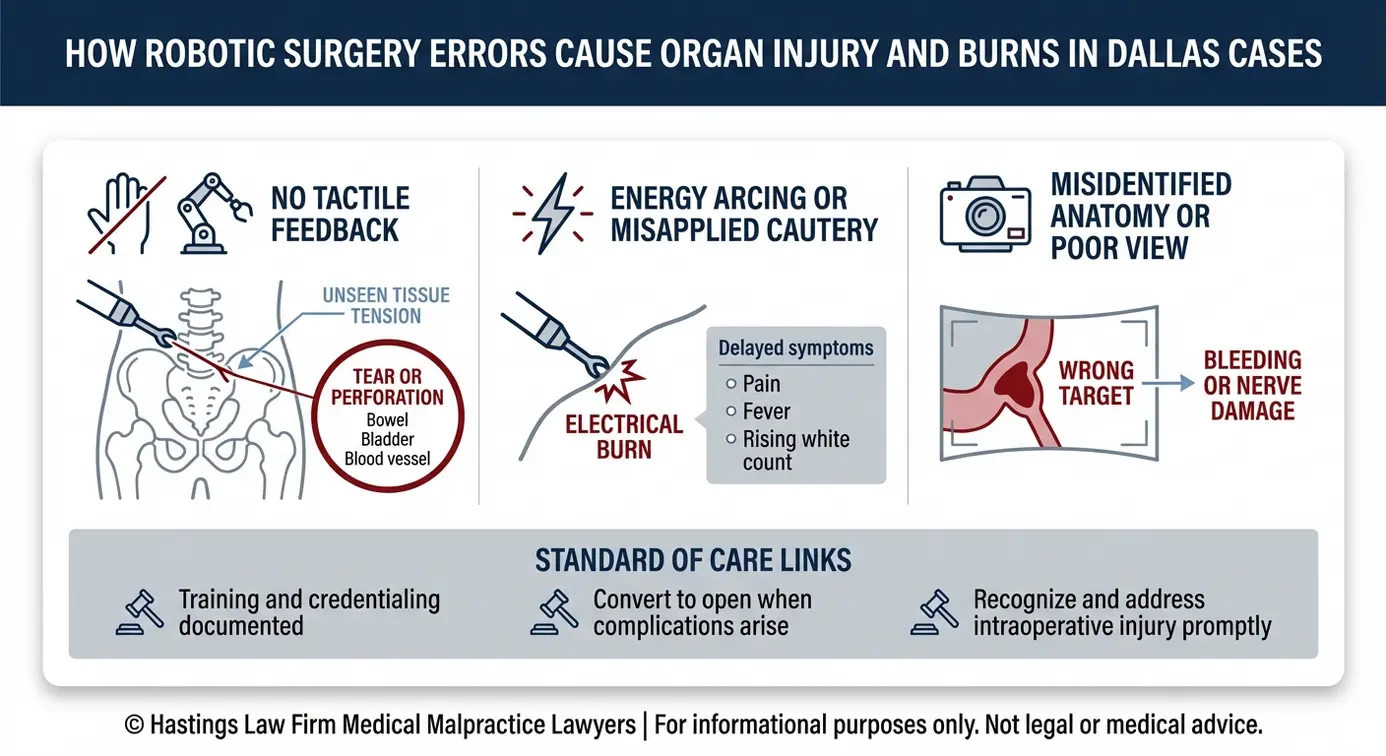
The loss of tactile feedback. One of the most significant clinical risks of robotic surgery is the absence of haptic feedback, meaning the surgeon cannot physically feel the tissue being manipulated. According to research published in PubMed Central on tactile feedback in robot-assisted minimally invasive surgery, this loss of sensation makes it harder for surgeons to gauge the force applied to delicate structures. Without that sensory input, even experienced surgeons may inadvertently damage tissue they cannot see or feel through the console.
This limitation contributes to a pattern of injuries our robotic surgery lawyers in Dallas investigate regularly, including:
- Organ perforation: Accidental cuts or tears to nearby organs such as the bowel, bladder, or blood vessels during instrument movement.
- Electrosurgical arcing: A form of stray energy thermal injury where electrical current from the robotic arm travels an unintended path, causing internal burns the surgeon may not detect in real time.
- Delayed sepsis: When internal injuries go unrecognized during surgery, patients can develop life-threatening infections in the hours or days that follow.
When we evaluate malpractice involving surgical robots, we reconstruct the procedure step by step, comparing the surgeon’s actions against what a reasonably trained professional should have done under the same circumstances.
Distinguishing Between Medical Malpractice and Product Liability
A case is considered medical malpractice if the surgeon made an error due to negligence or lack of skill, whereas it is product liability if the robotic device itself malfunctioned or had a manufacturing defect. Medical malpractice claims involve errors by professionals, while product liability targets defects in the technology. Identifying the correct legal liability path is one of the most important jobs a Dallas robotic surgery malpractice lawyer performs.
Surgeon negligence can include failing to convert to open surgery when complications arise. This involves the decision to abandon the robotic approach and operate directly. It can also involve hospital negligence for poor credentialing or operating without adequate credentialing on the specific robotic platform.
Device failure covers mechanical malfunctions, software errors, or instrument breakdowns. It is product liability if the robotic device itself malfunctioned or contained a design defect or manufacturing defect. In some documented cases, instrument tips have broken off inside the patient’s body. The U.S. Food and Drug Administration’s MDR Data Files contain thousands of adverse event reports involving surgical robots that can support these claims, including those involving inadequate warnings.
The blame dynamic. After a robotic surgery injury, hospitals frequently point to the machine while the manufacturer points to the surgeon. This deflection is predictable. Our team reviews the surgical robot’s internal event logs, which record error codes and system data throughout the procedure, to cut through conflicting narratives and determine what actually happened.
| Liability Type | Responsible Party | Example Scenario |
|---|---|---|
| Medical Malpractice | Surgeon or Hospital | Surgeon lacked training on the robotic system or failed to convert to open surgery during complications |
| Product Liability | Device Manufacturer | Robotic arm malfunctioned, instrument broke inside the patient, or software error caused unintended movement |
| Shared Liability | Multiple Parties | Hospital credentialed an undertrained surgeon while the device had a known, unreported defect |
Understanding this distinction early allows our attorneys to pursue every liable party and build the strongest possible claim for suing for robotic surgery errors.

The Hastings Law Firm Difference
Results matter, but what truly sets us apart is how we achieve them. Every verdict, every settlement, and every Dallas courtroom victory comes from one guiding promise: To treat each client’s fight for justice as if it were our own.
This balance of skill, experience, and empathy reflects our core philosophy that justice should not only compensate the injured, but also make health care safer nationwide.

Complications Following Robot Assisted Prostate Surgery
Prostatectomies performed via robotic systems carry specific risks including permanent nerve damage, urinary incontinence, and sexual dysfunction if the surgeon lacks the precise skill required to navigate the robotic arms. A prostatectomy is a surgery to remove all or part of the prostate gland. Robot-assisted radical prostatectomy, or RARP, is the surgical removal of the prostate gland using a robotic system. It is one of the most frequently performed da Vinci procedures in the country. While robotic prostate surgery is widely marketed as minimally invasive and highly precise, the reality is that outcomes depend heavily on the individual surgeon’s skill and experience with the platform.
The prostate sits near critical neurovascular bundles, the nerves and blood vessels responsible for bladder control and sexual function. A Dallas robotic surgery malpractice lawyer often sees cases where damage to these structures results in permanent urinary incontinence, sexual dysfunction, or both. These are not minor side effects. They fundamentally change a patient’s quality of life and sense of independence.
A key concern in robotic surgery injury claims involving prostatectomy is the surgeon’s learning curve. A retrospective study published in PubMed on robot-assisted radical prostatectomy learning curves found that surgeons require many cases before achieving consistent outcomes. Many surgeons begin performing this complex procedure robotically without enough proctored cases or simulation hours. When complications result from inexperience rather than the inherent risks of surgery, that gap between the surgeon’s skill level and the standard of care may support a robotic surgery lawsuit.
If you experienced unexpected complications after a robotic prostatectomy, including post-op infections, our team can review your records and the surgeon’s training history to evaluate whether negligence contributed to your injury.
The Role of AI and FDA Regulations in Surgical Litigation
The FDA approval process for many robotic systems utilizes the 510(k) pathway which allows devices to reach the market without independent clinical trials if they are substantially equivalent to existing products, creating legal challenges regarding “inadequate warnings.” The 510(k) pathway is a regulatory process where the FDA clears a device because it is substantially equivalent to one already on the market. This shortcut means some robotic systems enter operating rooms with limited real-world safety data, and that regulatory gap creates significant legal questions about inadequate warnings.
For a Dallas robotic surgery malpractice lawyer, FDA regulatory history is often a central piece of the case. If a manufacturer received clearance based on equivalence rather than independent testing, and failed to adequately warn surgeons or patients about known risks, that failure can support both product liability and informed consent claims. Research published in PubMed Central on litigation trends in robotic urologic surgery confirms that lawsuits involving robotic systems have increased steadily, with inadequate warnings and training deficiencies among the most common allegations.
An emerging question in this area involves artificial intelligence. As AI-assisted decision-making (and potential bias in clinical decision-making) becomes more integrated into surgical robots, new liability questions arise. If an AI system suggests a specific surgical action and the surgeon follows that guidance, determining who bears responsibility for a resulting injury becomes more complex. Our attorneys for surgical robot errors, including any experienced Dallas robotic surgery malpractice lawyer, monitor these developments closely because they will shape how robotic surgery malpractice counsel builds cases in the years ahead.
Manufacturer marketing also influences litigation. When companies like Intuitive Surgical overstate the safety or precision of their devices, that messaging can affect both the surgeon’s decision to use the system and the patient’s willingness to consent. We examine marketing materials, training records, and FDA correspondence to determine whether the information provided to your medical team was accurate and complete.

Why Choose Hastings Law Firm for Robotic Surgery Claims
Hastings Law Firm offers a unique advantage by combining board-certified trial advocacy with an in-house medical team that includes former hospital nurses and defense attorneys who understand the internal protocols of surgical departments. A trial-ready firm prepares every case with the expectation of presenting it before a judge and jury. Founder Tommy Hastings, a board-certified trial lawyer and ABOTA inductee, leads our team of former defense attorneys and nurse consultants. This insider knowledge helps us identify inconsistencies in medical records and anticipate how hospitals respond to malpractice allegations.
What sets our approach apart:
- Trial-ready from day one. As a medical malpractice trial firm, we prepare every case as though it will go before a jury. This level of preparation signals to defense counsel and insurance carriers that we will not accept an inadequate offer.
- Exclusive focus on medical malpractice. We do not handle car accidents, slip-and-fall cases, or general personal injury. Every resource in our firm is dedicated to medical negligence litigation, including wrongful death cases.
- No upfront costs. We work on a contingency fee basis, meaning you pay no attorney fees or expenses unless we secure a recovery of compensation and damages on your behalf.
- National expert network. Robotic surgery cases require specialized medical testimony. We work with top-tier surgical experts across the country who can evaluate whether the care you received met the standard.
As experienced robotic surgery attorneys, we understand the technical, medical, and legal layers these cases involve, and we have the resources to handle each one.
Contact the Dallas Surgical Error Attorneys at Hastings Law Firm Today for Help
If you or someone in your family was injured during a robot-assisted surgical procedure, the most important step you can take right now is getting clarity about what happened. Legal timelines strictly limit how long you have to file a claim. Robotic surgery injuries can involve multiple responsible parties, from the operating surgeon to the hospital to the device manufacturer, and sorting through those questions takes time and specialized knowledge.
Texas law limits how long you have to file a medical malpractice claim, so early action helps protect your rights and preserve critical evidence, including the surgical robot’s data logs.
Hastings Law Firm offers a free, confidential case evaluation led by a patient advocate who can help you understand whether your experience may involve negligence. There is no cost and no obligation. We are here to restore trust, find answers, and hold the right parties accountable so this does not happen to someone else.
Call us today or complete our online form to get started.
Frequently Asked Questions About Robotic Surgery Malpractice in Dallas


This content was researched and written by the Hastings Law Firm editorial team, which includes attorneys, medical professionals, and experienced researchers. Our writing is informed by internal knowledge and practical experience, and we cross-check critical details against authoritative sources cited throughout. Every piece undergoes human-led fact-checking and legal review. Because legal and medical information can change, if you spot an error, please contact us. Learn more about our content standards and review process on our editorial policy page.

Brady D. Williams is a nationally recognized medical malpractice attorney who has spent his career handling high-stakes litigation for injured patients and families across the country. Licensed in both Texas and California, Brady draws on experience from hundreds of resolved medical cases to break down complex legal and medical topics for the people who need that information most. His writing reflects the same attention to detail and commitment to clarity that he brings to every case he handles.
