


Dallas Cerebral Palsy Lawyer
Written by: Hastings Law Firm | Reviewed by: Tommy Hastings | Updated: July 27, 2026
A cerebral palsy diagnosis can bring lasting physical challenges and major changes to family life, especially when concerns remain about what happened during labor and delivery. Some cases are not preventable, but others are linked to errors such as missed warning signs, delayed intervention, or problems managing complications that reduce oxygen to a baby. Understanding possible causes, long term needs, and who may be responsible can help families make informed decisions and plan for care. If your child suffered harm or worse due to cerebral palsy birth injuries in Dallas, Texas, contact Hastings Law Firm for a free, confidential case review.

Trusted Medical Attorneys for Preventable Birth Injuries in Dallas
What You Should Know About Birth-Related Brain Injury Claims in Dallas:
- Long term care needs and financial strain can follow a cerebral palsy diagnosis, especially when the injury is linked to preventable labor and delivery errors.
- Accountability can extend beyond the delivering physician when nursing communication failures, anesthesia involvement, or hospital staffing and protocol problems contribute to harm.
- Severe outcomes can be tied to missed fetal distress signals or delayed escalation of care, since reduced oxygen and blood flow around birth is a recurring theme in these claims.
- Disputes often focus on whether the medical team responded appropriately to warning signs shown on electronic fetal monitoring.
- Recovery can reflect both measurable costs and personal impact, including ongoing medical care, assistive needs, home changes, and pain and suffering.
- Full compensation can depend on a life care plan that projects future needs and costs over a child’s lifetime.
- Options can be permanently limited if Texas filing rules are missed, since birth injury deadlines and related requirements are strictly enforced.
- Case clarity can depend on preserving records and witness availability, because delays can make labor and delivery events harder to reconstruct.

A Healthcare Focused Law Firm
Learning that your child has cerebral palsy can feel overwhelming, especially when you suspect something went wrong during labor or delivery. You may have questions you haven’t been able to get answered, and the weight of your child’s future care needs can make the uncertainty even harder to bear. You are not alone in feeling this way, and you are not wrong for wanting the truth.
A Dallas cerebral palsy lawyer at Hastings Law Firm can help you understand what happened and whether your child’s injury was preventable. Our team of medical malpractice attorneys and in-house medical professionals reviews birth injury cases every day, and we are here to listen. Contact us for a free, confidential case evaluation to learn about your options.
Understanding Cerebral Palsy and Its Connection to Birth Injuries
Cerebral palsy (CP) is a group of neurological conditions that affect movement, posture, and muscle tone, often caused by brain damage that occurs before or during birth. According to the Centers for Disease Control and Prevention, cerebral palsy (CP) is the most common motor disability in childhood, and its effects range from mild coordination difficulties to severe physical limitations that require lifelong support.
Not every case of cerebral palsy is caused by medical malpractice. Some cases have genetic origins or result from complications that no amount of medical skill could have prevented. But when brain damage at birth results from a preventable error, such as a failure to monitor oxygen levels or a delayed response to a known complication, the distinction matters. That distinction is exactly what cerebral palsy attorneys in Dallas investigate.
For families, a CP diagnosis often reshapes everything. Daily routines, financial planning, career decisions, and family dynamics all shift to accommodate a child’s long-term needs. The emotional weight of the diagnosis is real, and it can be even heavier when parents sense that a medical professional’s mistake played a role.
One form of the condition, dyskinetic cerebral palsy (also called athetoid CP), involves involuntary movements that can make even basic tasks difficult for a child and underscores the lifelong impact of the injury. This specific type of CP often relates to brain damage in the areas that control motor function. The uncertainty of not knowing the cause can be agonizing for parents seeking answers.
Understanding whether your child’s cerebral palsy was the result of a birth injury is the first step. From there, you can make informed decisions about your family’s future.
Common Medical Errors During Labor That Cause Cerebral Palsy
Medical errors such as failure to monitor fetal distress, delayed C-sections, or improper use of delivery tools can deprive a baby of oxygen and cause cerebral palsy. The underlying mechanism in many of these cases is hypoxic-ischemic encephalopathy (HIE), a type of brain injury that occurs when the brain does not receive enough oxygen and blood flow around the time of birth.
The American College of Obstetricians and Gynecologists (ACOG) has published guidance on neonatal encephalopathy and neurologic outcomes, establishing clear clinical expectations for how delivery teams should respond to signs of trouble. When those expectations are not met, a Dallas cerebral palsy lawyer can evaluate whether the failure constitutes medical malpractice.
During labor, medical teams rely on electronic fetal monitoring (EFM) to track the baby’s heart rate. A nonreassuring fetal heart rate pattern on EFM, meaning the monitor shows signs that the baby may not be tolerating labor well, is one of the most critical warning signs a clinician can receive. How the team responds to that warning often determines the outcome.
Common errors investigated by a medical malpractice attorney include:
- Failure to recognize or act on signs of fetal distress displayed on the monitor
- Delayed decision to perform an emergency C-section when vaginal delivery becomes unsafe
- Improper or excessive use of forceps or vacuum extractors during delivery
- Failure to manage labor and delivery complications such as placental abruption, where the placenta separates from the uterine wall, or uterine rupture
- Mismanagement of umbilical cord problems, including cord compression or prolapse
What makes these injuries so difficult for families is that many of them are preventable. Timely intervention, whether that means an earlier C-section, repositioning the mother, or escalating care, can often stop the chain of events that leads to brain damage at birth. When a birth injury lawyer reviews a case, the central question is whether the medical team’s actions fell below the standard of care and whether a different response would have changed the outcome.

The Hastings Law Firm Difference
Results matter, but what truly sets us apart is how we achieve them. Every verdict, every settlement, and every Dallas courtroom victory comes from one guiding promise: To treat each client’s fight for justice as if it were our own.
This balance of skill, experience, and empathy reflects our core philosophy that justice should not only compensate the injured, but also make healthcare safer nationwide.

Recognizing Symptoms and the Long-Term Effects of Cerebral Palsy
Early signs of cerebral palsy include delays in reaching developmental milestones, abnormal muscle tone (too stiff or too floppy), and favoring one side of the body. Some indicators appear shortly after birth, particularly if a baby requires time in the neonatal intensive care unit (NICU) due to seizures, breathing difficulty, or the need for resuscitation.
The CDC’s Developmental Milestones tracker provides a helpful reference for parents who want to understand whether their child’s developmental milestones are on track. Recognizing delays early allows families to seek both medical and legal guidance sooner.
Symptoms can vary by age and by the type of cerebral palsy involved:
| Stage / Type | Common Signs |
|---|---|
| Infant (0–12 months) | Poor head control, stiff or floppy muscles, difficulty feeding, not reaching for objects |
| Toddler (1–3 years) | Delayed crawling or walking, dragging one side of the body, difficulty with fine motor tasks |
| Spastic CP | Stiff, tight muscles; exaggerated reflexes; difficulty with coordinated movement |
| Dyskinetic (Athetoid) CP | Involuntary, slow writhing movements; fluctuating muscle tone; difficulty sitting or walking |
Spasticity, a condition where muscles are continuously tight or stiff, is one of the most common features of cerebral palsy and often requires ongoing physical therapy, medication, or surgical intervention. In some cases, neonatal jaundice left untreated can progress to kernicterus, a form of brain damage caused by dangerously high bilirubin levels, which can also lead to CP.
The long-term reality for many families includes years of physical therapy, occupational therapy, and speech therapy, leading to significant therapy costs over the child’s lifetime. Parents often underestimate the financial strain these ongoing treatments place on the family budget.
Some children will need assistive devices and home modifications to move safely through their own homes. Others will require specialized educational programs throughout their school years. A cerebral palsy law firm helps families account for all of these needs when pursuing a claim, so no part of a child’s future care is overlooked.
Liable Parties in a Dallas Birth Injury Lawsuit
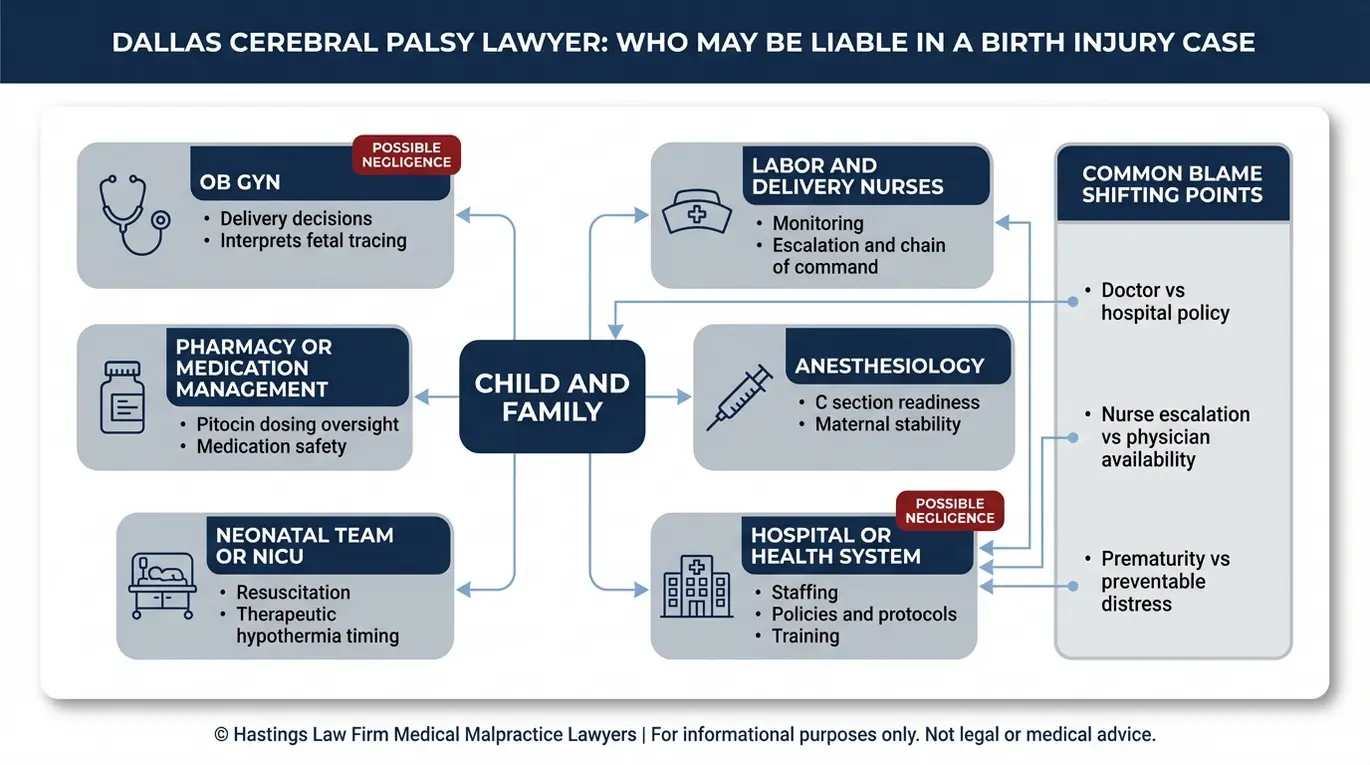
Liability in a birth injury case can extend well beyond the delivering doctor to include nurses, anesthesiologists, and the hospital itself for systemic failures or inadequate staffing. A Dallas cerebral palsy lawyer investigates every layer of the care team to determine who bears responsibility.
The OB-GYN is often the first party examined. As the physician directing the delivery, the obstetrician is responsible for interpreting fetal monitoring data, deciding when to escalate care, and managing acute obstetric emergencies such as placental abruption (sudden separation of the placenta) and uterine rupture. Physicians must also act quickly during umbilical cord prolapse, a condition involving cord compression, to prevent brain injury. If the OB-GYN failed to respond appropriately to warning signs, that failure can form the basis of an obstetrical malpractice claim.
Nursing staff also carry significant responsibility. Labor and delivery nurses are often the first to observe changes in the mother’s or baby’s condition. When a nurse identifies a problem but fails to activate the chain of command or promptly notify the physician, that gap in communication can contribute directly to the injury.
The hospital itself may be liable. Suing a hospital is necessary when the facility commits hospital negligence, such as understaffing the labor and delivery unit, failing to maintain safe protocols, or credentialing physicians who lack adequate training. A University of Houston Law Center analysis highlights institutional accountability as a key dimension of these claims.
Pharmaceutical issues can also factor into a case. Misuse of labor-inducing drugs like Pitocin, for example, can cause excessively strong contractions that reduce blood flow to the baby. Hastings Law Firm has specific experience with pharmaceutical injury cases, and we evaluate whether any medication administered during labor contributed to the harm. This may involve medical product liability if a defective drug caused the injury.
Unique Role of Preterm Birth Statistics
Defense teams in birth injury litigation frequently point to premature birth, defined as delivery before 37 weeks of gestation, as the sole cause of a child’s cerebral palsy. While premature birth does carry a higher risk for complications, this argument often ignores a critical question: was the premature birth itself caused by negligence?
In some cases, preterm labor results from a failure to identify and treat maternal infections such as chorioamnionitis, an intra-amniotic infection that can trigger early labor if left unmanaged. The standard of care generally requires clinicians to screen for and respond to signs of infection during prenatal care. We examine medical records to determine whether screening protocols were followed. When that does not happen, the prematurity itself may be part of the malpractice claim, not a defense against it.
Recoverable Damages and Life-Care Planning
Families can recover compensation for past and future medical bills, lifelong lost earning capacity, pain and suffering, and the cost of necessary home modifications. Securing full compensation for birth injuries is essential to ensure your child has access to the best possible care throughout their life. A Dallas cerebral palsy attorney helps families identify every category of loss so that a settlement or verdict reflects the true scope of the child’s needs.
Economic damages cover the measurable financial losses tied to the injury:
- Past and future medical expenses, including surgeries, hospital stays, and ongoing therapy costs
- The projected cost of assistive devices, home modifications, and adaptive technology
- Loss of future earning capacity if the child’s condition limits their ability to work as an adult
- Costs of specialized educational programs and in-home care
Non-economic damages address the human toll of the injury:
- Physical pain and discomfort
- Mental anguish experienced by the child and family, acknowledging the emotional toll of the injury
- Disfigurement or physical impairment
- Loss of enjoyment of life
One of the most important components of a cerebral palsy case is the life-care plan. This is a detailed projection, prepared by medical and economic experts, estimating the full cost of care over the child’s lifetime, which may span 70 years or more. A life-care plan ensures that all future medical needs, such as recurring surgeries or specialized care, are accounted for in the legal claim.
This comprehensive document accounts for inflation, potential medical complications, and the increasing cost of healthcare. The CDC’s data on cerebral palsy tracking methods underscores the prevalence of CP and the long-term resources these families require. Without a thorough life-care plan, families risk settling for far less than what their child will actually need. Legal help for CP cases means building this plan from the start.
The Legal Process and Statute of Limitations in Texas
In Texas, while adults have two years to file, the deadline for birth injury claims involving minors is often tolled (paused) until the child reaches age 14, though parents’ claims for medical bills may expire sooner. Early legal consultation matters because these deadlines are strictly enforced.
These deadlines are governed by Texas Civil Practice and Remedies Code Chapter 74, which also requires plaintiffs in medical malpractice cases to provide an expert report within 120 days after the defendant’s original answer is filed. The statute of limitations for birth injury cases can be nuanced, and missteps can permanently bar a family’s claim. We work with specialists to provide the necessary expert testimony to support your claim.
Even though the tolling rule provides additional time for the child’s claim, waiting too long carries real risks. Medical records can be lost or destroyed, key witnesses may become unavailable, and the details surrounding labor and delivery grow harder to reconstruct with each passing year. Families can request copies of their medical records directly from the provider, and the Texas Medical Board outlines the process for obtaining those records.
At Hastings Law Firm, the investigation begins with a free, confidential evaluation led by our in-house patient advocates. If we accept a Texas birth injury lawsuit, we prepare it from day one as though it will go to trial. This trial-ready philosophy puts us in a stronger position during settlement negotiations and signals to the defense that we will not accept less than fair value. And because we work on a contingency fee basis, families pay no attorney fees or costs unless we recover compensation.

Why Choose Hastings Law Firm for Your Family
We are a specialist medical malpractice firm with board-certified leadership, in-house medical staff, and a proven history of recovering millions for injured children and their families. When you work with a Dallas cerebral palsy lawyer at Hastings Law Firm, you get a team built specifically for cases like yours. Our goal is to be the best medical malpractice lawyer option for your family.
What sets us apart:
- Exclusive focus on medical malpractice. Unlike general personal injury firms, every member of our team, from attorneys to nurse consultants, works on medical malpractice litigation. That is all we do.
- In-house medical professionals. Our team includes nurse practitioners and Board Certified Patient Advocates who analyze records, identify charting inconsistencies, and interpret clinical data alongside our attorneys. Our legal team also includes former hospital nurses and defense attorneys who provide insight into how hospitals defend these cases.
- National expert network. We work with top-tier medical experts across the country to provide credible, objective testimony in every case.
- Recognized leadership. Founder Tommy Hastings is board certified in personal injury trial law, a distinction held by less than 2% of Texas attorneys. He is a 2025 inductee into the American Board of Trial Advocates (ABOTA) and has been named a Texas Super Lawyer every year since 2013.
- Client-centered care. We treat our clients as partners. You will have direct access to your legal team, consistent updates on your case, and the empathy and support you need during an incredibly difficult time.
As a Dallas birth injury attorney team, we understand that families are not just looking for compensation. Many want answers, and many want to make sure this does not happen to someone else. That motivation drives everything we do using a trial-ready approach.
Contact the Dallas Birth Injury Attorneys at Hastings Law Firm Today for Help
If your child was diagnosed with cerebral palsy and you believe a medical error may have played a role, you deserve to know the truth. The team at Hastings Law Firm is here to help you find it.
Our mission has always been to restore trust for families who feel let down by the healthcare system and to hold negligent providers accountable so that other families are better protected. A conversation with our team costs you nothing, and there is no obligation. We advance all investigation and litigation costs, and you pay no fees unless we secure a recovery for your family.
Take the first step. Call Hastings Law Firm or request a free case evaluation online. Let us review what happened and help you understand your options.
Frequently Asked Questions About Cerebral Palsy Malpractice in Dallas


This content was researched and written by the Hastings Law Firm editorial team, which includes attorneys, medical professionals, and experienced researchers. Our writing is informed by internal knowledge and practical experience, and we cross-check critical details against authoritative sources cited throughout. Every piece undergoes human-led fact-checking and legal review. Because legal and medical information can change, if you spot an error, please contact us. Learn more about our content standards and review process on our editorial policy page.

Tommy Hastings, founder of Hastings Law Firm, is a board-certified personal injury trial lawyer dedicated exclusively to healthcare injury cases. Since 2001, he has represented injured patients and families in litigation against major hospital systems, pharmaceutical companies, and negligent healthcare providers nationwide. He has handled numerous high-profile cases that have drawn national media attention and resulted in multi-million dollar recoveries. He draws on that experience in his writing, helping readers understand how these cases work and what options may be available to them.
