


Dallas Nursing Home Malnutrition Lawyer
Nursing home malnutrition can signal serious neglect when an older adult loses weight quickly, grows weaker, or shows signs of dehydration. These changes can lead to infections, poor wound healing, cognitive decline, and worsening pressure sores, especially when a facility fails to provide feeding assistance or follow dietary plans. Families often feel uncertain about what is normal aging versus preventable harm, and clear documentation can matter when care records do not match a resident condition. If you or a loved one were harmed or worse due to nursing home malnutrition in Dallas, Texas, contact Hastings Law Firm for a free, confidential case review.

Last Updated: July 27, 2026
Trusted Legal Representation for Elderly Care Negligence in Dallas
When a loved one in a nursing home begins losing weight, growing weaker, or showing signs of dehydration, the worry can feel overwhelming. You may sense that something is wrong but feel unsure how to confirm it or what steps to take. These concerns deserve serious attention, and you do not have to work through them alone.
Hastings Law Firm represents families across Dallas whose elderly loved ones have suffered harm from nutritional neglect in care facilities. As a firm focused exclusively on medical malpractice, we understand both the medical and legal sides of these cases. Our team includes in-house nursing professionals and former defense attorneys who know how facilities operate from the inside.
If you believe your family member is not receiving proper nutrition or hydration in a Dallas nursing home, a Dallas nursing home malnutrition lawyer at our firm can review what happened and explain your options in a free, confidential evaluation.

Recognizing Physical Signs of Malnutrition in Dallas Nursing Home Residents
Malnutrition in the elderly often shows up as rapid weight loss, physical weakness, poor wound healing, and cognitive confusion, and these signs frequently point to a facility’s failure to provide adequate dietary assistance.
There is an important distinction between the gradual changes that come with aging and the acute decline that signals neglect. A slow reduction in appetite over months may reflect a natural process. But a sudden, significant drop in body weight over weeks, paired with new symptoms, suggests something different entirely. The GLIM consensus approach to the diagnosis of malnutrition identifies criteria such as reduced muscle mass and unintentional weight loss as clinical indicators that should prompt immediate medical evaluation.
Malnutrition, a condition where the body does not receive enough nutrients to maintain normal function, also leads to micronutrient deficiencies, which are shortfalls in essential vitamins and minerals like iron, zinc, and vitamin D. Research published in Physiological Basis of Immune Function Among Geriatric Population and Nutrition confirms that these deficiencies directly weaken immune response in older adults. The result is a body that cannot fight off infections, heal wounds, or maintain basic cognitive function.
One of the most telling secondary injuries is pressure sores, also called bedsores. Without adequate protein intake, the body simply cannot repair damaged tissue. A resident who develops new or worsening pressure sores while losing weight is showing two connected signs of neglect at once.
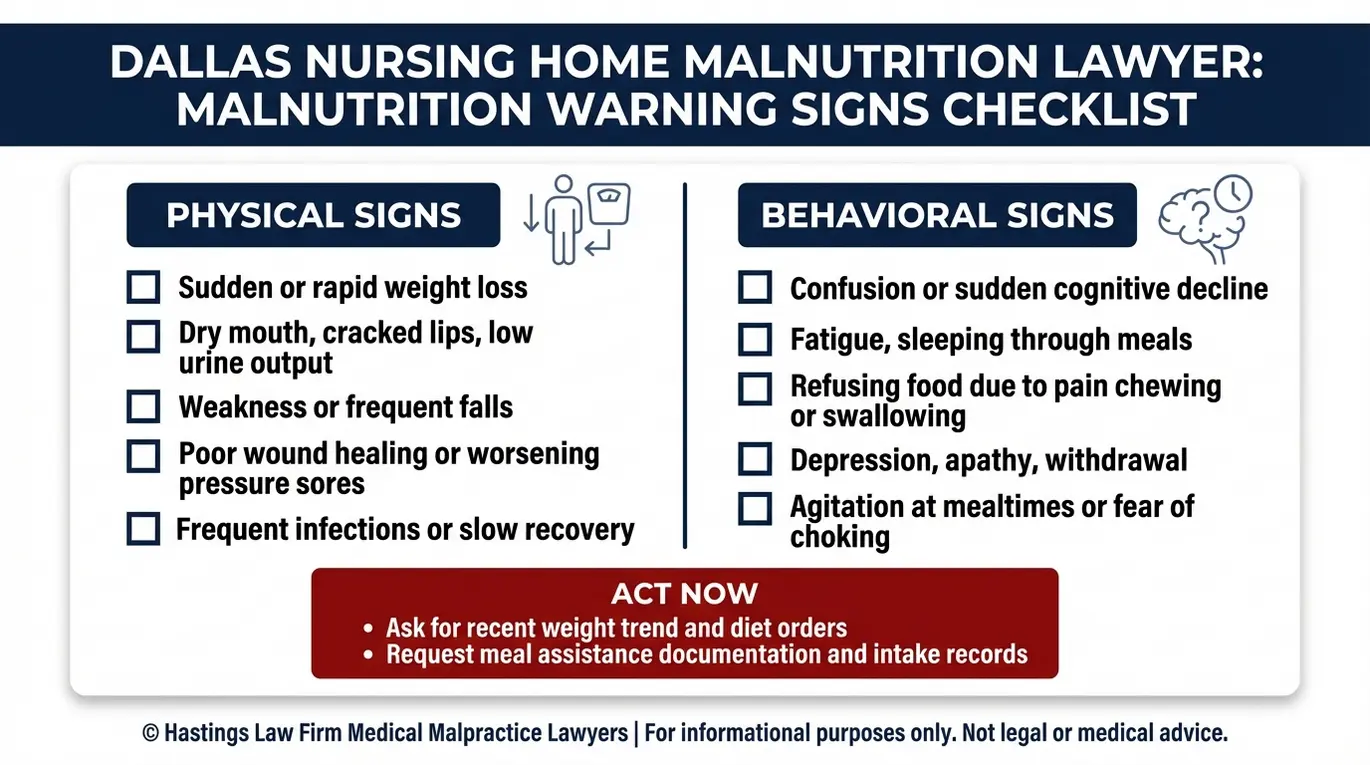
Families should watch for both physical and behavioral changes:
Physical Signs
- Unexplained or rapid weight loss
- Dry, cracked skin or chronic dehydration
- New or worsening pressure sores
- Frequent infections or slow wound healing
- Brittle nails and thinning hair
Behavioral Signs
- Increased confusion or cognitive decline
- Unusual fatigue or lethargy
- Withdrawal from social interaction
- Complaints of hunger or thirst
- Difficulty concentrating during visits
If you are noticing these changes in your loved one, our Dallas nursing home malnutrition lawyers can help you determine whether the facility met its obligations or whether these signs reflect a pattern of neglect.
Common Causes of Malnutrition in Texas Eldercare Facilities
Most cases of nursing home malnutrition result from understaffing, lack of individualized care plans, and the failure of staff to assist residents who cannot feed themselves.
Feeding assistance, the hands-on help residents need to eat and drink, takes time overworked staff may not have. A study on state variation in staffing and characteristics of nursing homes most impacted by new federal standards highlights how facilities with low staffing ratios struggle to meet even basic resident needs. When aides are responsible for too many residents at once, meals get removed before a resident finishes eating, or they are never delivered at all.
Systemic neglect also takes the form of ignoring specific dietary regulations. Residents with dysphagia, a swallowing disorder that makes eating standard food dangerous, may require texture-modified meals. If staff fail to follow these orders, the resident may choke, refuse to eat out of fear, or simply go without adequate nutrition. Poorly fitting dentures that a facility never addresses can create the same outcome.
| Systemic Failure | Resulting Harm |
|---|---|
| Inadequate staffing during mealtimes | Meals removed before resident finishes; missed feedings |
| Failure to follow prescribed dietary plans | Choking risk, food refusal, continued weight loss |
| Ignoring dental or swallowing problems | Inability to eat; chronic malnutrition |
| No individualized nutrition assessments | Undetected nutritional decline over weeks or months |
| Incomplete or falsified dietary logs | Neglect goes unrecognized and unreported |
Malnutrition attorneys in Dallas see this nursing home negligence appear across cases. The pattern is consistent: when a facility fails to invest in adequate staffing and feeding assistance, residents bear the physical cost.

The Hastings Law Firm Difference
Results matter, but what truly sets us apart is how we achieve them. Every verdict, every settlement, and every Dallas courtroom victory comes from one guiding promise: To treat each client’s fight for justice as if it were our own.
This balance of skill, experience, and empathy reflects our core philosophy that justice should not only compensate the injured, but also make health care safer nationwide.

Federal and State Laws Protecting Residents from Nutritional Neglect
The Nursing Home Reform Act and Texas state regulations mandate that facilities must maintain a resident’s nutritional status unless a clinical condition makes decline unavoidable.
Under the Omnibus Budget Reconciliation Act of 1987 (OBRA), every nursing home that accepts Medicare or Medicaid funding has a nursing home duty of care to provide services that help each resident attain and maintain their highest practicable level of well-being. This includes nutrition. According to the federal regulations outlined in F325 483.25(i) Nutrition, facilities are required to ensure that residents meet nutritional standards and receive sufficient daily fluid intake.
A core requirement is the individualized nutrition care plan, a documented plan created at admission that outlines each resident’s specific dietary needs, restrictions, and assistance requirements. This plan must be reviewed and updated as the resident’s condition changes. If a resident needs a texture-modified diet, sometimes called a pureed diet, which involves altering food consistency to make swallowing safer, that requirement must be documented and followed by staff.
When a resident loses weight, facilities often raise the “unavoidable decline” defense. The law allows for this only if the facility can prove it identified the risk, implemented interventions, monitored the results, and revised the plan when interventions failed. A Dallas nursing home malnutrition lawyer examines whether the facility actually took these steps or simply documented them on paper without following through.
Investigating Liability and Gathering Evidence of Starvation
Proving malnutrition requires rigorous evidence collection and a forensic examination of dietary logs, staffing rosters, and medical records to demonstrate a clear pattern of neglect rather than an isolated incident.
A Dallas nursing home malnutrition lawyer approaches these cases by reconstructing a detailed timeline of care, or the lack of it. One of the first places we look is the facility’s Intake and Output (I&O) records, the daily logs where staff are supposed to document exactly what and how much a resident ate and drank. Charting inconsistencies, which are discrepancies between what the records claim and what the resident’s physical condition shows, can be some of the strongest indicators of neglect. If the logs say a resident consumed three full meals daily but the resident has lost 20 pounds in six weeks, those records may have been falsified.
We also examine staffing data. The Texas Long-Term Care Ombudsman Policies and Procedures Manual outlines oversight protocols that can reveal whether a facility maintained safe staffing levels. Correlating periods of low staffing with a resident’s weight loss often reveals a direct connection.
Our national network of expert witnesses reviews the clinical evidence to determine whether the facility breached the standard of care. This includes geriatricians, dietitians, and nursing experts who can testify about what should have happened and what the records show actually did.
Critical Evidence We Secure:
- Admission records, including baseline weight and nutritional assessment
- Daily I&O logs and meal documentation
- Staffing schedules and call-in records during the relevant period
- Physician orders for dietary plans and any modifications
- Nursing notes documenting (or failing to document) resident complaints
- Photographs of the resident’s physical condition over time
- Expert analysis comparing documented care against accepted standards
Using Malnutrition as Evidence of Systemic Daily Neglect
Malnutrition is rarely the result of a single missed meal. It is evidence of systemic neglect and daily care failures. Unintentional weight loss, a decline in body weight that occurs without the resident choosing to eat less, develops over weeks and months of accumulated neglect.
When a resident also develops pressure ulcers, which are wounds caused by sustained pressure on the skin and underlying tissue, the connection becomes even clearer. These injuries require adequate protein and nutrition to heal. A malnourished resident with worsening bedsores tells a story that no amount of falsified paperwork can contradict. As a Dallas nursing home malnutrition lawyer, we present this pattern to show that the harm was not accidental but the predictable result of ongoing indifference to a resident’s basic needs.

Compensation Available for Malnutrition Injuries in Dallas Litigation
Families of residents who suffered nutritional neglect may pursue damages and compensation for medical expenses, physical pain, mental anguish, and in cases of gross negligence, punitive damages.
Economic damages cover the measurable financial costs: hospital bills for treating dehydration, infections, and pressure sores; rehabilitation expenses; and any specialized care the resident now requires. These costs can be substantial, especially when malnutrition triggers a cascade of secondary medical conditions.
Non-economic damages address the harm that does not come with a receipt. This includes physical pain and emotional suffering, as well as loss of dignity. For an elderly person who depended on a facility for basic sustenance, the experience of going hungry or thirsty day after day carries a heavy emotional burden.
If malnutrition contributed to a resident’s death, the family may pursue a wrongful death claim. Texas law allows surviving family members to seek compensation for their loss, including the grief and companionship they were denied.
Under Texas Civil Practice and Remedies Code Section 74.051, medical liability claims in Texas require specific pre-suit notice procedures. Our Dallas nursing home malnutrition lawyers handle every procedural requirement from the start. Because we prepare every case as if it will go before a jury, insurance carriers and defense counsel understand that we will not accept an inadequate offer.
Reporting Neglect to Texas Health and Human Services
Families should prioritize reporting neglect to Texas Health and Human Services or the Long-Term Care Ombudsman to trigger an official investigation by state agencies.
Taking action quickly matters, both for your loved one’s safety and for preserving evidence. Here is how to begin:
- Document what you see. Take dated photographs of your loved one’s physical condition, including visible weight loss, skin changes, and bedsores. Keep a written journal of your observations during each visit.
- Contact Texas Health and Human Services (HHS). You can report suspected Texas nursing home abuse by calling 1-800-458-9858 or by contacting the DFPS Texas Abuse Hotline at 1-800-252-5400 or filing a report online.
- File a complaint with the Texas Long-Term Care Ombudsman. This office investigates complaints about care in nursing homes and assisted living facilities and can advocate on your loved one’s behalf within the facility.
- Consult a Dallas nursing home malnutrition lawyer. State investigations may result in citations or corrective action against the facility, but they typically do not provide financial compensation for the harm your loved one suffered. A civil lawsuit is the legal path to recovering damages and holding the facility accountable.
Preserve your own records separately. Facilities can alter or lose documentation, so your independent evidence may become critical.
How Hastings Law Firm Restores Dignity to Neglected Elders
Our firm brings together legal skill and medical insight to ensure neglected seniors receive both justice and the resources they need for recovery.
Our Dallas nursing home malnutrition lawyers take these cases personally. Our team includes nurse practitioners and board-certified patient advocates who review clinical records with the same trained eye they once used at the bedside. Former defense attorneys on our staff know the tactics facilities and their insurers rely on, and we prepare accordingly. Our founder, Tommy Hastings, is a board-certified trial lawyer and a member of the American Board of Trial Advocates (ABOTA).
We offer a free evaluation and work on a contingency fee basis, which means there are no attorney fees or costs unless we recover compensation for you. Through client-centric care, every client is treated as a partner in their case, not a file number. We keep you informed at every stage because you deserve to understand what is happening and why.
Beyond the individual case, holding a negligent facility accountable sends a clear message. When facilities face real consequences for failing their residents, they are compelled to change staffing practices, training protocols, and oversight systems. Your case can protect the next family from the same experience.
Contact the Dallas Nursing Home Attorneys at Hastings Law Firm Today for Help
If your loved one is losing weight, growing weaker, or showing signs of dehydration in a Dallas nursing home, those changes may reflect more than aging. They may reflect a facility that is not meeting its most basic obligations.
You are not overreacting by asking questions. Seeking answers is one of the most important things you can do for your family member right now.
Hastings Law Firm offers a free, confidential case evaluation for families concerned about elder neglect. Our Dallas nursing home malnutrition lawyers will review your loved one’s situation, help you understand whether the facility’s care fell below acceptable standards, and explain the legal options available to you.
There is no fee unless we recover compensation on your behalf. Contact Hastings Law Firm today to take the first step toward protecting your loved one’s rights and dignity.
Frequently Asked Questions About Nursing Home Malnutrition in Dallas


This content was researched and written by the Hastings Law Firm editorial team, which includes attorneys, medical professionals, and experienced researchers. Our writing is informed by internal knowledge and practical experience, and we cross-check critical details against authoritative sources cited throughout. Every piece undergoes human-led fact-checking and legal review. Because legal and medical information can change, if you spot an error, please contact us. Learn more about our content standards and review process on our editorial policy page.

Brady D. Williams is a nationally recognized medical malpractice attorney who has spent his career handling high-stakes litigation for injured patients and families across the country. Licensed in both Texas and California, Brady draws on experience from hundreds of resolved medical cases to break down complex legal and medical topics for the people who need that information most. His writing reflects the same attention to detail and commitment to clarity that he brings to every case he handles.
