


Dallas Forcep & Vacuum Birth Injury Lawyer
Forceps and vacuum assisted deliveries can be appropriate in some labors, but improper use can cause severe and sometimes permanent harm to a newborn. Families may face confusing explanations, unexpected diagnoses, and long term care needs that affect daily life and future planning. Understanding when instrument use is considered unsafe, what warning signs may have been missed, and how injuries are linked to delivery decisions can help families make informed choices about next steps. If your child suffered harm due to forceps or vacuum birth injury in Dallas, Texas, contact Hastings Law Firm for a free, confidential case review.

Last Updated: July 27, 2026
Trusted Medical Attorneys in Dallas for Labor and Delivery Instrument Injuries
When your child has been hurt during delivery because of how forceps or a vacuum extractor was used, it can be difficult to know where to turn. You may be dealing with an unexpected diagnosis, mounting medical bills, and questions that no one at the hospital seems willing to answer. Those feelings of confusion and frustration are valid.
At Hastings Law Firm, we focus exclusively on medical malpractice, including birth injuries caused by the misuse of delivery instruments. As a Dallas Forcep & Vacuum Birth Injury Lawyer team, we combine in-house medical professionals with board-certified trial attorneys to examine what happened and determine whether your child’s injury was preventable.
If your family is facing this situation, we encourage you to reach out for a free, confidential case evaluation. We can review what happened and explain your options.

Understanding the Risks of Assisted Vaginal Delivery
Assisted vaginal delivery, also called operative vaginal delivery, involves using forceps or a vacuum extractor to help guide a baby through the birth canal during the second stage of labor, but improper use can cause severe permanent injury. This procedure is generally used to speed up the birth when labor stalls or the baby shows signs of distress. While these instruments have a role in obstetric care, improper use can cause severe and sometimes permanent injury to the child.
Our assisted vaginal delivery attorneys can help families understand whether the decision to use these tools was medically appropriate or whether it fell below the accepted standard of care.
Forceps are metal, tong-shaped instruments that a doctor places on either side of the baby’s head to apply traction during contractions. Vacuum extractors, sometimes called a ventouse, use a soft or rigid suction cup attached to the baby’s scalp to help guide the baby out during pushing.
Doctors may turn to these tools for several reasons:
- Prolonged labor: The second stage has stalled and the mother is physically exhausted.
- Fetal distress: The baby’s heart rate patterns suggest the need for rapid delivery.
- Maternal health concerns: Certain conditions make prolonged pushing dangerous for the mother.
According to the American College of Obstetricians and Gynecologists (ACOG), operative vaginal delivery should only be attempted when specific clinical criteria are met, including confirmation of the baby’s position and full cervical dilation.
The critical question in many forceps injury cases and vacuum extraction malpractice claims is whether a C-section was the safer option that should have been chosen instead. When fetal distress is present or labor has stalled for an extended period, a cesarean section may pose fewer risks to the baby than an instrument-assisted delivery. In some cases, the decision to proceed with forceps or vacuum extraction despite clear warning signs can form the basis of a medical malpractice claim.
Comparing Vacuum vs. Forceps Extraction Success and Risks
Each instrument carries its own profile of risks. Understanding these differences is important for families working with a birth injury lawyer to evaluate what went wrong.
Vacuum extractors are associated with a higher risk of scalp injuries and bleeding complications. These include cephalohematoma, a collection of blood between the skull bone and the tissue covering it, as well as more dangerous intracranial hemorrhage, which is bleeding inside or around the brain.
Obstetric forceps, the hinged metal instruments placed around the baby’s head, carry a higher risk of skull fractures, facial nerve palsy, and bruising or lacerations to the face and head. Excessive force or improper placement can cause lasting nerve damage.
| Risk Factor | Vacuum Extractor | Forceps |
|---|---|---|
| Scalp lacerations / bruising | Common | Common |
| Cephalohematoma | Higher risk | Lower risk |
| Intracranial hemorrhage | Higher risk | Moderate risk |
| Skull fractures | Lower risk | Higher risk |
| Facial nerve palsy | Lower risk | Higher risk |
| Retinal hemorrhage | More common | Less common |
Neither instrument is without danger, and the choice between them requires careful clinical judgment. When that judgment falls short, families deserve answers.

Common Injuries Caused by Forceps and Vacuum Extractors
Common injuries from instrumental delivery include skull fractures, brachial plexus injuries, intracranial hemorrhages, and facial nerve palsy, often resulting in long-term developmental delays or cerebral palsy. These conditions typically occur when the tools are applied with excessive force or in an improper position. A birth injury lawyer in Dallas can help families connect these injuries to the actions taken during delivery.
Forceps delivery injuries frequently include facial lacerations, bruising, and eye trauma caused by the pressure of the metal blades against the infant’s head. In more serious cases, the force applied can fracture the baby’s skull. These injuries are sometimes visible immediately after birth, but their full extent may not be apparent for days or weeks.
External Injuries
These types of trauma during delivery can range from minor surface marks to permanent physical damage. Forceps can cause deep bruising or eye trauma if they are not positioned correctly on the infant’s head.
Internal and Brain Injuries
Some of the most devastating injuries from vacuum birth and forceps delivery occur beneath the surface. Subgaleal hemorrhage, which is bleeding between the skull’s periosteum and the scalp tissue, can lead to life-threatening blood loss in newborns. This type of bleed is more commonly associated with vacuum extraction.
A study published in PubMed Central on vacuum-assisted birth and cerebral complications in term newborns found that vacuum extraction is associated with an increased risk of intracranial hemorrhage and other brain injuries. Intracranial hemorrhage, or bleeding within the skull, can cause brain damage that may not become fully apparent until the child misses developmental milestones.
Hypoxic-ischemic encephalopathy (HIE), a form of brain damage caused by oxygen deprivation, can also result when an assisted delivery is prolonged or poorly managed. If the baby’s oxygen supply is compromised during repeated attempts with instruments, the resulting damage can be permanent.
Nerve Damage
Brachial plexus injury, which is damage to the network of nerves running from the spine through the neck and into the arm, can occur when excessive traction is applied during delivery. This is especially common in cases involving shoulder dystocia, where the baby’s shoulder becomes lodged behind the mother’s pelvic bone. Depending on the severity, the child may experience partial or complete loss of arm function.
Facial nerve palsy, caused by pressure from forceps blades against the nerves controlling facial muscles, can result in temporary or permanent paralysis on one side of the face.
Long-Term Impact
Many of the most serious consequences of forceps delivery injuries and vacuum birth injuries do not appear right away. Cerebral palsy, a group of disorders affecting movement and coordination, may not be diagnosed until months or years after birth. The same is true for cognitive and developmental delays linked to brain damage sustained during delivery.
| Injury | Common Cause | Potential Long-Term Effect |
|---|---|---|
| Skull fracture | Forceps pressure | Neurological impairment |
| Intracranial hemorrhage | Vacuum suction / forceps | Brain damage, seizures |
| Brachial plexus injury | Excessive traction | Arm weakness or paralysis |
| Facial nerve palsy | Forceps compression | Facial paralysis |
| Cephalohematoma | Vacuum extraction | Usually resolves; may indicate deeper injury |
| HIE (oxygen deprivation) | Prolonged/failed delivery | Cerebral palsy, developmental delays |
For families dealing with a new diagnosis, speaking with a vacuum birth injury attorney can help clarify whether the injury was preventable and what legal options may exist.
The Hastings Law Firm Difference
Results matter, but what truly sets us apart is how we achieve them. Every verdict, every settlement, and every Dallas courtroom victory comes from one guiding promise: To treat each client’s fight for justice as if it were our own.
This balance of skill, experience, and empathy reflects our core philosophy that justice should not only compensate the injured, but also make health care safer nationwide.

Proving Medical Malpractice in Assisted Vaginal Delivery Cases
Medical malpractice in an assisted vaginal delivery case is proven by demonstrating that the obstetrician deviated from the standard of care, such as violating ACOG guidelines or using excessive force, and that this deviation directly caused the infant’s injury. The standard of care refers to the level of treatment a reasonably competent doctor would provide in the same situation. A Dallas birth injury attorney builds this proof through medical evidence, expert testimony, and a detailed reconstruction of what happened during labor and delivery.
The legal team must establish that the doctor’s decisions or actions fell below what the medical community considers acceptable. This means proving negligence in a birth injury case is not simply a matter of showing a bad outcome. We must show that specific clinical failures caused the harm.
The Standard of Care for OBGYNs in Texas
The standard of care is the level of treatment that a reasonably competent obstetrician would have provided under similar clinical circumstances. In Texas, medical malpractice claims are governed by the Texas Civil Practice and Remedies Code, Chapter 74. Chapter 74 requires that a qualified medical expert submit a written opinion confirming the provider’s negligence before the case can proceed.
ACOG Guidelines and Instrument-Specific Violations
ACOG and other professional bodies have established detailed guidelines for when and how forceps and vacuum extractors should be used. These guidelines directly inform what constitutes a breach of the duty of care.
According to the CRICO Guideline on Operative Vaginal Delivery, key safety requirements include proper assessment of fetal position and appropriate instrument selection.
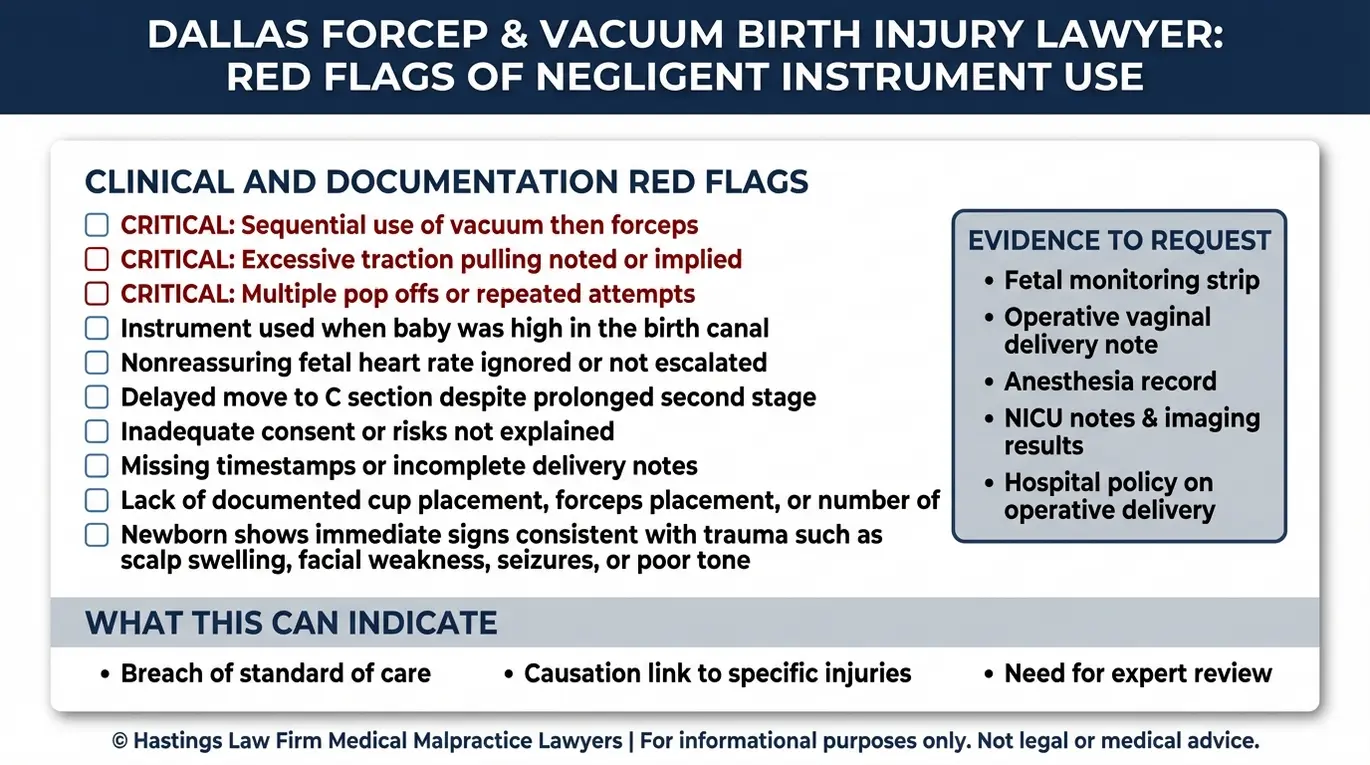
One of the most significant violations involves the sequential use of instruments, which means trying a vacuum extractor and then switching to forceps (or vice versa) when the first attempt fails. This practice is widely discouraged because each failed attempt adds cumulative trauma to the baby’s head and brain. Sequential instrument use is a strong indicator of medical negligence in many birth injury cases.
Another serious concern involves high forceps delivery, which refers to applying forceps when the baby’s head is still high in the birth canal. This technique carries extreme risk and is considered outside the bounds of acceptable modern obstetric practice.
Red Flags That May Indicate Negligence
When our medical malpractice lawyers review a birth injury case, we look for patterns that suggest the standard of care was not met. Common red flags include multiple pop-offs with the vacuum extractor, which occurs when the suction cup detaches from the baby’s scalp.
Other red flags include:
- Forceps or vacuum applied before the cervix was fully dilated
- Instrument used when the baby’s position in the birth canal was not confirmed
- Sequential use of vacuum followed by forceps, or the reverse
- Failure to move to a C-section after unsuccessful instrument attempts
- Ignoring non-reassuring fetal heart rate patterns before or during instrument use
- High forceps application when the baby was not adequately descended
- Excessive traction that was inconsistent with the clinical situation
- Incomplete or altered delivery notes in the medical record
The Evidence We Examine
Proving negligence in a birth injury requires a thorough medical investigation. Key evidence sources include fetal monitoring strips, which record the baby’s heart rate throughout labor and can reveal periods of distress that should have prompted intervention. Delivery notes, nursing documentation, and operative reports all provide a timeline of decisions and actions.
Gaps, inconsistencies, or missing entries in these records can themselves be significant. When the documentation does not match the clinical outcome, it often points to failures that warrant deeper review by qualified medical experts.
How Our Dallas Birth Injury Lawyers Uncover the Truth
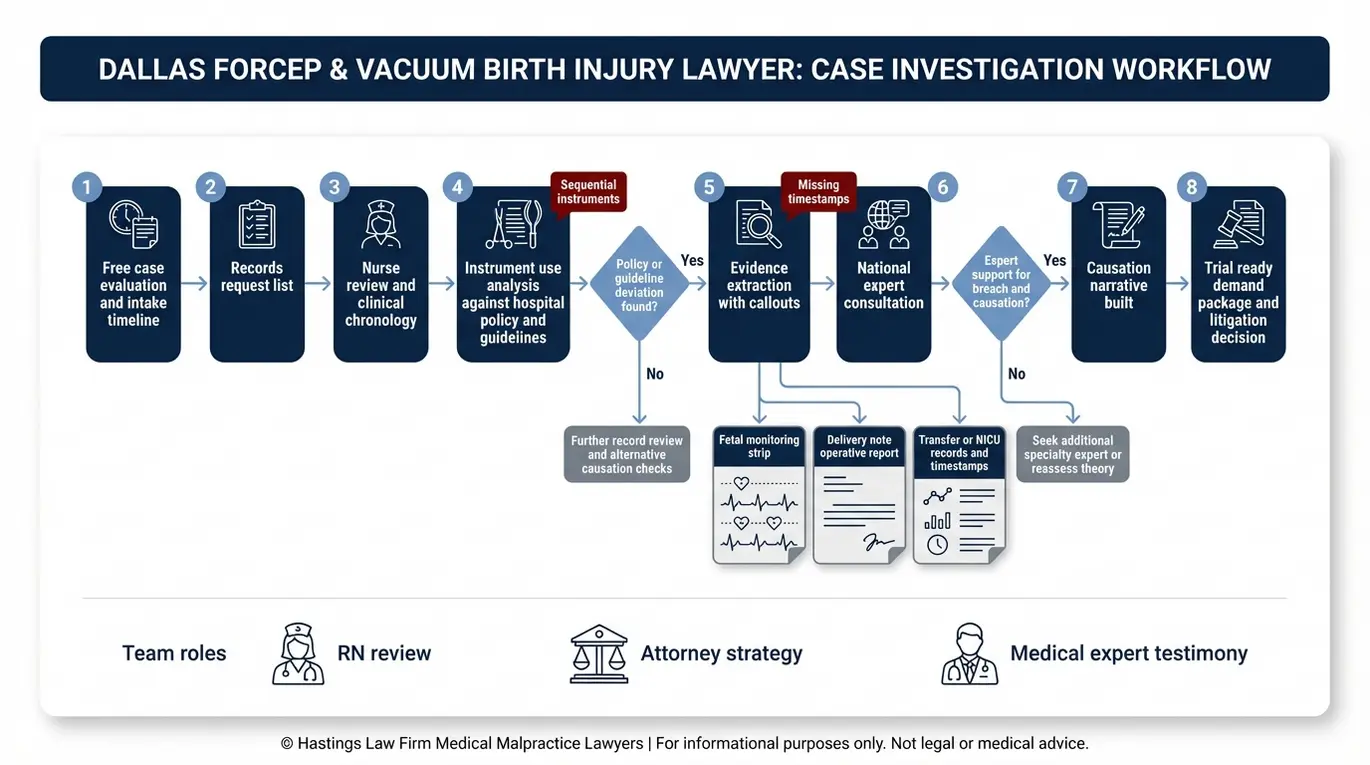
We use a team of registered nurses and board-certified trial attorneys to investigate medical records, identify policy violations, and consult with national expert witnesses to build a trial-ready case. Our legal team includes former defense attorneys and experienced nurses who understand hospital protocols from the inside. Our Dallas forcep injury lawyers and vacuum extraction lawyers approach every case with the same level of preparation, whether it resolves through settlement or goes before a jury.
Our investigation goes beyond reading the medical chart. We reconstruct the delivery minute by minute, starting with the onset of labor and continuing through every clinical decision made in the delivery room.
Reconstructing the Delivery
Our in-house medical staff, including nurse practitioners and Board Certified Patient Advocates, begin by analyzing the electronic fetal monitoring (EFM) strip. This strip continuously records the baby’s heart rate and the mother’s contractions. These strips can reveal whether the baby was in distress before instruments were applied and whether the care team responded appropriately.
We also examine nursing flow sheets, medication administration records, physician orders, and any communication logs between staff. If the hospital had internal protocols for operative vaginal delivery, we compare what happened against those policies.
Our Investigation Process
When you hire a birth injury attorney at Hastings Law Firm, here is what you can expect:
- Initial evaluation: A patient advocate reviews your case at no cost and gathers the relevant medical records.
- Medical record analysis: Our in-house nursing team reviews the complete labor and delivery records, identifying timeline gaps, charting inconsistencies, and deviations from protocol.
- Expert consultation: We work with a national network of obstetricians, neonatologists, and pediatric neurologists who provide independent opinions on whether the standard of care was met.
- Causation analysis: Our medical experts evaluate whether the instrument use directly caused the injury, or whether the injury may be linked to a related failure, such as a delayed diagnosis of hypoxic-ischemic encephalopathy (HIE), which is brain damage caused by reduced oxygen and blood flow to the baby’s brain.
- Litigation preparation: Every case is prepared as though it will go to trial. This trial-ready approach, including detailed medical reconstruction and identified expert testimony, signals to defense attorneys and insurance carriers that we will not accept less than fair value.
No Upfront Cost
We handle birth injury cases on a contingency fee basis. That means you pay no attorney fees or costs unless we secure a recovery for your family. This structure removes the financial barrier that can prevent families from pursuing legitimate claims against well-funded hospitals and insurance companies.
Why This Work Matters
Founder Tommy Hastings, a board-certified trial lawyer and 2025 inductee into the American Board of Trial Advocates, has built this firm on the belief that holding negligent providers accountable is one of the most effective ways to prevent the same mistakes from happening to another family. Every case we take is an opportunity to enforce that accountability.
Compensation and Damages for Instrumental Birth Injuries
Families affected by forceps or vacuum delivery injuries may recover compensation for past and future medical expenses, life care planning, pain and suffering, and loss of earning capacity for the child. This compensation is intended to provide the necessary resources for a child’s ongoing health and specialized needs. The full scope of damages depends on the severity of the injury and the long-term care the child will need.
A birth injury settlement or verdict in these cases must account for far more than current medical bills. Many children injured by medical instruments during delivery require a lifetime of specialized care.
Economic Damages
Economic damages cover the medical expenses and other measurable financial costs your family has already incurred and those you will face in the future. In cases involving cerebral palsy, brain damage, or spinal cord injuries, these costs can be substantial. Common categories include:
- Past and future medical expenses, including surgeries, hospitalizations, and specialist visits
- Physical, occupational, and speech therapy
- Medications and ongoing diagnostic testing
- Specialized equipment such as wheelchairs, adaptive devices, and communication aids
- Home modifications for accessibility
- In-home nursing care or 24/7 attendant care
- Special education and developmental support services
- Lost earning capacity if the child’s injuries prevent future employment
Research published in the Journal of Health Economics and Outcomes Research on the cost of rehabilitation for children with cerebral palsy illustrates how even targeted therapy programs carry significant costs. This underscores the need for compensation that reflects the true financial burden on families.
Non-Economic Damages
Not every loss carries a price tag, but the law allows families to seek compensation for forceps injuries and vacuum birth injuries that cause suffering beyond financial costs. Non-economic damages may include mental anguish experienced by the child and parents.
Other non-economic damages include:
- Physical pain and suffering endured by the child
- Physical impairment and loss of function
- Disfigurement resulting from scarring or facial nerve damage
- Diminished quality of life
These damages recognize the human toll of a preventable birth injury, and juries consider them alongside the economic evidence.
Life Care Plans
In cases involving serious, long-term conditions like cerebral palsy or HIE, we work with life care planners and forensic economists to project the full cost of care over the child’s expected lifespan. A life care plan is a detailed, evidence-based document that maps every anticipated medical need, therapy session, equipment replacement, and support service the child will require.
This plan becomes a central piece of evidence in damages calculations for medical malpractice cases. It translates a diagnosis into concrete, dollar-specific projections that a jury or settlement negotiator can evaluate. Without this kind of detailed planning, families risk accepting a settlement that falls far short of what their child will actually need.
Contact the Dallas Birth Injury Attorneys at Hastings Law Firm Today for Help
If your child was injured during a forceps or vacuum-assisted delivery, you deserve clear answers about what happened and whether it could have been prevented. The statute of limitations places a deadline on your ability to file a birth injury lawsuit in Texas, so early action helps preserve evidence and protect your family’s rights.
At Hastings Law Firm, your initial evaluation is led by a medical professional, not a sales team, and it costs you nothing. We work on a contingency fee basis, meaning you pay no fees unless we obtain a recovery.
Contact our Dallas birth injury lawyers today for a free, confidential case evaluation. Let us review your child’s medical records, explain your legal options, and help you take the first step toward accountability.
Call Hastings Law Firm or submit a request online to speak with a patient advocate today.
Frequently Asked Questions About **Forcep & Vacuum Birth Injury** in Dallas


This content was researched and written by the Hastings Law Firm editorial team, which includes attorneys, medical professionals, and experienced researchers. Our writing is informed by internal knowledge and practical experience, and we cross-check critical details against authoritative sources cited throughout. Every piece undergoes human-led fact-checking and legal review. Because legal and medical information can change, if you spot an error, please contact us. Learn more about our content standards and review process on our editorial policy page.

Brady D. Williams is a nationally recognized medical malpractice attorney who has spent his career handling high-stakes litigation for injured patients and families across the country. Licensed in both Texas and California, Brady draws on experience from hundreds of resolved medical cases to break down complex legal and medical topics for the people who need that information most. His writing reflects the same attention to detail and commitment to clarity that he brings to every case he handles.
