


Dallas Medication Error Lawyer
Prescription mistakes can happen when a medication is prescribed, dispensed, or administered incorrectly, and the results can be severe. Harm may come from side effects of the wrong drug while the underlying condition remains untreated, which can allow a treatable problem to escalate into a life threatening outcome. Responsibility may involve a prescribing physician, a pharmacy, hospital staff, or a manufacturer depending on where the breakdown occurred. If you or a loved one were harmed or worse due to a medication error in Dallas, Texas, contact Hastings Law Firm for a free, confidential case review.
Last Updated: July 27, 2026
Trusted Dallas Medical Attorneys for Prescription Mistakes
When you trust a doctor, pharmacist, or nurse to get your medication right, you expect that trust to be honored. A medication error, meaning any preventable mistake in prescribing, dispensing, or administering a drug, can turn a routine treatment into a serious health crisis. If you or someone you love has been harmed by a prescription mistake in Dallas, you may feel confused about what went wrong and uncertain about what to do next.
As a Dallas medication error lawyer team that focuses exclusively on medical malpractice, we understand the frustration of knowing something went wrong. Our firm, founded in 2005 by Tommy Hastings, a board-certified trial attorney, includes in-house nurse consultants and former defense attorneys. We know how to trace these errors back to their source and can review what happened and explain your legal options at no cost to you.

Common Types of Medication Errors in Dallas Healthcare Systems
Medication errors occur when a healthcare professional breaches the standard of care by prescribing, dispensing, or administering the wrong drug or dosage, resulting in preventable patient harm. These mistakes can happen at any stage of the medication process, and identifying exactly where the breakdown occurred is one of the first steps in building a case. If you need a medication mistake attorney to investigate, knowing the type of error is important.
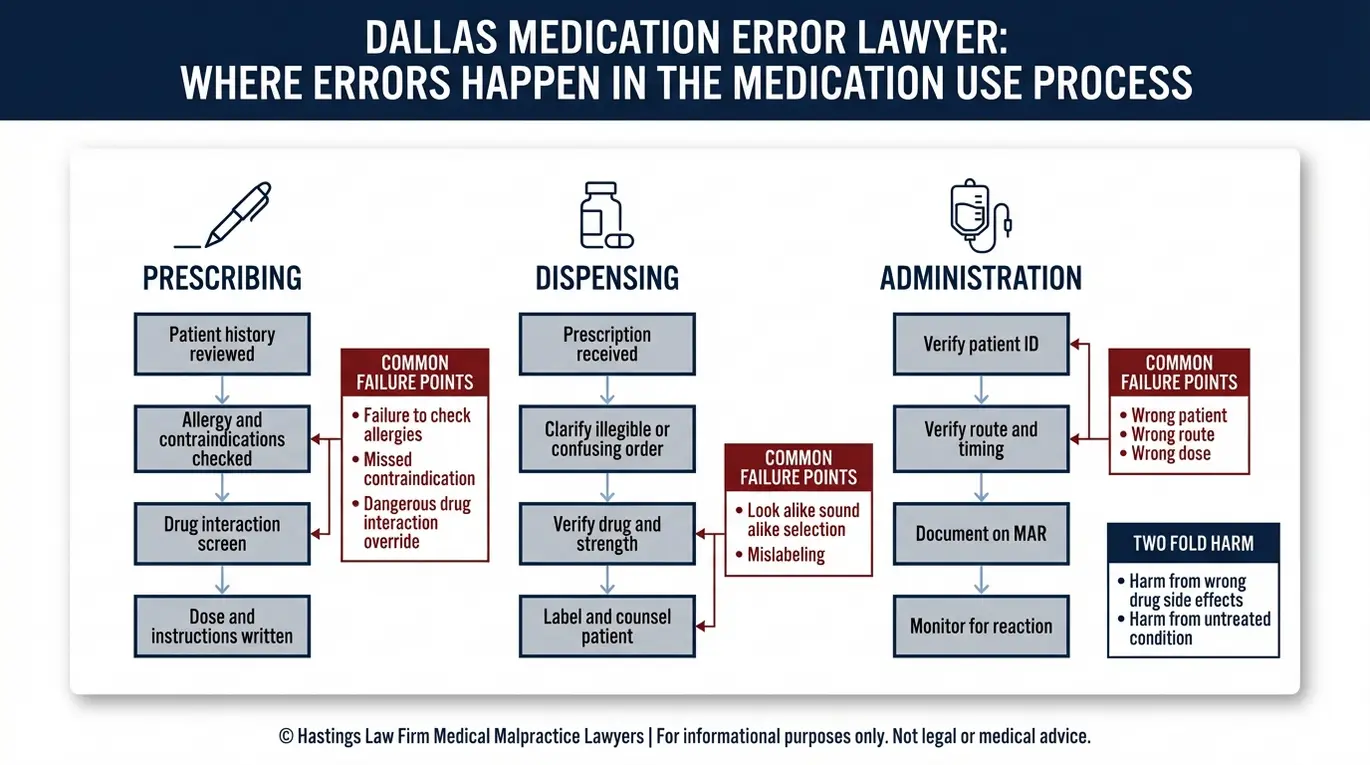
Errors generally fall into three categories based on when and how they happen:
- Prescribing errors: Prescribing errors occur during the initial physician order. This happens when a physician orders the wrong medication or dose, or fails to check for drug interactions before writing a prescription. A common example is prescribing an antibiotic to a patient with a documented allergy, or ordering a medication that dangerously interacts with something the patient already takes. These physician orders sometimes stem from illegible handwriting on paper prescriptions or data entry mistakes in electronic prescription systems.
- Dispensing errors: Dispensing errors happen at the pharmacy during fulfillment. This occurs when the pharmacist provides the wrong medication or an incorrect dosage to the patient. A pharmacy negligence lawyer often sees cases involving “look-alike/sound-alike” drugs, where medications with similar names or packaging are confused. The FDA and ISMP Lists of Look-Alike Drug Name Sets highlight how frequently this problem occurs and recommend “Tall Man” lettering to reduce confusion.
- Administration errors: Administration errors involve the delivery of medication to the patient. These occur in hospital settings when a nurse gives a medication to the wrong patient, through the wrong route, or at the wrong time. Breakdowns in patient identification protocols or failure to check the medication administration record often contribute to these errors.
What makes medication errors especially damaging is a concept sometimes described as “two-fold harm.” The patient suffers the side effects of the wrong drug, and at the same time, their actual medical condition goes untreated. That combination can cause a minor illness to escalate rapidly, turning a treatable problem into a life-threatening one. The NCCMERP classification system categorizes these errors by severity, helping professionals understand the impact of the mistake.
Liability: Suing a Doctor, Pharmacy, or Manufacturer
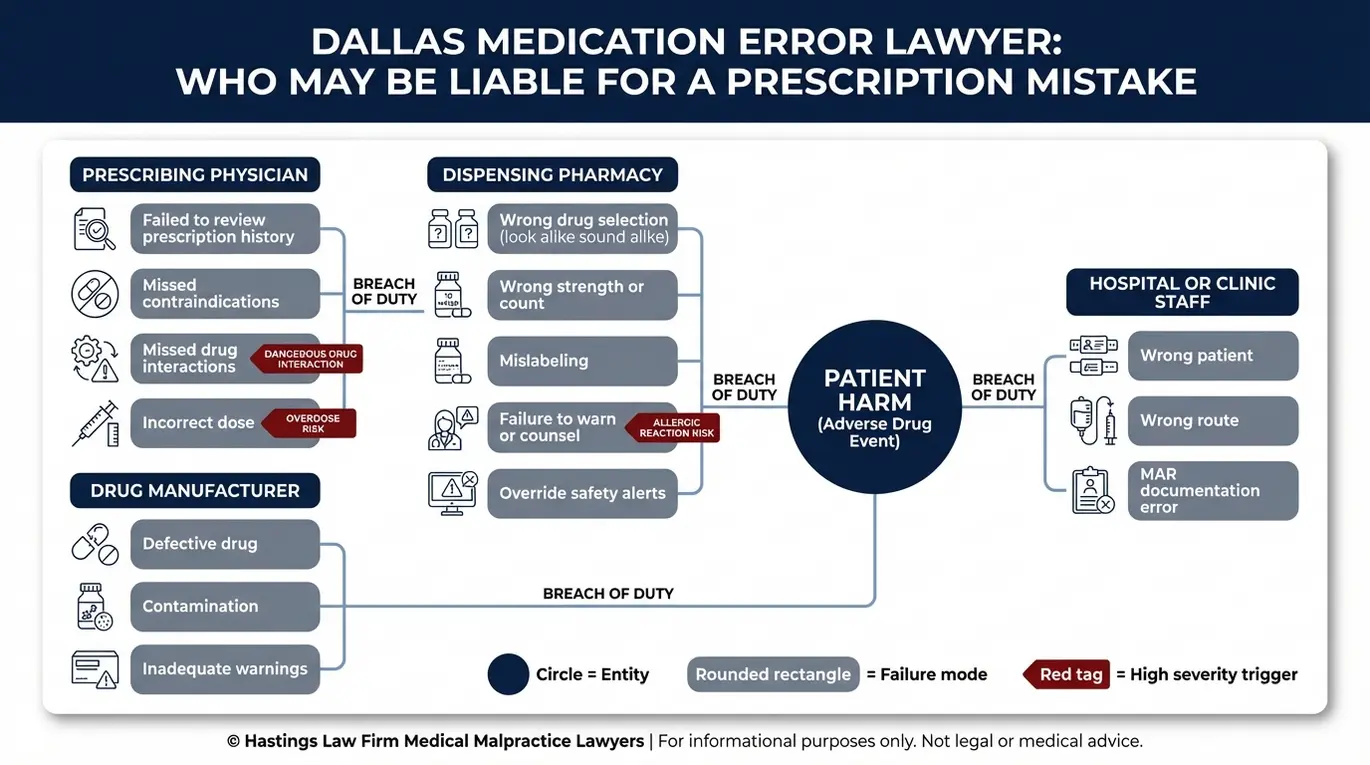
Liability for medication errors can extend to the prescribing physician, the dispensing pharmacy, the hospital nursing staff, or the pharmaceutical manufacturer, depending on where the breach of duty occurred. This legal responsibility depends on where the breakdown in the safety protocol happened. In many cases, more than one party shares responsibility.
Physician liability often centers on a failure to review the patient’s prescription history or to account for known drug interactions before ordering a medication. A contraindication, which is a specific condition or factor that makes a particular treatment inadvisable, should appear in the patient’s chart. When a physician prescribes despite that warning, the prescribing decision itself becomes the basis for the claim.
Pharmacist liability applies when the dispensing pharmacist or pharmacy staff makes an error during fulfillment. Corporate pharmacies can be held responsible if their systems allow staff to override safety alerts. They are also liable if the pharmacist fails to consult the doctor about a dangerous drug-drug interaction. This interaction occurs when two or more medications produce a harmful effect when taken together. Under the Texas Medical Liability Act, the standard of care for pharmacists involves strict adherence to safety protocols.
We investigate whether corporate policies contributed to the error when considering suing a pharmacy in Dallas. Manufacturer liability may apply if the drug itself was defective, contaminated, or inadequately labeled, or if there was a failure to warn of side effects. These claims fall under product liability rather than traditional medical malpractice. As a Dallas prescription error lawyer team, we investigate the entire chain of custody, from the doctor’s order to the pill that reached the patient, to identify every responsible party.
| Responsible Party | Common Liability Triggers |
|---|---|
| Prescribing Physician | Failed to review patient history, missed contraindications, prescribed incorrect dosage |
| Pharmacy / Pharmacist | Dispensed wrong drug, overrode safety warnings, failed to verify dangerous interactions |
| Hospital Nursing Staff | Administered medication to wrong patient, used wrong route, ignored allergy alerts |
| Drug Manufacturer | Defective product, contamination, inadequate labeling or safety warnings |
The Hastings Law Firm Difference
Results matter, but what truly sets us apart is how we achieve them. Every verdict, every settlement, and every Dallas courtroom victory comes from one guiding promise: To treat each client’s fight for justice as if it were our own.
This balance of skill, experience, and empathy reflects our core philosophy that justice should not only compensate the injured, but also make health care safer nationwide.

Severe Injuries Caused by Adverse Drug Events (ADEs)
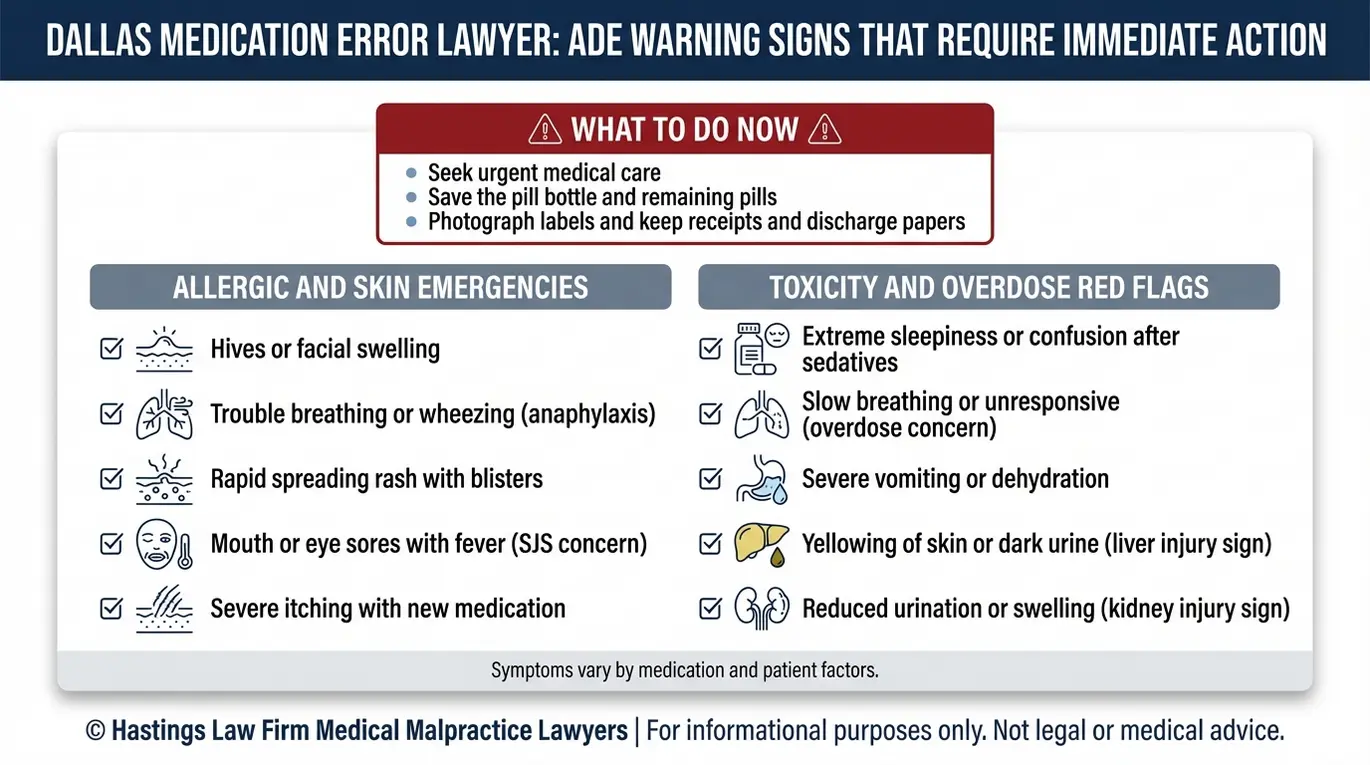
Adverse drug events (ADEs), which are injuries resulting from medication use rather than the underlying condition, range from temporary allergic reactions and anaphylaxis to permanent organ damage, Stevens-Johnson Syndrome, or fatal overdose. According to CDC Medication Safety data, adverse drug events account for a significant number of emergency department visits each year, making them one of the most common preventable causes of patient harm. Patients need to consult a medication injury attorney to understand the full scope of these damages.
Stevens-Johnson Syndrome (SJS)
Stevens-Johnson Syndrome is a severe, life-threatening skin reaction most often triggered by antibiotics, anticonvulsants, and certain other medications classified as high-alert medications, which are drugs that carry a heightened risk of causing significant harm when used in error. SJS causes the skin and mucous membranes to blister and peel, often requiring burn unit treatment and leaving lasting scarring or vision damage.
Organ Failure and Neurological Damage
Overdose or prolonged exposure to the wrong medication can cause liver or kidney toxicity, sometimes progressing to full organ failure that requires dialysis or transplant. Incorrect dosages of sedatives or anesthesia errors can lead to hypoxia, resulting in brain injury or permanent neurological impairment. An underdose carries its own risks, potentially allowing a dangerous condition like a blood clot or infection to progress unchecked, sometimes resulting in wrongful death.
Role of Evidence: The Pill Bottle
If you suspect a medication error, an adverse drug event lawyer will emphasize that preserving the physical evidence is one of the most important things you can do. The role of photographic evidence is critical. Keep the pill bottle, the pharmacy receipt, and any remaining pills. Do not return them to the pharmacy. Take clear photographs of the label, including the drug name, dosage, and pharmacy information. Mislabeling, which occurs when the label does not accurately reflect what is inside the container, can be powerful evidence, but only if the bottle is preserved before it is discarded or returned.
Proving Negligence Under Texas Law
To win a medication error claim in Texas, the plaintiff must prove that the provider violated the accepted standard of care and that this specific violation directly caused the injury. Negligence occurs when a medical professional fails to meet the accepted standard of care, causing preventable harm to a patient. Working with Dallas medication error counsel and pharmaceutical litigation experts is critical to meeting these requirements.
Here is how the process works:
- Filing the claim and serving the expert report. Under Texas Civil Practice and Remedies Code § 74.351, the plaintiff must serve a qualified expert report within 120 days after the date each defendant’s original answer is filed. This report, sometimes called an affidavit of merit, must identify the standard of care, explain the breach of duty, and describe how that breach caused the patient’s injury. Failure to meet this strict deadline can result in the case being dismissed with prejudice.
- Establishing the standard of care through expert witness testimony. Qualified experts, such as board-certified pharmacologists or physicians, define what a reasonably competent provider would have done under the same circumstances. A Medication Administration Record (MAR), which is the hospital log documenting every dose given to a patient, is one of the key pieces of evidence our medical team reviews. We also reference the NCC MERP classification system, a nationally recognized framework used to categorize medication errors by severity, to help establish how the error should be measured.
- Proving causation. It is not enough to show a mistake was made. The legal team must connect the specific chemical properties and effects of the wrong medication to the patient’s decline. Our in-house nurse consultants and national network of medical experts analyze records, pharmacy logs, and lab results to build that connection.
Each of these steps requires coordination between legal strategy and deep medical knowledge, which is why our team includes both experienced medical malpractice attorneys and clinical professionals who review every case together.
Recovering Damages for Medication Injuries
Patients harmed by medication errors may seek medication malpractice compensation to recover economic damages for medical bills and lost wages, as well as non-economic damages for pain, suffering, and physical impairment. Damages are the monetary compensation sought to cover the physical, emotional, and financial impact of a medical mistake. The type and severity of the injury determine the potential value of the claim.
Economic damages cover the measurable financial losses: the cost of corrective treatment such as dialysis after drug-induced kidney failure, hospital stays, rehabilitation, prescription costs, and income lost during recovery or due to long-term disability. These damages are not capped under Texas law, meaning recovery can reflect the full scope of financial harm.
Non-economic damages compensate for the physical pain, emotional distress, and diminished quality of life caused by the error. Under the Texas Civil Practice and Remedies Code § 74.301, Texas places statutory caps on non-economic damages in medical malpractice cases. This makes it necessary to work with an attorney who knows how to document and maximize the economic portion of the claim, where no cap applies. Securing a fair settlement for a wrong prescription depends on thoroughly calculating both current and future losses.
Contact the Dallas Healthcare Malpractice Attorneys at Hastings Law Firm Today for Help
If you or a loved one suffered harm because of a pharmacy mistake, a doctor’s prescription error, or a hospital administration failure, you do not have to face the insurance companies and hospital legal teams alone. Hastings Law Firm is dedicated exclusively to medical negligence cases. Our team includes in-house medical professionals and former defense attorneys who know how these cases are built and how the other side tries to defend them.
We charge no fees unless we recover compensation for you. Every consultation is free and confidential, and our patient advocates can begin reviewing your case right away. Contact our Dallas office today to start the investigation and protect your family’s future.
Frequently Asked Questions About Medication Error in Dallas


This content was researched and written by the Hastings Law Firm editorial team, which includes attorneys, medical professionals, and experienced researchers. Our writing is informed by internal knowledge and practical experience, and we cross-check critical details against authoritative sources cited throughout. Every piece undergoes human-led fact-checking and legal review. Because legal and medical information can change, if you spot an error, please contact us. Learn more about our content standards and review process on our editorial policy page.

Tommy Hastings, founder of Hastings Law Firm, is a board-certified personal injury trial lawyer dedicated exclusively to healthcare injury cases. Since 2001, he has represented injured patients and families in litigation against major hospital systems, pharmaceutical companies, and negligent healthcare providers nationwide. He has handled numerous high-profile cases that have drawn national media attention and resulted in multi-million dollar recoveries. He draws on that experience in his writing, helping readers understand how these cases work and what options may be available to them.
