


Dallas Delayed or Prolonged Surgery Lawyer
Surgical delays and unusually long operations can turn a treatable problem into lasting harm. Some waits are unavoidable, but malpractice can occur when an unjustified delay or prolonged operative time falls below the medical standard of care and worsens a patient’s condition. The risks can include serious complications from extended anesthesia exposure, infection, permanent disability, or fatal outcomes, along with major financial strain from added treatment and time away from work. If you or a loved one were harmed or worse due to delayed or prolonged surgery in Dallas, Texas, contact Hastings Law Firm for a free, confidential case review.

Last Updated: July 27, 2026
Trusted Legal Representation for Surgical Delays in Dallas
When a surgery is delayed without good reason, or when an operation takes far longer than it should, the consequences can be severe and life-altering. If you or a loved one suffered harm because a necessary procedure was postponed or prolonged, you may be wondering if what happened was more than just an unfortunate outcome.
These situations raise serious questions, and you deserve clear answers. As a Dallas delayed or prolonged surgery lawyer, Hastings Law Firm focuses exclusively on medical malpractice cases. Founded by board-certified trial lawyer Tommy Hastings, our team of attorneys, in-house nurses, and medical consultants understands both the clinical and legal sides of surgical negligence claims. We can review what happened, help you understand if the standard of care was met, and explain your options at no cost and no obligation.

Distinguishing Between Routine Waits and Surgical Malpractice
Surgical malpractice occurs when a delay in performing a procedure, or an unreasonably prolonged operation, breaches the medical standard of care and directly causes injury or worsens the patient’s condition. Not every wait before surgery rises to that level, and understanding the difference is essential.
The standard of care is the level of treatment a reasonably competent medical professional would provide under similar circumstances. While a reasonable delay is sometimes necessary, medical negligence occurs when the delay is unjustified. An operating room running behind schedule, for example, may be frustrating but does not automatically constitute negligence.
A critical delay is different. When a surgical malpractice attorney reviews cases where a hospital fails to perform a time-sensitive surgical intervention, such as an emergency C-section or an appendectomy for a ruptured appendix, the consequences can be catastrophic.
Prolonged operative duration, meaning the total time a patient spends in active surgery, also raises serious medical and legal concerns. Extended time under anesthesia increases the risk of complications, including hypoxia, a dangerous condition where the body or brain does not receive enough oxygen.
In cases involving a lawyer for delayed surgery in Dallas or a Dallas surgical negligence counsel, we examine whether the length of the procedure fell outside accepted norms. We investigate if this was a clear breach of duty, and whether it directly contributed to the patient’s injuries.
Under the Texas Civil Practice and Remedies Code § 74.251, patients pursuing surgical malpractice claims must meet specific legal requirements, including filing deadlines that make early investigation critical.
Medicare Designation of Preventable Errors
Some surgical complications are so clearly avoidable that the Centers for Medicare & Medicaid Services (CMS) classifies them as “Never Events,” errors that should never occur under any circumstances when proper protocols are followed. Medicare is the federal health insurance program that sets national safety standards for hospitals.
The Never Event designation matters because it reflects a national consensus that certain medical errors and avoidable errors are not acceptable risks of surgery. A Never Event is a serious, preventable medical error that should not occur if healthcare providers follow established safety rules. When a hospital’s own billing records show a Never Event, it can strengthen a malpractice claim by demonstrating that even federal reimbursement protocols recognize the error as preventable. Our Dallas surgical negligence attorneys review these classifications as part of the investigation to build the strongest possible case.
Common Scenarios Involving Dangerous Surgical Delays
Critical delays often occur in emergency settings, such as failure to perform a timely C-section, delayed treatment for internal bleeding, or postponing surgery for appendicitis that leads to rupture and life-threatening infection.
Delayed diagnosis leading to delayed surgery is one of the most common patterns we see. When emergency room staff or attending physicians miss early warning signs of a stroke, bowel obstruction, or internal bleeding, known as a hemorrhage, the window for effective surgical intervention shrinks. A Dallas delayed surgery lawyer or surgical error counsel knows that delayed diagnosis or misdiagnosis is often the root cause.
Research published in JAMA Neurology on treatment speed and ischemic stroke outcomes confirms that even small delays in time-sensitive procedures can result in significantly worse patient outcomes, including organ damage, permanent disability, or death.
Prolonged operation times can also cause serious harm. An attorney for prolonged surgery knows that when a procedure takes substantially longer than expected due to complications that may have been preventable, the patient faces extended exposure to anesthesia and a higher risk of infection. Sepsis, a dangerous and potentially fatal immune response triggered by infection, can develop rapidly when surgical timelines are not managed properly.
Scheduling decisions may also contribute to dangerous delays. When emergency surgical cases are not prioritized appropriately, due to staffing shortages or operating room availability, patients in urgent need of intervention may wait longer than is medically safe. A lawyer for surgical delays can help determine if administrative choices led to the injury.
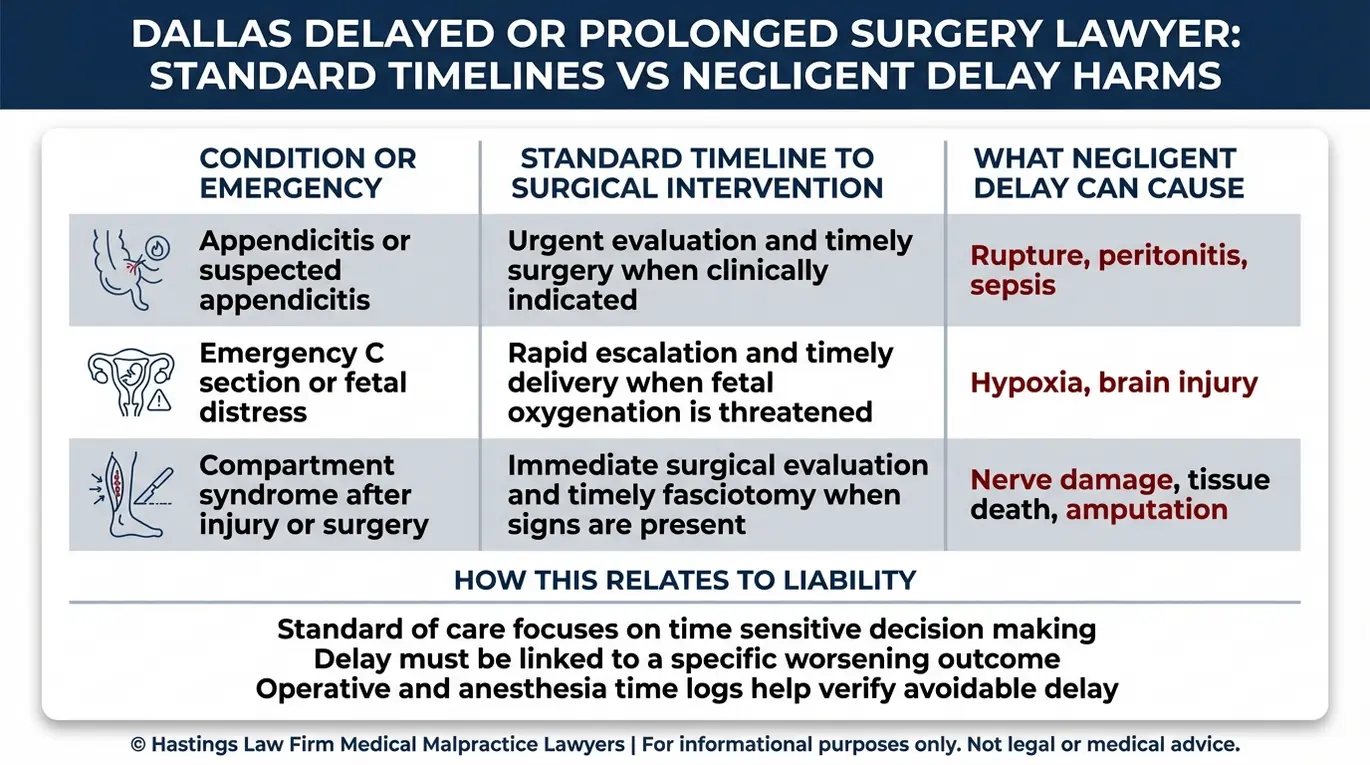
The table below illustrates how timing standards relate to specific conditions and what can happen when those standards are not met.
| Condition | Standard Timeline | Negligent Delay Consequence |
|---|---|---|
| Appendicitis | Surgery typically within hours of diagnosis | Rupture, peritonitis, sepsis |
| Emergency C-Section | Decision-to-delivery often within 30 minutes | Fetal hypoxia, brain injury, cerebral palsy |
| Compartment Syndrome | Fasciotomy within hours of onset | Tissue death, amputation, permanent disability |
A Dallas delayed surgery lawyer can evaluate if the timeline in your case fell outside accepted medical standards and if that gap caused the harm you or your family experienced.
The Hastings Law Firm Difference
Results matter, but what truly sets us apart is how we achieve them. Every verdict, every settlement, and every Dallas courtroom victory comes from one guiding promise: To treat each client’s fight for justice as if it were our own.
This balance of skill, experience, and empathy reflects our core philosophy that justice should not only compensate the injured, but also make health care safer nationwide.

Why Do Preventable Surgical Delays Happen in Dallas Hospitals
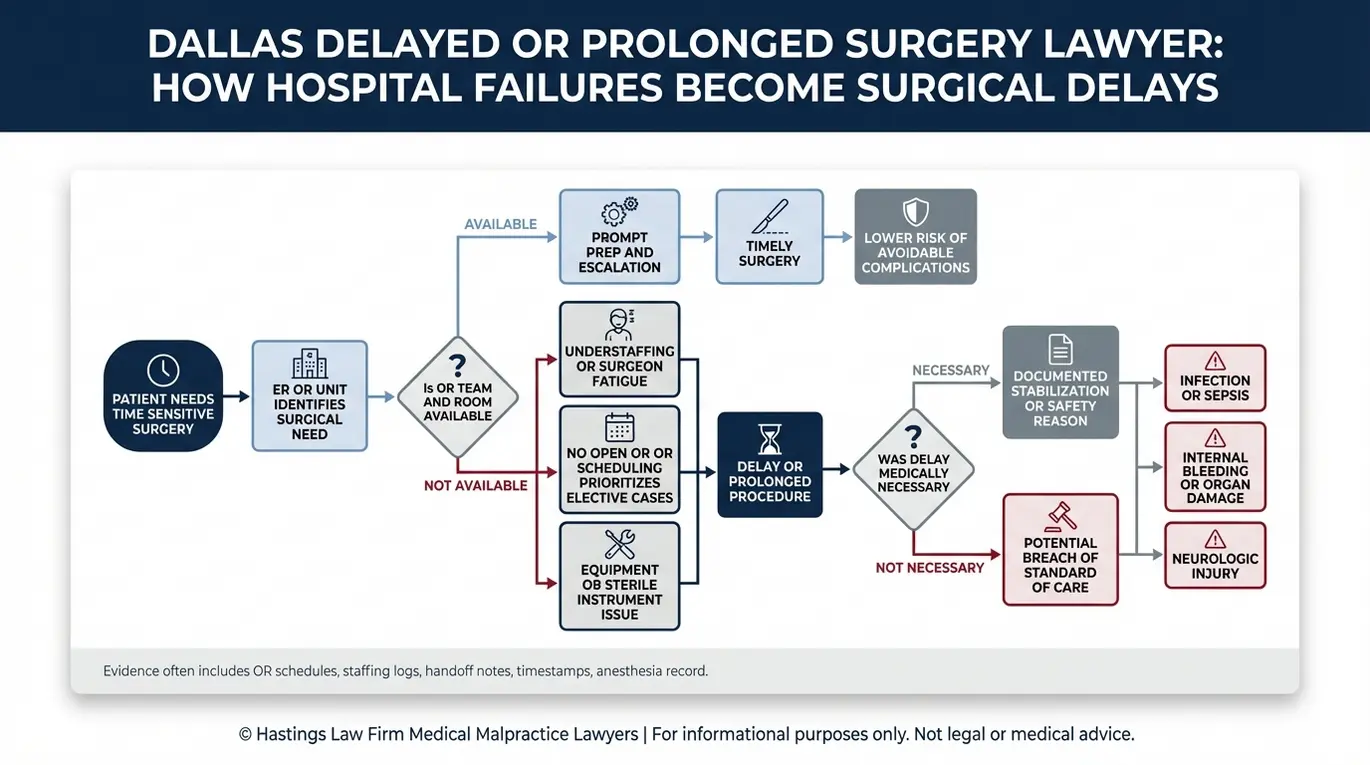
Surgical delays and prolonged procedures are frequently caused by hospital understaffing, surgeon fatigue, lack of available operating rooms, or miscommunication between emergency departments and surgical teams. These are administrative failures and system-level issues, and they are more common than most patients realize.
Research published in the Journal of Patient Safety on communication failures in malpractice claims found that breakdowns in communication and clinical handoffs are among the most frequent contributing factors in surgical malpractice cases. A surgical handoff, the transfer of patient care responsibility from one clinician or team to another, is a high-risk moment where critical information can be lost.
Common causes of preventable surgical delays include:
- Staffing and fatigue: Overbooked surgeons and exhausted support staff working extended shifts are more likely to make errors or fail to recognize deteriorating patients.
- Equipment and sterility failures: Delays caused by unavailable or improperly sterilized instruments can push back time-sensitive procedures.
- Communication breakdowns: Failure to escalate abnormal test results or delays in operating room (OR) triage, the process of prioritizing which patients need surgery first, can leave critical cases waiting.
At Hastings Law Firm, our Dallas delayed surgery attorneys and prolonged surgery lawyer team investigate anesthesia errors, postoperative care lapses, and institutional failures by reviewing staffing records, OR logs, communication notes, and internal hospital protocols. Our team includes former defense attorneys and in-house nursing professionals who know how hospital systems work from the inside, which helps our medical malpractice firm identify exactly where the breakdown occurred.
The Physical and Financial Toll of Prolonged Operations
Patients who endure prolonged surgeries often face increased risks of infection, deep vein thrombosis (DVT), anesthesia complications, and permanent organ damage, all of which can lead to substantial financial burdens.
A surgical site infection (SSI), an infection that develops in the area of the body where surgery was performed, becomes more likely the longer the body is exposed during an operation. A systematic review published by PubMed on prolonged operative duration and SSI risk confirmed a clear correlation between longer surgeries and higher infection rates. Deep vein thrombosis (DVT), a blood clot that forms in a deep vein, usually in the legs, is another serious complication linked to extended time on the operating table and internal bleeding risks.
Anesthesia-related injuries are also a concern. Patients kept under general anesthesia longer than necessary may experience cognitive effects, memory loss, or in severe cases, hypoxia resulting in brain damage or permanent disability. When these complications lead to a fatal outcome, families are left to face the loss of a loved one.
The financial impact compounds the physical harm. A surgical injury attorney understands that extended hospital stays, additional corrective surgeries, rehabilitation, and long-term care can cost hundreds of thousands of dollars. Lost wages, pain and suffering, and costs for future medical care add to the burden. A Dallas prolonged surgery lawyer or lawyer for surgical complications can help determine if you may be entitled to recover these losses.
Compensation for Victims of Surgical Negligence in Texas
Patients harmed by delayed or prolonged surgical care may recover economic damages for medical bills and lost wages, as well as non-economic damages for pain, suffering, and physical impairment, subject to Texas legislative caps.
Texas law divides malpractice damages into distinct categories. Understanding available medical malpractice damages is an important first step for an attorney for surgery mistakes.
Economic damages cover the measurable financial losses caused by the injury:
- Past and future medical bills, including corrective surgeries and rehabilitation
- Lost wages and diminished earning capacity
- Home care and assistive medical equipment
These damages have no statutory cap under Texas law, meaning recovery can reflect the full scope of your financial losses and compensation for surgical errors.
Non-economic damages address the personal toll of the injury:
- Physical pain and suffering
- Mental anguish and emotional distress
- Disfigurement and physical impairment
- Loss of companionship (in wrongful death cases)
Under Texas Civil Practice and Remedies Code Chapter 74, non-economic damages are subject to a cap on damages of $250,000 against all individual healthcare providers and up to $500,000 total against healthcare institutions.
Punitive damages may be available in rare cases involving gross negligence, where the conduct goes beyond a simple error and reflects a conscious disregard for the patient’s safety.
A Dallas delayed or prolonged surgery lawyer at Hastings Law Firm can evaluate the full value of your claim and pursue every category of compensation the law allows. Because we work on a contingency fee basis, you pay no attorney fees unless we recover on your behalf.
Understanding the Texas Statute of Limitations for Surgery Claims
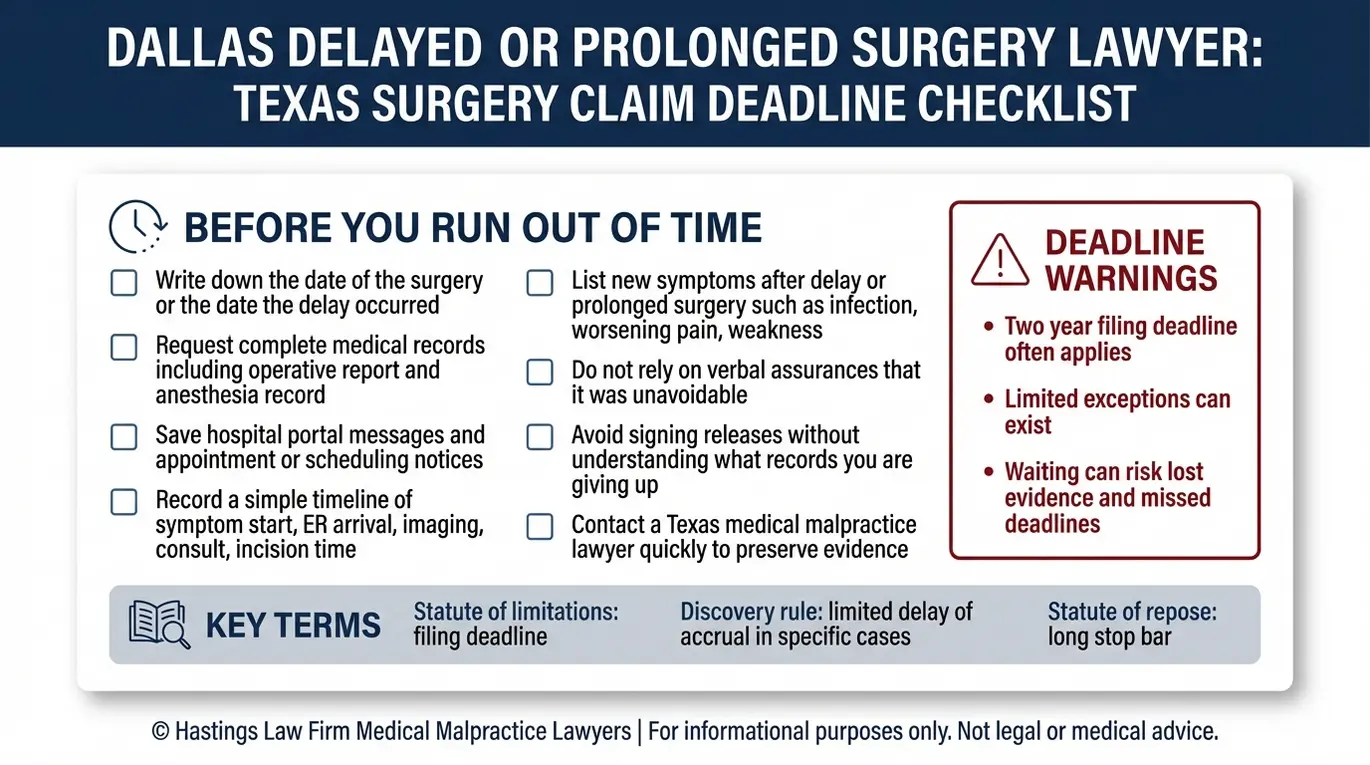
In Texas, medical malpractice claims generally must be filed within two years from the date of the surgical error, though limited exceptions exist for discovery of the injury or cases involving minors.
This two-year limit acts as a strict time limit for surgery lawsuit filings. If you do not file your claim within that window, the court will almost certainly dismiss your case regardless of how strong the evidence may be. In some situations, the “discovery rule” may apply, which can extend the deadline if the injury was not immediately apparent. For children, the statute may be tolled until the minor reaches a certain age.
Texas also imposes a statute of repose, an absolute 10-year outer limit that bars claims filed more than a decade after the date of the alleged negligence, even if the injury was discovered later.
Evidence preservation is another reason to act quickly. Medical records, staffing logs, and equipment maintenance records can be altered, archived, or destroyed over time. Contacting a Dallas delayed surgery lawyer early gives your legal team the best opportunity to secure and analyze the records that matter most.
Contact the Dallas Surgical Error Attorneys at Hastings Law Firm Today for Help
You trusted a medical team with your health, or with the life of someone you love. When that trust is broken by a preventable surgical delay or a procedure that went on far longer than it should have, you deserve honest answers about what happened and what comes next.
Hastings Law Firm represents patients and families across Dallas who have been harmed by surgical negligence. Our team of Dallas delayed surgery attorneys, supported by in-house nurses and a national network of medical experts, is prepared to review your case, identify where the standard of care may have been violated, and build a strategy designed for the courtroom.
The consultation is free. You pay no fees unless we win. If something went wrong during your surgical care, contact us today and let us help you understand your options.
Frequently Asked Questions About Delayed or Prolonged Surgery in Dallas


This content was researched and written by the Hastings Law Firm editorial team, which includes attorneys, medical professionals, and experienced researchers. Our writing is informed by internal knowledge and practical experience, and we cross-check critical details against authoritative sources cited throughout. Every piece undergoes human-led fact-checking and legal review. Because legal and medical information can change, if you spot an error, please contact us. Learn more about our content standards and review process on our editorial policy page.

Brady D. Williams is a nationally recognized medical malpractice attorney who has spent his career handling high-stakes litigation for injured patients and families across the country. Licensed in both Texas and California, Brady draws on experience from hundreds of resolved medical cases to break down complex legal and medical topics for the people who need that information most. His writing reflects the same attention to detail and commitment to clarity that he brings to every case he handles.
