


Dallas Hospital Malpractice Lawyer
Written by: Hastings Law Firm | Reviewed by: Tommy Hastings | Updated: September 20, 2026
Hospital negligence can leave patients and families facing serious injuries, overwhelming costs, and lasting uncertainty about what went wrong. In Dallas, hospital malpractice claims often turn on whether harm came from institutional failures such as unsafe staffing, poor oversight, or breakdowns in safety protocols rather than a single clinician decision. Liability can also depend on whether the provider was a hospital employee or an independent contractor and whether the facility failed in credentialing or supervision. If you or a loved one were harmed or worse due to hospital negligence in Dallas, Texas, contact Hastings Law Firm for a free, confidential case review.

Trusted Dallas Malpractice Attorneys for Hospital Injury Claims
What You Should Know About Medical Facility Negligence Claims in Dallas:
- Accountability can depend on whether the harm stemmed from hospital level failures such as staffing, protocols, equipment, or credentialing rather than only an individual clinician decision.
- Hospital responsibility can be disputed when a physician is treated as an independent contractor, which hospitals may use to deny liability for a doctors errors.
- Recovery can still be possible against a hospital even when a doctor is not an employee if the facility failed in credentialing, privileging, or oversight.
- Severe outcomes can occur when surgical teams fail to follow safety checklists, including wrong site procedures and anesthesia related injury.
- Patient harm can increase when emergency room staffing shortages lead to missed changes in condition, delayed treatment, or unsafe discharge.
- Life threatening complications can result from preventable hospital acquired infections when sterilization, hand hygiene, or isolation protocols break down.
- Options can be lost if required expert support is not provided, since Texas hospital malpractice claims can be dismissed without qualified expert testimony.
- Compensation can be shaped by Texas limits on non economic damages, while economic losses such as medical bills and lost wages are treated differently.
- The ability to pursue a claim can be permanently cut off by Texas filing deadlines, even when the underlying negligence appears clear.
- Claims against public hospitals can face additional limits and notice requirements under Texas law, which can restrict recovery and narrow available theories.

A Healthcare Focused Law Firm
When a hospital fails to provide safe, competent care, the harm can be life-altering. You may be dealing with unexpected complications, mounting medical bills, or the loss of someone you love. These situations often leave patients and families feeling powerless against a large institution that holds the resources and the expertise.
You deserve to know what happened and whether the care you received met the standard your hospital was required to follow. As a Dallas hospital malpractice lawyer, Hastings Law Firm focuses exclusively on medical malpractice. Our team includes former defense attorneys and experienced nurses led by founder Tommy Hastings, a board-certified trial lawyer. If you believe a hospital’s negligence caused harm to you or a loved one, we can review what happened and explain your options in a free, confidential consultation.
Distinguishing Between Hospital Negligence and Independent Doctor Liability
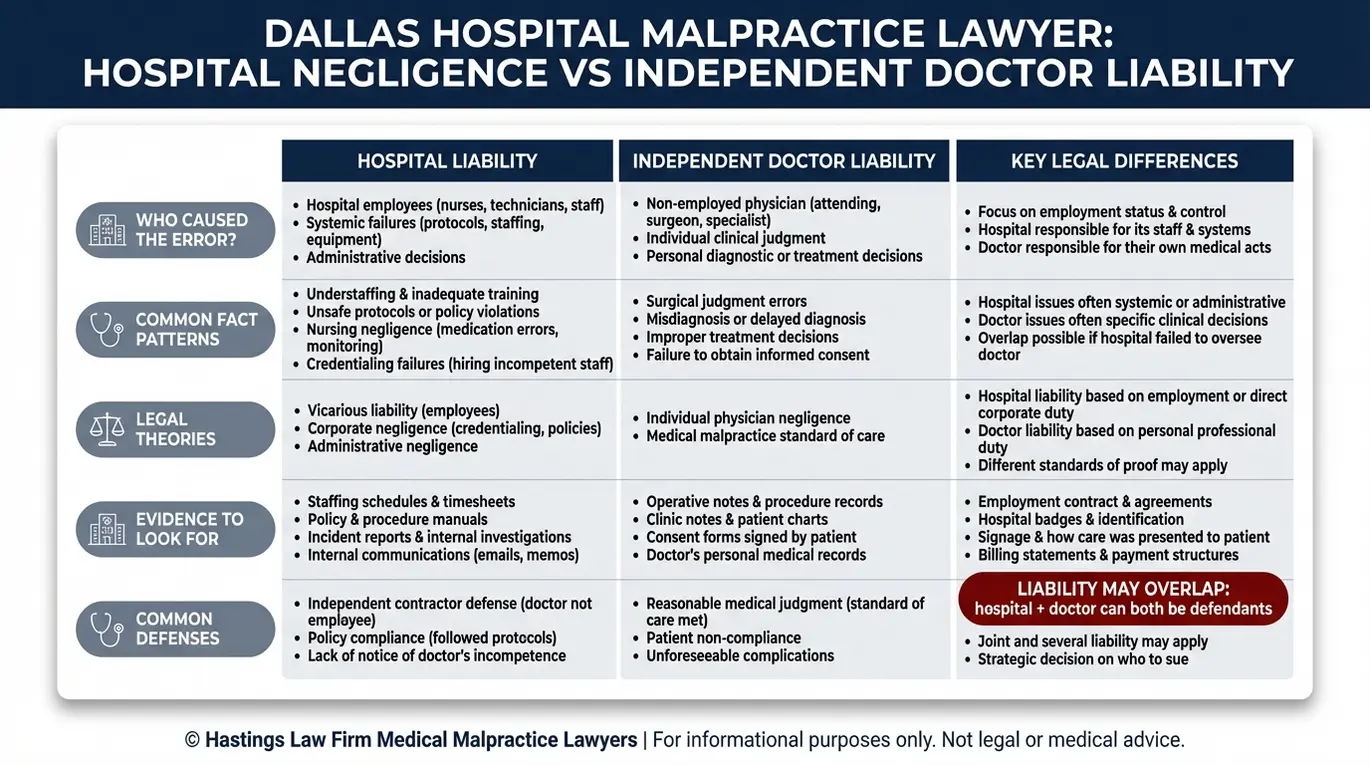
Hospital negligence involves failures by the institution itself, such as understaffing, unsafe protocols, or poor credentialing practices, while doctor malpractice typically involves the individual physician’s clinical decisions. Hospital liability relates to how facilities manage staff and safety separate from any individual doctor’s actions. Understanding the difference matters because it determines who can be held legally responsible for your injury. Establishing Dallas hospital liability often requires proving that the facility itself failed to uphold safety standards.
Hospitals are generally liable for the actions of their employees, including nurses and technicians, through vicarious liability. This legal principle means an employer can be held responsible for the negligent acts of its employees performed within the scope of their job. This applies to most of the staff you interact with during a hospital stay. If a nurse administers the wrong medication or a technician mishandles equipment, the hospital answers for those mistakes just as if the institution had made them itself.
Where it gets more complicated is with doctors. Many physicians who treat patients inside a hospital are actually independent contractor physicians, meaning they have their own practices and are not directly employed by the hospital. Hospitals frequently raise this independent contractor status as a defense to avoid liability for a doctor’s errors. If the doctor who harmed you was technically not an employee, the hospital may argue it should not be held responsible.
That defense does not always hold up. Dallas hospital malpractice lawyers can pursue claims against the hospital under theories of corporate negligence and administrative negligence. Corporate negligence holds the hospital accountable for its own institutional failures, such as failing to properly vet or credential a physician before granting them privileges.
Credentialing and privileging is the process hospitals use to verify a doctor’s qualifications, training, and history before allowing them to practice at the facility. When a hospital grants privileges to an incompetent or dangerous provider, it can be held directly liable for the resulting harm. This direct liability focuses on the hospital’s independent duty to ensure that only qualified professionals are permitted to treat patients.
| Factor | Hospital Liability | Independent Doctor Liability | Key Legal Differences |
|---|---|---|---|
| Employment Status | Liable for employed staff (nurses, techs, staff physicians) | Doctor operates as independent contractor | Vicarious liability applies to employees; hospitals may deny responsibility for contractors |
| Basis of Claim | Institutional failures: staffing, protocols, equipment, credentialing | Individual clinical judgment errors | Hospital sued for systemic breakdowns; doctor sued for personal negligence |
| Corporate Negligence | Hospital can be sued directly for hiring or retaining a dangerous provider | Not applicable to the doctor’s own claim | Allows claims against the hospital even when the doctor is not an employee |
| Common Defense | “The doctor was not our employee” | “I followed the standard of care” | Proving the hospital created conditions for harm can overcome the contractor defense |
Identifying Common Types of Hospital Errors in Dallas
Common hospital errors include surgical mistakes, medication administration failures, untreated hospital-acquired infections, and emergency room negligence caused by systemic understaffing or policy violations. These medical errors typically occur during active treatment or emergency stays and reflect institutional problems rather than a single provider’s lapse in judgment.
Surgical errors remain among the most serious types of hospital negligence. These can include wrong-site surgery, where a procedure is performed on the wrong body part or even the wrong patient, as well as retained surgical instruments, nerve damage from improper technique, and anesthesia errors that lead to brain injury or death. When surgical teams fail to follow established safety checklists, preventable mistakes become far more likely.
Emergency room and staffing failures are another common source of harm. When a hospital does not maintain adequate nurse-to-patient ratios, critical changes in a patient’s condition can go unnoticed. Staffing shortages can contribute to delayed treatment, failure to monitor patients in critical condition, missed test results, and improper discharge of patients who are not yet stable. In a busy Dallas emergency room, emergency room errors can have devastating consequences.
Hospital-acquired infections (HAIs), which are infections patients develop during the course of receiving treatment in a healthcare facility, represent a widespread and often preventable category of harm. Poor sterilization, inadequate hand hygiene, and failure to follow isolation protocols can lead to serious infections, including sepsis, a life-threatening condition that can progress rapidly without proper intervention. According to the Centers for Disease Control and Prevention’s HAI data reports, healthcare-associated infections remain a significant threat to patient safety across the country.
Other common hospital errors include:
- Medication errors: Wrong drug, wrong dose, or dangerous drug interactions due to poor communication between providers
- Nursing negligence: Failure to assess, document, or escalate a patient’s worsening condition
- Misdiagnosis or delayed diagnosis: Conditions like stroke, heart attack, or pulmonary embolism missed during initial evaluation
- Birth injuries: Failure to monitor fetal distress, delayed emergency cesarean sections, or improper use of delivery instruments
- Failure to obtain informed consent: Proceeding with treatment without adequately explaining risks and alternatives
If you suspect a hospital’s systemic failures caused harm to you or your family, speaking with a lawyer for hospital malpractice in Dallas can help you determine whether those failures constitute actionable negligence.
Systemic Failures and The Dr. Death Case
Few cases illustrate the danger of systemic hospital failure, a scenario where deep-seated operational flaws allow patient harm to recur, more clearly than the Christopher Duntsch case in Dallas. Duntsch, a neurosurgeon later nicknamed “Dr. Death,” left a trail of catastrophic patient injuries and deaths across multiple Dallas-area hospitals. Despite growing evidence of his incompetence, hospitals continued to grant him surgical privileges.
A peer review committee, which is the internal body responsible for evaluating physician performance and patient outcomes, should have identified the pattern early. Instead, the system allowed Duntsch to move from one facility to the next. This case became a landmark example of how failures in credentialing, oversight, and patient safety protocols can cause irreparable harm.
The Duntsch case also brought the concept of gross negligence and punitive damages into sharp public focus. Punitive damages are designed to penalize conduct so reckless that it shocks the conscience and go beyond just compensating the patient. When a hospital ignores red flags about a provider’s track record, it may face liability not just for the doctor’s actions, but for its own institutional failure to protect patients.

The Hastings Law Firm Difference
Results matter, but what truly sets us apart is how we achieve them. Every verdict, every settlement, and every Dallas courtroom victory comes from one guiding promise: To treat each client’s fight for justice as if it were our own.
This balance of skill, experience, and empathy reflects our core philosophy that justice should not only compensate the injured, but also make health care safer nationwide.

Proving Breach of Standard of Care with Expert Testimony
Proving a breach requires demonstrating that the hospital’s actions fell below the accepted standard of care, which is the level of treatment a reasonably competent hospital would have provided under similar circumstances. A breach of duty happens when a facility fails to meet professional safety expectations. This must be confirmed through detailed medical record analysis and testimony from qualified expert witnesses.
In Texas, you cannot simply allege that something went wrong. Under Texas Civil Practice and Remedies Code Section 74.351, a plaintiff must file an expert report within 120 days of the defendant’s answer. This report must identify the applicable standard of care, explain the breach of duty, or failure to meet that standard, and establish causation, the link between the breach and the patient’s injury. Without this report, the court can dismiss the case entirely.
Here is how we approach the investigation as a malpractice attorney for hospital claims:
- Obtain and analyze all medical records: We request the complete medical chart, including nursing notes, physician orders, lab results, imaging studies, and pharmacy records. Our in-house nursing staff reviews these records line by line.
- Build a detailed timeline: We reconstruct the sequence of events to identify gaps in care, such as a failure to monitor (neglecting to track vital signs), delayed responses, or deviations from hospital policy. Staffing logs, shift change reports, and electronic health record timestamps all factor into this analysis.
- Identify the standard of care: Using hospital policies, clinical guidelines, and established medical literature, we define what should have happened. For example, in cases involving birth injuries or a retained surgical item (RSI), which is a foreign object left inside a patient, the standard is strictly defined.
- Retain qualified expert witnesses: We work with our national network of medical experts to match the case with a specialist in the relevant field. The expert reviews all evidence and provides an opinion on whether the hospital’s conduct fell below the standard.
- Establish causation: The expert must connect the breach directly to the patient’s harm. This step separates a bad outcome from an actionable case of negligence.
This process is how we determine whether the evidence supports a claim, and it is why we prepare every case as though it will go to trial.

Calculating Damages and Understanding Texas Caps
Damages in hospital negligence cases cover economic losses like medical bills, rehabilitation costs, and lost wages, as well as non-economic damages for pain, suffering, disfigurement, and loss of companionship. Legal damages are the monetary compensation paid to cover your losses and help build a full picture of how the injury has affected your life and financial security.
Economic damages are calculated based on documented expenses and projected future needs. These can include past and future medical care, lost earning capacity, home modifications, and ongoing therapy. Because these costs are tangible and provable, there is no statutory cap on economic damages in Texas medical malpractice cases, allowing families to recover the full amount needed for long-term care.
Non-economic damages, however, are subject to limits under Texas law. According to Texas Civil Practice and Remedies Code Chapter 74, the caps on damages work as follows:
Texas Non-Economic Damage Caps
- $250,000 per claimant against all individual physicians and healthcare providers combined, regardless of how many are named as defendants
- $250,000 per claimant per healthcare institution, with a maximum of $500,000 across all healthcare institutions involved in the claim
- $750,000 maximum aggregate across all defendants when both individual providers and multiple institutions are involved
- These caps apply to claims for pain, suffering, mental anguish, disfigurement, and loss of companionship
- Economic damages (medical bills, lost income, future care costs) are not capped
In wrongful death cases, where a family has lost a loved one due to hospital negligence, surviving family members may bring claims for loss of companionship, mental anguish, and the deceased’s lost future earnings. These cases carry their own procedural requirements, and the damage caps still apply to the non-economic portion. As a Dallas hospital malpractice lawyer, we work closely with financial and medical experts to document the full scope of harm. If a public facility is involved, the Texas Tort Claims Act may impose different limits.
Navigating the Statute of Limitations in Texas
In Texas, the statute of limitations for medical malpractice is generally two years from the date of the injury. The statute of limitations is the legal deadline for filing a lawsuit. Handling Texas medical malpractice law requires strict adherence to these deadlines. Under Texas Civil Practice and Remedies Code Section 74.251, if you do not handle filing a lawsuit within that window, you may permanently lose the right to pursue your claim.
There are important exceptions. The discovery rule can extend the deadline in situations where the negligence was not immediately apparent. For example, if a surgical instrument was left inside a patient’s body and not discovered until years later, the two-year clock may start from the date the injury was found or reasonably should have been found. Texas also imposes a hard outer boundary of ten years, known as the statute of repose, which prevents claims filed more than a decade after the negligent act.
Special rules apply to minors and incapacitated patients. A child injured by hospital negligence generally has until their fourteenth birthday to file, provided the malpractice occurred before age twelve. Because these deadlines are strict and the exceptions are narrow, consulting with an attorney early protects your ability to pursue accountability. A delay of even one day can result in the complete dismissal of an otherwise valid claim.
Contact the Dallas Hospital Malpractice Attorneys at Hastings Law Firm Today for Help
If you or a loved one was harmed by hospital negligence, you do not have to face this alone. Legal help allows you to focus on recovery while professionals handle the investigation. Hastings Law Firm focuses exclusively on medical malpractice, and our team of attorneys, nurses, and patient advocates is built specifically to handle claims against hospitals and healthcare systems.
We understand the weight of what you are carrying. Many of our clients come to us feeling dismissed or unsure whether they even have a case. That uncertainty is exactly why we offer a free, confidential case evaluation led by a board-certified patient advocate who can help you understand what happened and whether the care you received fell short.
As your Dallas hospital malpractice lawyer, we charge no attorney fees or costs unless we secure a recovery on your behalf. If you are ready for answers, contact Hastings Law Firm today. Let us review your case and help you take the first step toward accountability.
Frequently Asked Questions About Hospital Malpractice in Dallas


This content was researched and written by the Hastings Law Firm editorial team, which includes attorneys, medical professionals, and experienced researchers. Our writing is informed by internal knowledge and practical experience, and we cross-check critical details against authoritative sources cited throughout. Every piece undergoes human-led fact-checking and legal review. Because legal and medical information can change, if you spot an error, please contact us. Learn more about our content standards and review process on our editorial policy page.

Tommy Hastings, founder of Hastings Law Firm, is a board-certified personal injury trial lawyer dedicated exclusively to healthcare injury cases. Since 2001, he has represented injured patients and families in litigation against major hospital systems, pharmaceutical companies, and negligent healthcare providers nationwide. He has handled numerous high-profile cases that have drawn national media attention and resulted in multi-million dollar recoveries. He draws on that experience in his writing, helping readers understand how these cases work and what options may be available to them.
