


Dallas Nursing Home Fall Lawyer
Written by: Hastings Law Firm | Reviewed by: Brady D. Williams | Updated: July 27, 2026
A nursing home fall can signal deeper neglect, especially when staffing is thin, assessments are missed, or safety measures are not followed. Families are often left with serious injuries, unclear explanations, and lasting worry about whether the harm was preventable. Facilities are expected to provide appropriate supervision, individualized care planning, and a safe environment, and failures in those basics can lead to rapid decline or fatal outcomes. If you or a loved one were harmed or worse due to nursing home falls in Dallas, Texas, contact Hastings Law Firm for a free, confidential case review.
Trusted Dallas Injury Attorneys for Nursing Home Negligence Claims
What You Should Know About Elderly Fall Negligence Claims in Dallas:
- Serious harm can follow a nursing home fall, including rapid decline, paralysis, or wrongful death.
- Accountability can turn on whether the fall was preventable rather than an unavoidable accident.
- Preventable falls can be linked to understaffing that leaves call lights unanswered and residents without needed assistance.
- Safety protections can fail when fall risk assessments are missing, outdated, or ignored.
- Injury risk can increase when medications are mismanaged and residents are over sedated.
- Facility responsibility can be implicated when environmental hazards are left uncorrected, such as wet floors or missing handrails.
- Regulatory consequences can follow poor fall safety performance, including lower ratings and enforcement actions.
- Options can be limited if legal time limits and pre suit requirements are missed in Texas.
- Recovery can include medical costs, rehabilitation, pain and suffering, and loss of quality of life.
- Proof disputes can depend on whether records show care plan compliance, staffing logs, incident reports, and available camera footage.
A Healthcare Focused Law Firm
When a loved one falls in a nursing home, the questions come fast and the answers feel hard to find. You trusted a facility to keep them safe, and now you are dealing with a serious injury, incomplete explanations, and concern about what really happened. That sense of betrayal is real, and so is your right to get answers.
At Hastings Law Firm, our team of attorneys, nurse consultants, and patient advocates focuses exclusively on medical malpractice and negligence claims. We understand the medical details behind nursing home falls and the legal standards Texas facilities are required to meet. If your family member was injured in a Dallas-area nursing home or assisted living facility, a Dallas nursing home fall lawyer at our firm can review what happened and explain your options in a free, confidential evaluation.
Why Nursing Home Falls Occur in Texas Facilities
Most nursing home falls are not simple accidents. They are often the result of systemic negligence, which occurs when a facility fails to maintain safe staffing levels or follow essential safety protocols.
Understaffing in nursing facilities is one of the most common factors. When a facility does not have enough staff on duty, call lights go unanswered. Residents who need help getting out of bed or walking to the bathroom may try to move on their own, significantly increasing their risk of a fall. A Dallas nursing home fall lawyer will often find that staffing logs reveal dangerously low ratios during the shift when the fall occurred.
Assessment failures are another red flag. Every resident should have a fall-risk assessment, a clinical evaluation identifying factors like unsteady gait, medication side effects, or cognitive impairment. Facilities are required to use these assessments to build individualized care plans. When those assessments are outdated or missing, frail seniors are left without the protections they need.
Falls also result from medication errors and unsafe premises. Improper restraints, such as chemical restraints, can leave elderly residents too drowsy to maintain balance. This involves the practice of using sedatives or anti-anxiety drugs to keep residents quiet rather than addressing their needs.
Wet floors, poor lighting, and missing handrails are environmental hazards that a responsible facility should identify and fix. The Quality Measures published by CMS include fall rates as a tracked indicator of facility performance. This reinforces that preventable falls reflect a measurable failure in care.
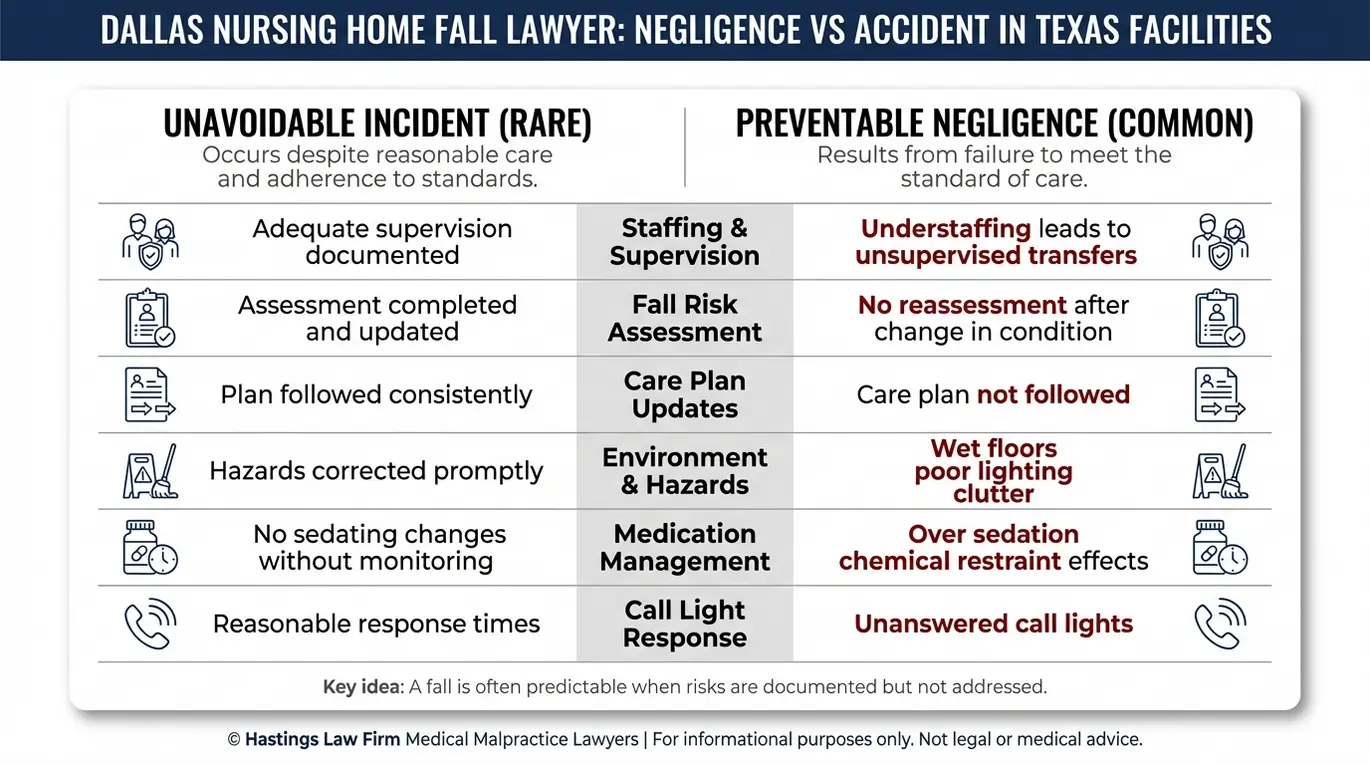
If you are trying to understand whether your family’s situation involved negligence, consulting with a nursing home fall attorney can help distinguish a genuine accident from a preventable one. Families needing legal help for facility falls can use the chart below to compare categories:
| Factor | Unavoidable Accident | Preventable Negligence |
|---|---|---|
| Fall-risk assessment | Completed, current, and followed | Missing, outdated, or ignored |
| Staffing levels | Adequate for resident needs | Understaffed; call lights unanswered |
| Environment | Floors dry, lighting adequate, rails in place | Wet floors, poor lighting, missing safety equipment |
| Medications | Appropriately managed and monitored | Over-sedation or unmonitored side effects |
| Care plan | Followed as written | Not updated or not followed |
| Supervision | Consistent with assessed risk level | Inadequate supervision for known fall risk |
A Dallas nursing home fall lawyer examines each of these areas to determine whether the facility met its obligations or fell short.
Common Injuries Sustained After a Nursing Home Fall
Falls in the elderly frequently result in life-altering trauma, including hip fractures, subdural hematomas, and spinal injuries, often leading to rapid decline or wrongful death. In legal terms, these serious injuries serve as evidence of the physical impact of a facility’s failure to provide an appropriate standard of care, often leading to complex medical complications.
- Orthopedic Trauma: The most common orthopedic injury is a hip fracture, a break in the upper portion of the femur that almost always requires surgery. For elderly residents, the consequences extend far beyond the fracture itself. Prolonged immobility after surgery can lead to bedsores, blood clots, and pneumonia. According to the Centers for Disease Control and Prevention’s data on falls, falls are the leading cause of injury-related death among adults 65 and older.
- Neurological Damage: Damage to the brain or nerves can be even more devastating. A subdural hematoma, which is bleeding between the brain and its outer covering, may develop slowly after a fall and go undetected for hours. Elderly residents taking blood thinners face an especially high risk of traumatic brain injuries (TBIs), because their blood does not clot effectively enough to stop the bleeding.
- Spinal Injuries: Spinal injuries can result in partial or complete paralysis.
Beyond the physical harm of a fall, there is a well-documented psychological impact known as the fear of falling. After a single fall, many residents become afraid to move at all, which accelerates muscle loss and limits independence. A Dallas injury attorney handling fall injury claims can help families pursue compensation that accounts for this full scope of harm, not just the initial injury.
The Hastings Law Firm Difference
Results matter, but what truly sets us apart is how we achieve them. Every verdict, every settlement, and every Dallas courtroom victory comes from one guiding promise: To treat each client’s fight for justice as if it were our own.
This balance of skill, experience, and empathy reflects our core philosophy that justice should not only compensate the injured, but also make healthcare safer nationwide.

Understanding “Never Events” and Facility Liability
The Centers for Medicare & Medicaid Services (CMS) classifies many facility-acquired injuries as “Never Events,” meaning they are identifiable, preventable falls that should never occur under proper medical care. A “Never Event” is a serious, largely preventable patient safety incident that should not occur if proper preventive measures are in place.
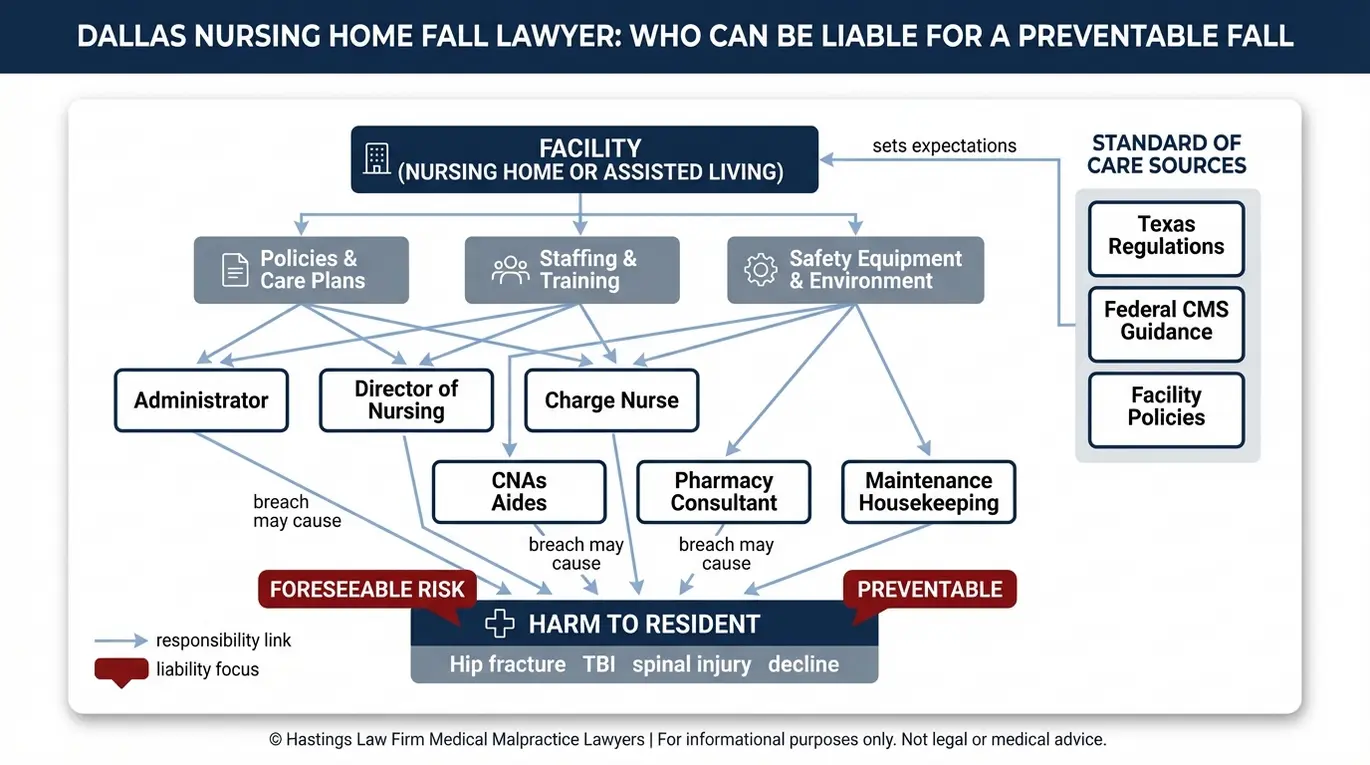
Under Texas law for facility liability, nursing homes and assisted living facilities owe each resident a standard of care. This is the level of treatment and supervision a reasonably competent facility would provide under similar circumstances. When a facility accepts a resident, it accepts responsibility for providing the equipment and protocols needed to keep that resident safe. This includes bed alarms, walkers, non-slip flooring, and adequate staffing.
Federal and state laws reinforce this obligation. CMS tracks fall rates as a quality measure within its Five Star Quality Rating System, and facilities with poor safety records can face regulatory consequences including lower ratings, survey deficiencies, and potential enforcement actions. Improper restraints, the inappropriate use of physical devices or chemical sedation to limit movement, also violate federal guidelines and can support a nursing home abuse claim.
To determine if standards were met, a fall negligence lawyer can evaluate whether the fall reflects a pattern of medical malpractice. When suing for nursing home falls, establishing these violations is key.
Why Most Falls Are Avoidable
The reason most falls are preventable often comes down to the care plan, a written, individualized protocol that details exactly how a facility will address a resident’s specific fall risk. If a resident is identified as a fall risk, the care plan should specify interventions like bed-exit alarms, scheduled toileting assistance, and one-on-one supervision during transfers.
When a resident falls, we examine whether a fall-prevention care plan existed and whether the facility actually followed it. In many nursing home abuse and neglect cases, the plan is either missing, outdated, or ignored. Care plan violations like this create a gap between what should have happened and what did happen, providing clear evidence of negligence.
Filing a Nursing Home Fall Lawsuit in Texas
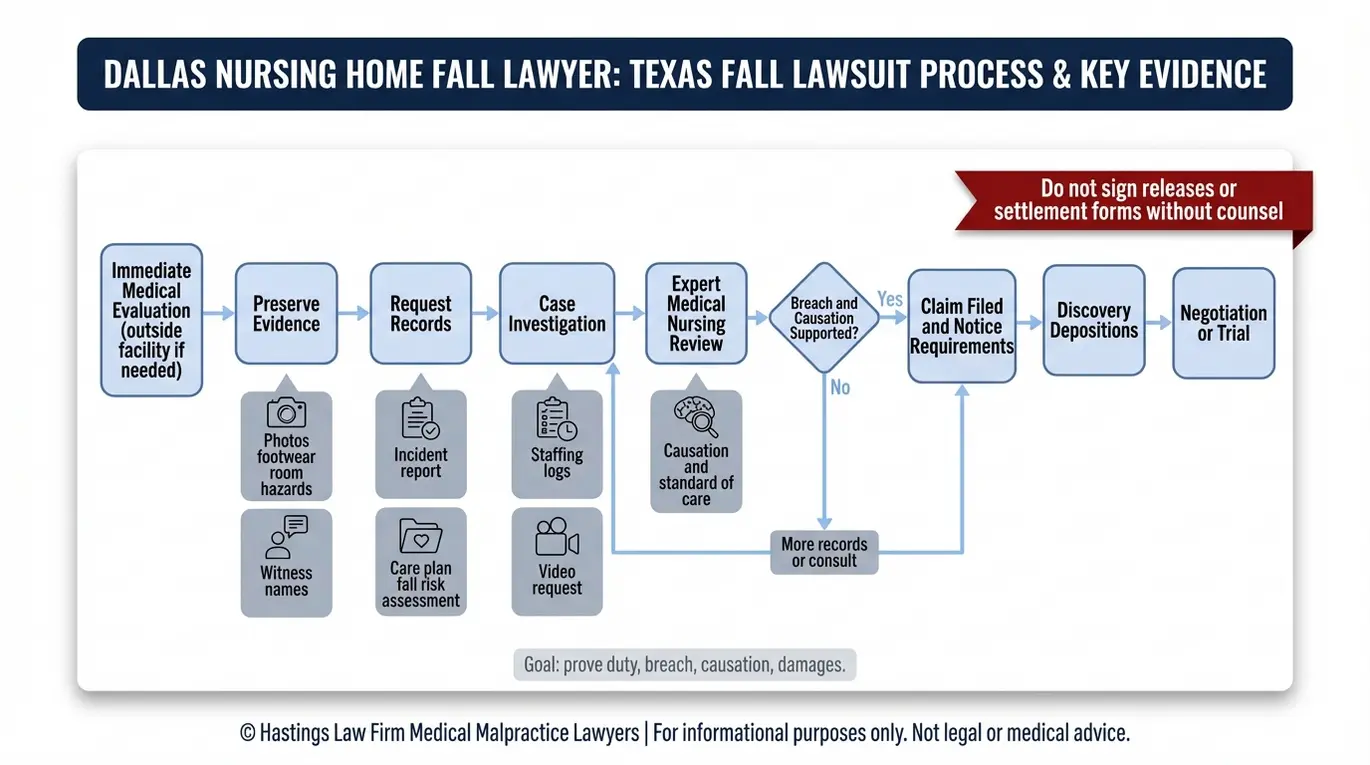
To file a successful lawsuit, a plaintiff must prove the facility owed a duty of care, breached that duty through negligence, and directly caused the resident’s injury or death. This process requires meeting specific Texas legal thresholds that distinguish professional negligence from unavoidable accidents. Families seeking legal recourse should understand how the legal process typically works:
- Step 1: Free Case Evaluation. The case review process begins with a confidential review by an attorney and medical professional who assess the facts and determine whether the case meets the legal threshold for medical malpractice.
- Step 2: Investigation and Evidence Collection. During the investigation, the legal team gathers evidence like staffing logs, incident reports, medical records, and any available camera footage. These documents often reveal patterns of understaffing, missed assessments, or care plan violations.
- Step 3: Expert Medical Review. A qualified medical expert reviews the evidence to determine whether the facility breached the standard of care. Expert testimony is essential in proving that the fall was preventable and that the facility’s actions were the direct cause, forming the basis of a nursing home abuse lawsuit.
- Step 4: Filing the Lawsuit and Building the Claim. In the litigation phase, the attorney for elderly falls handles all filings, depositions, and discovery. At Hastings Law Firm, every case is prepared from day one as if we will file a fall lawsuit and go to a jury trial. This approach signals to the defense that we are prepared to take the case to a jury if a fair settlement is not reached.
- Step 5: Pursuing Full Compensation. If the case is successful, recoverable damages in a Dallas nursing home fall case may include medical bills, rehabilitation costs, pain and suffering, and loss of quality of life. In wrongful death cases, this may also include funeral expenses and loss of companionship.
Taking legal action for falls can feel overwhelming, but a Dallas nursing home fall lawyer manages the entire process so families can focus on their loved one’s care.
Contact the Dallas Nursing Home Attorneys at Hastings Law Firm Today for Help
A fall is often a symptom of deeper neglect. If your loved one has been injured in a nursing home or assisted living facility, the most important step you can take right now is finding out what happened and why.
At Hastings Law Firm, our team includes attorneys, nurse consultants, and former defense lawyers who previously worked for the systems they now challenge. This background provides a strategic advantage in anticipating defense tactics and identifying charting inconsistencies. The firm was founded by Tommy Hastings, a trial lawyer board-certified in personal injury trial law by the Texas Board of Legal Specialization, to ensure families receive specialized representation in complex negligence cases.
Your consultation is free and confidential. A board-certified attorney and a nurse will review the facts of your case and help you understand your options. There are no fees unless we secure a recovery on your behalf. If something feels wrong about the care your family member received, trust that instinct. Contact a Dallas nursing home fall lawyer at our office to start the conversation.
Frequently Asked Questions About Nursing Home Fall in Dallas

This content was researched and written by the Hastings Law Firm editorial team, which includes attorneys, medical professionals, and experienced researchers. Our writing is informed by internal knowledge and practical experience, and we cross-check critical details against authoritative sources cited throughout. Every piece undergoes human-led fact-checking and legal review. Because legal and medical information can change, if you spot an error, please contact us. Learn more about our content standards and review process on our editorial policy page.

Brady D. Williams is a nationally recognized medical malpractice attorney who has spent his career handling high-stakes litigation for injured patients and families across the country. Licensed in both Texas and California, Brady draws on experience from hundreds of resolved medical cases to break down complex legal and medical topics for the people who need that information most. His writing reflects the same attention to detail and commitment to clarity that he brings to every case he handles.
