


Dallas OB-GYN Malpractice Lawyer
Written by: Hastings Law Firm | Reviewed by: Brady D. Williams | Updated: July 27, 2026
Obstetric and gynecological negligence can leave families facing lasting injuries, overwhelming costs, and a painful sense that warning signs were missed. Problems can arise during prenatal care, labor, delivery, or surgery when providers fail to monitor, respond, or communicate appropriately. The results can affect both mother and child, including life altering complications and fatal outcomes. Understanding how standard of care, hospital systems, and delayed diagnosis issues intersect can help clarify what went wrong and why it mattered. If you or a loved one were harmed or worse due to OB GYN malpractice in Dallas, Texas, contact Hastings Law Firm for a free, confidential case review.

Trusted Dallas Medical Attorneys for Obstetrics Negligence Claims
What You Should Know About Obstetrician Negligence Claims in Dallas:
- Long term harm can result when obstetric teams miss or delay responses to fetal distress shown on monitoring.
- Severe outcomes can follow when emergency decisions such as a cesarean section are delayed during time sensitive complications.
- Hospital responsibility can extend beyond a single clinician when staffing, equipment, or shift communication problems contribute to preventable errors.
- Life altering surgical complications can occur when gynecological procedures injure nearby organs and the injury is not recognized or addressed promptly.
- Recovery options can be lost when Texas medical malpractice timing rules are missed, since courts can dismiss claims even when evidence is strong.
- Compensation can be limited for non economic losses in Texas even when economic losses like medical care costs remain uncapped.
- Proof disputes can turn on whether records show a breach of the accepted standard of care and a direct link to the injury.
- Evidence can become harder to obtain over time because records may be altered, lost, or destroyed and memories can fade.
- Accountability can depend on whether credentialing and oversight failures allowed an unsafe physician to continue treating patients.

A Healthcare Focused Law Firm
When an obstetrician-gynecologist, a doctor specializing in pregnancy, childbirth, and women’s reproductive health, causes preventable harm, the consequences can reshape your family’s life. You may be left with unanswered questions, mounting medical bills, and a deep sense that the care you received fell short. These feelings are valid, and you deserve honest answers about what happened.
As a Dallas OB-GYN malpractice lawyer, Hastings Law Firm focuses exclusively on medical malpractice litigation. Founded by Tommy Hastings, a board-certified trial lawyer with over 20 years of experience, we provide trial-ready advocacy for families in crisis. Our team of attorneys, in-house nurse consultants, and former defense lawyers understands both the medicine and the law behind these cases.
If you or a loved one was harmed during obstetric or gynecological care, we can review what happened and explain your options in a free, confidential consultation.
Common Forms of Obstetric Negligence in Dallas Hospitals
Obstetric negligence occurs when a healthcare provider fails to follow the accepted standard of care, the level of treatment a reasonably competent OB-GYN would provide under similar circumstances, during pregnancy, labor, or delivery, resulting in preventable harm to the mother or child.
Not every difficult delivery or unexpected complication is malpractice. Obstetric negligence lawyers know that childbirth carries inherent risks, and some outcomes are unavoidable even with excellent care. The distinction a medical negligence attorney must prove is that the provider’s actions fell below what other qualified professionals would have done in the same situation. A known complication, like postpartum hemorrhage, becomes potential negligence when the medical team fails to recognize or respond to it appropriately. Experienced OB-GYN malpractice attorneys review medical records to pinpoint exactly where this breach occurred.
Many patients struggle to question their doctor’s decisions. This hesitation, sometimes called the “White Coat Effect,” comes from years of conditioning to trust medical authority without question. If something felt wrong during your care, that instinct matters. Hospitals and OB-GYN malpractice attorneys both understand this dynamic. Our job is to look past the authority of the white coat and examine what actually happened in the medical records. A Dallas medical malpractice lawyer can provide the objective analysis needed to overcome this hesitation and seek justice.
Obstetric negligence lawyers investigate a range of delivery room failures. Common scenarios include:
- Medication errors during labor, such as administering too much Pitocin (a drug used to induce or strengthen contractions) without proper monitoring
- Improper use of forceps or vacuum extractors during assisted deliveries, leading to skull fractures, nerve damage, or brain bleeds
- Failure to monitor using electronic fetal monitoring (EFM), the continuous tracking of the baby’s heart rate during labor that alerts providers to fetal distress, a term clinicians now call nonreassuring fetal status, which signals the baby may not be getting enough oxygen
- Delayed response to hemorrhage or other maternal emergencies
- Failure to identify risk factors like placenta previa or gestational diabetes during prenatal visits
Hospital liability can extend beyond the individual doctor. Systemic issues like inadequate nurse staffing, missing equipment, or poor communication between shifts may all contribute to preventable errors. Dallas medical malpractice lawyer teams frequently find that these institutional failures are as damaging as individual errors.
The Patient Safety Indicators tracked by the Texas Department of State Health Services provide data on adverse events in Texas hospitals. These metrics can support a Dallas medical malpractice lawyer’s investigation into institutional failures.
If any of these scenarios sound familiar, an experienced obstetric negligence lawyer can help you understand whether the care you received met the standard.
Birth Injuries and Delivery Room Errors Caused by Negligence
Birth injuries such as cerebral palsy and hypoxic-ischemic encephalopathy (HIE), a type of brain damage caused by oxygen deprivation around the time of birth, are often caused by the medical team’s failure to respond in time to signs of fetal distress during labor.
One of the most critical responsibilities of a labor and delivery team is reading and interpreting fetal heart rate strips. These tracings provide a real-time picture of how the baby is tolerating labor. When patterns show decelerations or reduced variability, the standard of care typically requires prompt intervention, which may include repositioning the mother, administering oxygen, stopping Pitocin, or proceeding with an emergency cesarean section. A birth injury lawyer in Dallas often finds that cases hinge on a gap between when warning signs appeared on the monitor and when the team acted. Dallas birth injury attorneys work with experts to analyze these strips second-by-second to identify the missed warnings.
Shoulder dystocia, a complication where the baby’s shoulder becomes lodged behind the mother’s pelvic bone during delivery, demands precise and practiced maneuvers. When the delivering physician applies excessive downward traction or fails to perform recognized maneuvers like the McRoberts position or suprapubic pressure, the result can be brachial plexus injuries that cause partial or total paralysis of the child’s arm. An OB-GYN malpractice lawyer evaluates whether the provider followed established protocols or deviated from them. Dallas birth injury attorneys frequently see these preventable injuries result from panic or lack of preparation in the delivery room.
The timing of a C-section can be the difference between a healthy baby and a catastrophic injury. When fetal monitoring indicates distress, delays of even minutes may result in prolonged oxygen deprivation. An experienced birth injury lawyer in Dallas knows that every second counts when oxygen is restricted. The American College of Obstetricians and Gynecologists (ACOG) provides guidance on fetal heart rate interpretation that Dallas birth injury attorneys rely on when evaluating whether the care team responded appropriately.
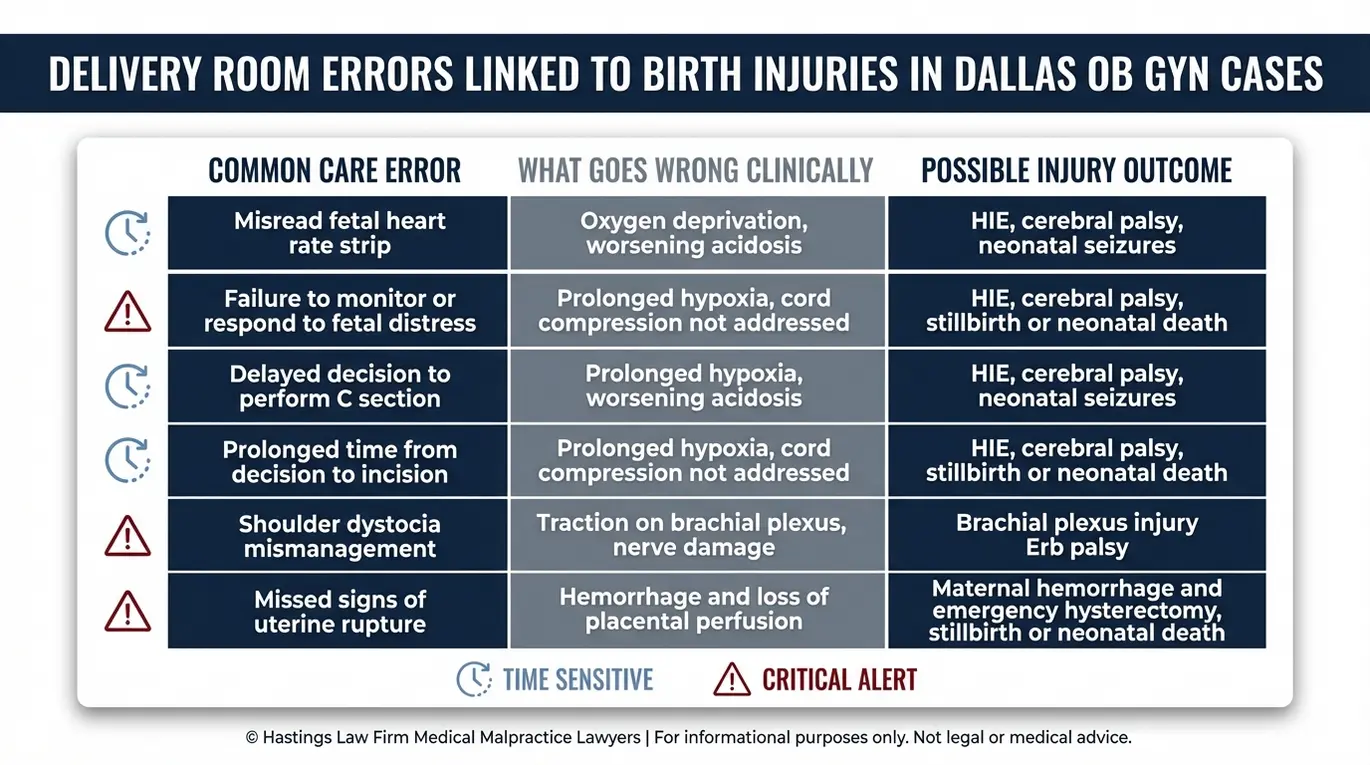
The following table outlines common delivery room errors and the injuries they can cause:
| Delivery Room Error | Potential Injury |
|---|---|
| Delayed or failure to perform C-section | Hypoxic-ischemic encephalopathy (HIE), cerebral palsy |
| Excessive force during shoulder dystocia | Brachial plexus injury (Erb’s palsy), fractured clavicle |
| Failure to monitor fetal heart rate | Brain damage from undetected oxygen deprivation |
| Improper use of vacuum or forceps | Skull fractures, intracranial hemorrhage |
| Failure to detect or treat uterine rupture | Maternal hemorrhage, fetal death |
| Delayed response to umbilical cord prolapse | Fetal hypoxia, stillbirth |
The Impact of Maternity Care Deserts in Texas on Patient Outcomes
Maternity care deserts are geographic areas where patients face limited healthcare access to specialized obstetric care. This can increase the risk of preventable birth injuries in parts of Texas. In some regions, the nearest hospital with a neonatal intensive care unit may be hours away. When a community hospital lacks the staff or resources to handle high-risk deliveries, the standard of care may require a timely transfer to a higher-level facility. This lack of resources contributes significantly to maternal mortality and morbidity rates in underserved areas.
An emergency C-section delay, measured by what clinicians call decision-to-incision time, can be especially dangerous in under-resourced settings. This term refers to the minutes between deciding to operate and making the first cut. When a uterine rupture occurs, a life-threatening tear in the wall of the uterus, every minute without surgical intervention puts both mother and baby at risk of significant blood loss and oxygen deprivation. An OB-GYN malpractice lawyer will scrutinize whether the decision to transfer was made quickly enough to save lives.
Our firm investigates whether the facility had appropriate resources, whether transfer protocols were followed, and whether delays in escalating care contributed to the injury. These systemic failures can establish hospital liability even when the individual physician performed adequately within the constraints they faced.
The Hastings Law Firm Difference
Results matter, but what truly sets us apart is how we achieve them. Every verdict, every settlement, and every Dallas courtroom victory comes from one guiding promise: To treat each client’s fight for justice as if it were our own.
This balance of skill, experience, and empathy reflects our core philosophy that justice should not only compensate the injured, but also make healthcare safer nationwide.

Gynecological Surgical Errors and Complications During Procedures
Gynecological surgical errors frequently involve accidental damage to surrounding organs such as the bowel, bladder, or ureters during procedures like hysterectomies or laparoscopic surgeries. When a surgeon fails to identify critical anatomy or respond appropriately to a complication, the consequences can be life-altering. A dedicated gynecological malpractice lawyer can help patients understand if their long-term complications were preventable.
Hysterectomy errors are among the most common gynecological malpractice claims. During a total laparoscopic hysterectomy (TLH), a minimally invasive procedure to remove the uterus through small abdominal incisions, the ureter and bladder sit in close proximity to the surgical field. Ureteral injury, or damage to the tube that carries urine from the kidney to the bladder, can lead to kidney damage, chronic pain, and the need for additional corrective surgeries. Research published through DukeSpace on the incidence of lower urinary tract injury during total laparoscopic hysterectomy documents how frequently these injuries occur and underscores the importance of careful surgical technique.
Laparoscopic procedures carry their own set of risks. One of the most dangerous moments is the initial entry into the abdomen, sometimes called “blind entry,” because the surgeon is inserting instruments before the camera provides a view of internal structures.
If a bowel perforation or vascular injury occurs during this step, the surgeon must recognize it immediately. A surgical error attorney will investigate whether the surgeon adhered to safety protocols during this critical phase. Failure to convert from a laparoscopic approach to open surgery when complications arise can turn a manageable problem into a fatal one. Medical product liability may be a factor if defective surgical mesh or instruments contributed to the injury.
Post-operative negligence is equally dangerous. After gynecological surgery, signs of internal bleeding, infection, or organ perforation may not appear for hours or even days. A gynecological malpractice lawyer examines whether the surgical team provided adequate discharge instructions, whether follow-up protocols were in place, and whether the patient’s reported symptoms were taken seriously. When a patient calls back complaining of fever, severe abdominal pain, or abnormal drainage and is told to “wait and see,” the resulting delay can lead to sepsis, permanent organ damage, or wrongful death. A Dallas OB-GYN lawyer can determine if this dismissal of symptoms constituted a breach of care.
A Dallas OB-GYN lawyer evaluating these cases works with surgical experts to reconstruct what happened in the operating room, reviewing operative reports, anesthesia records, and nursing notes to determine whether the surgeon’s actions met the standard of care. If you suspect your injury was caused by a mistake, consulting a surgical error attorney is the first step toward accountability.
Failure to Diagnose Critical Pregnancy Complications
A failure to diagnose occurs when an OB-GYN dismisses symptoms or does not order necessary tests for conditions like preeclampsia, leading to catastrophic maternal or fetal harm. A misdiagnosis lawyer specializes in proving that these overlooked signs were clear indications for intervention.
Preeclampsia, a pregnancy-related condition characterized by dangerously high blood pressure and potential organ damage, is one of the leading causes of maternal death in the United States. When diagnosed early, it can typically be managed through monitoring, medication, and timely delivery. When missed, it can progress to eclampsia (seizures), HELLP syndrome, stroke, or death. The warning signs are well-documented, and the standard of care requires OB-GYNs to screen for them at every prenatal visit. OB-GYN negligence in these cases often involves a failure to act on elevated blood pressure readings that should have triggered immediate concern.
Red-flag symptoms that should prompt immediate evaluation include:
- Persistent, severe headaches that do not respond to medication
- Visual disturbances, including blurred vision, seeing spots, or light sensitivity
- Sudden swelling of the face, hands, or feet
- Rapid, unexplained weight gain
- Upper abdominal pain, particularly under the right ribs
- Nausea or vomiting in the second half of pregnancy
- Decreased urine output
- Shortness of breath
The Preeclampsia Foundation’s guide on signs and symptoms provides a detailed overview of these warning indicators.
When patients report these symptoms and a provider attributes them to normal pregnancy discomfort without ordering blood pressure monitoring, blood panels, or urine protein tests, the delay in diagnosis can be devastating. A pregnancy complication attorney can help families hold providers accountable for these critical oversights.
An ectopic pregnancy, a condition where a fertilized egg implants outside the uterus (most often in a fallopian tube), is another time-sensitive diagnosis. If not identified early, the growing pregnancy can rupture the fallopian tube, causing internal hemorrhage that can be fatal within minutes. Misdiagnosis as a normal early pregnancy or gastrointestinal issue is a well-documented pattern in malpractice claims. Similarly, failure to screen for and manage gestational diabetes can lead to macrosomia (excessive birth weight) and birth injuries. OB-GYN negligence regarding glucose screening protocols puts both mother and baby at unnecessary risk.
Maternal infections also require prompt identification. Group B Streptococcus (GBS), for example, can be transmitted to the baby during delivery if the mother is not treated with antibiotics during labor. Screening is standard practice, and failure to test or treat represents a clear departure from accepted care. A misdiagnosis lawyer can evaluate whether your provider skipped these essential safety steps.
Our firm works with maternal-fetal medicine specialists to review whether the OB-GYN negligence involved missed test results, ignored patient complaints, or gaps in the prenatal care timeline. These records often tell a story the patient was never told. If you believe your condition was overlooked, a pregnancy complication attorney can help uncover the truth.

Establishing Liability and The Standard of Care for OB-GYNs
To prove negligence in Texas, a plaintiff must demonstrate that the OB-GYN breached the accepted standard of care and that this breach was the direct cause of the patient’s injury. Proving medical malpractice requires a methodical approach to evidence and expert testimony.
This means it is not enough to show that something went wrong. A Dallas OB-GYN malpractice lawyer must prove what a reasonably prudent OB-GYN would have done under the same clinical circumstances and that the treating provider failed to meet that benchmark. The standard of care is not defined by perfection; it is defined by what competent professionals in the same specialty would consider acceptable. Experienced liability attorneys work closely with medical experts to define this standard clearly for a jury.
Texas imposes specific procedural requirements on medical malpractice claims that do not apply to other types of lawsuits. Under Chapter 74 of the Texas Civil Practice and Remedies Code, a plaintiff must serve an expert report, a report from a qualified medical expert, within 120 days after each defendant’s original answer is filed. This expert report must identify the applicable standard of care, explain how the provider breached it, and describe how that breach caused the injury. Cases that fail to meet this requirement can be dismissed. Proving medical malpractice is impossible without securing these expert reports early in the process.
Before a lawsuit is even filed, Texas Civil Practice and Remedies Code § 74.051 also requires that the healthcare provider receive written notice of the claim at least 60 days before suit is filed. This pre-suit notice triggers a statutory period during which the parties can attempt resolution without litigation.
Expert witnesses are the backbone of any OB-GYN malpractice case. These are typically practicing or recently retired obstetricians who can testify about what the standard of care required and how the defendant’s actions fell short. Our firm maintains a national network of top-tier medical experts who provide objective, credible opinions. A Dallas OB-GYN malpractice lawyer relies on these experts to substantiate every element of the claim.
Utilizing In-House Nurse-Attorney Liaisons for Medical Record Review
One of the distinct advantages we bring to liability attorneys‘ analysis is the involvement of our in-house nurse consultants and Board Certified Patient Advocates. These professionals read medical records through a clinical lens, identifying charting inconsistencies, gaps in monitoring, and deviations from hospital protocols that a purely legal review might miss.
This dual perspective, clinical knowledge combined with legal strategy, allows us to build a detailed, minute-by-minute reconstruction of what happened during the patient’s care. It is one of the reasons we identify viable cases that other firms may overlook.
Hospital Credentialing Negligence and Liability for Dangerous Doctors
Hospitals have a legal duty to properly vet and monitor the physicians they allow to practice within their walls. When a hospital grants or renews privileges for a doctor with a history of disciplinary actions, malpractice claims, or inadequate training, the hospital itself can be held liable under a theory of corporate negligence.
These credentialing failures have received national attention in cases involving physicians who continued operating despite known patterns of patient harm. A Dallas OB-GYN malpractice lawyer can investigate a hospital’s credentialing records, peer review processes, and internal complaint history to determine whether the institution bears responsibility for allowing an unsafe doctor to continue treating patients.

Texas Statute of Limitations for Birth Injury Claims
In Texas, the statute of limitations for medical malpractice is generally two years from the date of the injury, but specific exceptions apply to claims involving minors and birth injuries. Understanding the time limit to sue is crucial for preserving your family’s rights.
For mothers, the two-year clock typically starts on the date the negligent act occurred or, in some cases, the date the injury was discovered or reasonably should have been discovered. Missing this deadline almost always means the court will dismiss the case, regardless of how strong the evidence may be. Because Texas medical malpractice laws are strict regarding these deadlines, immediate legal counsel is advised.
For children under the age of 12 who are injured during birth, Texas law provides an extended timeline. The child generally has until their 14th birthday to file, or have filed on their behalf, a medical malpractice claim for injuries they personally suffered. This is known as the minor statute of limitations. However, the parents’ own claims, such as for medical expenses they have already incurred, remain subject to the standard two-year limitations period.
This distinction is critical, and families often do not realize the two timelines run separately. A statute of limitations error can bar recovery for the millions of dollars in medical bills already paid.
There is also an absolute outer boundary. Under Texas Civil Practice and Remedies Code § 74.251, the statute of repose bars most medical malpractice claims filed more than 10 years after the date of the alleged negligence, regardless of when the injury was discovered. This 10-year cap applies even to minors in most situations. Understanding these complex birth injury laws requires experienced legal guidance.
Time-Sensitive Warning: Medical records can be altered, lost, or destroyed over time. Witness memories fade. Equipment logs and fetal monitoring strips may not be preserved indefinitely.
>
Consulting a birth injury lawyer as early as possible gives your legal team the best opportunity to secure and preserve the evidence needed to build your case. Do not wait until the time limit to sue is approaching to seek help.
Recoverable Damages for Mothers and Infants Under Texas Law
Patients harmed by OB-GYN malpractice may be entitled to compensation for economic damages like medical bills and lost wages, as well as non-economic damages for pain, suffering, and physical impairment. Securing full compensation for birth injury claims is essential for the child’s long-term stability.
Understanding the types of damages available helps families plan for what may be a lifetime of care needs. Recoverable damages in Texas OB-GYN malpractice cases generally fall into two categories.
Economic damages cover the measurable financial losses caused by the negligence. There is no cap on economic damages in Texas, and in birth injury cases, these amounts can be substantial.
Medical malpractice damages often focus heavily on these costs:
- Past and future medical costs, including surgeries, hospitalizations, therapy, and medications
- Life care plan costs for children with conditions like cerebral palsy, which may require 24-hour care, adaptive equipment, specialized schooling, and in-home nursing for decades
- Lost earning capacity for both the injured child (projected future earnings they will never realize) and the mother (if her own injuries prevent her from returning to work)
- Cost of home modifications, wheelchair-accessible vehicles, and assistive technology
Non-economic damages compensate for losses that do not carry a specific dollar amount but profoundly affect quality of life:
- Physical pain and suffering, both past and future
- Mental anguish and emotional distress
- Physical impairment or disfigurement
- Loss of consortium, the impact on the relationship between spouses or between parent and child
Texas does impose a cap on non-economic damages in medical malpractice cases. Under Texas medical malpractice caps, non-economic damages are generally limited to $250,000 per claimant against all physicians and individual healthcare providers combined, and $250,000 per claimant against each health care institution, with a maximum of $500,000 against multiple institutions.
When both individual providers and multiple institutions are involved, the total non-economic cap can reach $750,000. These caps do not apply to economic damages, which is why thoroughly documenting the full cost of future care is essential. Dallas malpractice settlements are often structured to maximize the uncapped economic portion of the award.
For families caring for a child with a permanent birth injury, a professionally prepared life care plan is often the most important piece of the damages case. This document, created by medical and vocational experts, projects every category of care the child will need throughout their lifetime, often totaling millions of dollars for compensation for birth injury cases involving severe injuries.
Our firm works with life care planners, economists, and medical specialists to ensure that no future expense is overlooked. Medical malpractice damages must account for inflation and rising healthcare costs over the child’s life. Compensation cannot undo what happened, but it can provide the financial foundation a family needs to give their child the best possible quality of life.
Contact the Dallas Birth Injury Attorneys at Hastings Law Firm Today for Help
No amount of money can undo a birth injury or erase the harm caused by medical negligence. But financial recovery can help secure your child’s future care, protect your family from significant expenses, and hold the providers responsible accountable in a way that makes the system safer for the next family.
At Hastings Law Firm, we focus exclusively on medical malpractice because these cases demand a level of medical knowledge and litigation experience that general practice firms simply cannot match. Our team includes former defense attorneys who know how hospitals and insurers approach these cases, and in-house nurse consultants who can interpret the clinical records that matter most.
We handle every case on a contingency fee basis, which means you pay no attorney fees or costs unless we recover compensation for you.
Call Our Dallas Medical Law Firm Today for Help! Contact us for a free, confidential case evaluation. We will review your records, explain what we find, and help you understand your options.
Frequently Asked Questions About OB-GYN Malpractice in Dallas


This content was researched and written by the Hastings Law Firm editorial team, which includes attorneys, medical professionals, and experienced researchers. Our writing is informed by internal knowledge and practical experience, and we cross-check critical details against authoritative sources cited throughout. Every piece undergoes human-led fact-checking and legal review. Because legal and medical information can change, if you spot an error, please contact us. Learn more about our content standards and review process on our editorial policy page.

Brady D. Williams is a nationally recognized medical malpractice attorney who has spent his career handling high-stakes litigation for injured patients and families across the country. Licensed in both Texas and California, Brady draws on experience from hundreds of resolved medical cases to break down complex legal and medical topics for the people who need that information most. His writing reflects the same attention to detail and commitment to clarity that he brings to every case he handles.
