


Dallas Infant Brain Injury Lawyer
An infant brain injury during labor and delivery can leave families overwhelmed and searching for clarity about what happened. These injuries are often linked to problems such as reduced oxygen, traumatic delivery events, or medication and monitoring errors, and the effects can be lifelong for a child and deeply disruptive for a household. Understanding warning signs, possible causes, and the long term impact can help families make informed decisions about care and accountability. If your child suffered harm or worse due to infant brain injury during birth in Dallas, Texas, contact Hastings Law Firm for a free, confidential case review.

Last Updated: July 27, 2026
Trusted Legal Representation for Birth Negligence Claims in Dallas
When a baby suffers a brain injury during birth, the emotional weight can feel unbearable. You may be searching for answers about what went wrong, wondering whether the care your child received fell below what it should have been, and feeling unsure about what to do next. These feelings are valid, and you are not alone in asking these questions.
At Hastings Law Firm, we focus exclusively on medical malpractice cases, including birth injuries involving infant brain damage. Our team of attorneys, in-house nurses, and Board Certified Patient Advocates understands both the medical and legal sides of these claims. If your family is dealing with a potential birth injury in Dallas, a Dallas infant brain injury lawyer at our firm can review what happened and explain your options during a free, confidential evaluation.

Why Choose Our Dallas Infant Brain Damage Lawyers
Families facing a potential infant brain damage case should look for a firm that focuses solely on medical malpractice, employs in-house medical professionals to analyze clinical records, and prepares every case as if it will go before a jury.
Hastings Law Firm does not handle car accidents, slip-and-fall claims, or other personal injury matters. Every attorney, nurse consultant, and staff member on our team is dedicated to one area of law: medical malpractice. This concentration allows us to master the complex statutes governing medical negligence in Texas. Our founder, Tommy Hastings, is board-certified in Personal Injury Trial Law by the Texas Board of Legal Specialization, a credential held by fewer than 2% of attorneys in the state.
Our in-house medical team includes Board Certified Patient Advocates and former hospital nurses who know how to read medical records. They identify charting gaps, inconsistencies in nursing notes, and deviations from accepted clinical standards that might otherwise go unnoticed. These professionals are an important part of building a foundation for your claim by translating medical data into clear evidence.
What sets our approach apart:
- Exclusive medical malpractice focus. We do not split our attention across unrelated practice areas, so your case gets the specialized knowledge it demands.
- In-house medical professionals. Our nurse consultants and patient advocates review your records from a clinical perspective, translating medical data into evidence.
- Trial-ready from day one. We prepare every birth injury case as though it will go to a jury. That level of preparation signals to insurance carriers and defense counsel that we will not accept less than fair value.
- Former defense attorneys on staff. Members of our legal team previously defended hospitals, giving us direct insight into the tactics the other side will use.
This trial-ready philosophy is not just a slogan. When opposing counsel knows a firm has the resources, the medical knowledge, and the willingness to present a case at trial, settlement negotiations reflect that reality.
Signs and Symptoms of Infant Brain Damage in Newborns
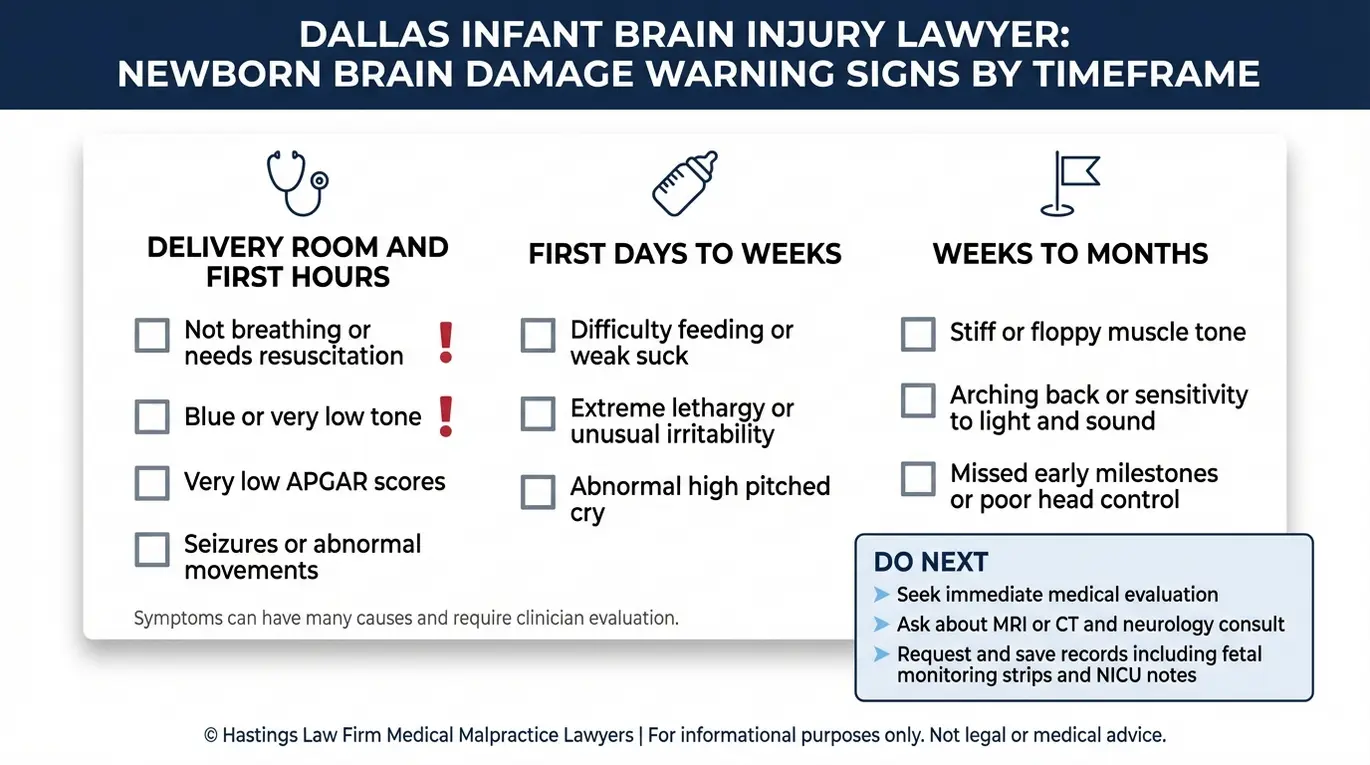
Symptoms of baby brain damage may include seizures, unusual lethargy, difficulty feeding, abnormal or high-pitched crying, or a failure to reach developmental milestones in the weeks and months after birth. Recognizing these neurological issues early can be important for both your child’s medical care and any potential legal claim.
Some signs appear immediately in the delivery room. A baby who is not breathing at birth or has bluish skin may need resuscitation. A low Apgar score, which is a physical assessment on a 0 to 10 scale, can indicate oxygen deprivation during delivery. Abnormal results from fetal heart rate monitoring (cardiotocography or CTG) can also point to distress that occurred before delivery.
Other signs develop over the early weeks and months of life. These may include:
- Seizures or tremors in the first days after birth
- Excessive irritability or high-pitched crying
- Arching of the back or unusual muscle stiffness
- Difficulty latching, sucking, or swallowing during feeding
- Extreme sensitivity to light or sound
- Missing early developmental milestones such as holding the head up or tracking objects visually
- Low muscle tone or a “floppy” appearance
If your child is showing any of these signs, medical imaging can help confirm a diagnosis. According to recent recommendations published in Anales de Pediatría, brain MRI is a preferred tool for evaluating suspected brain injuries because it provides detailed information about the extent of damage. CT scans may also be used in urgent situations.
The Hastings Law Firm Difference
Results matter, but what truly sets us apart is how we achieve them. Every verdict, every settlement, and every Dallas courtroom victory comes from one guiding promise: To treat each client’s fight for justice as if it were our own.
This balance of skill, experience, and empathy reflects our core philosophy that justice should not only compensate the injured, but also make health care safer nationwide.

Common Medical Causes of Infant Brain Damage During Labor and Delivery
Common causes of infant brain damage involve oxygen deprivation, known as hypoxia, due to delayed emergency interventions, umbilical cord complications, or physical trauma from the improper use of delivery instruments like forceps and vacuum extractors. Dallas infant brain injury lawyers investigate these events by reconstructing the clinical timeline minute by minute.
Oxygen Deprivation and Hypoxic-Ischemic Encephalopathy (HIE)
When a baby suffers a lack of oxygen during labor or delivery, the result can be a hypoxic-ischemic injury known as hypoxic-ischemic encephalopathy (HIE). This is a condition where reduced oxygen and blood flow cause direct damage to brain tissue. HIE can occur when fetal distress goes unrecognized or when a necessary C-section is delayed. Umbilical cord compression, including cord prolapse or a nuchal cord, can cut off oxygen rapidly if not addressed.
Traumatic Delivery Injuries
Forceps and vacuum extractors are tools used to assist difficult deliveries, but improper application can cause head trauma, brain bleeds, and lasting neurological damage. These instruments require precise technique. Their misuse can result in injuries that would not have occurred with a timely C-section.
Medication Errors**
Drugs like Pitocin, which is used to induce contractions, can cause excessive uterine activity if improperly dosed or monitored. Overstimulation of the uterus can lead to uterine rupture or placental abruption, both of which threaten the baby’s oxygen supply. The Texas Department of State Health Services continues to track maternal and infant outcomes across the state.
| Cause | What Can Go Wrong | How Brain Injury Occurs |
|---|---|---|
| Delayed C-section | Failure to respond to signs of fetal distress | Prolonged oxygen deprivation leading to HIE |
| Umbilical cord complications | Cord prolapse, nuchal cord, or cord compression | Reduced or cut-off blood and oxygen flow to the brain |
| Forceps or vacuum misuse | Excessive force or incorrect placement | Direct head trauma, skull fractures, or brain bleeds |
| Pitocin/Cytotec mismanagement | Overstimulation of contractions | Uterine rupture or placental abruption causing hypoxia |
| Anesthesia errors | Maternal blood pressure drops | Reduced blood flow to the baby |

How Infant Brain Damage Affects Children and Families
Brain damage sustained during birth can result in long-term disabilities that require a lifetime of medical needs, including cerebral palsy, cognitive impairments, and conditions that demand around-the-clock assistance.
Children with infant brain damage may experience spasticity, a condition involving abnormal muscle tightness and stiffness that limits movement. They may also face neurodevelopmental delay, where the brain develops more slowly in areas like speech and motor skills. Some children require ongoing physical therapy, occupational therapy, and specialized medical equipment for the rest of their lives.
The financial reality is significant. Research published in PubMed Central on modeling long-term costs following pediatric traumatic brain injury shows that healthcare demands for children with brain injuries can reach into the millions. These costs compound year after year, placing enormous pressure on families who are already managing emotional stress.
Understanding States of Consciousness: Coma vs. Vegetative State
In the most severe cases of infant brain damage, a child may enter an altered state of consciousness. These states represent different neurological levels of awareness following a brain injury. A coma is a state of deep unconsciousness where the child cannot be awakened. A vegetative state is different; the child may open their eyes and have sleep-wake cycles but shows no meaningful response to their environment.
Some children may progress to a minimally conscious state, where they demonstrate limited capacity for awareness. Understanding these distinctions is necessary for treatment planning and for determining the neurological prognosis.
Recovering Compensation for Infant Brain Injuries in Dallas Courts
Compensation in infant brain injury cases covers past and future medical expenses, pain and suffering, lost earning capacity, and the cost of life-care plans designed to protect the child’s quality of life over a lifetime. A lawyer for infant brain injuries will work to identify every category of economic and non-economic losses your family has suffered.
Economic damages include:
- Past and future medical bills, surgeries, and hospitalizations
- Physical, occupational, and speech therapy
- Specialized medical equipment and home modifications
- Lost wages for parents who must provide care
- The child’s lost future earning capacity
- Early Childhood Intervention services and other therapies
Non-economic damages account for:
- The child’s physical pain and suffering
- Mental anguish experienced by both the child and parents
- Physical impairment and disfigurement
- Loss of the child’s ability to enjoy life
Our firm has a record of securing results in medical negligence cases. We focus on holding negligent parties accountable and pursuing high settlement amounts and verdicts. Our trial-ready preparation applies to every birth injury claim we handle.
Texas Laws Affecting Infant Brain Injury Lawsuits
Texas law generally imposes a two-year statute of limitations for medical malpractice claims, but specific rules for minors can extend that deadline. However, a rigid statute of repose creates an absolute cutoff that families need to understand.
Under Texas Civil Practice and Remedies Code Chapter 74, most medical malpractice claims must be filed within two years of the date the negligence occurred. For minors under the age of 12, Texas law extends the filing deadline until the child’s 14th birthday. Section 74.251 also includes a 10-year statute of repose that bars all claims filed more than 10 years after the date of the negligence, regardless of when the injury was discovered.
This means parents cannot wait indefinitely, even if their child’s condition is not fully understood until years later. Texas law also requires that an expert report from a qualified medical professional be served early in the case. Filing a Texas birth injury lawsuit involves strict procedural requirements, and missing these deadlines can eliminate your right to seek compensation.

Contact the Dallas Birth Injury Attorneys at Hastings Law Firm Today for Help
If your child suffered a brain injury during birth and you believe medical negligence may have been involved, our team is here to help you find answers. As a Dallas infant brain injury lawyer, Hastings Law Firm works to uncover the truth about what happened and hold the responsible parties accountable so it does not happen to another family.
You pay nothing unless we recover compensation for your family. Our firm operates on a contingency fee basis, which means there are no upfront costs and no hourly fees.
Contact Hastings Law Firm today for a free, confidential case evaluation. Your initial consultation will be led by a patient advocate who will listen to your story and help determine if your family has a viable claim. You deserve answers, and we are ready to help you find them.
Frequently Asked Questions About Infant Brain Injury in Dallas


This content was researched and written by the Hastings Law Firm editorial team, which includes attorneys, medical professionals, and experienced researchers. Our writing is informed by internal knowledge and practical experience, and we cross-check critical details against authoritative sources cited throughout. Every piece undergoes human-led fact-checking and legal review. Because legal and medical information can change, if you spot an error, please contact us. Learn more about our content standards and review process on our editorial policy page.

Tommy Hastings, founder of Hastings Law Firm, is a board-certified personal injury trial lawyer dedicated exclusively to healthcare injury cases. Since 2001, he has represented injured patients and families in litigation against major hospital systems, pharmaceutical companies, and negligent healthcare providers nationwide. He has handled numerous high-profile cases that have drawn national media attention and resulted in multi-million dollar recoveries. He draws on that experience in his writing, helping readers understand how these cases work and what options may be available to them.
