


Dallas Pediatric Malpractice Lawyer
Pediatric medical malpractice can leave families facing lasting medical needs, emotional strain, and uncertainty about what went wrong. Children have unique physiology and communication limits that can make errors harder to spot and consequences more severe. The topic often involves missed warning signs, delayed diagnosis, medication dosing mistakes, birth related injuries, and surgical or anesthesia errors, with outcomes that can include permanent impairment or fatal outcomes. Damages may require long term planning through life care projections and expert input. If your child suffered harm due to pediatric medical malpractice in Dallas, Texas, contact Hastings Law Firm for a free, confidential case review.

Last Updated: September 19, 2026
Trusted Dallas Medical Attorneys for Pediatric Negligence Claims
When your child has been harmed by a medical error, the weight of that experience can feel impossible to carry. You may sense that something went wrong during your child’s care. However, years of trusting medical professionals can make you second-guess your instincts. This deep societal conditioning to defer to doctors without question is a well-documented psychological tendency. That hesitation is normal, and it does not mean you are wrong.
At Hastings Law Firm, we focus exclusively on medical malpractice. Our founder, Tommy Hastings, is a board-certified trial lawyer with over 20 years of experience in medical negligence cases. Our team includes former defense attorneys, in-house nurse consultants, and board-certified patient advocates who understand both the medicine and the law behind pediatric negligence claims. As a Dallas pediatric malpractice lawyer team, we help you find answers and protect your child’s future.
If you believe your child or a loved one was injured by negligent medical care, we can review what happened and explain your options in a free, confidential evaluation.

What Constitutes Medical Malpractice in a Pediatric Setting
Pediatric medical malpractice occurs when a doctor, nurse, or hospital deviates from the accepted standard of care for a child, directly resulting in injury, worsening of a condition, or death. The standard of care is the level of treatment a reasonably competent medical provider would deliver under similar circumstances, and for children, that standard is distinct. Children are not simply small adults. Their developing organs, immature immune systems, and inability to clearly communicate symptoms all require age-specific clinical protocols.
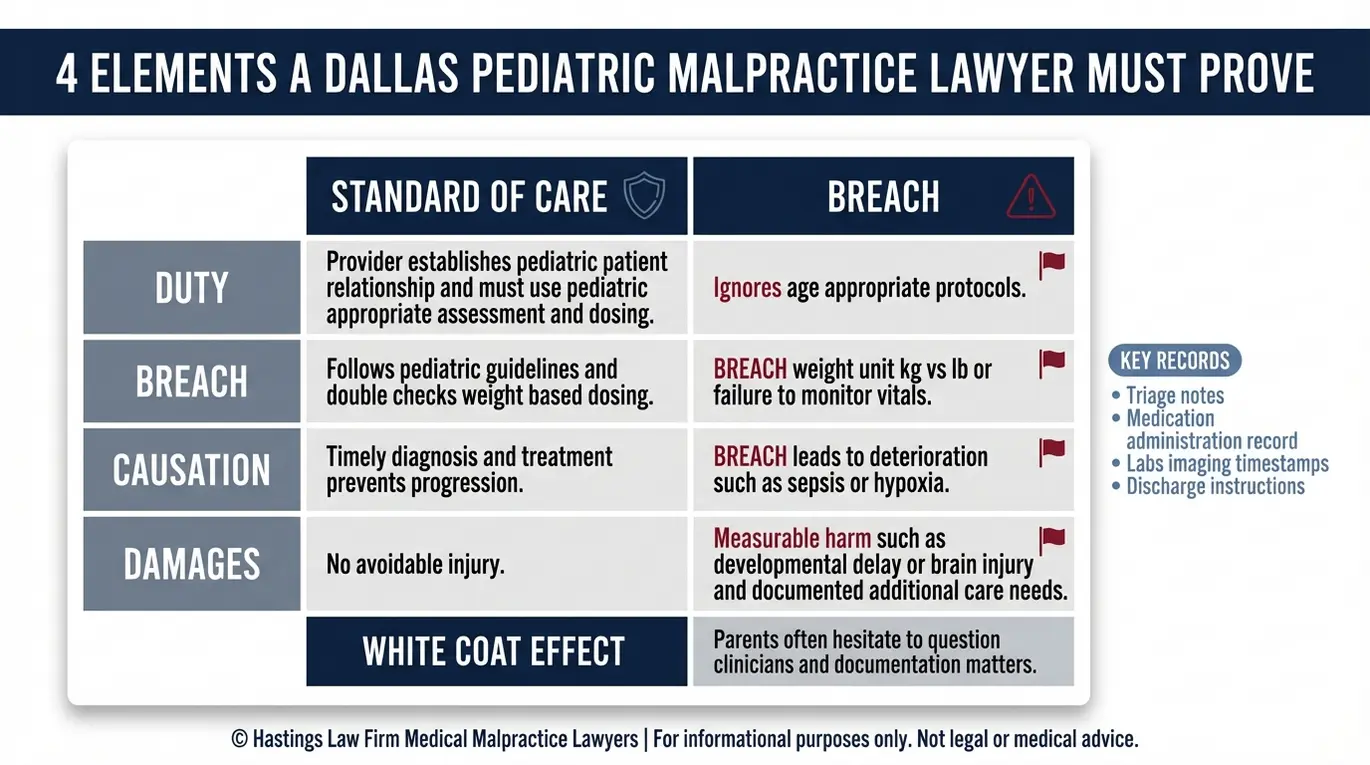
To establish liability in a pediatric negligence claim under Texas Civil Practice and Remedies Code Chapter 74, four legal elements must be proven. First, the medical provider owed a duty of care to the child. Second, the provider breached that duty by failing to meet the standard of care. Third, that breach directly caused harm. And fourth, the child suffered measurable damages as a result.
In pediatric cases, identifying a breach often requires understanding tools and benchmarks specific to children. For example, an Apgar score, a quick assessment of a newborn’s health taken at one and five minutes after birth, can reveal whether early warning signs were missed. Hypoxia, or oxygen deprivation to the brain, is another condition that demands immediate recognition and intervention in young patients. A delay of even minutes can lead to permanent neurological damage.
Research published in *BMJ Quality & Safety* on the delayed diagnosis of serious paediatric conditions in regional emergency departments found that children are particularly susceptible to diagnostic errors in acute care settings. These findings reinforce what our pediatric malpractice lawyers see in practice: when a provider fails to account for the unique vulnerabilities of a child, the consequences can be severe and lasting.
Many parents hesitate to question a doctor’s decisions. That instinct to trust is understandable. But if your child was hurt and you believe negligent care may be the reason, your concern deserves to be taken seriously. Our team investigates the medical records, timelines, and clinical decisions to determine whether the standard of care was met, so you do not have to carry that burden alone.
Common Types of Pediatric Malpractice Cases We Handle
Common cases involve birth injuries, medication errors due to weight calculation mistakes, misdiagnosis of conditions like meningitis or appendicitis, and surgical errors. As a Dallas pediatric malpractice lawyer team, we have the medical and legal resources to investigate each of these case types thoroughly. Our firm has focused exclusively on medical negligence since 2005, giving our attorneys the insight needed to handle complex pediatric claims.
Misdiagnosis and Delayed Diagnosis are among the most frequent pediatric errors we evaluate. Conditions like meningitis, appendicitis, and pneumonia can present with vague symptoms in children, and busy emergency departments may dismiss them as routine viral infections. A study published in *PLoS ONE* on higher rates of misdiagnosis in pediatric patients versus adults found that pediatric patients in the study population faced elevated diagnostic error rates compared to adult patients. When a provider fails to order the right tests or follow up on worsening symptoms, a treatable condition can progress to sepsis, organ failure, or death.
Medication Errors in children carry unique risks because pediatric dosing relies on weight-based dosing, the practice of calculating medication amounts in milligrams per kilogram (mg/kg) of body weight. A decimal point in the wrong place can create a ten-fold dosing error, where a child receives ten times the intended dose. According to Medication Dosing Safety for Pediatric Patients guidance from Maine Regional EMS, weight-based calculation mistakes are a leading source of preventable harm in pediatric medicine. These errors can cause seizures, cardiac events, or toxic organ damage.
Birth Injuries often result from failures during labor and delivery. Delayed C-sections, improper use of forceps or vacuum extractors, and failure to monitor fetal distress can lead to hypoxia and conditions like cerebral palsy. Our malpractice attorney team works with obstetric and neonatal experts to reconstruct delivery timelines and determine whether earlier intervention could have prevented the injury.
Surgical and Anesthesia Errors round out the cases we most commonly handle. A child’s smaller anatomy and developing physiology leave almost no margin for error during procedures.
| Error Type | Pediatric-Specific Risk |
|---|---|
| Misdiagnosis / Delayed Diagnosis | Vague symptom presentation; conditions like meningitis mistaken for viral illness |
| Medication Errors | Weight-based dosing miscalculations; ten-fold overdose risk |
| Birth Injuries | Hypoxia from delayed C-section; cerebral palsy from fetal monitoring failures |
| Surgical Errors | Smaller anatomy increases risk of tissue or organ damage |
| Anesthesia Errors | Children metabolize drugs differently; dosing and airway management are more sensitive |
| Failure to Treat | Dismissed parental concerns leading to disease progression and sepsis |
If your child was harmed during medical care, our Dallas pediatric malpractice lawyer team can evaluate the records to determine what went wrong. A lawyer for child injury cases like ours understands the medical details that general practitioners may miss.
The Hastings Law Firm Difference
Results matter, but what truly sets us apart is how we achieve them. Every verdict, every settlement, and every Dallas courtroom victory comes from one guiding promise: To treat each client’s fight for justice as if it were our own.
This balance of skill, experience, and empathy reflects our core philosophy that justice should not only compensate the injured, but also make health care safer nationwide.

Unique Risks: How Pediatric Physiology Impacts Delayed Diagnosis
Children have faster metabolisms and lower blood volumes than adults, meaning a delayed diagnosis of infection or dehydration can lead to shock or permanent damage much faster than in adult patients. Understanding pediatric physiology is central to many pediatric malpractice cases we evaluate in Dallas.
A child’s body compensates for illness differently than an adult’s. Age-adjusted vital signs, the normal ranges for heart rate, blood pressure, and respiratory rate that shift as a child grows, must be used to accurately assess a pediatric patient. When a provider applies adult benchmarks to a child, early warning signs of deterioration can be missed entirely.
One of the most dangerous phenomena in pediatric medicine is compensated shock, a stage where a child’s body maintains near-normal blood pressure even as organs begin to fail. By the time blood pressure visibly drops, the child may already be in critical condition. This is why “watch and wait” approaches can be especially dangerous for young patients with infections, dehydration, or internal bleeding.
The consequences of delayed diagnosis in children extend far beyond the immediate crisis:
- Rapid sepsis progression: What begins as a treatable infection can become life-threatening within hours in a child’s smaller body.
- Brain damage from oxygen deprivation: Even brief periods of hypoxia during infancy or early childhood can cause lasting cognitive and motor impairments.
- Developmental delays: Injuries sustained during critical growth periods can disrupt neurological development, affecting speech, learning, and physical milestones for years.
- Preventable wrongful death: In the most tragic pediatric malpractice cases, conditions that were entirely treatable with timely intervention lead to the death of an infant or child.
Our team reviews medical records, monitor strips, lab results, and nursing notes to build a minute-by-minute timeline. We work with pediatric specialists to determine whether the diagnostic errors fell below the standard of care and whether earlier action could have changed the outcome. As a Dallas pediatric lawyer team with in-house medical staff, we understand the clinical details that make or break these cases.

Calculating Damages and Life Care Plans for Injured Children
Compensation for children must cover a lifetime of needs, calculated through a “Life Care Plan” that projects costs for future surgeries, therapy, specialized education, and loss of earning capacity. Because children may live 50, 60, or 70 years with the effects of a medical error, these cases require a level of financial planning that goes well beyond typical injury claims.
Recoverable damages in a pediatric malpractice case generally fall into two categories.
Economic damages cover the measurable financial costs of the injury:
- Past and future medical bills, including surgeries, hospitalizations, and specialist visits
- Physical, occupational, and speech therapy
- Home modifications such as wheelchair ramps or accessible bathrooms
- Specialized education and developmental support services
- Loss of future earning capacity, reflecting what the child would have earned over a working lifetime
Non-economic damages account for losses that are real but harder to quantify:
- Physical pain and suffering
- Disfigurement or scarring
- Emotional distress
- Loss of enjoyment of childhood activities and milestones
The life care plan ties these elements together into a single document that courts and juries can evaluate. It accounts for developmental delays, the slowing or disruption of a child’s expected physical or cognitive growth, and projects costs for decades of care. These measurable financial costs provide an evidence-based roadmap for the child’s future needs.
Why Expert Witnesses Are Critical for Life Care Plans
Building a credible life care plan for a pediatric injury case requires expert testimony from multiple disciplines. Medical experts establish the child’s diagnosis, prognosis, and future medical costs. Economists calculate the present-day value of future losses, adjusting for inflation and life expectancy. Vocational rehabilitation specialists assess how the injury will affect the child’s ability to work as an adult.
Our pediatric malpractice lawyer team coordinates with these experts from the start of every case. Their expert reports and testimony translate a child’s long-term needs into concrete dollar figures that reflect the true scope of the harm, giving families the strongest possible foundation for fair compensation.
Texas Statute of Limitations for Minors
In Texas, the statute of limitations for minors under 12 at the time of injury is extended until the child’s 14th birthday, though the 10-year statute of repose still applies as a hard outer limit.
Under the Texas Civil Practice and Remedies Code § 74.251, the standard statute of limitations for medical malpractice is two years from the date of the negligent act. For minors under 12, Texas law extends this deadline, giving them until their 14th birthday to file or have filed on their behalf. However, a child who is 12 or older at the time of injury faces the standard two-year window, just like an adult.
There is also a critical hard limit known as the statute of repose. Texas imposes a 10-year outer boundary from the date of the negligent act, regardless of the patient’s age. Once that 10-year period passes, the right to file a personal injury lawsuit is permanently lost, even if the child is still a minor. This means that for injuries occurring at or near birth, the window can close well before the child reaches adulthood.
Do not wait to consult a pediatric malpractice attorney, even if you believe you have years remaining. Medical records can be lost or destroyed, witnesses relocate, and memories fade. The earlier our team can investigate, the stronger the evidence will be to support your child’s claim.
Tolling rules and repose deadlines interact in ways that can be confusing, and miscalculating a deadline by even one day can permanently bar your child’s case. A free consultation with our team can clarify exactly where your family stands and what steps need to happen next.

Contact the Dallas Doctor Malpractice Attorneys at Hastings Law Firm Today for Help
No parent should have to carry the weight of a child’s medical injury alone, especially when that injury could have been prevented. At Hastings Law Firm, every case is prepared from day one as if it will go to trial. That trial-ready approach signals to insurance carriers and defense teams that we will not accept less than fair compensation for your child’s future.
Our team includes former defense attorneys who provide insider insight into how hospitals and insurers build their cases. We also employ in-house medical professionals who can identify exactly where the standard of care was broken. You pay nothing unless we recover compensation for your family.
Hand us the legal burden so you can focus on your child’s healing. Contact Hastings Law Firm today for a free, confidential case evaluation with a patient advocate. Call our Dallas office or reach out online to get started.
Frequently Asked Questions About Pediatric Malpractice in Dallas


This content was researched and written by the Hastings Law Firm editorial team, which includes attorneys, medical professionals, and experienced researchers. Our writing is informed by internal knowledge and practical experience, and we cross-check critical details against authoritative sources cited throughout. Every piece undergoes human-led fact-checking and legal review. Because legal and medical information can change, if you spot an error, please contact us. Learn more about our content standards and review process on our editorial policy page.

Brady D. Williams is a nationally recognized medical malpractice attorney who has spent his career handling high-stakes litigation for injured patients and families across the country. Licensed in both Texas and California, Brady draws on experience from hundreds of resolved medical cases to break down complex legal and medical topics for the people who need that information most. His writing reflects the same attention to detail and commitment to clarity that he brings to every case he handles.
