


Dallas Failure To Diagnose Lawyer
Written by: Hastings Law Firm | Reviewed by: Brady D. Williams | Updated: July 27, 2026
A missed or delayed diagnosis can leave a patient facing a more advanced illness, more intensive treatment, and a prognosis that might have been better with timely care. Not every diagnostic mistake is negligence, but accountability can apply when the diagnostic process falls below the accepted standard of care. Common breakdowns include incomplete history review, missed testing, misread imaging, and communication failures that delay treatment and worsen outcomes, sometimes with life threatening consequences. If you or a loved one were harmed or worse due to failure to diagnose in Dallas, Texas, contact Hastings Law Firm for a free, confidential case review.

Trusted Legal Representation for Diagnosis Failures in Dallas
What You Should Know About Delayed or Missed Diagnosis Claims in Dallas:
- Outcomes can become more severe when a serious condition is not identified in time and treatment is delayed.
- Liability can turn on whether the diagnostic process fell below the accepted standard of care rather than on a bad outcome alone.
- Recovery can depend on showing that the delay caused measurable harm such as a worsened prognosis or reduced chance of survival.
- Fatal outcomes can occur when time sensitive emergencies are dismissed and a patient is sent home without appropriate intervention.
- Disputes can arise when symptoms are minimized or attributed to stress or anxiety, including patterns tied to gender bias and diagnostic dismissal.
- Options can be lost if filing deadlines are missed under Texas medical malpractice time limits.
- Compensation can include economic losses such as medical bills and lost wages and non economic harms such as pain and suffering and reduced quality of life.
- Wrongful death damages may be available when a delayed diagnosis results in the loss of a loved one.
- Case viability can hinge on obtaining credible expert testimony that confirms a breach of the standard of care.
- Clarity can depend on what medical records show about symptoms, testing, imaging results, follow up, and provider communication.

A Healthcare Focused Law Firm
When a doctor fails to identify a serious medical condition, the consequences can change your life or the life of someone you love. You may be dealing with a disease that has advanced, treatments that are now more aggressive, or a prognosis that could have been different. These situations leave patients and families searching for answers, often unsure whether what happened qualifies as medical negligence.
A Dallas failure to diagnose lawyer at Hastings Law Firm can help you get those answers. Our firm handles medical malpractice cases exclusively, and our team includes in-house medical professionals who know how to evaluate whether a diagnostic error crossed the line from an unfortunate outcome into actionable negligence. If you believe a missed or delayed diagnosis caused harm, we welcome the chance to review what happened and explain your options through a free, confidential case evaluation.
Understanding Failure to Diagnose Claims in Texas
A failure to diagnose claim arises when a physician acts negligently by failing to identify a medical condition that a competent doctor in the same specialty would have recognized, leading to delayed treatment and worsened health. This is not about penalizing doctors for every incorrect guess. It is about accountability when the diagnostic process itself fell below the accepted standard of care, the level of competence and attention a reasonably skilled physician would have provided under similar circumstances.
The distinction between a bad outcome and negligence matters. Medicine involves uncertainty, and not every missed diagnosis is malpractice. The question a failure to diagnose attorney in Dallas must answer is whether the physician followed a proper differential diagnosis, the systematic method doctors use to evaluate symptoms, rule out conditions, and arrive at the correct diagnosis. When a doctor skips steps in that process, ignores test results, or fails to consider conditions that the symptoms clearly point toward, that breakdown can constitute a breach of duty. This failure means the physician did not act with the prudence required by law, violating the standards set forth under the Texas Civil Practice and Remedies Code Chapter 74.001.
Medical Conditions Frequently Missed by Dallas Physicians
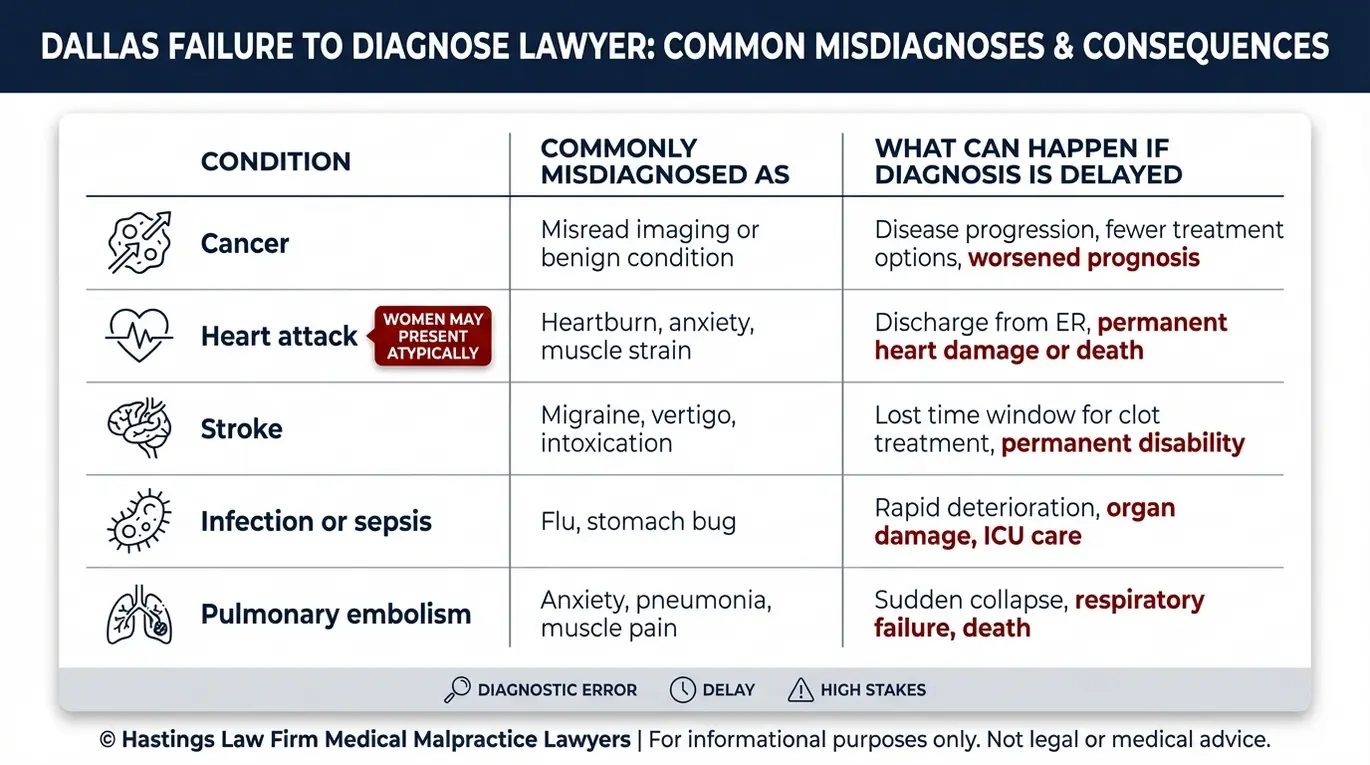
Common conditions at the center of diagnostic error claims include cancer, heart attacks, strokes, and infections, often because their early symptoms can mimic less serious ailments. A heart attack misdiagnosis or stroke misdiagnosis can be fatal if the patient is sent home without intervention. When these conditions go unrecognized, the window for effective treatment narrows, sometimes permanently.
A misdiagnosis, where a doctor identifies the wrong condition, and a delayed diagnosis, where the correct condition is eventually identified but only after critical time has passed, both carry serious consequences. Radiology errors often contribute to these failures, particularly in reading scans for cancer or embolisms. The table below outlines several conditions we frequently encounter in these cases.
| Condition | Commonly Misdiagnosed As | Potential Consequence |
|---|---|---|
| Cancer (breast, lung, colorectal) | Benign cysts, infections, IBS | Disease advances to later stage; reduced survival rate |
| Heart attack | Heartburn, anxiety, muscle strain | Cardiac tissue death; heart failure; death |
| Stroke | Migraine, vertigo, intoxication | Permanent brain damage; paralysis; death |
| Pulmonary embolism | Pneumonia, anxiety, muscle pain | Organ damage; cardiac arrest; death |
| Sepsis/Infection | Flu, general fatigue | Organ failure; amputation; death |
Cancer misdiagnosis is among the most devastating because early-stage cancers are often highly treatable. A delayed diagnosis can mean the difference between a localized tumor and metastatic disease, fundamentally reducing a patient’s chance of survival. In evaluating these cases, a misdiagnosis lawyer examines whether the diagnostic delay worsened the patient’s prognosis and reduced their likelihood of survival or recovery.
Emergency room errors are another common source of diagnostic failures. Heart attacks, for example, are sometimes dismissed as acid reflux or panic attacks, and patients are sent home without the cardiac workup their symptoms warranted. A delayed diagnosis attorney can investigate whether ER physicians followed appropriate protocols or rushed through the evaluation.
The Role of Gender Bias in Misdiagnosis
Research consistently shows that women and minorities face higher rates of diagnostic dismissal. According to the American Heart Association, women often experience heart attack symptoms like jaw pain, nausea, and fatigue rather than the classic chest-clutching presentation most commonly associated with men. These are sometimes called atypical presentations, meaning the symptoms do not match the textbook pattern, even though they are well-documented and should be recognized.
This pattern of dismissal is sometimes referred to as medical gaslighting, where a patient’s legitimate symptoms are minimized or attributed to psychological causes like stress or anxiety. A report from the National Academy of Medicine has documented how diagnostic errors remain a significant patient safety concern. When a physician attributes chest pain in a 45-year-old woman to anxiety without ordering appropriate cardiac testing, the consequences can be fatal.
The Hastings Law Firm Difference
Results matter, but what truly sets us apart is how we achieve them. Every verdict, every settlement, and every Dallas courtroom victory comes from one guiding promise: To treat each client’s fight for justice as if it were our own.
This balance of skill, experience, and empathy reflects our core philosophy that justice should not only compensate the injured, but also make healthcare safer nationwide.

Why Do Diagnostic Errors Occur?
Diagnostic errors often stem from systemic failures, including rushing through patient exams, skipping necessary tests, or misreading lab and imaging results due to fatigue, cognitive overload, or insufficient training. These are not isolated incidents; they reflect patterns that the CDC’s Core Elements of Hospital Diagnostic Excellence (DxEx) framework was developed to address.
Some of the most common breakdowns we investigate as a Dallas diagnostic error lawyer include:
- Incomplete medical history reviews, where a physician fails to ask about family history, prior conditions, or current medications that would have pointed toward a specific diagnosis.
- Failure to order appropriate tests, such as CT scans, MRIs, or bloodwork, when symptoms warranted further investigation.
- Communication gaps between providers, where lab test mistakes occur because technicians identify an abnormal result but it never reaches the treating physician.
- Emergency room errors, where rapid triage leads to missed symptoms in high-pressure environments.
- Radiology interpretation errors, where an imaging study is misread, leading to a false-negative test result, a result that incorrectly indicates no disease is present.
Systemic Profit Motives and Rushed Care
High-volume hospital models can create environments where physicians are pressured to see more patients in less time. When a doctor spends only a few minutes with a patient, there is a greater risk of premature closure, a well-documented cognitive error where a physician settles on an initial diagnosis too quickly and stops considering other possibilities. We investigate whether a rushed diagnosis, staffing patterns, or hospital liability due to institutional practices contributed to the missed diagnosis.
Proving Negligence: The Breach of Standard of Care
Proving negligence requires demonstrating that a doctor failed to follow the differential diagnosis method that a reasonably prudent physician in the same field would have used under similar circumstances. As a Dallas failure to diagnose lawyer, we build this case through a structured, evidence-driven process.
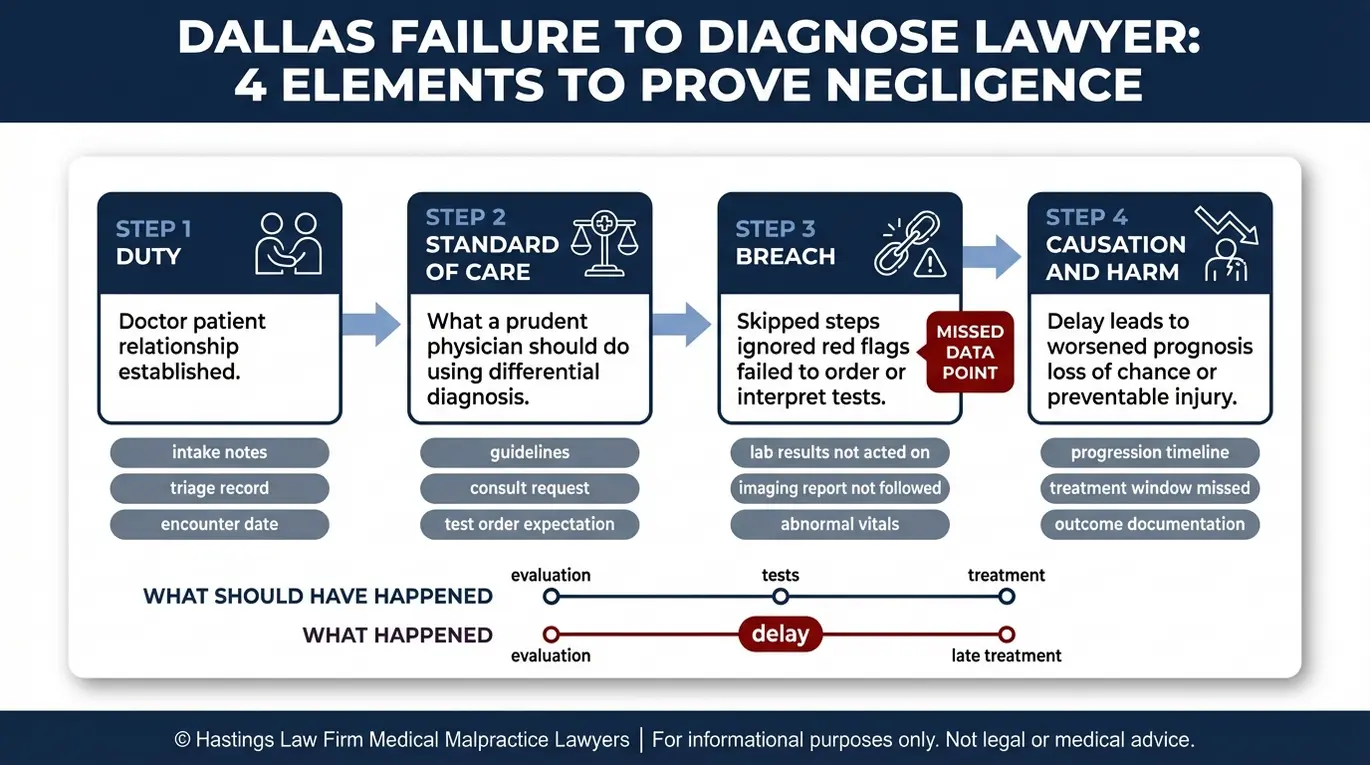
Every medical malpractice claim rests on four legal elements. Here is the framework we follow:
- Step 1: Establish the Doctor-Patient Relationship. We confirm that a formal treatment relationship existed, creating a legal duty of care. This is typically established through medical records showing the physician evaluated or treated the patient.
- Step 2: Define the Standard of Care. Working with qualified medical experts, we establish what a competent physician in the same specialty should have done given the patient’s symptoms, history, and available information. We must show exactly which protocols were ignored.
- Step 3: Prove the Breach. We analyze medical records, test results, imaging studies, and clinical notes to identify where the physician deviated from the standard. This could mean failing to order a test, ignoring abnormal results, or not following up on a concerning finding. We must show that the evidence clearly indicates a missed opportunity for intervention that a competent doctor would have seized.
- Step 4: Establish Causation. The breach must be directly connected to specific, measurable harm. We work with experts to demonstrate that the diagnostic delay led to a worsened prognosis, meaning the patient’s condition deteriorated beyond where it would have been with a timely and accurate diagnosis. Proving this link often requires detailed statistical analysis of survival rates and disease progression.
The resources of a medical malpractice attorney make the difference. Our team reconstructs a detailed timeline from the medical records, and our in-house nursing staff identifies charting inconsistencies that might otherwise go unnoticed.
The Critical Role of Expert Witnesses
In Texas, you cannot win a malpractice case without credible expert testimony from a physician who can confirm that the defendant violated the standard of care. This requirement is built into the Texas Civil Practice and Remedies Code Chapter 74, also known as the Texas Medical Liability Act, which governs medical liability claims statewide.
Before a failure to diagnose attorney can even file a lawsuit, Texas law requires an expert report, a written report from a qualified expert stating that the claim has a factual and medical basis. The expert must practice in a field involving the same type of care or treatment as that delivered by the defendant physician, which means a cardiologist reviews a cardiology case, an oncologist reviews a cancer case, and so on.
This is one of the reasons hiring a medical malpractice lawyer in Dallas with an established expert network is so important. At Hastings Law Firm, we maintain relationships with top-tier medical experts across the country who provide objective case reviews and, when needed, courtroom testimony.
Compensation for Victims of Diagnostic Errors
Patients harmed by diagnostic errors can recover economic damages for medical bills and lost wages, as well as non-economic damages for pain, suffering, and the reduced quality of life caused by the delay. The specific value of a case depends on the severity of harm and how significantly the missed diagnosis changed the patient’s outlook.
A Dallas failure to diagnose lawyer will evaluate the full scope of your losses, which may include:
- Past and future medical expenses, including surgeries, medications, rehabilitation, and ongoing care that would not have been necessary with a timely diagnosis.
- Lost earning capacity, if the condition now prevents the patient from returning to work or limits their ability to earn, impacting future financial security.
- Pain and suffering, including physical discomfort, emotional distress, and mental anguish caused by the diagnostic failure.
- Diminished prognosis, reflecting the worsened health outcome caused by the diagnostic delay.
- Wrongful death damages, if the delayed diagnosis resulted in the death of a loved one. Texas law allows surviving family members to pursue a misdiagnosis settlement or verdict for funeral expenses, lost financial support, and loss of companionship. We focus on recovering non-economic damages to address the emotional and physical impact of your loss.
Deadlines for Filing a Failure to Diagnose Lawsuit in Texas
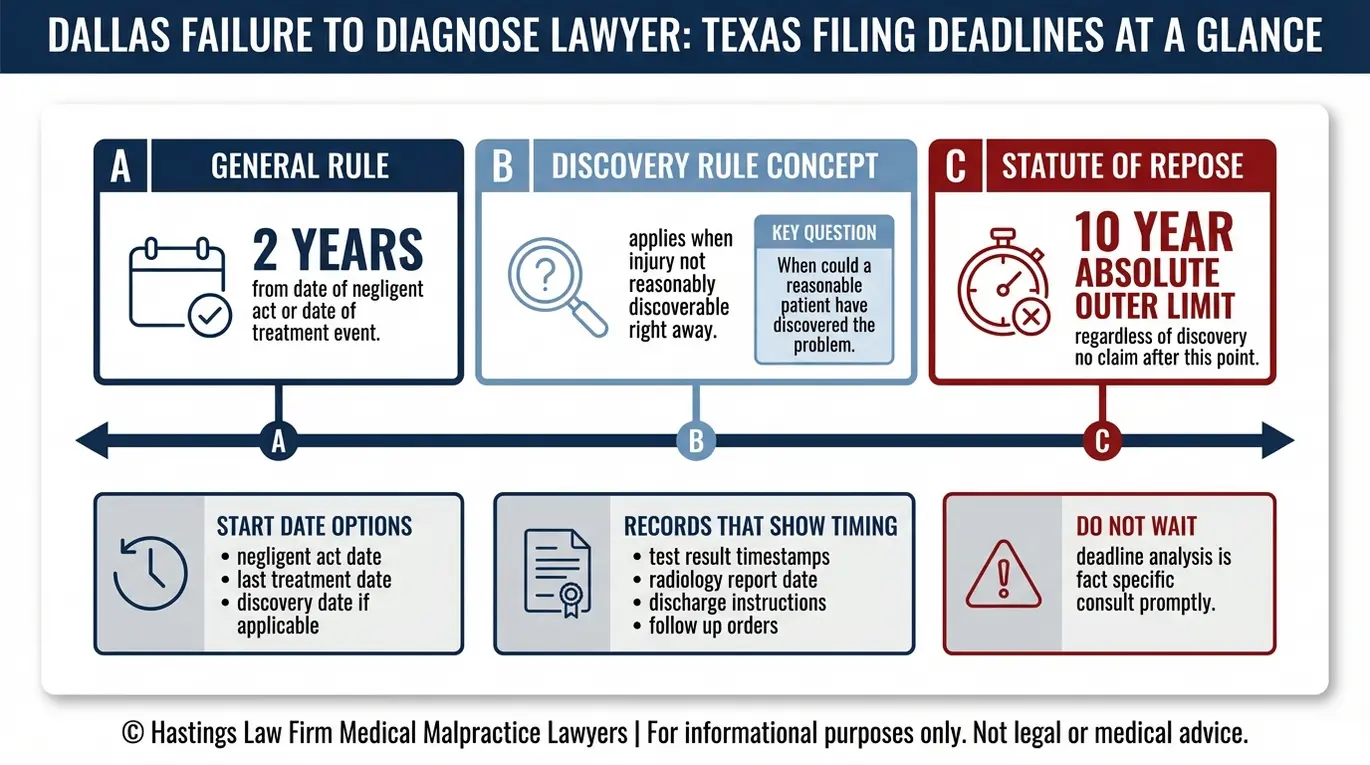
The statute of limitations for medical malpractice in Texas is generally two years from the date the negligence occurred, though specific exceptions may apply when the diagnostic error was not immediately discoverable.
The Two-Year Rule: Under Texas law, most failure to diagnose claims must be filed within two years of the date of the negligent act. Missing this deadline almost always means losing the right to pursue your case entirely.
The Discovery Rule: In some diagnostic error cases, the patient could not have reasonably known about the missed diagnosis at the time it happened. For example, a cancer that was overlooked on imaging in 2021 may not produce symptoms until 2023. The discovery rule allows the statute of limitations to begin when the patient knew or should have known about the injury, rather than when the error originally occurred.
The Statute of Repose: Texas imposes a hard 10-year deadline from the date of the negligent act. Even if the injury was not and could not have been discovered within that period, no claim can be filed after 10 years. This absolute cutoff makes timely filing and consulting a Dallas medical negligence attorney as early as possible critical to preserving your legal rights. We investigate every timeline detail to ensure we respect the statute of repose.
Why Choose Hastings Law Firm for Your Misdiagnosis Case
We are a specialized medical malpractice firm with board-certified leadership, in-house medical staff, and a track record of holding negligent healthcare providers accountable. Our firm does not handle car accidents, slip-and-falls, or general personal injury cases. Every member of our team, from our attorneys to our nurse consultants, focuses entirely on medical malpractice.
That specialization gives us a distinct advantage. Our legal team includes former defense attorneys who previously represented hospitals, giving us direct insight into the strategies the other side will use. Our in-house nurses review your medical records with clinical expertise, identifying gaps and inconsistencies that support your case. Because founding attorney Tommy Hastings is a board-certified trial lawyer, a distinction held by fewer than 2% of Texas attorneys, your case is led by one of the best failure to diagnose lawyers Dallas families can turn to.
We take cases on a contingency fee basis, meaning there are no upfront costs and you pay no attorney fees unless we secure a recovery for you. We also offer a free case review to help you understand your legal options.
Contact the Dallas Diagnosis Failure Attorneys at Hastings Law Firm Today for Help
If a delayed or missed diagnosis has caused serious harm to you or someone in your family, you deserve a firm that understands both the medicine and the law. As a Dallas failure to diagnose lawyer, Hastings Law Firm has the medical knowledge, legal experience, and trial preparation to investigate what went wrong and pursue the accountability you deserve.
We operate on a contingency basis, so there is no financial risk to you. Your consultation is free and confidential, and our patient advocates are ready to listen. Contact us today to schedule your case evaluation and take the first step toward getting the answers your family needs.
Frequently Asked Questions About Failure To Diagnose in Dallas


This content was researched and written by the Hastings Law Firm editorial team, which includes attorneys, medical professionals, and experienced researchers. Our writing is informed by internal knowledge and practical experience, and we cross-check critical details against authoritative sources cited throughout. Every piece undergoes human-led fact-checking and legal review. Because legal and medical information can change, if you spot an error, please contact us. Learn more about our content standards and review process on our editorial policy page.

Brady D. Williams is a nationally recognized medical malpractice attorney who has spent his career handling high-stakes litigation for injured patients and families across the country. Licensed in both Texas and California, Brady draws on experience from hundreds of resolved medical cases to break down complex legal and medical topics for the people who need that information most. His writing reflects the same attention to detail and commitment to clarity that he brings to every case he handles.
