


Dallas Nurse Malpractice Lawyer
Nursing negligence can leave patients and families facing serious injuries, financial strain, and uncertainty about what happened during care. In Dallas, these claims often turn on whether nursing actions matched the expected standard for that nurse’s training and role, including the duty to monitor, document, administer medications safely, and escalate concerns through the chain of command. Hospitals may also share responsibility through vicarious liability or their own staffing and safety failures. If you or a loved one were harmed or worse due to nursing negligence in Dallas, Texas, contact Hastings Law Firm for a free, confidential case review.
Last Updated: July 27, 2026
Trusted Medical Attorneys for Nursing Negligence Claims in Dallas
When a nurse’s error causes serious harm, the path forward can feel overwhelming. You may be dealing with a worsening medical condition, mounting bills, and unanswered questions about what went wrong. Details buried in nursing charting, the clinical documentation nurses are required to maintain, or in a medication administration record (MAR) that tracks every drug given to a patient, can hold the answers your family needs.
Our Dallas nurse malpractice lawyers at Hastings Law Firm can help you make sense of those records and determine whether negligent nursing care caused your injury. As a firm focused exclusively on medical negligence, we have the specialized experience needed to challenge large hospital systems. Our team includes in-house nurses and board-certified patient advocates who know exactly what to look for in clinical files. If you believe a nurse’s mistake harmed you or someone you love, we invite you to contact us for a free, confidential case evaluation.

Defining the Legal Standard of Care for Nursing Professionals
Nursing malpractice occurs when a nurse fails to meet the accepted standard of care, resulting in patient injury or death. Under Texas Civil Practice and Remedies Code Chapter 74, a health care liability claim arises from a departure from accepted standards of medical care or health care that proximately causes injury. The standard of care refers to the level of treatment, skill, and attentiveness that a reasonably competent nurse with similar training would provide under the same circumstances. Experienced nursing malpractice lawyers know that this is not a single, fixed rule. It shifts depending on the nurse’s credentials, their scope of practice (the range of duties their license authorizes them to perform), and the clinical situation.
The Texas Board of Nursing sets specific guidelines that dictate what each level of nurse can and cannot do. Violating these statutes is a primary indicator of negligence. The Texas Board of Nursing creates these rules to ensure patient safety across the state. For instance, a nurse who attempts a procedure reserved for a physician, or who fails to execute a physician’s valid order, has breached the standard of care. This regulatory framework provides the baseline against which all nursing conduct is measured in a courtroom.
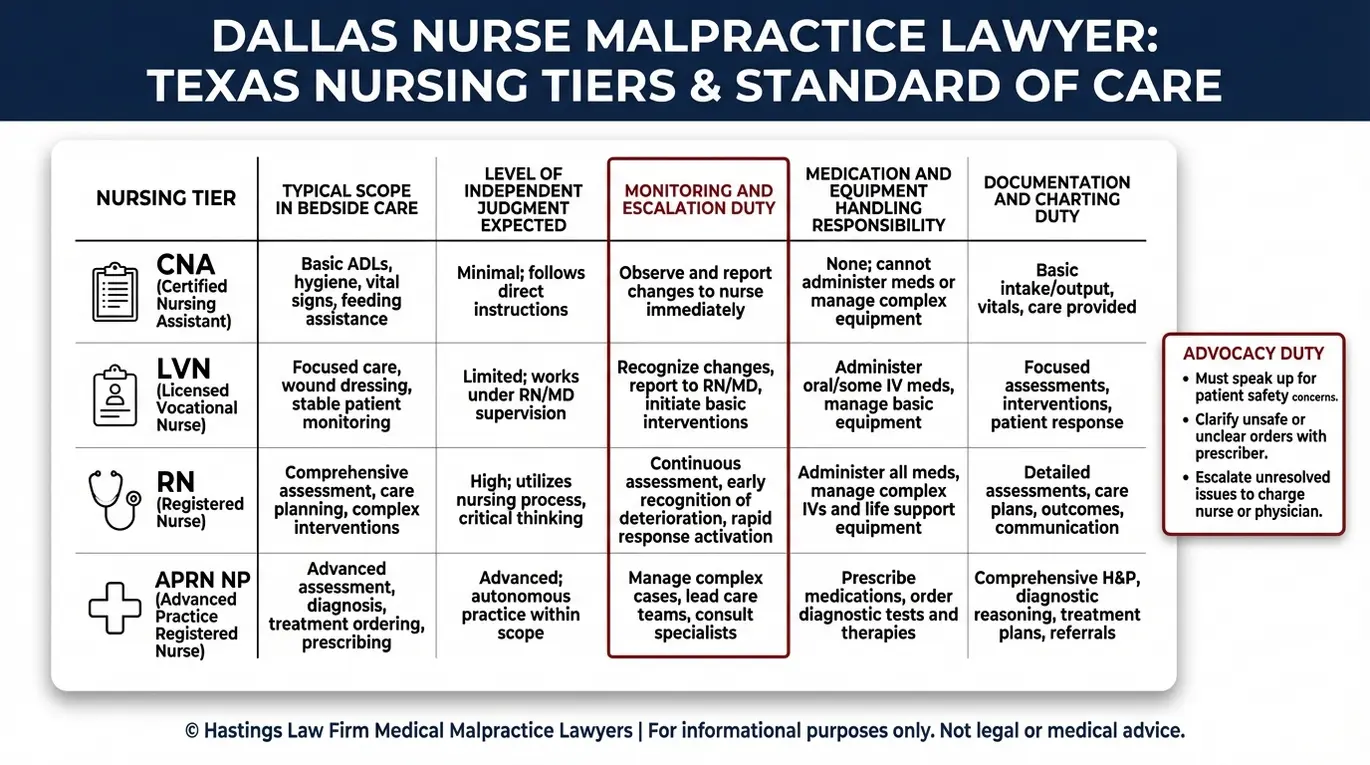
Texas law recognizes distinct tiers of nursing professionals, and each carries different legal expectations. A Certified Nursing Assistant (CNA) is trained to assist with basic patient needs like bathing and repositioning. A Licensed Vocational Nurse (LVN) can administer medications and perform clinical tasks under supervision. A Registered Nurse (RN) is expected to exercise independent clinical judgment, interpret patient data, and escalate concerns. An Advanced Practice Registered Nurse (APRN), including Nurse Practitioners (NPs), operates with a scope closer to that of a physician, often diagnosing conditions and prescribing treatment.
| Nursing Level | Key Responsibilities | Legal Standard |
|---|---|---|
| CNA | Basic patient care, vital signs, hygiene assistance | Must follow care plan instructions and report changes |
| LVN | Medication administration, wound care, supervised clinical tasks | Must follow physician orders accurately and escalate concerns |
| RN | Patient assessment, care coordination, independent judgment | Must interpret clinical data and activate the chain of command when patient safety is at risk |
| NP / APRN | Diagnosis, prescribing, treatment planning | Held to a standard often comparable to a physician’s in their specialty |
One legal duty that applies across all nursing levels is the obligation to advocate for the patient. This includes activating the chain of command, the formal nursing escalation process used to alert supervisors or physicians when a patient’s condition is deteriorating or when an order seems inappropriate. A nurse who recognizes a danger but stays silent may face civil liability for the resulting harm, even if a doctor gave the original order.
This “duty to advocate” ensures that nurses act as a final safety check for patients, preventing errors from reaching the bedside. Our Dallas nurse malpractice attorneys work with qualified nursing experts to evaluate whether the care provided met the standard required for that nurse’s specific credentials and role. This analysis is the foundation of every nursing malpractice case we handle.
How Malpractice Litigation Impacts a Professional License
A nurse who commits malpractice can face consequences on two separate tracks. The first is civil liability, meaning a lawsuit filed by the injured patient seeking financial compensation. The second is administrative discipline through the Texas Board of Nursing, the state agency responsible for licensing and regulating nurses in Texas. The Board maintains these records to protect the public from unsafe nursing practices. Disciplinary action can result in penalties ranging from mandatory education requirements to license suspension or permanent revocation.
These two processes are independent of each other. A nurse can face a malpractice lawsuit and a board investigation at the same time, or one without the other. For the injured patient, the board’s findings and disciplinary history can become important evidence in a civil case.
Identifying Common Medical Errors Committed by Nurses
Common nursing errors include medication administration mistakes, failure to monitor vital signs leading to conditions like sepsis or shock, and improper use of medical equipment. A 2025 report from the HHS Office of Inspector General found that hospitals failed to capture half of all patient harm events. These nursing errors occur when clinical protocols designed to protect patients are not followed, meaning many incidents go unreported and may only come to light through independent investigation.
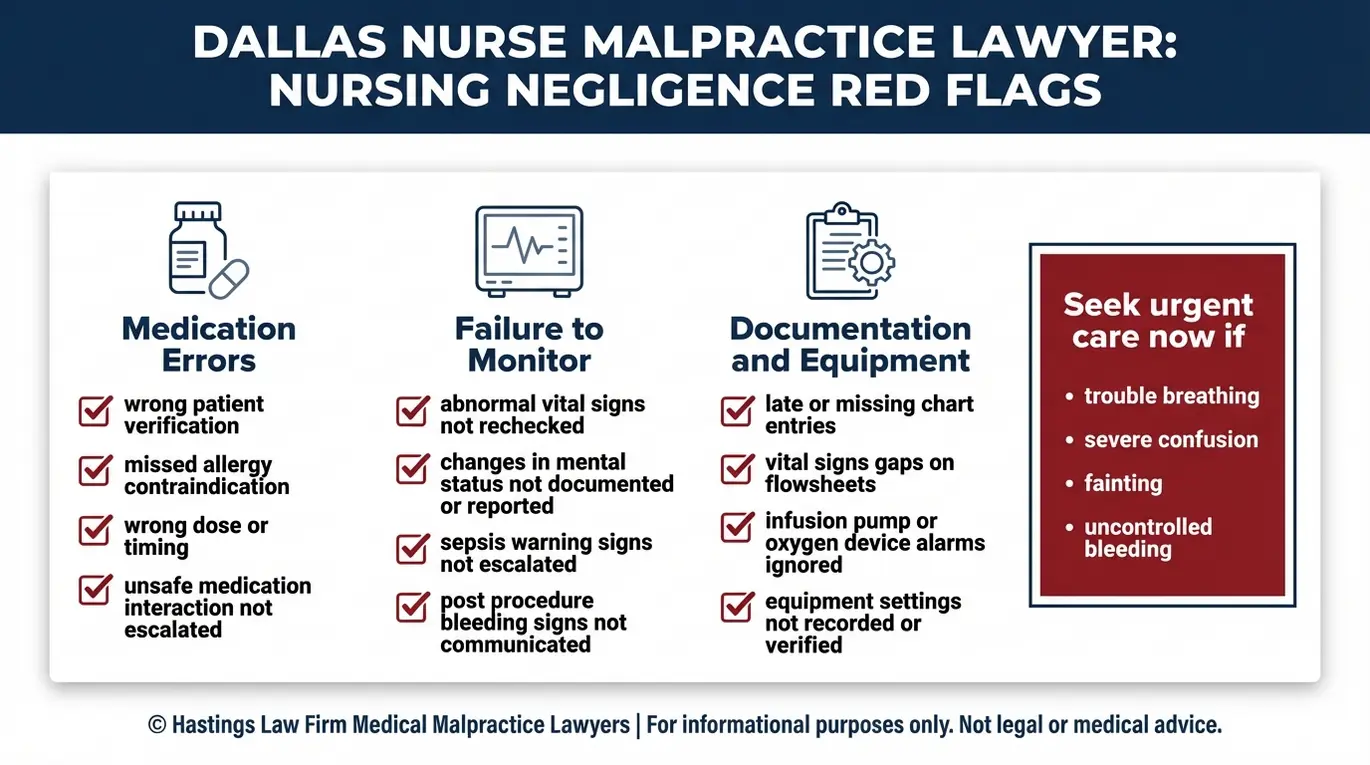
As malpractice lawyers in Dallas handling these claims, we categorize nursing errors into three main types: administration errors, monitoring failures, and documentation breakdowns.
Medication Errors
Nurses are trained to follow the Five Rights of medication administration, a safety protocol requiring verification of the right patient, right drug, right dose, right route, and right time before giving any medication. This process acts as a final safety check to ensure patients receive the correct treatment. Violations of this protocol can lead to overdoses, allergic reactions, dangerous drug interactions, or administration of medication to the wrong patient entirely. These errors are among the most preventable in healthcare, yet they remain one of the most common sources of patient harm.
Failure to Monitor
Failure to monitor refers to a nurse’s failure to regularly assess a patient’s condition, track vital signs, and recognize signs of distress or deterioration. Monitoring is one of the most critical functions a nurse performs. When a nurse misses or ignores warning signs, such as dropping blood pressure, rising heart rate, or early indicators of sepsis, the delay in treatment can turn a manageable condition into a life-threatening emergency.
Documentation Failures
In medical malpractice cases, there is a well-known principle: “If it wasn’t charted, it wasn’t done.” Poor documentation, whether through incomplete notes, delayed entries, or gaps in the medical record, can serve as direct evidence that required care was never provided. When our nurse negligence attorney team reviews a case, these missing details often reveal patterns of inattention or missed interventions.
These errors frequently overlap. A nurse who fails to monitor a patient’s condition properly may also fail to document the assessments that should have occurred:
- Administering the wrong dose or wrong medication to a patient
- Failing to check and record allergies before giving a new drug
- Missing scheduled vital sign checks during a critical recovery window
- Ignoring early signs of infection, hemorrhage, or respiratory decline
- Charting vitals or assessments that were never actually performed
- Failing to report a change in patient condition to the supervising physician
- Improper use of IV pumps, feeding tubes, or monitoring equipment
Each of these errors can be traced back to a departure from the standard of care, and each can form the basis of a malpractice claim.
The Hastings Law Firm Difference
Results matter, but what truly sets us apart is how we achieve them. Every verdict, every settlement, and every Dallas courtroom victory comes from one guiding promise: To treat each client’s fight for justice as if it were our own.
This balance of skill, experience, and empathy reflects our core philosophy that justice should not only compensate the injured, but also make health care safer nationwide.

Hospital Liability and Vicarious Responsibility
While individual nurses can be sued for malpractice, hospitals are often liable for their employees’ actions under the doctrine of respondeat superior, a legal principle also known as vicarious liability, or for their own negligent hiring practices.
Vicarious Liability: When the Hospital Answers for Its Staff
Under Texas law, a hospital can be held financially responsible for a nurse’s negligence if the act occurred within the scope of their employment. This applies to both Registered Nurses (RNs) and Licensed Vocational Nurses (LVNs) and is known as vicarious liability. The legal theory is clear: the hospital chose to hire, train, and supervise that nurse, and the hospital profits from their labor. When the nurse causes harm on the job, the hospital shares the liability.
Direct Hospital Negligence
Beyond vicarious liability, a facility may be liable for hospital negligence, which involves the institution’s own administrative failures. This can include maintaining unsafe staffing ratios, failing to repair defective medical equipment, or implementing policies that compromise patient safety. In these scenarios, the hospital itself breached a duty of care to the patient, separate from the actions of any single nurse.
Negligent Hiring and Retention
Hospitals also have an independent duty to vet the professionals they bring into their facilities. If a hospital hires a nurse with a history of disciplinary actions, prior malpractice claims, or substance abuse issues, and that nurse injures a patient, the hospital can be held liable for negligent hiring. The same applies to retention, keeping a nurse on staff despite known performance issues or repeated complaints. The Texas Board of Nursing license verification system is a publicly available tool that allows employers and the public to check a nurse’s credentials and disciplinary history.
How Hospitals and Staffing Agencies Shift Blame
One challenging aspect of these cases involves identifying who actually employed the nurse. Many hospitals rely on temporary staffing agencies to fill nursing positions. When a patient is harmed, the hospital may argue that the nurse was an independent contractor, not a direct employee, in an attempt to avoid liability.
Sometimes, facilities engage in a corporate shell game, using complex organizational structures to shield assets and complicate the liability landscape. Our Dallas nursing negligence firm has experience identifying these arrangements and building the evidence needed to hold the right parties accountable.
We examine employment contracts, staffing agency agreements, and hospital credentialing records to determine the true chain of responsibility. Expert witnesses can help establish that the hospital maintained sufficient control over the nurse’s work to support a vicarious liability claim, regardless of the formal employment label.
Recovering Damages Under Texas Medical Malpractice Laws
Texas law allows patients harmed by nursing negligence to recover economic damages, such as medical bills and lost wages, and non-economic damages, such as pain and suffering, though non-economic damages are subject to strict state caps under Texas Civil Practice and Remedies Code Chapter 74.
Economic Damages
Economic damages cover the financial losses caused by the malpractice. These are measurable costs not capped under Texas law and are calculated to restore the patient’s financial stability. They may include:
- Past and future medical bills, including surgeries, rehabilitation, and prescription costs
- Lost wages and reduced earning capacity
- Cost of in-home care or long-term assisted living
- Out-of-pocket expenses related to the injury
Non-Economic Damages
Non-economic damages compensate for losses that do not carry a specific price tag, such as physical impairment. These include physical pain, emotional suffering, and loss of enjoyment of life. Texas law caps non-economic damages in medical malpractice cases at $250,000 per claimant against all individual health care providers combined and $250,000 per claimant against each health care institution (up to $500,000 total across multiple institutions), with a combined maximum cap of $750,000 when both individual providers and multiple institutions are involved.
Punitive Damages
Rarely, the court may award punitive damages. Unlike compensatory damages, these are intended to punish the defendant for conduct that involves malice or gross negligence, or actions that demonstrate a flagrant disregard for patient safety. While difficult to secure due to high burden of proof requirements in Texas, they serve as a powerful deterrent against reckless behavior in the healthcare industry.
Wrongful Death
When nursing negligence results in a patient’s death, surviving family members may pursue claims in wrongful death cases. These legal actions allow spouses, children, and parents to seek compensation for the loss of companionship, mental anguish, and lost inheritance. As a medical malpractice lawyer and Board Certified specialist in Personal Injury Trial Law, Tommy Hastings has secured compensation for families facing these devastating losses.
Every case we accept is handled on a contingency fee basis. You pay no attorney fees or costs unless we secure a recovery on your behalf.
Contact the Dallas Nurse Malpractice Attorneys at Hastings Law Firm Today for Help
No patient should bear the financial burden of injuries caused by a nurse’s negligence. Founded by Tommy Hastings in 2005, Hastings Law Firm focuses exclusively on medical negligence cases. If you or a loved one was harmed by a nursing error in Dallas, we are here to help you find answers and hold the responsible parties accountable.
Tommy Hastings is Board Certified in Personal Injury Trial Law by the Texas Board of Legal Specialization, a distinction held by less than 2% of Texas attorneys. Our team of attorneys, in-house nurses, and patient advocates will review your medical records, identify what went wrong, and explain your legal options. We believe every client deserves the truth about what happened and the resources to move forward.
As your Dallas Nurse Malpractice Lawyers, we handle every case on a contingency fee basis, meaning you pay nothing unless we recover compensation for you. Contact us today for a free, confidential case evaluation. Let us help you take the first step toward answers and accountability.
Frequently Asked Questions About Nurse Malpractice in Dallas


This content was researched and written by the Hastings Law Firm editorial team, which includes attorneys, medical professionals, and experienced researchers. Our writing is informed by internal knowledge and practical experience, and we cross-check critical details against authoritative sources cited throughout. Every piece undergoes human-led fact-checking and legal review. Because legal and medical information can change, if you spot an error, please contact us. Learn more about our content standards and review process on our editorial policy page.

Brady D. Williams is a nationally recognized medical malpractice attorney who has spent his career handling high-stakes litigation for injured patients and families across the country. Licensed in both Texas and California, Brady draws on experience from hundreds of resolved medical cases to break down complex legal and medical topics for the people who need that information most. His writing reflects the same attention to detail and commitment to clarity that he brings to every case he handles.
