


Dallas Home Health Care Provider Malpractice Lawyer
Home health care is meant to provide safe, attentive support at home, but negligence by a visiting nurse, aide, or therapist can cause serious injury and lasting decline. Harm in this setting often involves missed visits, medication mistakes, poor wound care, unsafe transfers, or a failure to respond to worsening symptoms. Accountability can involve both the individual caregiver and the agency responsible for hiring, training, and supervision. If you or a loved one were harmed or worse due to home health care provider malpractice in Dallas, Texas, contact Hastings Law Firm for a free, confidential case review.
Last Updated: July 27, 2026
Trusted Dallas Medical Attorneys for Patients Injured by Home Healthcare
When you trust a home health care provider to look after someone you love, you expect skilled, attentive care in a place that should feel safe. Learning that a visiting nurse, aide, or therapist may have caused harm instead can leave you feeling confused, angry, and unsure of what to do next. You are not alone, and what you are feeling is a reasonable response to a serious breach of trust.
Hastings Law Firm is a medical malpractice firm with a Dallas office and a legal team that includes in-house nurse consultants and former defense attorneys. We focus exclusively on cases involving medical negligence, and we understand the specific challenges that come with holding home health agencies accountable. If you believe your loved one was injured by a home health care provider, a Dallas Home Health Care Provider Malpractice Lawyer at our firm can review what happened and explain your options at no cost.

Defining Home Health Care Malpractice in Texas
Home health care malpractice occurs when a visiting nurse, aide, or therapist fails to follow the accepted standard of care, directly resulting in injury or a worsening of the patient’s condition. Not every poor outcome qualifies as malpractice, but when negligence by a provider falls below what a competent professional would have done, the law provides a path to accountability.
A home health agency (HHA), the organization that employs and dispatches caregivers to a patient’s residence, owes a clear duty of care. That duty covers administering medications correctly, performing wound care, monitoring vital signs, and following the plan of care (POC), which is the individualized treatment roadmap created by the patient’s physician. A breach of duty in a home setting can look different than it does in a hospital. It may involve skipping scheduled visits, ignoring worsening symptoms, or failing to report changes to the supervising doctor.
Texas medical malpractice claims, including those involving home health negligence, are governed by Texas Civil Practice and Remedies Code Chapter 74. This statute sets specific procedural requirements a Dallas malpractice attorney must follow before a lawsuit can proceed, including an expert report that identifies the standard of care and how the provider deviated from it.
The distinction between a bad outcome and a medical error matters. The table below illustrates the difference.
| Adverse Outcome | Actionable Malpractice | |
|---|---|---|
| What happened | Patient’s condition declines despite proper, timely care | Patient’s condition declines because medications were withheld or care was not provided |
| Provider conduct | Followed the plan of care and documented appropriately | Skipped visits, ignored symptoms, or failed to follow physician orders |
| Legal significance | No breach of the standard of care occurred | A breach of duty directly caused or worsened the patient’s injury |
A home care lawyer evaluates the provider’s conduct against what a reasonably competent professional would have done under the same circumstances. That analysis is the foundation of every home health malpractice claim.

Proving Negligence Against a Dallas Home Health Agency
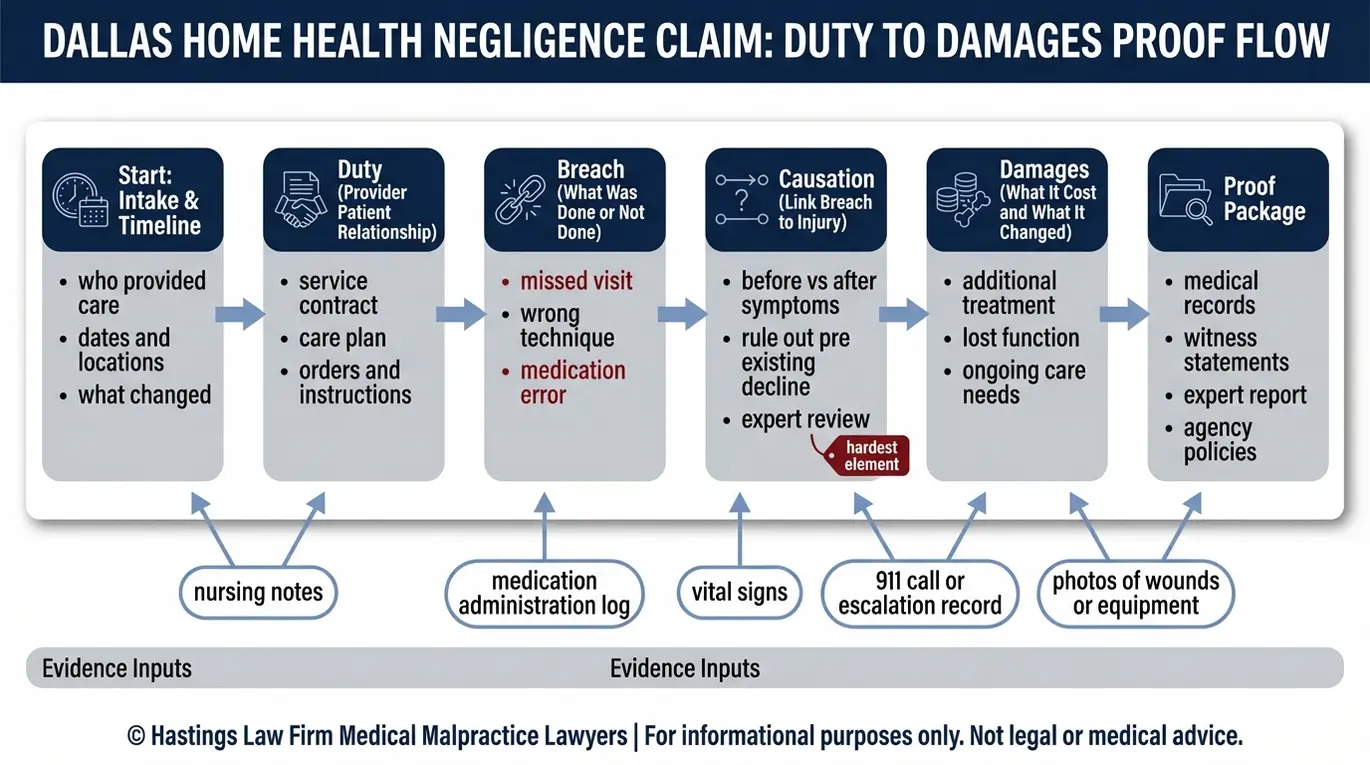
Proving negligence requires clear evidence that the provider owed a duty of care, breached that duty through action or inaction, and directly caused specific, documented damages to the patient. Each of these elements must be established before a home health negligence claim can succeed. In a Dallas medical malpractice case, proving negligence means showing a provider failed to meet the required standard of care.
Duty is typically the simplest element to establish. Once a home health agency accepts a patient and begins providing services, a provider-patient relationship exists. Service contracts, intake paperwork, and physician referral orders all help establish this connection.
Breach involves a detailed investigation into specific failures. We look for specific failures: a nurse who did not show up for a scheduled visit, an aide who used improper lifting techniques, or a therapist who ignored a patient’s complaints of increasing pain. Identifying these facts is essential when suing a home health agency. Under Texas Civil Practice and Remedies Code § 74.351, a malpractice provider lawyer must file a report early in the case confirming that the provider’s conduct fell below the accepted standard.
Causation is often the most difficult element to prove. The defense will argue that the patient’s injury was pre-existing or the result of their underlying condition, not the provider’s error. Our medical team, which includes nurse consultants and access to a national network of expert witnesses, analyzes records to build a timeline showing exactly when the patient’s condition changed.
Damages must be documented with specificity. Medical bills, records of additional treatment, and evidence of physical decline all support this element.
Evidence We Gather to Prove Your Claim
- Medication administration records (MARs), the logs showing what drugs were given and when
- Medication reconciliation documents, the records tracking whether the correct prescriptions were being managed
- Visit logs and time-stamped caregiver check-in records
- Physician orders and the plan of care
- Internal agency communications, including supervisor notes
- Witness testimony from family members present during care
- Photographs of injuries such as bedsores or bruising
Each piece of evidence helps connect Dallas provider liability to the patient’s harm.
The Hastings Law Firm Difference
Results matter, but what truly sets us apart is how we achieve them. Every verdict, every settlement, and every Dallas courtroom victory comes from one guiding promise: To treat each client’s fight for justice as if it were our own.
This balance of skill, experience, and empathy reflects our core philosophy that justice should not only compensate the injured, but also make health care safer nationwide.

Liability for Visiting Nurses and Home Health Agencies
Liability can extend to the individual caregiver for their actions and to the employing agency for negligent hiring, training, or supervision of their staff. Liability identifies who is legally responsible for the harm caused to a patient.
The Agency. A home health agency can be held liable if it failed to properly vet employees or ignored complaints. This supervisory role distinguishes home care from hospital negligence or nursing home care environments. We examine vicarious liability, which means the agency is responsible for the actions of its staff, and contractor vs employee status. If an agency used delegation, the assignment of clinical tasks to an aide who lacked proper certification, that action can be a basis for agency malpractice claims.
State oversight provides additional guidance for these agencies. Texas Health and Human Services provides oversight guidance for home and community support services agencies.
The Individual. The nurse, physical therapist, or aide who directly committed the error can be held personally liable. A provider negligence attorney will evaluate the caregiver’s training records and disciplinary history.
Third Parties. In some cases, a home medical device may have malfunctioned, shifting liability to the equipment manufacturer. A Dallas home care lawyer examines every contributing factor.
Determining Multiple Liable Parties
Home health cases often involve layers of liability. Determining liability often involves identifying multiple parties who contributed to a patient’s injury. The referring doctor who wrote the physician’s orders, the formal medical instructions guiding care, may bear responsibility if those orders were unclear. The agency responsible for care coordination, the structured process of managing a patient’s transition between providers, may have failed to communicate critical information. Texas laws regarding joint and several liability help determine how fault is allocated among these parties. This rule determines how financial responsibility is shared when multiple parties are at fault.
Common Negligence by Home Health Providers
Common forms of negligence include medication errors, failure to treat bedsores, dropping patients during transfers, and ignoring signs of infection or distress. These are not rare events. Medical negligence in home health care involves specific errors that occur during visiting care. They represent recurring patterns that our medical and legal team sees in home health cases across Dallas and throughout Texas.
Medication Errors. Overdosing, under-dosing, administering the wrong drug, or giving it at the wrong time can have serious consequences. According to the Agency for Healthcare Research and Quality (AHRQ) Patient Safety Network, medication ordering errors remain one of the most frequently reported safety events in healthcare. In a home setting, medication errors at home can go unnoticed for days because there is no second nurse checking the work. A Dallas medical malpractice lawyer investigates whether proper protocols were in place.
Wound Care Failures. Pressure ulcers, commonly called bedsores, are staged from I to IV based on severity. When a home health aide neglects repositioning schedules or fails to report early signs of skin breakdown, a manageable condition can become life-threatening. Surgical errors during post-op care or misdiagnosis of a developing infection also occur in this setting.
Fall Accidents. Patients who need help moving from a bed to a wheelchair are vulnerable during transfers. A gait belt, a safety device worn around the patient’s waist to provide a secure grip, should be used during these movements. Dropping a patient because of improper technique is a clear provider error.
Failure to Escalate. Perhaps the most dangerous form of caregiver malpractice is the failure to recognize and respond to a medical emergency. If a patient’s vitals crash, the caregiver has a duty to call 911 immediately. A delayed diagnosis or failure to report worsening symptoms to the supervising physician can lead to wrongful death. A home nursing mistake of this magnitude demands a thorough investigation.

Damages Recoverable in Home Care Negligence Lawsuits
Patients and families affected by home care negligence may recover compensation for malpractice, including economic damages for medical bills and lost care costs, as well as non-economic damages for pain, suffering, and mental anguish. Damages are the financial and personal losses a patient suffers due to medical errors. The specific compensation available depends on the severity of the injury, the patient’s circumstances, and the strength of the evidence.
Economic damages cover measurable financial losses. These include past and future medical expenses, the cost of hiring replacement home care or moving a loved one into a higher level of care, and lost wages or loss of earning capacity if the injured patient can no longer work. Wage and employment data from the U.S. Bureau of Labor Statistics Occupational Employment and Wage Statistics for Texas can help document projected income losses. Economic damages are not subject to a statutory cap in Texas.
Non-economic damages address the human cost: physical pain, emotional trauma, loss of independence, and, in wrongful death cases, loss of companionship for surviving family members. Texas does impose caps on non-economic damages in medical malpractice cases, which your attorney will explain during your consultation.
Punitive damages may be available in rare cases involving gross negligence. While suing for neglect of this nature is uncommon, it is an option we evaluate to ensure a fair provider liability payout.
A Dallas injury settlement or verdict should account for the full scope of harm, both what has already been lost and what will be needed going forward.
Statute of Limitations for Filing Home Health Claims
In Texas, you generally have two years from the date of the negligent act or omission to file a medical malpractice claim, though exceptions exist for minors and cases involving undiscovered injuries. A statute of limitations is the legal time limit for filing a medical malpractice lawsuit in Texas. This deadline is strict, and missing it almost always means losing the right to pursue your case.
The two-year rule is codified in Texas Civil Practice and Remedies Code Chapter 74. The statute of limitations Texas enforces makes timing critical. If the injury was not immediately apparent, the discovery rule may apply, starting the clock from the date the patient knew or should have known about the harm. This time limit to sue may be extended for minors, but these exceptions are narrow.
Waiting too long creates practical problems beyond the legal deadline. Medical records can be lost, staff members leave, and memories fade. Contacting an attorney before the Dallas malpractice deadline protects your ability to preserve evidence. Filing a lawsuit begins with a conversation, not a commitment.
Contact the Dallas Healthcare Malpractice Attorneys at Hastings Law Firm Today for Help
Home health agencies accept a responsibility when they send a caregiver into your loved one’s home. Hastings Law Firm provides legal representation for families handling home health negligence cases. When that responsibility is not honored, families deserve honest answers and a clear path forward.
Hastings Law Firm focuses exclusively on medical malpractice. Our team includes in-house nurse consultants, former defense attorneys who understand how agencies and insurers build their cases, and a national network of medical experts. Our founder, Tommy Hastings, has dedicated over two decades to this field and is Board Certified in Personal Injury Trial Law, a credential held by fewer than 2% of Texas lawyers.
Founded by board-certified trial attorney Tommy Hastings, our firm prepares every case as if it will go to trial, because that level of preparation is what it takes to hold powerful healthcare organizations accountable.
We represent clients on a contingency fee basis, which means you pay no attorney fees or costs unless we recover compensation on your behalf. If you believe a home health provider’s negligence harmed someone you love, contact our Dallas office to speak with a Board Certified Patient Advocate. Your consultation is free, confidential, and carries no obligation. Let us help you find the answers you deserve.
Frequently Asked Questions About Home Health Care Provider Malpractice in Dallas


This content was researched and written by the Hastings Law Firm editorial team, which includes attorneys, medical professionals, and experienced researchers. Our writing is informed by internal knowledge and practical experience, and we cross-check critical details against authoritative sources cited throughout. Every piece undergoes human-led fact-checking and legal review. Because legal and medical information can change, if you spot an error, please contact us. Learn more about our content standards and review process on our editorial policy page.

Brady D. Williams is a nationally recognized medical malpractice attorney who has spent his career handling high-stakes litigation for injured patients and families across the country. Licensed in both Texas and California, Brady draws on experience from hundreds of resolved medical cases to break down complex legal and medical topics for the people who need that information most. His writing reflects the same attention to detail and commitment to clarity that he brings to every case he handles.
