


Dallas Laparoscopic Surgery Error Lawyer
Laparoscopic surgery is often promoted as minimally invasive, but mistakes during entry, visualization, or closing can cause serious internal injuries and delayed complications. Harm may not be obvious until symptoms worsen after discharge, and missed warning signs can lead to infection, emergency intervention, long hospital stays, lasting impairment, or fatal outcomes. Consent forms do not excuse negligent technique or inadequate postoperative care, and responsibility may extend beyond the surgeon to hospitals, anesthesia providers, or device makers. If you or a loved one were harmed or worse due to laparoscopic surgery errors in Dallas, Texas, contact Hastings Law Firm for a free, confidential case review.

Last Updated: July 27, 2026
Trusted Dallas Medical Attorneys for Surgical Negligence Claims
When a procedure that was supposed to be routine leaves you or a loved one facing unexpected complications, the confusion and frustration can feel overwhelming. Laparoscopic surgery, a minimally invasive approach that uses small incisions and a camera to perform procedures inside the abdomen, is widely considered safer than traditional open surgery. But when errors occur during these procedures, the injuries can be severe and life-altering.
At Hastings Law Firm, we focus exclusively on medical malpractice cases. Our team includes in-house nurse consultants and former defense attorneys who understand exactly how hospitals and insurers respond to surgical injury claims. If you believe a surgical error caused you harm, a Dallas laparoscopic surgery error lawyer at our firm can review your medical records, explain what may have gone wrong, and help you understand your legal options.
Reach out for a free, confidential case evaluation. There is no fee unless we recover compensation for you.

Common Errors Committed During Laparoscopic Procedures
Laparoscopic errors frequently involve the accidental cutting or perforation of internal organs, blood vessels, or bowels caused by the blind insertion of the trocar or poor visualization during the procedure. These injuries can go unnoticed during surgery and may not produce symptoms until days later. We look for evidence of damage to internal organs that may have occurred during the initial entry or throughout the operation.
Trocar Entry Injuries
Surgeons must handle a trocar, a sharp, pointed instrument used to puncture the abdominal wall and create a port for the camera and surgical tools, with extreme care during laparoscopic surgery. Doctors sometimes call the initial trocar insertion a “blind” entry because the surgeon cannot yet see the internal organs. If the trocar is inserted with too much force or at an improper angle, it can puncture the bowel, bladder, or a major blood vessel before the camera is even in place. A laparoscopic surgery attorney can work with medical experts to determine whether the entry technique met accepted safety protocols.
Accidental Nicks and Perforations
In laparoscopic surgery, once inside the abdomen, surgeons rely on a video monitor for guidance. Electrosurgical tools used to cut and cauterize tissue can accidentally burn or nick adjacent organs. Bowel perforation, a nicked bowel where instruments damage the intestinal wall, occurs when these tools strike the wrong tissue. Because the injury may be small and the surgical field is limited on screen, a Dallas surgical error lawyer often finds that these perforations went undetected during the procedure itself.
Retained Objects
Surgical teams must account for every sponge, clip, and instrument before closing after a laparoscopic procedure. Healthcare safety groups consider leaving objects behind in the abdominal cavity a preventable “never event,” which means it should not happen under any circumstances. According to the Agency for Healthcare Research and Quality (AHRQ) Patient Safety Network, retained surgical instruments and items remain a persistent patient safety problem linked to serious complications including infection, obstruction, and reoperation.
Common laparoscopic surgical errors that should not occur include:
- Uncontrolled trocar insertion causing organ or vascular perforation
- Thermal burns to the bowel or bladder from electrosurgical instruments
- Failure to identify and repair an organ injury before closing
- Retained sponges, clips, or instrument fragments in the abdominal cavity
- Operating on the wrong part of the body
If you suspect any of these errors contributed to your injury, consulting a laparoscopic malpractice attorney is an important first step toward understanding what happened.
Complications from CO2 Insufflation
Laparoscopic procedures require the surgeon to inflate the abdomen with CO2 gas to create working space, a process called pneumoperitoneum. While this is standard practice, it carries unique risks. If the gas enters a blood vessel, it can cause a gas embolism, a potentially fatal condition where a bubble of gas blocks blood flow to the heart or lungs. Excessive internal pressure from over-insufflation can also compress blood vessels and affect heart function, making careful anesthesia monitoring essential throughout the procedure. When anesthesia errors occur, such as failing to detect these pressure changes, the consequences can be severe.

Physical Consequences of Nicked Organs and Sepsis
If a surgeon fails to notice a nicked bowel during surgery, leakage into the abdomen can cause peritonitis and sepsis, leading to multi-organ failure and death if not treated immediately. Left untreated, peritonitis, a dangerous infection of the abdominal lining, can rapidly progress to sepsis, the body’s overwhelming and life-threatening response to infection.
What makes bowel perforation during a laparoscopic procedure especially dangerous is the delay between injury and symptoms. Patients are often sent home and told their recovery is normal. It may be hours or even days before signs of perforated bowels like worsening abdominal pain, fever, rapid heart rate, and confusion appear. By that time, the infection may have spread significantly. This kind of surgical negligence, failing to detect a perforation or committing postoperative care errors like dismissing a patient’s symptoms, can turn a recoverable complication into a fatal one.
The progression from peritonitis to septic shock can be rapid. Organ systems begin to fail, blood pressure drops, and emergency intervention becomes necessary. Patients who survive often require additional open surgeries to repair the original damage, drain infected fluid, and remove damaged tissue.
These corrective procedures carry their own risks and can result in prolonged hospitalization, permanent scarring, and a drastically longer recovery. In the most tragic cases, undiagnosed bowel perforation and the resulting sepsis lead to wrongful death. Surgical malpractice claims in these situations focus on whether the surgical team met the standard of care both during and after the procedure.
The Hastings Law Firm Difference
Results matter, but what truly sets us apart is how we achieve them. Every verdict, every settlement, and every Dallas courtroom victory comes from one guiding promise: To treat each client’s fight for justice as if it were our own.
This balance of skill, experience, and empathy reflects our core philosophy that justice should not only compensate the injured, but also make health care safer nationwide.

Proving Negligence Despite Signed Consent Forms
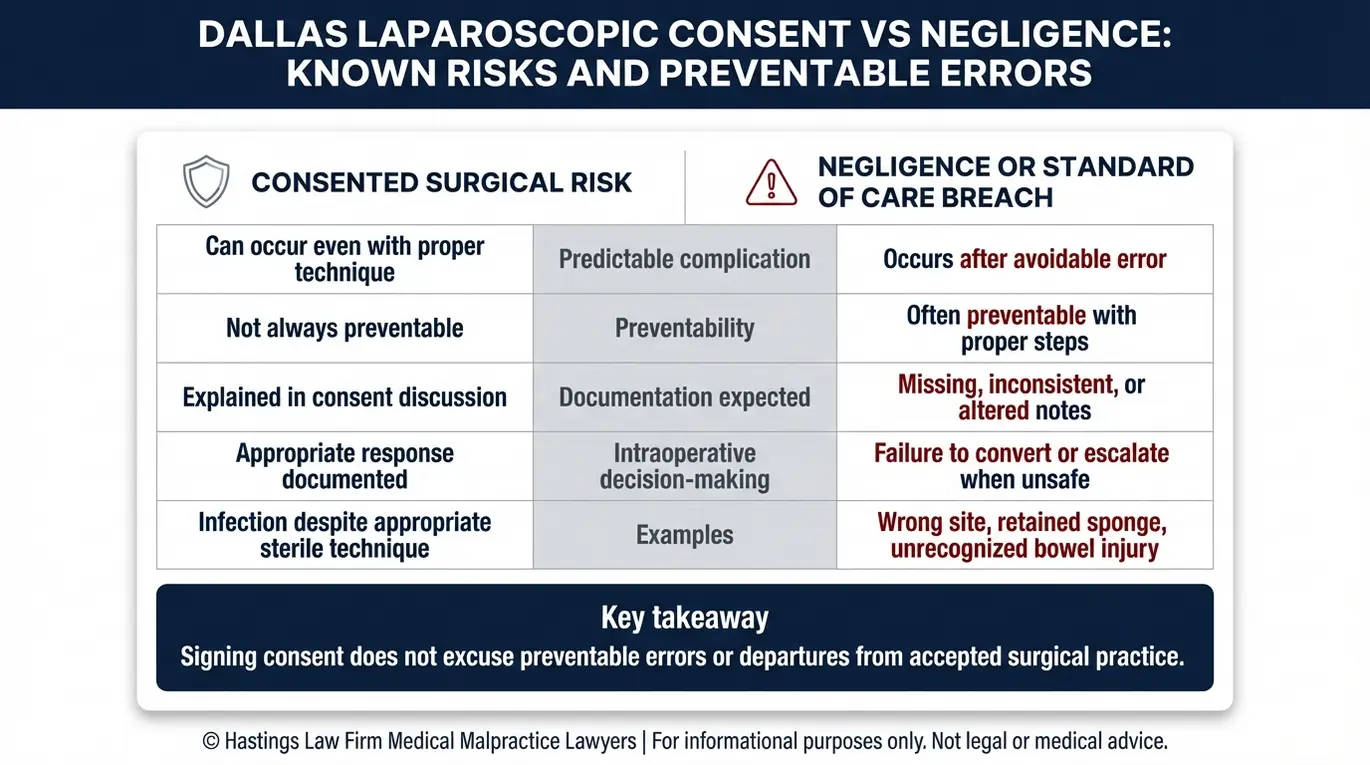
Signing a surgical consent form acknowledges known risks but does not grant the surgeon permission to act negligently or deviate from the accepted standard of care. This is one of the most common misunderstandings we encounter when speaking with potential clients.
The standard of care is the level of treatment that a reasonably competent surgeon in the same specialty would have provided under similar circumstances. For example, if a surgeon loses clear visualization during a laparoscopic procedure, the standard of care may require conversion to open surgery, known as a laparotomy, to safely complete the operation. Continuing to operate blindly or with inadequate visibility could constitute a breach of that standard.
A consent form typically lists known complications such as bleeding, infection, or organ injury. These are risks that can occur even when everything is done correctly. But preventable errors caused by poor technique, inadequate preparation, or failure to follow established protocols are not “known risks.” They are potential negligence. While patients must provide consent to known surgical risks, they do not consent to malpractice.
Here is how to think about the distinction:
- Known surgical risk: A small bowel perforation that is immediately identified and repaired during surgery, with the patient properly monitored afterward
- Potential negligence: A bowel perforation caused by careless instrument handling that goes undetected because the surgeon failed to inspect the operative field, followed by dismissal of the patient’s worsening symptoms
A Dallas surgical malpractice lawyer works with qualified medical experts to compare what happened in your laparoscopic case against what should have happened under the applicable standard of care. Under the Texas Civil Practice and Remedies Code, Chapter 74, medical malpractice claims in Texas require expert support to establish that the provider’s conduct fell below accepted medical standards.
Identifying Liable Parties in Your Case
Liability may extend beyond the lead surgeon to include the hospital for inadequate staffing, the equipment manufacturer for defective devices, or the anesthesiologist for monitoring failures. Identifying every responsible party is an important part of building a strong claim.
The surgeon bears individual responsibility for technical errors committed during the procedure, such as improper trocar insertion or failure to recognize an organ injury. But the hospital may also share liability for hospital negligence if it failed to properly credential the surgeon or allowed inadequate staffing in the operating room. It may also be responsible for lacking protocols for instrument counts that could have prevented retained surgical items (RSI), such as sponges or clips.
In some cases, electrosurgical (thermal) injury occurs when the instruments themselves are defective. If a trocar, grasper, or electrosurgical device malfunctioned and contributed to the injury, the device manufacturer may be liable under medical product liability law. The U.S. Food and Drug Administration (FDA) maintains a database of medical device recalls that can help determine whether the equipment used in your surgery had known safety issues. The anesthesiologist may also be liable for anesthesia errors if monitoring failures during CO2 insufflation contributed to the harm.
Recoverable Damages for Surgical Injuries in Texas
Victims of laparoscopic errors in Texas may recover economic damages for medical bills and lost wages, as well as non-economic damages for pain, suffering, and physical impairment. The goal of compensation for surgical errors is to address the full scope of harm caused by the negligence.
| Economic Damages | Non-Economic Damages |
|---|---|
| Past and future medical bills, including corrective surgeries and rehabilitation | Physical pain and suffering caused by the injury and recovery |
| Lost wages during recovery | Mental anguish and emotional distress |
| Loss of earning capacity if the injury affects long-term employment | Physical impairment or disfigurement, including scars from open corrective surgery |
| Out-of-pocket costs for prescriptions, home care, and medical equipment | Loss of enjoyment of life and daily activities |
Economic damages are calculated based on documented financial losses and projected future costs. Non-economic damages reflect the personal toll of the injury. We evaluate both categories carefully to build a full picture of how the surgical error has affected your life.
Understanding the Texas Statute of Limitations and Discovery Rule
In Texas, medical malpractice claims must generally be filed within two years of the injury, though the Discovery Rule may extend this if the error was not immediately discoverable. Missing this deadline can permanently bar your right to seek compensation, regardless of how strong the evidence may be.
The Two-Year Rule
The standard filing deadline under the Texas statute of limitations is two years from the date of the negligent act. For most laparoscopic surgery errors, the clock starts on the date of the procedure.
The Discovery Rule
Some surgical injuries are not immediately apparent. A retained sponge may not cause symptoms for weeks or months. A thermal burn to the bowel may be misdiagnosed as a routine postoperative complication. In these situations, the discovery rule may apply, allowing the two-year clock to start from the date the patient knew or reasonably should have known about the injury rather than the date of surgery.
⚠️ Statute of Repose: The Absolute Deadline
Even with the discovery rule, Texas imposes a 10-year statute of repose. This means no medical malpractice claim can be filed more than 10 years after the date of the negligent act, regardless of when the injury was discovered. This hard cutoff makes it essential to consult with an attorney as soon as you suspect something went wrong.
Immediate Steps After a Suspected Surgical Error
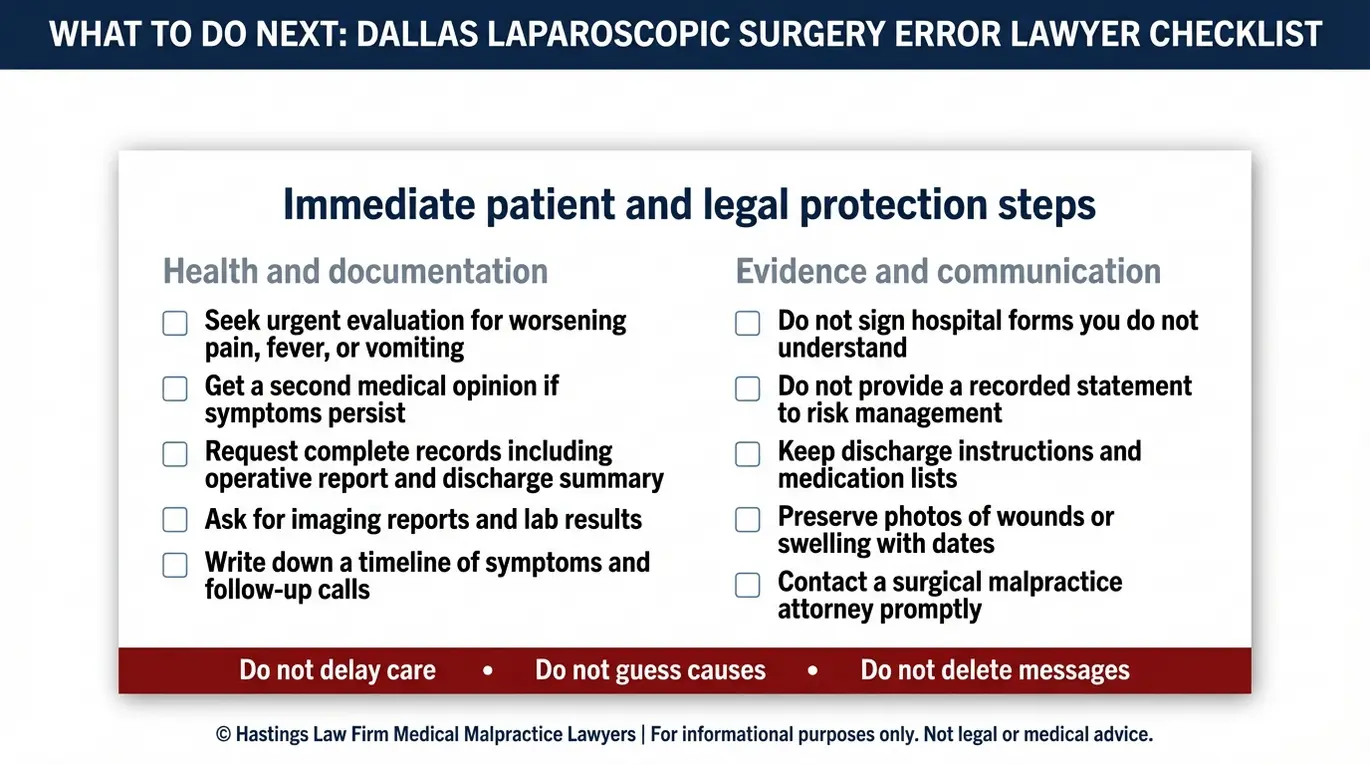
Patients should immediately seek a second medical opinion to stabilize their health, request a full copy of their medical records, and contact a specialized malpractice attorney before speaking to hospital risk management. Here is what a Dallas surgical errors attorney would recommend:
- Get immediate medical attention. Your health comes first. Seek a second medical opinion to diagnose and treat the suspected injury. Emergency care records also create important documentation of your condition.
- Request your complete medical records. Under the U.S. Department of Health and Human Services HIPAA guidelines, you have the right to access your health information. Request operative reports, anesthesia logs, nursing notes, and discharge summaries. Do not rely on the hospital to preserve this evidence on your behalf.
- Do not sign anything from the hospital’s risk management team. Hospital representatives or risk managers may contact you after a complication. Anything you sign or say could be used to limit the hospital’s liability.
- Contact a specialized malpractice attorney before making statements. Speaking with an experienced legal team who can consult with expert witnesses before engaging with the hospital or its insurers helps protect your claim from the start.
Contact the Dallas Surgical Error Attorneys at Hastings Law Firm Today for Help
If a laparoscopic procedure left you or someone you love with unexpected injuries, you deserve straight answers about what happened and whether negligence was involved. Hastings Law Firm exists to restore trust after the medical system fails its patients.
Our legal team, which includes former hospital defense attorneys and in-house medical professionals, investigates surgical error claims with the same rigor we would bring to a jury trial. We know how defense teams build their arguments because we used to be on that side. That insight shapes every case we take.
Founded by board-certified trial attorney Tommy Hastings, our firm has recovered millions for clients across Texas, including surgical injury and medical negligence cases handled through our Dallas office. We prepare every case as if it is going to trial, which puts us in the strongest possible position whether we are negotiating a settlement or presenting evidence to a jury.
As your Dallas laparoscopic surgery error lawyer, we offer a free, confidential case evaluation with no obligation. You pay nothing unless we secure a recovery. Contact Hastings Law Firm today so we can review your records, explain your options, and help you take the first step forward.
Frequently Asked Questions About Laparoscopic Surgery Error in Dallas


This content was researched and written by the Hastings Law Firm editorial team, which includes attorneys, medical professionals, and experienced researchers. Our writing is informed by internal knowledge and practical experience, and we cross-check critical details against authoritative sources cited throughout. Every piece undergoes human-led fact-checking and legal review. Because legal and medical information can change, if you spot an error, please contact us. Learn more about our content standards and review process on our editorial policy page.

Brady D. Williams is a nationally recognized medical malpractice attorney who has spent his career handling high-stakes litigation for injured patients and families across the country. Licensed in both Texas and California, Brady draws on experience from hundreds of resolved medical cases to break down complex legal and medical topics for the people who need that information most. His writing reflects the same attention to detail and commitment to clarity that he brings to every case he handles.
