


Dallas Unnecessary Surgery Lawyer
Learning that a surgery may not have been medically justified can leave lasting physical and emotional harm. Unnecessary procedures can bring pain, scarring, prolonged recovery, and ongoing health problems, along with the distress of feeling rushed, coerced, or not fully informed about safer alternatives. These situations often turn on whether the decision to operate matched accepted medical standards and whether conservative care was reasonably considered first. Clear records and careful review of the clinical rationale can matter when the outcome feels avoidable. If you or a loved one were harmed or worse due to unnecessary surgery in Dallas, Texas, contact Hastings Law Firm for a free, confidential case review.

Last Updated: July 27, 2026
Trusted Dallas Malpractice Attorneys for Unneeded Medical Procedures
When you trusted a surgeon to act in your best interest and later learned the procedure may not have been medically justified, the sense of betrayal can be overwhelming. You may be dealing with pain, scarring, a longer recovery, or lingering health problems from a surgery that should never have happened. These feelings are valid, and you deserve honest answers about what went wrong.
Founded by Tommy Hastings, who is Board Certified in Personal Injury Trial Law by the Texas Board of Legal Specialization, Hastings Law Firm focuses exclusively on medical malpractice. Our firm has represented patients in medical negligence cases since 2005. Our team, which includes in-house medical staff and former defense attorneys, understands how to investigate whether a surgery met the accepted standard of care or whether it should have been avoided entirely. As a Dallas unnecessary surgery lawyer team with deep experience in surgical negligence cases, we know how to uncover the truth inside medical records, billing data, and operative reports.
If you or a loved one had a procedure that felt rushed, coerced, or unjustified, we can review what happened and explain your legal options at no cost.

Proving Texas Malpractice After an Unnecessary Surgery Is Performed
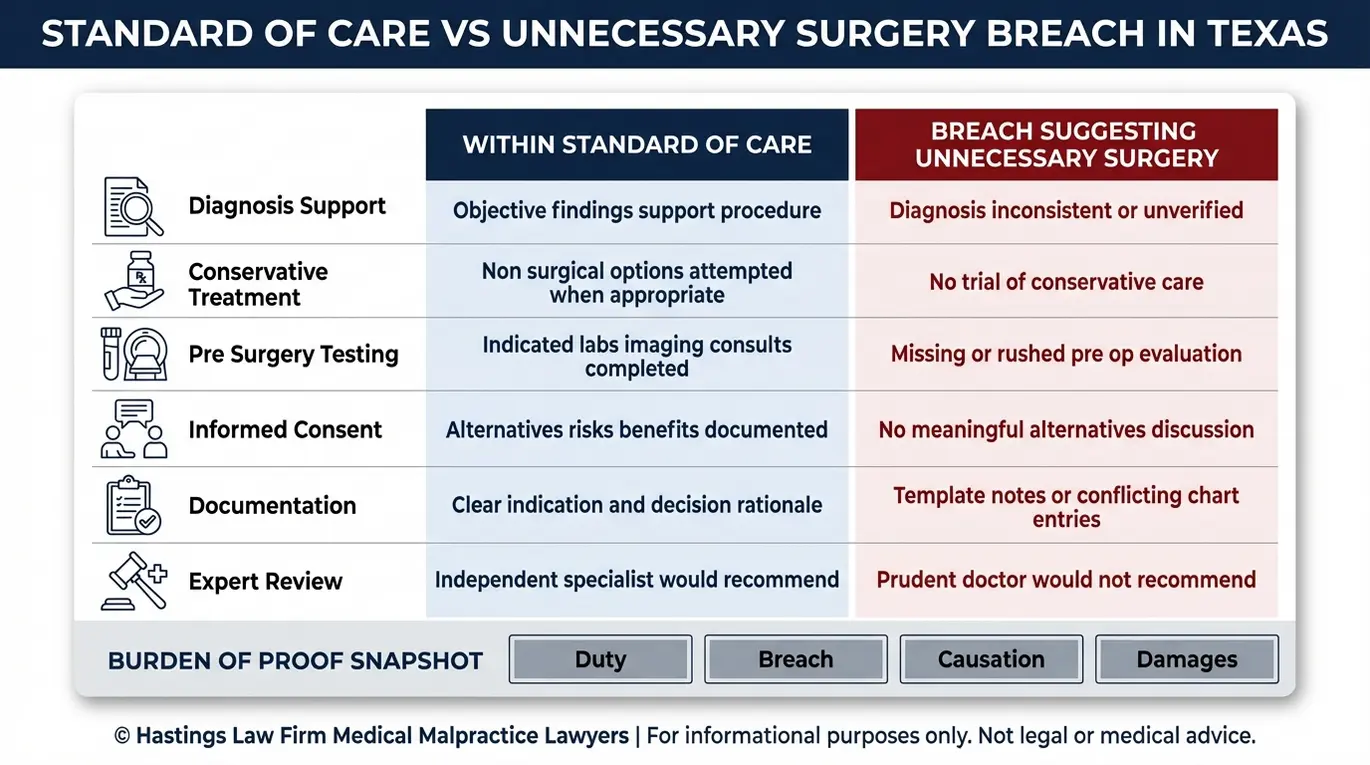
Proving that a surgery was unnecessary in Texas requires demonstrating that the physician deviated from the accepted standard of care and performed a procedure that a prudent doctor would not have recommended under similar circumstances. This is the foundation of every unnecessary surgery claim, and it sets the bar high for both sides.
The standard of care refers to the level of treatment a reasonably competent physician in the same specialty would provide under similar clinical circumstances. In the context of surgical decisions, this means showing that a qualified surgeon, given the same test results, patient history, and symptoms, would not have recommended the operation. Instead, they would have pursued conservative treatment, meaning non-surgical management such as medication, physical therapy, monitoring, or other less invasive options, before resorting to the operating room.
Understanding Texas medical malpractice laws is complex because the statute protects physicians from frivolous lawsuits and imposes strict procedural hurdles. Under the Texas Civil Practice and Remedies Code Chapter 74, a plaintiff must file an expert report within 120 days of the defendant’s answer. That report must come from a qualified medical professional who can explain how the physician’s decision to operate fell below the standard of care and how it caused harm. If no report is served within that deadline, the court must dismiss the case with prejudice, and if a report is served but found deficient, the court may grant only one 30-day extension to cure the deficiency before dismissal.
Expert witness testimony becomes essential at this stage to bridge the gap between medical data and legal requirements. Medical experts review the pre-surgery testing, the clinical findings, and the documented rationale for the procedure to determine whether medical necessity, the clinical justification required before performing an operation, actually existed.
These cases are difficult to prove without attorneys who understand both the legal framework and the medicine behind the surgical decision. Our team includes former hospital defense lawyers and experienced nurse consultants who know how to read between the lines of a medical chart. When you seek legal help for unneeded procedures, you need that kind of dual insight.
A Dallas surgical malpractice lawyer from our firm can ensure your claim is supported by the necessary medical evidence to withstand scrutiny from defense teams. The burden of proof lies entirely with the plaintiff to show that no reasonable physician would have operated under the same conditions.
What Must Be Proven in an Unnecessary Surgery Claim:
- The surgeon owed a duty of care to the patient
- The surgeon deviated from the accepted standard of care by recommending or performing a medically unjustified procedure
- Conservative treatment options existed and were not adequately explored or offered
- The patient suffered harm as a direct result of the unnecessary operation
- A qualified medical expert can confirm that a competent surgeon would not have performed the procedure under the same circumstances
Common Types of Unnecessary Procedures Our Dallas Attorneys Litigate
Common medically unjustified surgeries often include hysterectomies involving benign fibroids, spinal fusions for back pain that could be managed physically, and cardiac catheterizations performed without sufficient diagnostic evidence of blockage. These are among the most frequently litigated unnecessary surgery cases in Texas, and each one follows a recognizable pattern.
Physicians generally follow established clinical guidelines to determine if an operation is required. When a surgeon recommends medically unjustified procedures without following these protocols, it may indicate negligence. Our team reviews these cases to see if alternative, non-surgical treatments were ignored.
Gynecological Errors. These claims often involve unnecessary hysterectomies where less invasive options like medication or ablation were skipped. In many cases, patients with benign uterine fibroids or manageable bleeding are directed toward full hysterectomies when less invasive options, such as medication, ablation, or myomectomy, could have preserved the uterus. For a patient who was not informed about those alternatives, the consequences are permanent and life-altering.
Orthopedic Overreach. Cases of orthopedic overreach often involve Spinal fusion, which is a high-risk procedure that permanently joins vertebrae to reduce motion and relieve pain. Yet it is one of the most frequently performed operations in the United States. Variations in regional surgical rates, documented by the Dartmouth Atlas of Health Care surgical discharge data, suggest that clinical need alone does not always drive these decisions. When physical therapy, injections, or other conservative treatment could have been tried first, a spinal fusion may constitute a medically unjustified procedure. Reimbursement rates for fusions are often higher than for decompression surgeries, which can influence recommendations.
Cardiac Procedures. Cardiac procedures may involve invasive intervention like stenting when the patient is stable and has no acute symptoms warranting surgery. Cardiac catheterization, a procedure in which a thin tube is threaded through a blood vessel to diagnose or treat heart conditions, is sometimes performed on stable patients who show no acute symptoms warranting invasive intervention. Placing stents in patients without significant blockage exposes them to anesthesia, bleeding, and infection risks without a corresponding medical benefit.
| Procedure Type | Why It May Be Considered Unnecessary |
|---|---|
| Hysterectomy | Less invasive options (medication, ablation) were not explored for benign conditions |
| Spinal Fusion | Physical therapy or pain management could have addressed symptoms without surgery |
| Cardiac Catheterization/Stenting | Performed on stable patients without adequate diagnostic evidence of blockage |
| Gall Bladder Removal | Surgery performed based on incomplete imaging or vague symptoms |
| Bariatric Surgery | Dietary and behavioral interventions were not attempted or properly documented |
| Cosmetic Procedures | Performed by unqualified providers or without proper informed consent |
Cosmetic Surgery Fraud and Medical Spa Negligence
The growth of medical spas, which are non-hospital facilities that offer medical-grade cosmetic procedures, has introduced another category of unnecessary surgery risk. A medical spa (sometimes called a “med spa”) often operates under the license of a supervising physician who may not be on-site or directly involved in patient care. Credentialing, the process by which a facility verifies a provider’s qualifications and training, can be minimal or nonexistent in these settings.
This lack of oversight leads to cosmetic surgery errors and complications from unqualified doctors or untrained staff performing invasive work. We also see rising instances of bariatric surgery malpractice, where weight-loss surgeries are performed on patients who do not meet medical guidelines. When unqualified providers perform invasive cosmetic procedures without proper training, adequate pre-operative assessment, or meaningful informed consent, patients can suffer serious complications. If you have been harmed, a lawyer for surgical errors can investigate whether the facility met the minimum safety standards required by Texas law.
The Hastings Law Firm Difference
Results matter, but what truly sets us apart is how we achieve them. Every verdict, every settlement, and every Dallas courtroom victory comes from one guiding promise: To treat each client’s fight for justice as if it were our own.
This balance of skill, experience, and empathy reflects our core philosophy that justice should not only compensate the injured, but also make health care safer nationwide.

Why Do Surgeons Perform Medically Unjustified Procedures
Unnecessary surgeries often occur due to financial incentives, misdiagnosis of the patient’s condition, or a lack of informed consent regarding less invasive alternatives. While no one can assume a surgeon’s intent without evidence, the circumstances surrounding many of these cases point to identifiable systemic problems.
Financial Structures That Reward Volume. Under a fee-for-service (FFS) payment model, where providers are reimbursed for each individual procedure rather than for patient outcomes, there is an inherent incentive to perform more surgeries. This systemic focus on billing volume can warp clinical judgment. Fraudulent billing, the practice of submitting claims for procedures that were medically unjustified or misrepresented to insurers, can compound the problem.
When a surgeon’s income depends on surgical volume, the threshold for recommending an operation may shift. We act as lawyers for surgical fraud patients to expose these financial conflicts.
Diagnostic Error. Misdiagnosis is one of the most common contributing factors. A misread MRI, an over-interpreted lab result, or an incomplete workup can lead a physician to recommend surgery for a condition the patient does not actually have, or for a condition that does not require surgical intervention.
Systemic Failures in Oversight. Hospitals and surgical centers have a responsibility to credential and monitor the physicians who operate within their facilities. When a facility fails to review a surgeon’s outcomes, complication rates, or pattern of aggressive billing, it may enable a cycle of medically unjustified procedures. Insurance fraud is often a byproduct of these environments, where procedures are coded to maximize payouts rather than treat the patient.
Common factors we examine when suing for unnecessary operations include:
- Fee-for-service billing patterns that suggest volume-driven decision-making
- Incomplete or rushed pre-operative diagnostic workups
- Failure to document that conservative treatment was considered or offered
- A pattern of the same surgeon recommending invasive procedures at higher-than-expected rates
- Lack of informed consent regarding non-surgical alternatives
- Negligent credentialing by the hospital or surgical facility

Determining Medical Necessity and Reviewing Surgical Records
Determining necessity involves a forensic review of pre-operative testing, pathology reports, and imaging to see if the patient’s symptoms truly warranted surgical intervention according to clinical guidelines. This is the investigative core of every unnecessary surgery claim, and our medical-legal team approaches it with a structured, step-by-step method.
You have a right to obtain your own medical records. Under 45 CFR § 164.524, enforced by the U.S. Department of Health and Human Services, individuals can request access to their complete health information, including operative reports, imaging, lab work, and pathology results. Reviewing unnecessary surgery claims starts with securing this documentation.
Once we have the records, our in-house nurse consultants and medical experts follow a defined review process involving deep surgical record analysis:
- Analyze the Chief Complaint Against the Surgical Indication. A surgical indication is the documented medical reason justifying an operation. We compare the patient’s original symptoms and complaints to the rationale the surgeon recorded to see if they align.
- Review Pathology Reports. A pathology report is the laboratory analysis of tissue removed during surgery. We examine these reports to see if the tissue was healthy or if the condition was manageable without surgery.
- Compare the Timeline of Care Against Standard Protocols. We build a detailed timeline showing when tests were ordered and whether the pace of care left adequate time for a trial of conservative treatment. Rushed timelines without documented clinical urgency can suggest a surgical error in judgment.
We also investigate any post-surgery complications to see if they resulted from the unneeded intervention. Our team includes experienced nurses who previously worked inside hospital systems and attorneys who formerly defended healthcare providers. As a Dallas medical negligence attorney team, that background gives us the ability to spot charting inconsistencies, missing documentation, and deviations from standard surgical protocols that a general practice firm might overlook.

Securing Compensation for Victims of Surgical Fraud and Negligence
Patients who underwent unnecessary surgery may be entitled to compensation for medical bills, lost wages, pain and suffering, and in cases of gross negligence or fraud, punitive damages designed to punish the provider and deter similar conduct. Securing fair compensation for unnecessary surgery requires a detailed accounting of both current and future losses.
Economic Damages. These cover the measurable financial losses tied to the unnecessary procedure. That includes the cost of the unneeded surgery itself, any corrective or revision surgeries required afterward, rehabilitation expenses, prescription costs, and income lost during recovery. When a surgery that should never have happened leads to months of additional medical care, those costs add up quickly.
Non-Economic Damages. Not every harm shows up on a bill. Patients who endure unnecessary operations often deal with lasting physical pain, emotional distress, permanent scarring, and a diminished quality of life. We aggressively pursue damages for surgical malpractice to account for these intangible losses. A Dallas unnecessary surgery lawyer can work with medical and psychological experts to document these losses and present them clearly to a jury or during settlement discussions. In the most tragic outcomes, we represent families in wrongful death claims where an unjustified procedure resulted in the loss of a loved one.
Punitive Damages. Texas courts may award punitive damages when the evidence shows that a surgeon or facility acted with fraud, malice, or gross negligence. If a procedure was performed primarily for billing purposes rather than patient benefit, punitive damages can become a significant component of the case. These damages go beyond compensating the patient; they are intended to hold the provider accountable and discourage the same behavior in the future.
| Damage Category | Examples |
|---|---|
| Economic Damages | Cost of the unnecessary surgery, corrective procedures, lost wages, ongoing medical care |
| Non-Economic Damages | Pain and suffering, emotional distress, compensation for scarring, loss of quality of life |
| Punitive Damages | Awarded in cases involving fraud, insurance fraud, or gross negligence by the surgeon or facility |
Malpractice Without Direct Physical Injury
Legal claims can arise from risk exposure, which means a patient was subjected to surgery and anesthesia without valid medical necessity. Even if the operation did not result in a visible complication, the patient was still subjected to general anesthesia, surgical incision, infection risk, and recovery, all without valid medical justification. In some circumstances, performing a procedure without true informed consent or medical necessity may support claims of civil battery or fraud. The harm is not limited to what went wrong during the surgery; it includes the fact that the patient was exposed to serious, avoidable risks in the first place. Hospital liability can extend to the facility that permitted the procedure to go forward without adequate oversight.
Contact the Dallas Surgical Error Attorneys at Hastings Law Firm Today for Help
If you or a loved one underwent a procedure that felt rushed, coerced, or medically unjustified, you do not have to sort through the medical records and legal questions alone. Hastings Law Firm focuses exclusively on medical malpractice, and our team includes in-house medical professionals and former defense attorneys who know how hospitals and insurers approach these cases.
We take cases on a contingency fee basis, which means you pay no attorney fees or costs unless we secure a recovery for you. Your consultation is free and confidential.
Whether the surgery involved a questionable diagnosis, a lack of informed consent, or a procedure that a second opinion would have prevented, we can review your records and help you understand what happened. Contact our Dallas medical law firm today to start your investigation.
Frequently Asked Questions About Unnecessary Surgery in Dallas


This content was researched and written by the Hastings Law Firm editorial team, which includes attorneys, medical professionals, and experienced researchers. Our writing is informed by internal knowledge and practical experience, and we cross-check critical details against authoritative sources cited throughout. Every piece undergoes human-led fact-checking and legal review. Because legal and medical information can change, if you spot an error, please contact us. Learn more about our content standards and review process on our editorial policy page.

Brady D. Williams is a nationally recognized medical malpractice attorney who has spent his career handling high-stakes litigation for injured patients and families across the country. Licensed in both Texas and California, Brady draws on experience from hundreds of resolved medical cases to break down complex legal and medical topics for the people who need that information most. His writing reflects the same attention to detail and commitment to clarity that he brings to every case he handles.
