


Dallas Defective Medical Device Lawyer
Defective implantable medical devices can turn a treatment into a lasting injury, leaving patients coping with pain, repeat procedures, and a loss of trust in the systems meant to keep them safe. Harm can stem from design flaws, manufacturing errors, or missing warnings, and responsibility may involve a manufacturer, a healthcare provider, or both. Recalls and FDA reporting can also play a role in understanding what went wrong. If you or a loved one were harmed or worse due to a defective medical device in Dallas, Texas, contact Hastings Law Firm for a free, confidential case review.
Last Updated: July 27, 2026
Trusted Medical Product Liability Attorneys in Dallas
When an implantable medical device, a product surgically placed inside the body to treat or support a medical condition, causes harm instead of healing, the experience can feel deeply disorienting. You trusted your doctor. You trusted the manufacturer. And something still went wrong.
Defective medical devices have caused serious, life-altering injuries to patients across Dallas and throughout Texas. If you or a loved one has been hurt by a product that was supposed to help, you deserve honest answers about what happened and what your legal options are.
As a Dallas defective medical device lawyer, Hastings Law Firm focuses exclusively on medical negligence and product liability cases. Our team of attorneys, nurse consultants, and medical staff can review what happened and explain your options during a free, confidential case evaluation.

How Medical Devices Fail: Understanding Product Liability
A medical device is considered legally defective if it contains a design flaw, a manufacturing error, or a failure to warn patients and doctors about known risks. Each of these defect types creates a distinct basis for a product liability claim, and understanding the difference matters when building a case. The FDA strictly regulates these products, but failures still occur.
A defective medical device attorney will evaluate the evidence to determine which theory of liability applies. In many cases, more than one may be relevant.
- Design defects, flaws inherent to the blueprint itself, make a device unsafe even when it is built exactly as intended. The problem is baked into the specifications. Every unit that comes off the production line carries the same risk because the design itself is fundamentally compromised.
- Manufacturing defects, errors occurring during assembly or production despite a sound design, arise when something goes wrong on the factory floor. A single batch or lot may be affected, meaning only some patients receive a defective product while others receive safe units.
- Marketing defects (failure to warn) happen when a manufacturer knows about potential risks but does not adequately disclose them to doctors or patients. Incomplete safety labeling, missing contraindications, or downplayed side effects can all fall into this category.
There is also the legal theory of breach of warranty, which applies when a device fails to perform as the manufacturer represented it would. And in cases involving negligence, the question becomes whether the manufacturer failed to exercise reasonable care at any point in the product’s lifecycle.
The 510(k) Clearance Process and Patient Safety
In medical product liability cases, many patients assume that every medical device implanted in their body has undergone rigorous clinical testing. That is often not the case.
The FDA 510(k) clearance process, formally known as Premarket Notification, allows manufacturers to bring a new device to market without full clinical trials. The requirement is that the device be “substantially equivalent,” a designation meaning it has a similar intended use and technological characteristics, to a device already on the market.
This regulatory pathway, often criticized as a fast-track for approval, was designed to reduce barriers for innovation. However, it has also allowed devices with serious safety problems to reach patients. If the older “predicate” device was itself flawed, the newer device may inherit those same risks without independent human testing to catch the error.
This loophole has contributed to recalls and patient injuries involving some of the most widely used implants in the country. Manufacturers can bypass the more stringent Pre-Market Approval (PMA) pathway that requires actual safety data.

Common Defective Medical Device Cases We Handle
Common defective device cases involve implants that degrade, migrate, or fail, such as hernia mesh, IVC filters, and metal-on-metal hip implants. Our medical device lawyers in Dallas have reviewed claims involving a wide range of products, and certain categories appear repeatedly.
Orthopedic implants, particularly metal-on-metal hip replacements, have been linked to metallosis, a condition where metal debris sheds into surrounding tissue and causes chronic pain, tissue death, and the need for early revision surgery. Certain knee implants have also been subject to recalls due to premature loosening or component failure.
Surgical mesh products, including hernia mesh and transvaginal mesh (a synthetic material implanted to treat pelvic organ prolapse or stress urinary incontinence), have caused severe complications. Patients have reported mesh migration, chronic infection, organ perforation, and debilitating pain that persists long after the initial procedure.
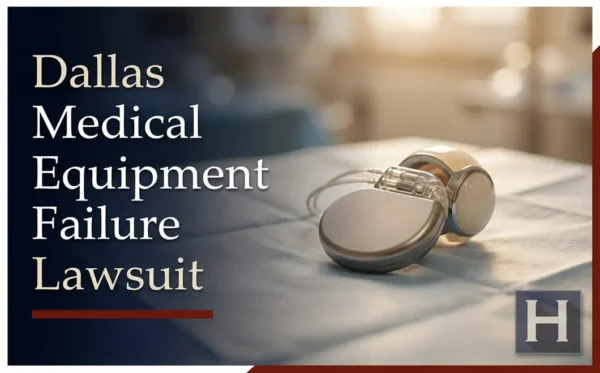
Cardiovascular devices present their own risks. An IVC filter, a small metal device placed in the inferior vena cava (the large vein carrying blood from the lower body to the heart) to catch blood clots, can fracture, migrate, or perforate the vessel wall. Pacemakers and defibrillators have also been the subject of recalls due to battery failures and software malfunctions.
In some egregious cases, allegations of fraud have surfaced where manufacturers were found to hide dangers or even forge signatures to expedite approval. Evidence has emerged that manufacturers may have concealed known dangers from regulators and the public. We also monitor cases involving dangerous drugs that function similarly to these devices in how they cause harm.
Adverse event reports filed through the U.S. Food and Drug Administration’s MAUDE Database can reveal patterns of device failures that were reported but not acted on quickly enough. The FDA’s guide on medical device recalls provides important information for evaluating a product recall claim.
| Device Type | Common Complications | Recall Activity |
|---|---|---|
| Metal-on-Metal Hip Implants | Metallosis, tissue necrosis, early failure | Multiple recalls across manufacturers |
| Hernia Mesh | Migration, infection, bowel obstruction | Select products recalled; many remain on market |
| Transvaginal Mesh | Erosion, chronic pain, organ perforation | FDA ordered market withdrawal in 2019 |
| IVC Filters | Fracture, migration, vessel perforation | Several models subject to safety alerts |
| Pacemakers / Defibrillators | Battery failure, software defects | Ongoing recalls from multiple manufacturers |
The Hastings Law Firm Difference
Results matter, but what truly sets us apart is how we achieve them. Every verdict, every settlement, and every Dallas courtroom victory comes from one guiding promise: To treat each client’s fight for justice as if it were our own.
This balance of skill, experience, and empathy reflects our core philosophy that justice should not only compensate the injured, but also make health care safer nationwide.

Manufacturer Liability vs. Medical Malpractice: Who is at Fault?
Product liability claims target the device manufacturer for placing a defective product on the market, while medical malpractice claims target the healthcare provider for negligent installation, selection, or follow-up care. These are two separate legal theories, and the distinction shapes how a case is investigated and pursued.
Identifying liable parties is a detailed process. Sometimes the device itself was the problem. It broke, corroded, or failed in a way that no surgeon could have prevented. That points to a product liability claim against the manufacturer. Other times, the device was functioning as designed, but the surgeon implanted it incorrectly, chose the wrong size, or failed to monitor for complications afterward. That constitutes doctor malpractice or hospital negligence.
In many situations, both may apply. A patient may have received a device with a known design flaw that was also implanted by a surgeon who ignored warning signs during follow-up. Our Dallas medical device attorneys work with in-house medical staff and outside experts to reconstruct the timeline and determine the root cause, whether it was a failure to warn, a product defect, surgical error, or a combination. A medical device recall, which is a formal action to address a product that violates FDA standards, can also provide important evidence pointing toward manufacturer responsibility.
| Factor | Product Liability (Manufacturer) | Medical Malpractice (Provider) |
|---|---|---|
| Defendant | Device manufacturer or distributor | Surgeon, hospital, or medical staff |
| Core Allegation | The product was defective | The provider was negligent |
| Burden of Proof | Defect in design, manufacturing, or warnings | Breach of the accepted standard of care |
| Common Evidence | Device testing data, recall history, FDA filings | Medical records, surgical notes, imaging |
Navigating Mass Torts and Multi-District Litigation (MDL)
Most defective device cases are consolidated into Multi-District Litigation (MDL) rather than class actions, allowing individual plaintiffs to retain their own lawsuits while sharing discovery resources.
The distinction between a class action and an MDL matters. In a class action lawsuit, all members of the group are treated as one and share a single outcome. However, defective medical device injuries vary widely from patient to patient.
One person may need a single revision surgery while another may suffer permanent disability. MDL respects those differences. Each case is evaluated on its own facts, even though common legal questions, like whether the manufacturer concealed safety data, are handled together.
While the header mentions mass torts, the specific legal process focuses on individual case outcomes. Under 28 U.S.C. § 1407, the Judicial Panel on Multidistrict Litigation can transfer related cases from courts across the country to a single federal judge for coordinated pretrial proceedings. This consolidation puts significant pressure on manufacturers by exposing the full scope of injuries their product has caused.
Early cases selected for trial, called “bellwether trials,” test the strength of the evidence and often drive settlement negotiations for the remaining cases. Having a Dallas defective product lawyer who understands federal court procedure is a real advantage. While many firms refer these cases out, local representation ensures you are not just a number in a national file.
Your attorney can manage filings, coordinate with national litigation teams, and protect your individual interests throughout the process. This helps ensure that when settlements are calculated, your specific medical needs and pain and suffering are accurately reflected. This is true whether your case resolves through settlement or proceeds to trial.

Compensation Available to Victims of Defective Devices
Victims may recover economic damages for medical bills and lost wages, as well as non-economic damages for pain, suffering, and physical impairment. The specific categories of compensation depend on the severity of the injury and the conduct of the manufacturer.
Recoverable damages in a defective device case often include:
- Past and future medical expenses, including hospitalizations, imaging, medications, physical therapy, and any needed revision surgery, which is a follow-up operation to remove, repair, or replace a failed device. According to data from the Healthcare Cost and Utilization Project (HCUP), operating room procedures remain among the most costly categories of inpatient care.
- Lost wages and diminished earning capacity, particularly when recovery requires extended time away from work or results in permanent physical limitations.
- Pain, suffering, and mental anguish, reflecting the daily burden of living with chronic pain, reduced mobility, or the psychological toll of repeated surgeries.
- Loss of quality of life, covering long-term disability, loss of independence, and the inability to participate in activities that once defined a patient’s daily routine. A life care plan may be necessary to estimate these future costs accurately.
- Wrongful death damages, available to families who have lost a loved one due to a defective device, including funeral costs, loss of companionship, and lost future support.
In cases where the evidence shows that a manufacturer acted with gross negligence or fraud, such as concealing known dangers or falsifying safety data, punitive damages may also be available. These damages are intended to punish particularly egregious conduct and discourage similar behavior.
A defective medical device law firm will work with medical and financial experts to document the full scope of your losses, both current and projected.

Why Choose Hastings Law Firm for Your Device Claim
Hastings Law Firm offers a trial-ready approach led by board-certified attorneys and in-house medical staff, ensuring your case is built on scientific evidence and legal expertise.
Our team includes former defense attorneys who previously represented hospitals and manufacturers. That background gives us direct insight into how the other side builds its case, what arguments they rely on, and where their strategies are most vulnerable. We also have nurse practitioners and Board Certified Patient Advocates on staff who review medical records and interpret clinical data.
Founder Tommy Hastings is board certified in Personal Injury Trial Law by the Texas Board of Legal Specialization, a distinction held by fewer than 2% of Texas attorneys. We are not just settlement negotiators; we are trial lawyers. He has recovered tens of millions of dollars for clients harmed by defective products and dangerous drugs, including an $18 million settlement involving a contaminated medication.
Every case we accept is prepared as though it will go to a jury. That trial-ready posture sends a clear signal to manufacturers and their insurers: we will not accept less than your case is worth. If you need a defective medical device attorney in Dallas, our firm is prepared to take the case to a jury.
As a Dallas defective medical device lawyer, Hastings Law Firm works on a contingency fee basis. You pay no attorney fees or costs unless we secure a recovery for you. A free consultation is always available so we can review your situation and give you a clear assessment of your options.
Contact the Dallas Medical Device Attorneys at Hastings Law Firm Today for Help
If a medical device has caused you or someone in your family serious harm, you are not alone, and you do not have to accept what happened without answers. Hastings Law Firm was built to restore trust for patients who have been let down by the systems designed to protect them, and to hold manufacturers accountable so the same failures do not happen to someone else.
Time limits apply to defective device claims in Texas, so have your case evaluated as soon as possible. As your Dallas Defective Medical Device Lawyer, we are ready to listen, investigate, and explain your legal options with honesty and care.
Contact Hastings Law Firm for a free, confidential case evaluation. There is no fee unless we win.
Frequently Asked Questions About Defective Medical Devices in Dallas


This content was researched and written by the Hastings Law Firm editorial team, which includes attorneys, medical professionals, and experienced researchers. Our writing is informed by internal knowledge and practical experience, and we cross-check critical details against authoritative sources cited throughout. Every piece undergoes human-led fact-checking and legal review. Because legal and medical information can change, if you spot an error, please contact us. Learn more about our content standards and review process on our editorial policy page.

Brady D. Williams is a nationally recognized medical malpractice attorney who has spent his career handling high-stakes litigation for injured patients and families across the country. Licensed in both Texas and California, Brady draws on experience from hundreds of resolved medical cases to break down complex legal and medical topics for the people who need that information most. His writing reflects the same attention to detail and commitment to clarity that he brings to every case he handles.
