






Trusted Legal Representation for Medical Malpractice Claims in Dallas
Written by: Hastings Law Firm | Reviewed by: Tommy Hastings | Updated: August 27, 2026
What You Should Know About Healthcare Negligence Lawsuits in Dallas:
- Accountability can depend on whether the harm was avoidable under the accepted standard of care rather than an unavoidable complication.
- Serious outcomes can follow when critical test results are not acted on within a reasonable timeframe.
- Recovery options can be limited if required expert support is not provided early enough and the court dismisses the claim.
- Hospital liability can still apply even when the treating doctor is an independent contractor if the facility failed to maintain adequate systems or protocols.
- Compensation can be constrained by state limits on non economic damages even when a jury awards a higher amount.
- Financial recovery can remain substantial when economic losses are well documented because economic damages are not capped.
- The ability to pursue a claim can be lost if the filing deadline is missed even when evidence of negligence is strong.
- Timing can be affected when an injury is not immediately apparent or when the patient is a minor.
- Case outcomes can turn on whether records and diagnostic materials show warning signs that were present before the injury worsened.

A Medical Injury Focused Law Firm
Medical negligence can leave patients and families feeling dismissed, confused, and unsure whether the harm was preventable. This can be made worse by medical gaslighting, where patient concerns are minimized. In Dallas healthcare settings, malpractice claims often depend on whether a provider or facility fell below the accepted standard of care and whether that lapse caused injury or fatal outcomes.
As top-rated Dallas medical malpractice lawyers, Hastings Law Firm represents patients and families who have been injured by preventable medical errors. Our team of attorneys, in-house nurses, and medical consultants focuses exclusively on medical malpractice, and we are here to help you understand your options.
If you or a loved one were harmed by a medical professional or facility in the Dallas area, you deserve to know the truth about what happened. If that harm was caused by negligence, then you deserve justice and compensation as well.
Understanding Medical Malpractice in Dallas
Medical malpractice occurs when a healthcare professional deviates from the accepted standard of care and causes injury or death to a patient. In the context of healthcare litigation, the standard of care is the level of skill and treatment that a reasonably competent provider in the same specialty would deliver under similar circumstances. A violation of that standard is what separates a medical error from a bad outcome that was not preventable.
Not every complication or poor result means negligence occurred. Surgery carries inherent risk, and not all conditions respond to treatment. The distinction that matters in Texas medical liability cases is whether the harm was avoidable. Or stated differently, if a competent provider, acting reasonably, would have prevented the injury.
Negligence or Unavoidable Complication?
That question is at the core of every case we evaluate as medical negligence lawyers in Dallas. Under Texas Civil Practice and Remedies Code, Chapter 74, specific procedural requirements govern how these claims are filed, including mandatory expert reports early in the process.
Here are some common indicators that negligence, rather than an unavoidable complication, may have occurred:
- A never event took place, meaning a serious error that should never happen under proper protocols, such as operating on the wrong body part
- A sentinel event, an unexpected occurrence resulting in death or serious harm, was not disclosed or investigated by the facility
- Critical test results were available but not acted on within a reasonable timeframe
- A known risk was not communicated to the patient before a procedure
- Hospital negligence such as staffing shortages or protocol failures contributed to the injury
Insurance companies and hospital risk management teams often push back on these claims early, framing preventable errors as acceptable risks. That response does not mean your case lacks merit. It means you need experienced legal and medical professionals reviewing what actually happened.
Major Hospitals and Medical Facilities in Dallas
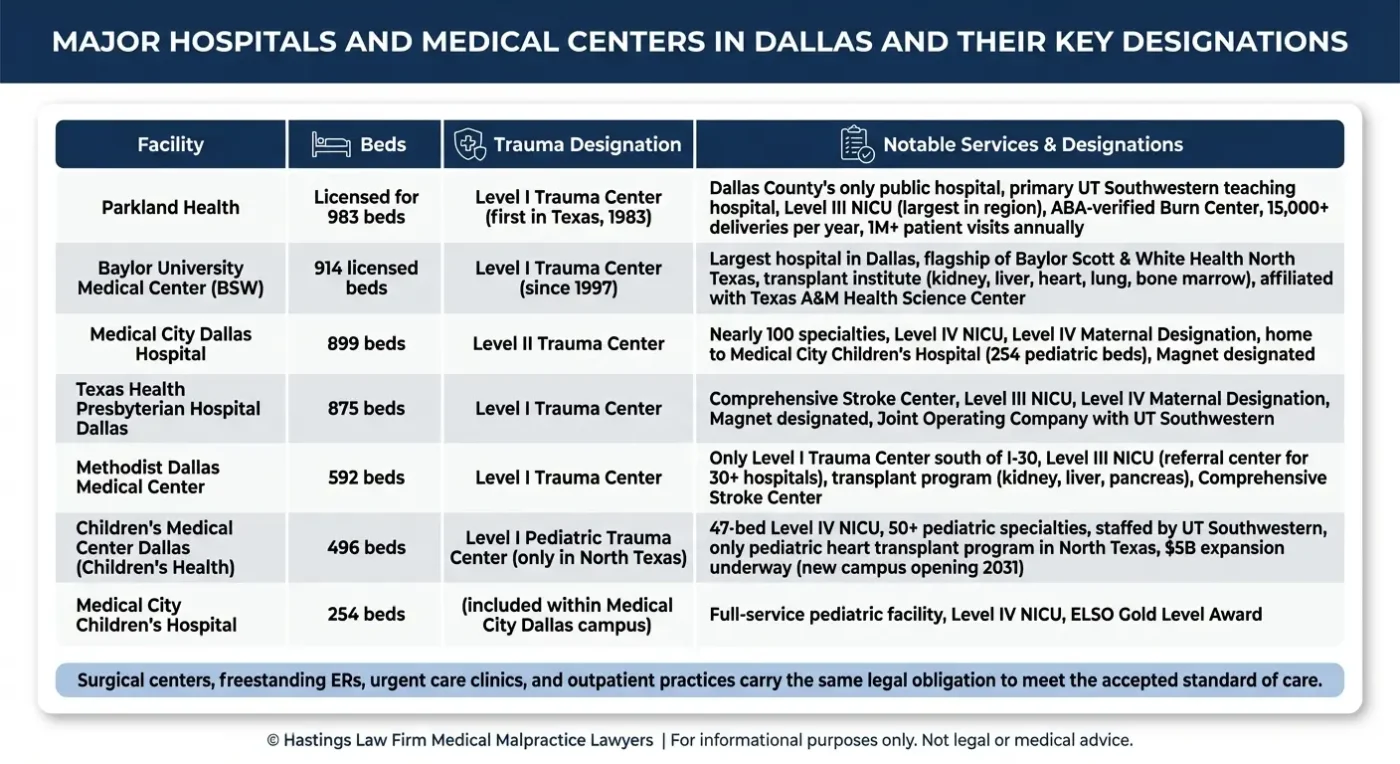
Dallas is one of the largest healthcare markets in the country. The Southwestern Medical District alone covers more than 1,000 acres northwest of downtown and anchors three major institutions: UT Southwestern Medical Center, Parkland Health, and Children’s Medical Center Dallas.
Parkland is Dallas County’s only public hospital and one of the busiest in the nation, averaging more than 10,000 deliveries per year and over one million outpatient visits annually. It also serves as the primary teaching hospital for UT Southwestern Medical School, meaning many patients receive care from residents and fellows working under attending physician supervision. Children’s Medical Center Dallas is the region’s only pediatric Level I Trauma Center and operates a 47-bed Level IV Neonatal Intensive Care Unit.
Outside the medical district, several large private health systems operate hospitals and clinics across the metro. Baylor Scott & White Health runs Baylor University Medical Center on Gaston Avenue, the largest hospital in Dallas with roughly 1,000 licensed beds. Texas Health Resources operates Texas Health Presbyterian Hospital Dallas, an 875-bed Level I Trauma Center on Walnut Hill Lane. Medical City Healthcare and Methodist Health System each maintain multiple facilities throughout Dallas and the surrounding suburbs.
Malpractice claims in Dallas don’t only involve hospitals. Surgical centers, freestanding emergency rooms, urgent care clinics, nursing facilities, and outpatient specialty practices all carry the same legal obligation to meet the accepted standard of care. When that standard is not met and a patient is harmed, any of these providers or facilities can face liability.
Proving Liability and The Standard of Care in Texas
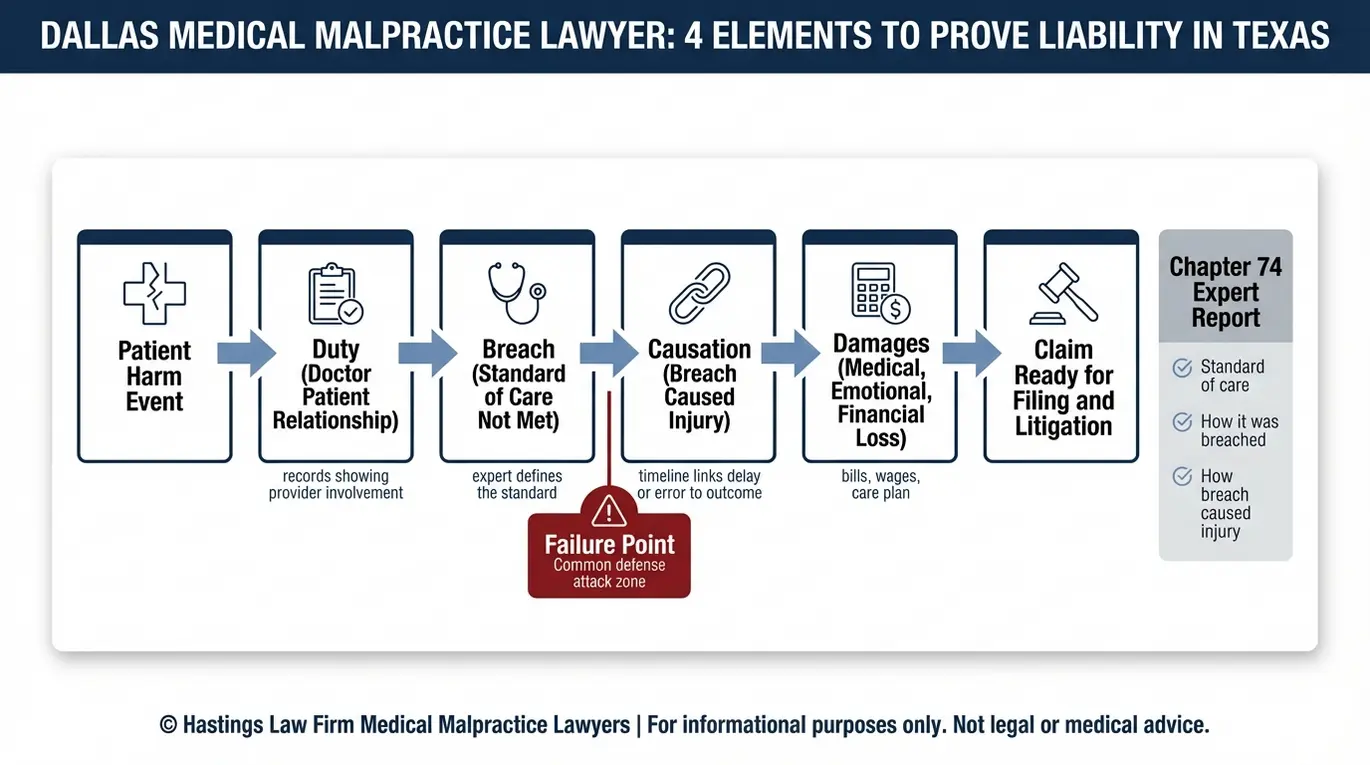
To win a malpractice case in Texas, the patient must prove four elements: duty of care, breach of duty, causation, and resulting damages. These elements form the legal framework for every medical negligence claim, and each must be supported by credible evidence.
Here is what each element requires:
- Duty of care: A doctor-patient relationship existed, creating a legal obligation to provide competent treatment.
- Breach of duty: The provider failed to act the way a reasonably prudent doctor in the same specialty would have acted. Differential diagnosis is the systematic process of ruling out conditions, which is relevant to establishing a breach of duty. A diagnostic failure may involve anchoring bias, where a provider locks onto an initial diagnosis and ignores contradictory evidence.
- Causation: There must be a direct link between the provider’s error and the injury. It is not enough to show the doctor made a mistake; we must demonstrate that the mistake caused the specific harm.
- Damages: The patient suffered measurable physical, emotional, or financial harm as a result.
Under Chapter 74, Dallas medical lawyers must serve a qualified expert report within 120 days of each defendant’s original answer being filed. This report must address each of these four elements. HB 3984 reflects ongoing legislative attention to how these requirements are applied. If the expert report is insufficient or untimely, the court can dismiss the case entirely.
Our team works with a national network of medical experts who provide objective analysis and credible expert witness testimony. Former defense attorneys on our staff anticipate how hospitals will challenge each element, allowing us to build cases designed to withstand that scrutiny.
The Impact of Bush vs HCA on Liability
A key question in many Dallas medically-related injury cases is whether a hospital can be held liable for the actions of a doctor who is technically an independent contractor rather than an employee. The Texas Supreme Court’s decision in *Bush v. Columbia Medical Center/HCA* established a legal precedent addressing this issue directly.
Under this ruling, hospitals can face direct liability for failing to implement adequate systems, protocols, or policies that would prevent medical errors, even when the actual care is delivered by independent-contractor physicians. This matters because many patients do not know, and are never told, that their treating doctor has no employment relationship with the facility. If the hospital failed in its own institutional duties, it may bear legal responsibility for the resulting harm.
We evaluate these relationships carefully, because hospital negligence claims often hinge on whether the institution can distance itself from the doctor who caused the harm.
Recoverable Damages in a Dallas Malpractice Lawsuit
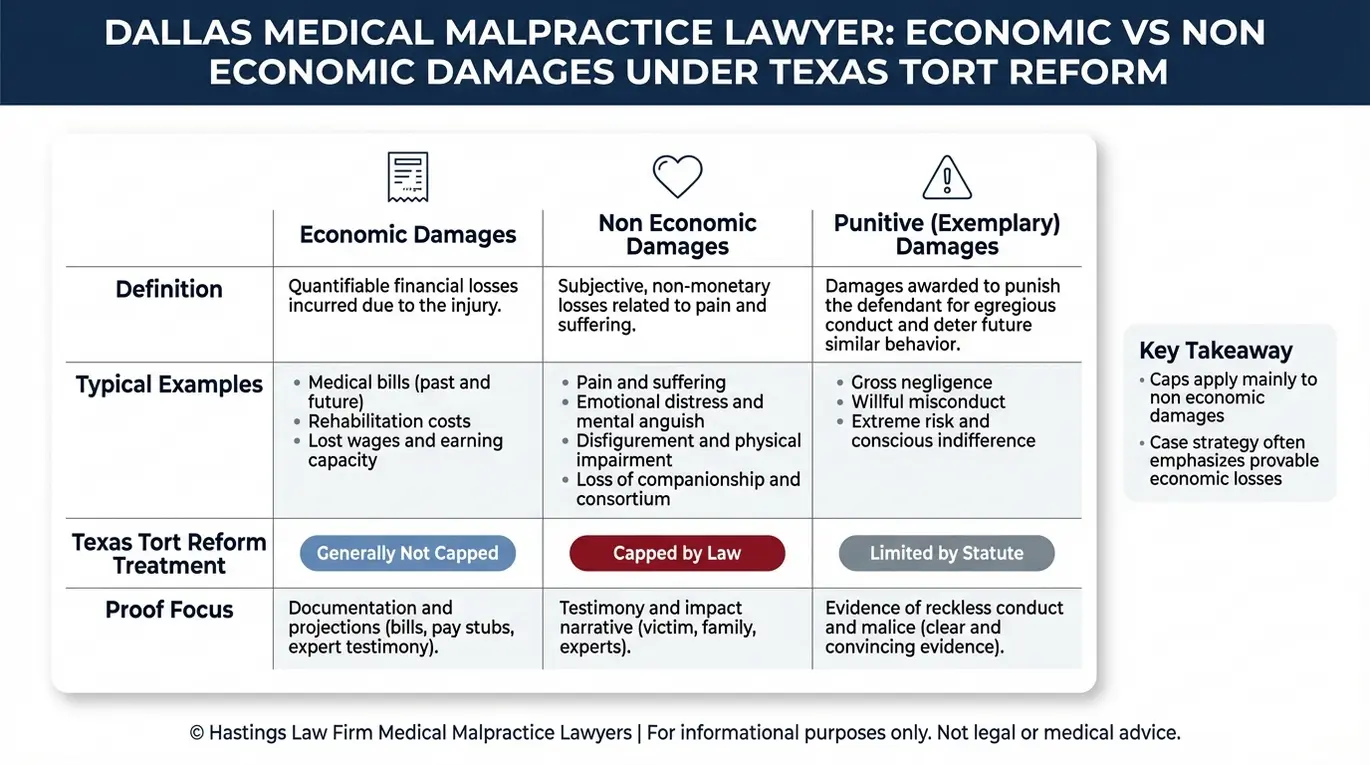
Patients can recover economic damages for medical bills and lost wages, along with non-economic damages for pain and suffering, which are capped by state law. Understanding the difference between these categories is essential to building a case strategy that maximizes your recovery.
| Damage Type | What It Covers | Cap in Texas |
|---|---|---|
| Economic Damages | Past and future medical bills, lost wages, lost earning capacity, rehabilitation costs, home care needs | No cap |
| Non-Economic Damages | Pain and suffering, emotional distress, disfigurement, loss of companionship | $250,000 against all physicians/providers combined; $250,000 per healthcare institution (up to $500,000 for two or more institutions); aggregate maximum of $750,000 when both providers and multiple institutions are involved |
| Punitive Damages | Awarded in rare cases involving gross negligence or malice | Subject to separate statutory limits |
Texas Tort Reform, enacted in 2003, placed these caps on non-economic damages. This means a jury can award any amount it believes is fair, but the judge will reduce the non-economic portion to the statutory limit. The caps do not apply to economic damages, which is why our Dallas medical malpractice attorneys focus heavily on documenting every financial loss, both current and projected.
In wrongful death cases, surviving family members, including spouses, children, and parents, may bring claims for their own losses. These cases involve both economic components like funeral costs and loss of future financial support, and non-economic components like loss of companionship and mental anguish.
Our approach to settlement negotiations and jury verdict preparation accounts for these caps from the start. By building the strongest possible record of economic harm, we work to ensure that damage caps do not prevent you from receiving the compensation you need.

“Cases aren’t won by the lawyer with the fanciest tie, but by the lawyer who works the hardest and cares the most.”
– Tommy Hastings, founding attorneyA Dallas Medical Law Firm That Gets Results
Hastings Law Firm was founded in 2005 by Tommy Hastings, a board certified personal injury attorney who has spent his entire career representing patients and families harmed by medical negligence. He is one of the only attorneys in Texas who still handles medical malpractice cases exclusively, and that focus shapes every part of how this firm operates.
The preparation and intensity we bring to every case has earned us a reputation that defense attorneys and insurance carriers recognize. Medical malpractice is all we do, and that matters when you’re going up against hospitals, insurance carriers, and defense teams with unlimited resources.
Experienced & Dedicated Medical Injury Lawyers Near You
Patients and families across the Dallas area trust Hastings Law Firm because we combine deep medical knowledge with aggressive litigation strategy. Tommy has obtained millions of dollars in compensation for his clients, and the attorneys and medical professionals on our team bring that same standard to every case we take on.
Where Dallas Medical Negligence Lawsuits Are Filed
Medical malpractice cases originating in Dallas County are filed in the Dallas County Civil District Courts, located at the George L. Allen, Sr. Courts Building at 600 Commerce Street in downtown Dallas. The county has 13 civil district courts, and the county courts at law hold concurrent jurisdiction with no cap on the damages a jury can award.
All attorneys filing in Dallas County are required to use the state’s electronic filing system. Once a case is filed, it is assigned to one of the district courts where it will be managed through discovery, pretrial motions, and, if necessary, trial.
If either side appeals a verdict or ruling, the case goes to the Fifth Court of Appeals of Texas at Dallas. The Fifth Court covers Dallas, Collin, Grayson, Hunt, Kaufman, and Rockwall counties, and it is the largest appellate court in the state by number of justices.
Our attorneys file and try cases in these courts regularly. That familiarity with local procedural rules, scheduling practices, and courtroom expectations affects how we prepare cases and manage timelines from the start.
The Texas Statute of Limitations for Medical Injury Claims
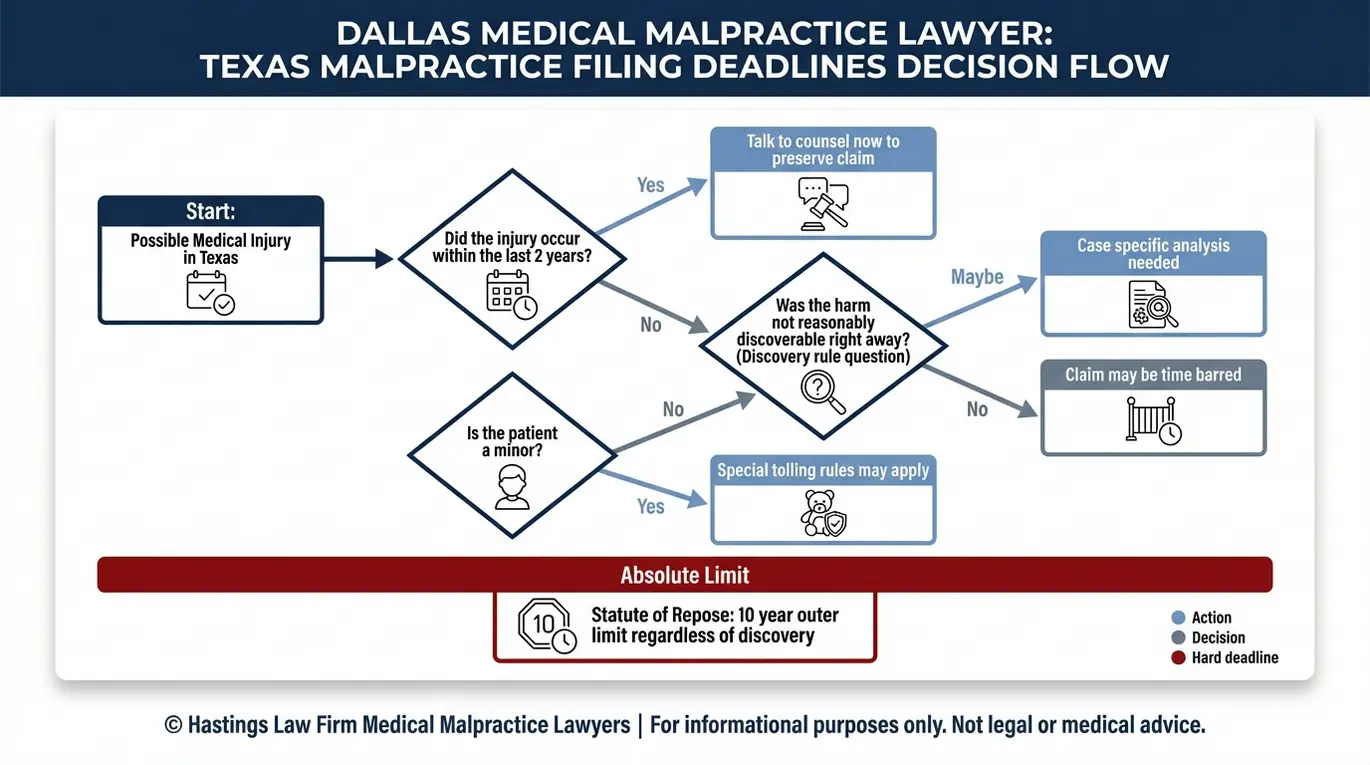
Texas law generally requires medical malpractice lawsuits to be filed within two years from the date of the injury or the date the injury was discovered. Missing this deadline almost always means losing the right to pursue a personal injury lawsuit, regardless of how strong the evidence may be.
The standard rule is simple: you have two years from the date the breach of care occurred. But several exceptions can change that timeline:
- Discovery rule: If the injury was not and could not have been immediately apparent, the two-year clock may begin on the date the patient discovered, or reasonably should have discovered, the harm. This applies in cases like a retained surgical instrument that causes symptoms months or years later.
- Minors: For children under the age of 12, the law provides until the child’s 14th birthday to file, or have filed on their behalf, a medical malpractice claim.
- Statute of repose: Texas imposes an absolute 10-year outer limit. Even if the injury was not discoverable within that period, no claim can be filed after 10 years from the date of the negligent act. This is a hard cutoff with very limited exceptions.
Patient safety research from the Agency for Healthcare Research and Quality (PSNet) highlights how disparities in care can delay both the recognition of harm and access to legal remedies. These delays make understanding your legal deadline even more important.
If you are unsure whether your deadline has passed, speaking with a Dallas healthcare injury lawyer as soon as possible is the safest step you can take.
What to Expect When Pursuing a Malpractice Case in Dallas
Filing a medical malpractice claim in Dallas County involves several steps, and the timeline can vary depending on the complexity of the case. Here is a general overview of how the process works.
The first step is a thorough investigation. We obtain your complete medical records from the treating facility, whether that is Parkland, Baylor, Texas Health Presbyterian, or any other provider in the area. Our in-house nurses and medical consultants review those records to build a detailed timeline of the care you received and identify where the standard of care may have been breached.
Under Chapter 74, your legal team must serve a qualified expert report on each defendant within 120 days of their original answer. Dallas County judges enforce this deadline, and failure to meet it can result in dismissal. We work with a national network of medical experts to prepare these reports early in the process so the case stays on track.
From there, the case moves into discovery, where both sides exchange evidence, take depositions, and retain additional experts if needed. Many malpractice cases in Dallas resolve through negotiated settlements or mediation before reaching trial. But settlement offers are only meaningful when the other side knows you are prepared to go to a jury. That is why we build every case as if it will be tried in a Dallas County courtroom.
You Need an Experienced Medical Lawyer for a Malpractice Litigation
We combine the resources of a national firm with the personalized attention of a smaller practice to ensure you are treated as a partner, not just a case file. Hastings Law Firm was built specifically for medical malpractice litigation, and that singular focus shapes everything we do.
Here is what sets our Dallas medical malpractice law firm apart:
- Trial-ready from day one: Every case is prepared as if it will go to a jury trial. This level of preparation signals to insurance carriers and defense counsel that we will not accept an inadequate settlement. It also positions us to pursue a jury verdict when a fair resolution cannot be reached through negotiation.
- Exclusive focus on medical malpractice: We do not handle car accidents, slip-and-falls, or general personal injury. Our trial lawyer team, nurse consultants, and patient advocates work only on medical negligence cases, giving us a depth of knowledge that general practice firms cannot match.
- Former defense insight: Several members of our team previously represented hospitals and their insurers. That experience gives us a clear understanding of how the other side builds its defense, and it allows us to anticipate and counter those strategies early.
- In-house medical professionals: Our staff includes nurse practitioners and Board Certified Patient Advocates who analyze medical records, including electronic fetal monitoring (EFM), the tracking of fetal heart rate during labor, to identify charting inconsistencies and help translate clinical data into evidence a jury can understand.
- We understand the intimidation factor: Many of our clients tell us they felt hesitant to question a doctor or a hospital system – we refer to this as the white coat effect. We help you move past that hesitation by giving you the information and support you need to pursue accountability.
We work on a contingency fee basis. You pay no attorney fees or costs unless we recover compensation on your behalf.
Dallas and DFW Communities We Represent
We represent patients and families harmed by medical negligence across the Dallas metro from two office locations.
From our Central Dallas office, we serve clients in Downtown, Oak Lawn, Uptown, Oak Cliff, South Dallas, Deep Ellum, East Dallas, Lakewood, Pleasant Grove, Mesquite, Garland, Grand Prairie, Cedar Hill, DeSoto, Lancaster, Duncanville, and Arlington.
From our North Dallas office, we represent patients and families in Far North Dallas, Preston Hollow, Lake Highlands, Richardson, Plano, Frisco, McKinney, Allen, Prosper, Denton, Carrollton, Lewisville, Flower Mound, Irving, Coppell, Grapevine, Southlake, and Fort Worth.
Many of these communities fall within the same appellate jurisdiction as Dallas County, which means cases from Collin, Kaufman, and Rockwall counties follow similar procedural paths. Patients treated at facilities in Tarrant, Denton, and Ellis counties may have cases governed by different local court rules, but the underlying Texas medical liability standards remain the same.
No matter where in the DFW metro the injury occurred, our team handles the full process from investigation through resolution.
Talk to a Dallas Healthcare Malpractice Attorney About Your Case
If you or a loved one was harmed by a medical provider or facility in Dallas or anywhere in the DFW metro, we’re here to help you understand what happened and whether you have a case. Your first conversation with us is free, confidential, and comes with no obligation. We’ll review the details of your situation, answer your questions, and give you an honest assessment of your legal options. If we take your case, you pay no attorney fees or costs unless we recover compensation on your behalf. Call or use the contact form on this page to schedule your free case review.
Dallas Medical Injury Claim Questions


This content was researched and written by the Hastings Law Firm editorial team, which includes attorneys, medical professionals, and experienced researchers. Our writing is informed by internal knowledge and practical experience, and we cross-check critical details against authoritative sources cited throughout. Every piece undergoes human-led fact-checking and legal review. Because legal and medical information can change, if you spot an error, please contact us. Learn more about our content standards and review process on our editorial policy page.

Tommy Hastings, founder of Hastings Law Firm, is a board-certified personal injury trial lawyer dedicated exclusively to healthcare injury cases. Since 2001, he has represented injured patients and families in litigation against major hospital systems, pharmaceutical companies, and negligent healthcare providers nationwide. He has handled numerous high-profile cases that have drawn national media attention and resulted in multi-million dollar recoveries. He draws on that experience in his writing, helping readers understand how these cases work and what options may be available to them.
