







Trusted Legal Representation for Healthcare Negligence in Texas
Written by: Hastings Law Firm | Reviewed by: Tommy Hastings | Updated: May 11, 2026
What You Should Know About Healthcare Negligence Claims in Texas:
- Life changing harm and financial loss can follow negligent medical care, especially when errors delay effective treatment or worsen an injury.
- Options for recovery can be limited because Texas places statutory limits on non economic damages even when injuries are severe.
- A claim can fail even with an apparent mistake when causation is disputed and the defense argues the underlying condition caused the outcome.
- A case can be dismissed if legal time limits are missed, even when evidence of negligence is strong.
- Pursuing a claim can be financially difficult because qualified medical experts are required early and can be expensive.
- Liability can extend beyond a single clinician when hospitals, nursing staff, pharmacies, or manufacturers contributed to the harm.
- A bad outcome alone may not lead to compensation because negligence requires a preventable deviation from the standard of care.
- Key records can be central to what happened because medical charts and timelines may reveal inconsistencies or missed warning signs.
- In birth related injury claims, fetal monitoring strips and nursing notes can be pivotal when the dispute involves missed signs of distress.
- In surgical error claims, operating room documentation can be critical when the event involves wrong site surgery or retained items.

A Healthcare Focused Law Firm
When a doctor, hospital, or medical team causes harm through negligent care, the consequences can reshape your entire life. You may be dealing with unexpected medical bills, lost income, physical pain, and the emotional weight of feeling like the system you trusted let you down. You deserve answers, and if negligence occurred, you deserve accountability and compensation.
Hastings Law Firm is a plaintiff trial firm that handles medical malpractice cases exclusively. Our team of attorneys, in-house nurses, and medical consultants focuses entirely on representing patients and families harmed by preventable medical errors across Texas. We do not handle car accidents, slip-and-falls, or general personal injury. Every member of our staff works on medical negligence cases, and that singular focus shapes how we investigate, prepare, and litigate every claim.
If you believe you or a loved one was harmed by negligent medical care anywhere in Texas, we welcome the opportunity to review what happened and explain your options in a free, confidential consultation.
Understanding Medical Negligence in Texas
Medical negligence occurs when a healthcare provider fails to deliver the accepted standard of care and a patient is injured or killed as a result. The standard of care is the level of treatment that a reasonably competent provider in the same specialty would deliver under similar circumstances. It does not guarantee a perfect outcome. It establishes a baseline of competence that every provider is expected to meet.
When a provider falls below that baseline and the patient is harmed, the deviation may constitute actionable negligence. But not every medical error rises to the level of a legal claim. A bad result alone is not enough. To pursue a medical malpractice case in Texas, the provider’s conduct must have departed from accepted medical practice, and that departure must have directly caused the patient’s injury.
Chapter 74 of the Texas Civil Practice and Remedies Code governs how medical malpractice claims are filed and litigated in this state. It imposes strict procedural requirements, damage caps, and expert report deadlines that do not exist in most other types of civil cases. These rules were designed to reduce frivolous lawsuits, but they also create real obstacles for patients with legitimate claims. Working with a Texas medical malpractice lawyer who understands these requirements is not optional; it is a practical necessity.
Causation, the link between the provider’s error and the patient’s harm, is often the most contested element in these cases. Defense teams routinely argue that the patient’s underlying condition, not the provider’s actions, caused the injury. Establishing that connection requires careful medical analysis supported by qualified experts who can reconstruct the timeline of care and tie the breach directly to the resulting harm.
Negligence vs. Bad Outcomes and the Role of Informed Consent
The line between a compensable claim and an unfortunate result is not always obvious, and it is one of the first things we evaluate during our investigation.
A known complication is not the same as negligence. Surgery carries inherent risk, and not every condition responds to treatment as expected. If a surgeon performs a procedure correctly and a recognized complication occurs despite proper technique, that is generally not malpractice. But if a surgeon fails to review the patient’s chart, misses a documented contraindication, and proceeds with a procedure that causes foreseeable harm, that is a different situation entirely.
Informed consent is part of this analysis. Before a procedure, a provider is legally obligated to explain the material risks, expected benefits, and available alternatives so the patient can make an informed decision. Signing a consent form acknowledges that certain complications can occur even when care is delivered properly. But a consent form does not authorize a provider to perform negligently. If an infection resulted from unsterilized instruments or a failure to follow surgical protocols, the provider is not shielded from liability simply because “infection” was listed as a possible risk. The consent process covers known risks of competent care, not the consequences of substandard care.
Here is a practical way to think about the distinction:
- A patient experiences nerve damage after spinal surgery, a risk that was disclosed and that can occur even with proper technique. That is a known complication.
- A patient experiences nerve damage because the surgeon operated on the wrong spinal level or because monitoring alerts were ignored during the procedure. That is potential negligence.
When the difference is unclear, an investigation matters. Our team reviews the medical records, consults with specialists in the relevant field, and determines whether the care provided met the accepted standard. If it did not, and that failure caused the injury, you may have a valid claim.
Proving a Medical Malpractice Claim in Texas
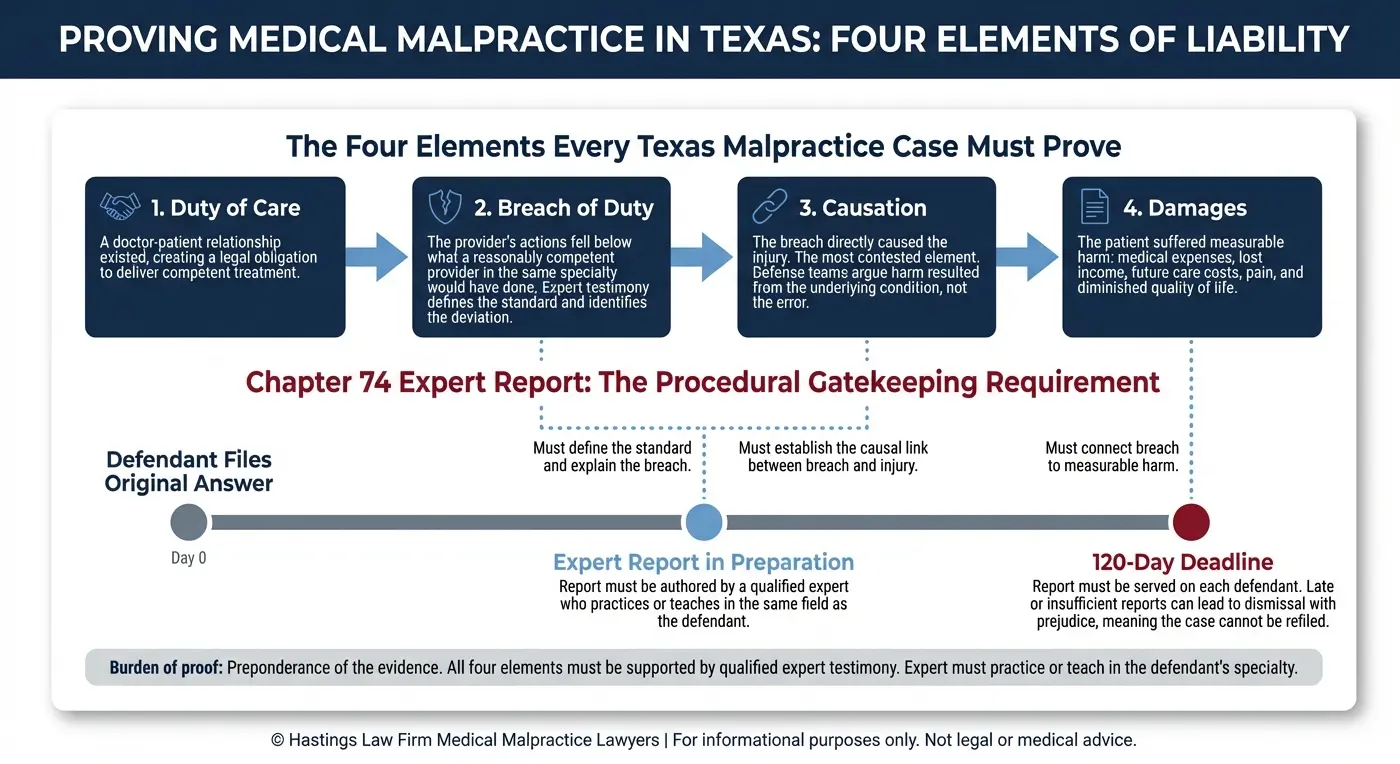
Every medical malpractice case in Texas requires proof of four elements: a duty of care owed to the patient, a breach of that duty, a direct causal connection between the breach and the injury, and measurable damages. Each element must be supported by evidence, and the failure to prove any one of them can result in the case being dismissed.
The Four Elements of Liability
Duty of care. A doctor-patient relationship must have existed, establishing that the provider owed the patient a legal obligation to deliver competent treatment. This element is typically the simplest to establish, as the duty is created the moment a provider begins treating or evaluating a patient.
Breach of duty. The provider’s actions or omissions must have fallen below what a reasonably competent provider in the same specialty would have done under similar circumstances. In diagnostic cases, this can involve anchoring bias, where a physician fixates on an initial diagnosis and overlooks contradictory test results or symptoms. In surgical cases, it may involve a failure to follow established operative protocols. Expert testimony is required to define the standard and demonstrate the deviation.
Causation. The breach must be directly linked to the patient’s injury. This is the most heavily disputed element in most Texas malpractice cases. Defense teams regularly argue that the harm resulted from the patient’s underlying condition rather than the provider’s error. Establishing causation requires detailed medical analysis and expert testimony connecting the specific breach to the specific harm. In birth injury cases, for example, this often means demonstrating that a failure to recognize fetal distress, where the baby shows signs of oxygen deprivation or other stress, led to a preventable neurological injury.
Damages. The patient must have suffered real, measurable harm. Medical bills, lost income, future care costs, physical pain, emotional suffering, and diminished quality of life all fall under this element. Without proof of actual harm, there is no claim.
Our team builds each case by collecting and analyzing medical records, consulting with qualified experts, and constructing a detailed timeline of the care that was provided. The Texas Medical Board provides resources regarding patient access to medical records, which is often an important first step in any investigation.
Expert Report Requirements Under Chapter 74
Expert testimony is a legal requirement in Texas medical malpractice cases. Under Chapter 74, a patient must serve a written expert report on each defendant within 120 days of the date that defendant files an original answer. The report must identify the applicable standard of care, explain how the defendant breached it, and establish the causal connection between the breach and the patient’s injury. HB 3984 reflects ongoing legislative attention to how these requirements are applied in practice.
If the report is late, insufficient, or fails to meet the statutory threshold, the court can dismiss the case with prejudice, meaning it cannot be refiled. This makes the expert report one of the most consequential procedural steps in the entire litigation process.
The qualifications for an expert witness are strict. The expert must practice or teach in the same field as the defendant provider. A cardiologist would not typically qualify to opine on the standard of care for an orthopedic surgeon. This requirement exists to ensure that opinions about medical care come from professionals with direct, relevant clinical experience.
These requirements also create a significant financial barrier. Qualified medical experts are expensive, and their involvement is needed early, often before a case generates any recovery. At Hastings Law Firm, we fund all expert costs upfront as part of our contingency fee structure. Our clients never pay out of pocket for expert reviews, reports, or testimony. We maintain a national network of medical experts across virtually every specialty, which allows us to match each case with the right expert, someone whose credentials and clinical experience will carry weight with both opposing counsel and a jury.
Damages Available in a Texas Medical Malpractice Case
Compensation in a Texas medical malpractice case falls into two primary categories: economic damages for measurable financial losses, and non-economic damages for the personal toll of the injury. Texas law treats these categories differently, and understanding the distinction is essential to building a case strategy that pursues maximum compensation.
Economic damages cover past and future medical expenses, lost wages, diminished earning capacity, rehabilitation costs, home care needs, and any other out-of-pocket costs directly caused by the injury. Because these losses can be documented and projected with expert support, Texas law does not impose a cap on their recovery. In cases involving catastrophic injury, such as brain damage or paralysis, future medical care costs alone can reach into the millions.
Non-economic damages compensate for losses that are real but harder to quantify: physical pain, emotional suffering, mental anguish, loss of companionship, and disfigurement. Under Chapter 74, Texas imposes strict caps on these recoveries.
| Damage Type | What It Covers | Cap in Texas |
|---|---|---|
| Economic Damages | Past and future medical bills, lost wages, lost earning capacity, rehabilitation costs, home care needs | No cap |
| Non-Economic Damages | Pain and suffering, emotional distress, disfigurement, loss of companionship | $250,000 against all physicians/providers combined; $250,000 per healthcare institution (up to $500,000 for two or more institutions); aggregate maximum of $750,000 when both providers and multiple institutions are involved |
| Punitive Damages | Awarded in rare cases involving gross negligence or malice | Subject to separate statutory limits |
These caps were established by Texas Tort Reform in 2003. A jury is free to award whatever amount it considers fair, but the court will reduce the non-economic portion to the statutory ceiling. Economic damages are not subject to any limit, which is why our Texas medical malpractice attorneys focus heavily on documenting every financial loss, both current and projected.
In wrongful death cases, surviving family members, including spouses, children, and parents, may each pursue compensation for their individual losses. These claims include both economic components like loss of financial support and funeral expenses, and non-economic components like loss of companionship and mental anguish. The statutory caps on non-economic damages still apply.
Because the caps constrain one category of recovery, our approach to every case prioritizes thorough documentation of the economic harm. We work with economists and life-care planners to calculate future medical costs, lost earning capacity, and long-term care needs so that no category of financial loss goes unaccounted for.

“Cases aren’t won by the lawyer with the fanciest tie, but by the lawyer who works the hardest and cares the most.”
– Tommy Hastings, founding attorneyA Texas Medical Law Firm That Gets Results
Hastings Law Firm was founded in 2005 by Tommy Hastings, a board certified personal injury attorney who has spent his entire career representing patients and families harmed by medical negligence. He is one of the only attorneys in Texas who still handles medical malpractice cases exclusively, and that focus shapes every part of how this firm operates.
The preparation and intensity we bring to every case has earned us a reputation that defense attorneys and insurance carriers recognize. Medical malpractice is all we do, and that matters when you’re going up against hospitals, insurance carriers, and defense teams with unlimited resources.
Experienced & Dedicated Medical Injury Lawyers Near You
Patients and families across the Dallas area trust Hastings Law Firm because we combine deep medical knowledge with aggressive litigation strategy. Tommy has obtained millions of dollars in compensation for his clients, and the attorneys and medical professionals on our team bring that same standard to every case we take on.
The Texas Statute of Limitations for Medical Malpractice
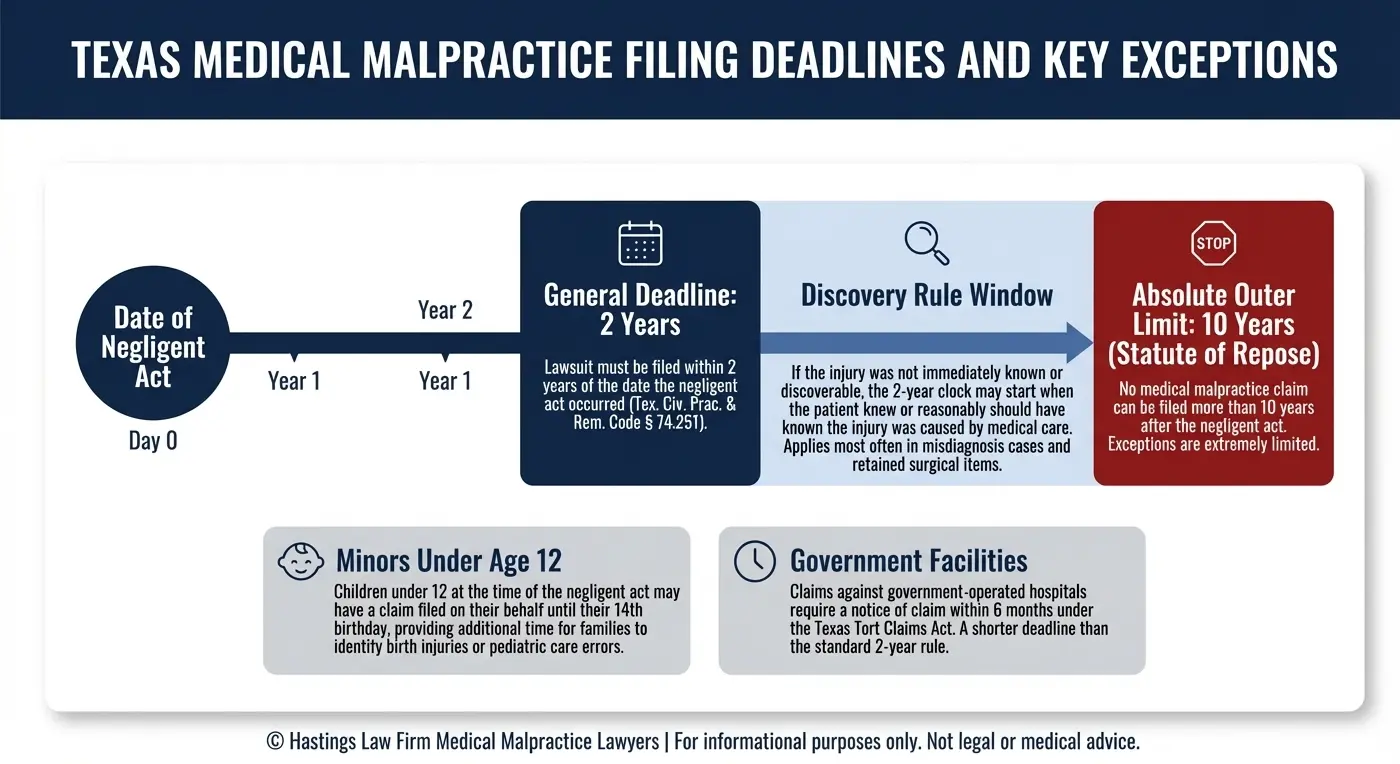
Texas law requires medical malpractice lawsuits to be filed within two years of the date the injury occurred. If that deadline passes, the court will almost certainly dismiss the case, regardless of how strong the evidence may be.
In most cases, the two-year period begins on the date the negligent act took place. For injuries that are immediately apparent, such as a wrong-site surgery or a retained surgical instrument, the start date is usually clear. But many medical injuries are not discovered right away, and Texas law accounts for that.
The Discovery Rule and Statute of Repose
The discovery rule can extend the filing deadline in cases where the injury was not immediately known or discoverable. Under this exception, the statute of limitations may begin on the date the patient knew, or reasonably should have known, that an injury occurred and that it may have been caused by medical care. This rule applies most often in misdiagnosis cases, where a patient may not learn about the error until months or years later, and in cases involving retained surgical items that do not cause symptoms immediately.
For minors, the timeline is different. Texas law allows children under the age of 12 to have a claim filed on their behalf until their 14th birthday, providing additional time for families to identify and pursue claims related to birth injuries or pediatric care errors.
Regardless of when the injury is discovered, Texas imposes a 10-year statute of repose. This is an absolute outer boundary. No medical malpractice claim can be filed more than 10 years after the date of the negligent act, and the exceptions to this cutoff are extremely limited.
If you are unsure whether your deadline has passed, speaking with a Texas medical malpractice lawyer as soon as possible is the safest step. Building a strong case requires time for investigation, expert review, and record analysis, and that process should begin well before the filing deadline approaches.
Who Can Be Held Liable for Medical Negligence
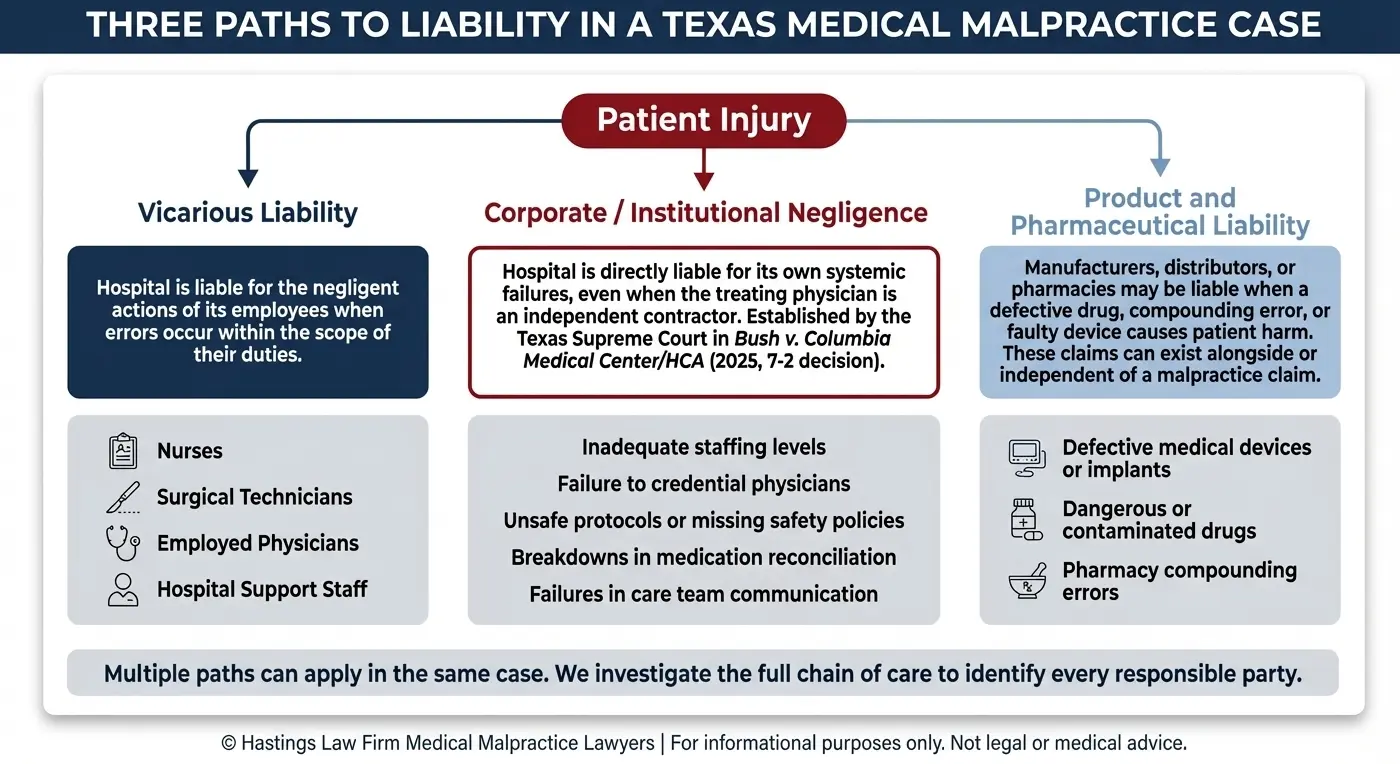
Liability in a medical malpractice case can extend well beyond the physician who provided direct care. Depending on where and how the negligence occurred, hospitals, nursing staff, pharmacists, anesthesiologists, and medical device manufacturers may all share responsibility. Identifying every responsible party is a critical part of building a complete claim.
Vicarious Liability and Hospital Responsibility
Hospitals can be held liable for the actions of their employees, including nurses, technicians, and employed physicians, under the legal doctrine of vicarious liability. If a staff member causes patient harm while carrying out their duties, the employing institution may share in the legal liability.
However, many physicians working in Texas hospitals are independent contractors rather than employees. Defense teams frequently use this distinction to argue that the hospital bears no responsibility for the doctor’s conduct. The Texas Supreme Court addressed this in Bush v. Columbia Medical Center/HCA, establishing that hospitals can face direct liability for their own institutional failures even when the treating physician is not an employee. Our investigation determines the true employment relationship and whether the hospital’s own systems contributed to the harm.
Corporate Negligence and Institutional Failures
A hospital may also face direct liability for its own systemic failures, separate from the conduct of any individual provider. Inadequate staffing, failure to properly credential physicians, unsafe protocols, breakdowns in medication reconciliation (the process of verifying a patient’s medications to prevent dangerous interactions), and failures in communication between care teams can all create conditions for patient harm.
These institutional negligence claims target the organizational decisions that allowed the error to occur. When a hospital’s own policies were not followed, or when those policies failed to meet acceptable safety standards, the facility itself can be held accountable.
Pharmaceutical and Medical Device Liability
If a patient is harmed by a defective drug, a compounding error, or a faulty medical device or implant, the manufacturer, distributor, or pharmacy may be liable under medical product liability principles. These claims can exist alongside a medical malpractice claim or independently. We evaluate every potential source of liability to ensure that all responsible parties are identified and held accountable.
Where Medical Malpractice Cases Are Filed in Texas
Medical malpractice lawsuits in Texas are filed in the state district courts of the county where the negligent care occurred or where the defendant resides. Texas has 254 counties, each with its own district court system, and the procedural expectations, scheduling practices, and local rules can vary meaningfully from one jurisdiction to another.
In the state’s largest metros, cases are concentrated in a handful of high-volume court systems. Harris County cases are heard at the Harris County Civil Courthouse in downtown Houston. Dallas County cases are filed at the George L. Allen, Sr. Courts Building at 600 Commerce Street. Bexar County cases go through the Bexar County Courthouse in San Antonio. Travis County cases are filed at the Blackwell-Thurman Criminal Justice Center complex in Austin.
Appeals from Texas district courts are heard by the appropriate regional court of appeals. Texas has 14 intermediate appellate courts, and the jurisdictional boundaries determine which court hears the appeal based on where the case originated.
Hastings Law Firm maintains offices throughout Texas. Our attorneys file and appear in courts across Texas and that familiarity with local rules, judge-specific practices, and scheduling norms affects how we prepare cases and manage timelines from the start.
Types of Medical Malpractice Litigation We Handle
Medical malpractice takes many forms, and each type of case presents distinct medical and legal challenges. Our team has the clinical knowledge and litigation experience to handle claims across the full spectrum of healthcare negligence.
Surgical errors include wrong-site surgery, retained instruments, nerve damage, and anesthesia complications. These cases require detailed reconstruction of operative protocols and often involve testimony from surgeons and anesthesiologists in the defendant’s specialty.
Birth injuries involve harm to a mother or infant during pregnancy, labor, or delivery. These claims depend heavily on electronic fetal monitoring strips, nursing notes, and expert review by maternal-fetal medicine specialists and neonatologists.
Misdiagnosis and delayed diagnosis cases arise when a failure to identify or correctly diagnose a condition causes it to worsen or become untreatable. Cancer, stroke, heart attack, and pulmonary embolism are among the most commonly involved conditions.
Hospital and systemic failures involve negligence at the institutional level, including inadequate staffing, unsafe protocols, medication errors, and communication breakdowns between care teams.
Emergency room negligence involves failures in triage, diagnostic errors, and premature discharge. Proving negligence in the ER requires showing that the standard of care was violated despite the time constraints inherent to emergency medicine.
Nursing home abuse and neglect cases target substandard care in long-term care facilities, including falls, medication errors, pressure injuries, and failures in basic patient monitoring.
Pharmaceutical injuries and medical device failures involve harm caused by dangerous drugs, compounding errors, defective implants, or device malfunctions. These claims may target manufacturers, distributors, and the providers who prescribed or implanted the product.
Wrongful death claims are brought by surviving family members when a patient dies as a result of preventable medical error.
You Need an Experienced Medical Lawyer for a Malpractice Lawsuit
Medical malpractice cases are among the most complex in civil litigation. They require a team that understands both the law and the medicine behind every claim, and that has the resources to take on hospitals, insurance carriers, and defense firms with deep pockets. Hastings Law Firm was built specifically for this work.
Our founder, Tommy Hastings, is board certified in Personal Injury Trial Law by the Texas Board of Legal Specialization, a distinction held by fewer than 2% of Texas attorneys. He is a 2025 inductee into the American Board of Trial Advocates (ABOTA), an invitation-only organization recognizing experienced trial lawyers. His record includes a $19.5 million settlement for a teenager with a neurological injury, a $10 million jury verdict against operators of a pill mill (a national first), and a $3.5 million jury verdict against Kelsey-Seybold for failure to diagnose a blood clot.
We prepare every case from day one as if it will go before a jury. That level of preparation signals to insurance carriers and defense counsel that we will not accept less than fair value. It also means that when a case cannot be resolved through negotiation, we are ready to try it. That trial-ready posture is a major reason our settlements and verdicts reflect the true scope of our clients’ injuries.
Our legal team includes former defense attorneys who previously represented hospitals and healthcare systems. They understand how the defense builds its case because they used to build it themselves. That experience allows us to anticipate opposing arguments and counter them before they gain traction.
Our staff also includes experienced nurses and Board Certified Patient Advocates who once worked inside the hospital systems we now hold accountable. They review medical records, identify charting inconsistencies, and interpret clinical data that might otherwise go unnoticed. This collaboration between legal and medical professionals gives our clients a strategic advantage at every stage of a case.
We operate on a contingency fee basis. You pay no attorney fees or costs unless we recover compensation for you.
Talk to a Texas Medical Malpractice Lawyer About Your Case
If you or a loved one has been harmed by medical negligence anywhere in Texas, we are here to help you understand what happened and whether you have a case. We represent patients and families from our offices in throughout Texas. Your first conversation with us is free, confidential, and comes with no obligation. We will review the details of your situation, answer your questions, and give you an honest assessment of your legal options. If we take your case, you pay no attorney fees or costs unless we recover compensation on your behalf. Call or use the contact form on this page to schedule your free case review.
Injured by a Healthcare
Professional?
We’re Available 24/7!
Questions About Texas Medical Injury Lawsuits

Key Medical Malpractice Terms:
- Standard of care
- The benchmark of skill, judgment, and treatment that a reasonably competent healthcare provider in the same specialty would deliver under comparable circumstances. In Texas medical malpractice cases, the patient must demonstrate that the provider’s care fell below this benchmark and that the shortfall directly caused the injury.
- Anchoring bias
- A pattern of clinical reasoning in which a physician becomes attached to an initial diagnosis and does not adequately reassess as new symptoms, lab values, or imaging findings become available. When anchoring bias contributes to a missed or delayed diagnosis that results in patient harm, it can serve as evidence that the provider breached the standard of care.
- Contraindication
- A specific condition, allergy, or medication interaction that makes a particular drug or treatment inadvisable for a patient because it poses a risk of harm. Proceeding with a treatment despite a documented contraindication, such as a known drug allergy or a dangerous interaction with another prescription, can constitute a breach of the standard of care.
- Informed consent
- The legal obligation of a healthcare provider to explain the material risks, expected benefits, and available alternatives of a proposed treatment or procedure before the patient agrees to undergo it. Signing a consent form does not protect a provider from liability for negligence. Informed consent covers known risks of competent care, not the consequences of substandard care or preventable errors.
- Vicarious liability
- A legal doctrine that holds an employer, such as a hospital, responsible for the negligent actions of its employees performed within the scope of their employment. If a nurse, technician, or other staff member causes patient harm while carrying out their duties, the employing institution may share in the legal liability for the resulting injury.
- Institutional negligence
- A legal theory that holds a hospital or healthcare facility directly responsible for its own systemic failures, such as unsafe staffing levels, inadequate credentialing of physicians, poorly maintained equipment, or absent safety protocols. Unlike claims against individual providers, institutional negligence targets the organizational decisions that created conditions for patient harm.
- Medication reconciliation
- The process of creating and maintaining an accurate list of all medications a patient is taking and comparing that list across different care settings to prevent errors. Failures in medication reconciliation can lead to dangerous drug interactions, duplicate therapies, or incorrect dosing, and may establish liability when the resulting harm was preventable.
- Medical product liability
- A legal claim arising from harm caused by a defective medical device, implant, or pharmaceutical product. These claims may target the manufacturer, distributor, or healthcare provider who recommended or implanted the product, and they can be pursued alongside or separate from a traditional medical malpractice claim.
- Differential diagnosis
- The systematic clinical process of evaluating a patient’s symptoms and test results to distinguish between possible conditions and arrive at the correct diagnosis. In a malpractice claim, expert testimony may focus on whether the provider conducted an adequate differential diagnosis or failed to consider conditions that the available evidence should have prompted them to evaluate.
- Discovery rule
- An exception to the standard statute of limitations that applies when an injury was not immediately apparent. Under the discovery rule, the filing deadline may begin on the date the patient discovered, or reasonably should have discovered, the injury and its connection to medical care rather than the date the negligent act occurred.
- Statute of repose
- A hard legal deadline that prevents a malpractice claim from being filed after a set number of years following the date of the negligent act, regardless of when the patient discovered the injury. In Texas, the statute of repose for medical malpractice is 10 years, and the exceptions to this outer limit are extremely narrow.
- Contingency fee
- A fee structure in which the attorney’s compensation is calculated as a percentage of the recovery obtained for the client, with no payment required upfront. If the case does not result in a recovery, the client owes no attorney fees. This arrangement allows patients and families to pursue malpractice claims without assuming financial risk.
- Texas Civil Practice and Remedies Code, Chapter 74 | Texas Legislature Online
- Texas Civil Practice and Remedies Code § 74.351, Expert Report | Texas Legislature Online
- HB 3984, 87th Legislature | Texas Legislature Online
- Patient Information and Medical Records | Texas Medical Board
- Licensee Complaint Form | Texas Medical Board
- Healthcare Safety Reports by Facility | Texas Department of State Health Services
- OCA Data and Research Newsletter, July 2025 | Texas Office of Court Administration
- District Courts Overview | Texas Judicial Branch
- Chartbook on Patient Safety | Agency for Healthcare Research and Quality
- 26 Texas Administrative Code § 509.54, Medical Records Requirements | Legal Information Institute
- Standards of Practice | International Academy of Life Care Planners
- Equity and Patient Safety | AHRQ Patient Safety Network
Get Answers Today
If you think that medical negligence, a dangerous drug, or a failed medical product caused harm to you or someone you love, our team is standing by to offer guidance. We’ll explain your options under current laws and help you move forward with clarity and understanding. Case reviews are free and 100% confidential.