


Lubbock Texas Medical Malpractice Lawyer
Written by: Hastings Law Firm | Reviewed by: Tommy Hastings | Updated: July 27, 2026
Medical negligence can leave patients and families facing pain, unexpected costs, and lasting uncertainty about what went wrong. In Lubbock, claims often involve errors in surgery, diagnosis, emergency care, medications, or childbirth, and proving responsibility can depend on showing a breach of the accepted standard of care and a clear link to the injury or fatal outcomes. Texas rules can also limit recovery for certain losses and can restrict options if key requirements are missed. If you or a loved one were harmed or worse due to medical malpractice in Lubbock, Texas, contact Hastings Law Firm for a free, confidential case review.
Trusted Legal Representation for Healthcare Negligence in Lubbock
What You Should Know About Healthcare Negligence Claims in Lubbock:
- Long term harm can follow medical negligence when care causes injury instead of healing.
- Proving liability can depend on showing a breach of the accepted standard of care and a direct link between the breach and the injury or death.
- Options can be lost if a required expert report is not served on time or does not meet Texas requirements.
- Recovery can be limited for pain and suffering because Texas caps non economic damages in medical malpractice cases.
- Financial recovery for measurable losses can be broader because Texas does not cap economic damages such as medical bills and lost wages.
- Wrongful death losses can be recoverable when medical negligence results in a loved one dying.
- Case outcomes can hinge on whether qualified experts are available to review care and provide credible opinions.
- Clarity about what happened can depend on complete medical records and related documentation such as hospital policies and witness statements.
- Accountability can be informed by publicly available hospital safety data that tracks reportable adverse events across Texas facilities.
- Disputes about what occurred can be shaped by charting inconsistencies and medication reconciliation problems found in clinical records.

A Healthcare Focused Law Firm
When a doctor, nurse, or hospital causes harm instead of healing, the aftermath can feel isolating. You may be dealing with unexpected medical costs, physical pain, and a deep sense that something went wrong during your care. Those feelings are valid, and you don’t have to sort through this alone.
Hastings Law Firm is a medical malpractice firm built to stand with patients and families in exactly this situation. As a Lubbock Texas medical malpractice lawyer team focused entirely on healthcare negligence, we bring in-house medical professionals, experienced trial attorneys, and a record of results to every case we accept.
If you believe you or a loved one was harmed by a medical error in Lubbock, we can review what happened and explain your options in a free, confidential evaluation.
Why Choose a Board Certified Specialist for Your Case
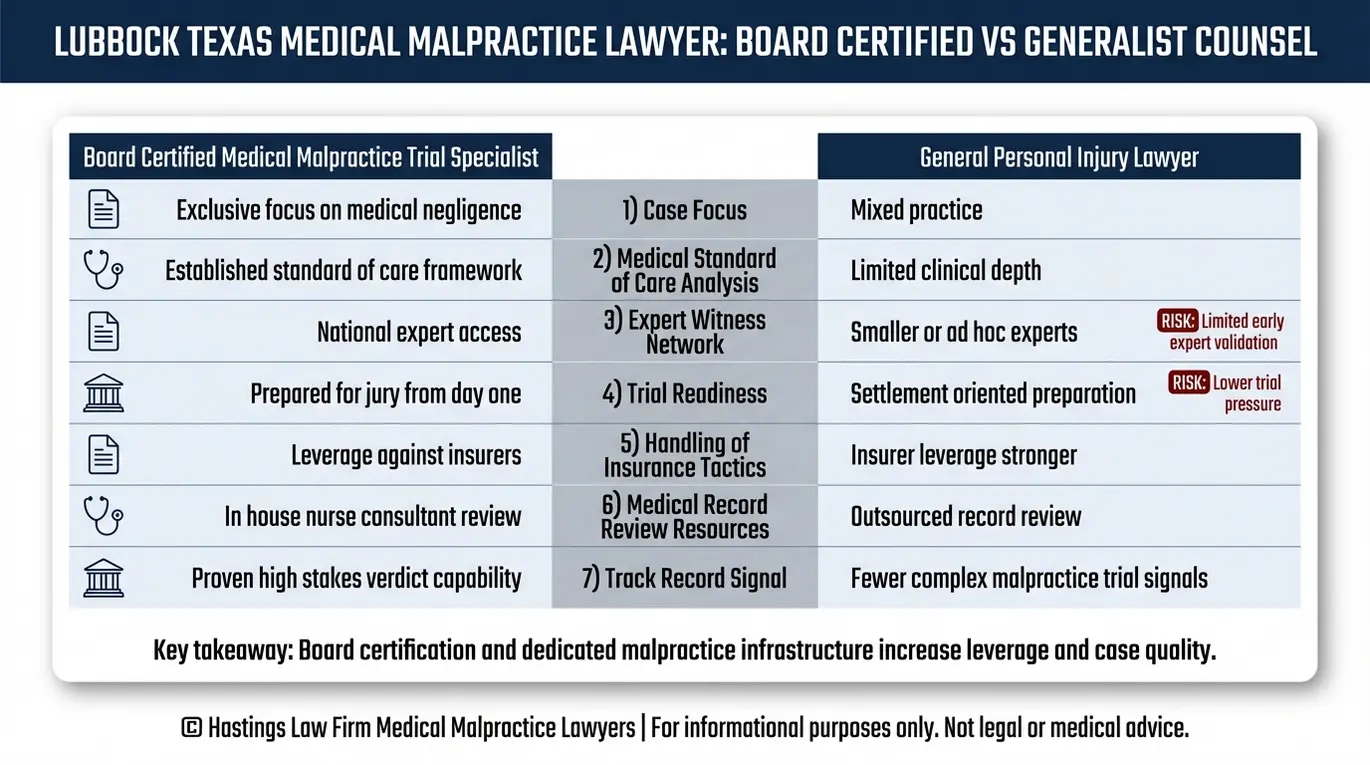
A Board Certified specialist has achieved a level of objective recognition and trial experience that general personal injury lawyers simply don’t have—and that distinction matters in medical liability cases where clinical evidence, expert witness coordination, and procedural deadlines can determine the outcome.
Medical malpractice is one of the most demanding areas of civil law. Unlike a standard accident claim, these cases require an attorney who can interpret medical records, identify departures from accepted practice, and work side by side with physicians and nurses to build a case. A Lubbock medical malpractice attorney who splits time between car wrecks, slip-and-falls, and the occasional malpractice file cannot offer that same depth.
Hastings Law Firm does not handle car crashes, premises liability, or general personal injury. Every resource in our firm is directed toward medical negligence cases, and that singular focus shapes how we prepare from day one.
What sets our team apart:
- Board Certified trial attorney leadership. Founder Tommy Hastings is Board Certified in Personal Injury Trial Law by the Texas Board of Legal Specialization, a distinction held by fewer than 2% of Texas attorneys.
- In-house medical professionals. Our team includes nurse consultants and Board Certified Patient Advocates who analyze clinical records, identify charting gaps, and translate medical data into clear legal arguments.
- Former defense counsel on staff. Attorneys who previously represented hospitals give us direct insight into how the defense builds its strategy, allowing us to anticipate and counter those arguments early.
- A trial-ready approach that drives results. Every case is investigated and prepared as if it will go before a jury. That level of preparation signals to insurance companies and defense teams that we won’t accept less than fair value.
- Contingency fee structure. You pay no attorney fees or costs unless we recover compensation for you.
Our team offers the specialization and medical insight these cases demand. We provide representation to patients in Lubbock and throughout the surrounding region.
Common Medical Errors in Lubbock Hospitals and Clinics
Medical malpractice in Lubbock can involve surgical mistakes, diagnostic failures in busy emergency departments, or birth injuries at the area’s major medical centers. Because Lubbock is a regional healthcare hub for much of West Texas, its hospitals handle a high volume of challenging cases, and that volume brings risk.
As medical malpractice lawyers handling cases across Texas, we see recurring patterns of hospital negligence and medical errors that affect patients when a healthcare provider fails to follow safety protocols. Here are some of the most common types of negligence we investigate:
| Error Category | Examples | Where It Often Occurs |
|---|---|---|
| Surgical & Anesthesia Errors | Wrong-site surgery (an operation performed on the wrong body part or wrong patient), retained surgical items, or RSIs (instruments or sponges left inside a patient after a procedure), and anesthesia dosing failures | Operating rooms, outpatient surgical centers |
| Diagnostic Failures | Misdiagnosis, missed, or delayed diagnosis of cancer, stroke, heart attack, or infection | Emergency rooms, urgent care clinics, primary care offices |
| Birth Injuries | Oxygen deprivation, delayed C-section, improper use of forceps or vacuum extraction | Labor and delivery units |
| Medication Errors | Wrong drug, wrong dose, harmful drug interactions | Hospitals, pharmacies, nursing facilities |
| Emergency Room Errors | Premature discharge, failure to order critical tests, delayed triage | Hospital emergency departments |
We represent clients injured at major regional facilities, including UMC (University Medical Center) and Covenant Health. Pursuing a claim against a large hospital system is inherently challenging. These institutions have dedicated legal teams and risk management departments working to protect them from liability. That reality is exactly why working with experienced Lubbock malpractice counsel matters.
Tracking patient safety data at the facility level is an important step toward accountability. The Texas Healthcare Safety Network Annual Reports provide publicly available data on reportable adverse events across Texas hospitals. Patients also have specific rights regarding access to their own medical records under federal privacy rules outlined by the U.S. Department of Health and Human Services HIPAA guidelines. As lawyers for medical errors, we help clients secure and review those records early in the process.
The Hastings Law Firm Difference
Results matter, but what truly sets us apart is how we achieve them. Every verdict, every settlement, and every Lubbock courtroom victory comes from one guiding promise: To treat each client’s fight for justice as if it were our own.
This balance of skill, experience, and empathy reflects our core philosophy that justice should not only compensate the injured, but also make healthcare safer nationwide.

Proving Liability Under the Texas Medical Liability Act
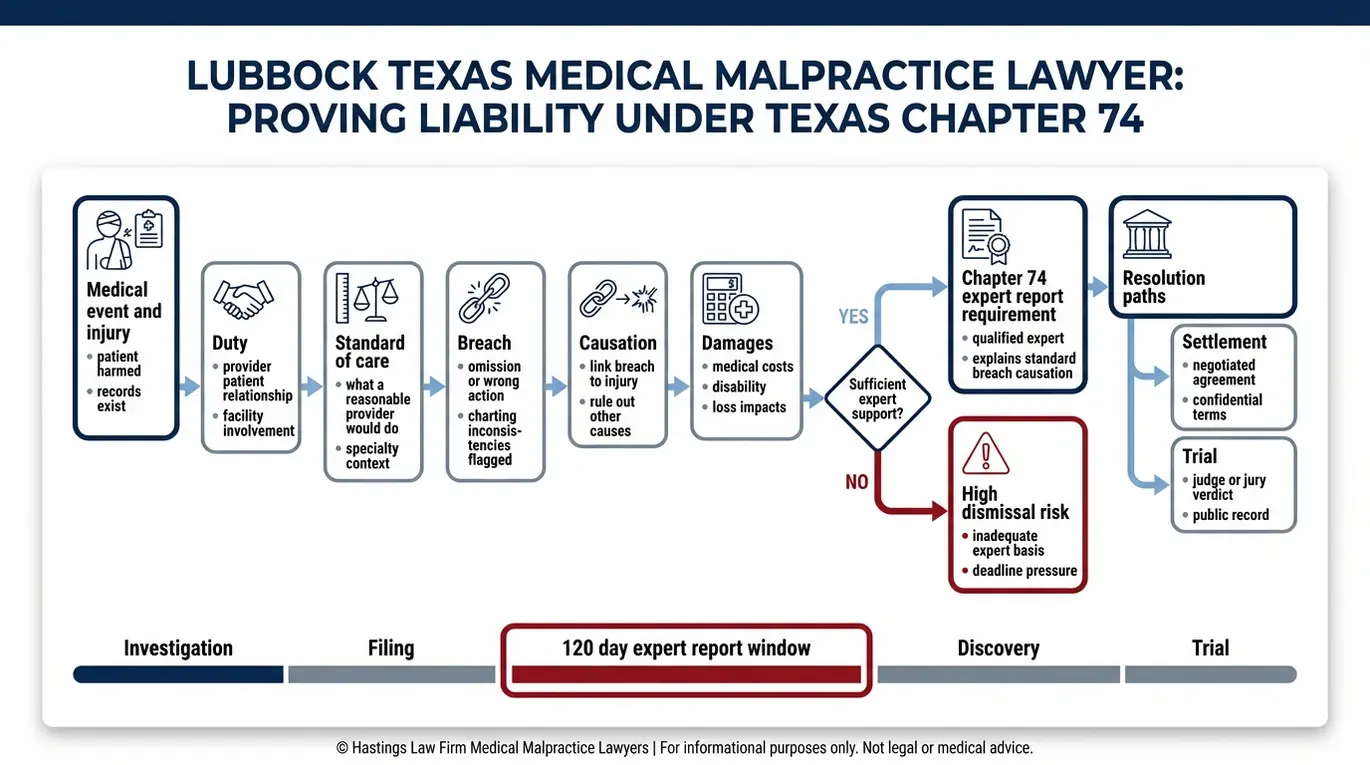
To prove liability in Texas, a patient must demonstrate that a healthcare provider violated the accepted standard of care, the level of treatment a reasonably competent provider would deliver under similar circumstances, and that this violation directly caused the injury or death. In Lubbock malpractice litigation, this requires establishing exactly how the treatment fell short of what is expected in the local medical community.
Under Texas Civil Practice and Remedies Code Chapter 74, every medical malpractice claim requires proof of four legal elements:
- Duty: The healthcare provider owed the patient a professional duty of care based on the treatment relationship.
- Breach: The provider failed to meet the accepted standard for that type of care.
- Causation: The breach directly caused or contributed to the patient’s injury.
- Damages: The patient suffered measurable harm, whether physical, financial, or emotional.
Texas imposes an additional requirement that makes early legal representation especially important. Under Section 74.351 of the Texas Civil Practice and Remedies Code, a plaintiff must serve a qualified expert report within 120 days after the date each defendant’s original answer is filed. This report must outline the standard of care, how the provider breached it, and how that breach caused harm. Failure to meet this deadline can result in dismissal of the case. This is why retaining a malpractice lawyer Texas families trust is essential.
Our firm maintains a national expert network specifically because medical negligence attorneys need independent, credible expert witness opinions. Local experts may be reluctant to testify against colleagues or institutions in their own community. By working with specialists across the country, we secure objective reviews that can withstand defense scrutiny.
Failure to diagnose, informed consent, and failures in postoperative monitoring are among the issues our experts frequently evaluate. This includes evaluating the duty to explain risks and alternatives before treatment.
The Role of the Certified Legal Nurse Consultant
Nurse consultants bridge a critical gap between medicine and law. When we investigate medical errors in Lubbock, our nurse consultants identify breaches in the standard of care that legal professionals alone might miss. On our team, these professionals review medical records line by line, looking for charting inconsistencies. These are documentation discrepancies where what is recorded does not match standard protocols or the patient’s clinical presentation.
They also examine medication reconciliation, the process of verifying that all drugs prescribed, administered, and documented are accurate and consistent. Errors in this process can reveal breakdowns in communication between providers. This analysis of clinical data helps our attorneys understand exactly what happened and build a stronger foundation for every case.
Recoverable Damages in Texas Medical Malpractice Cases
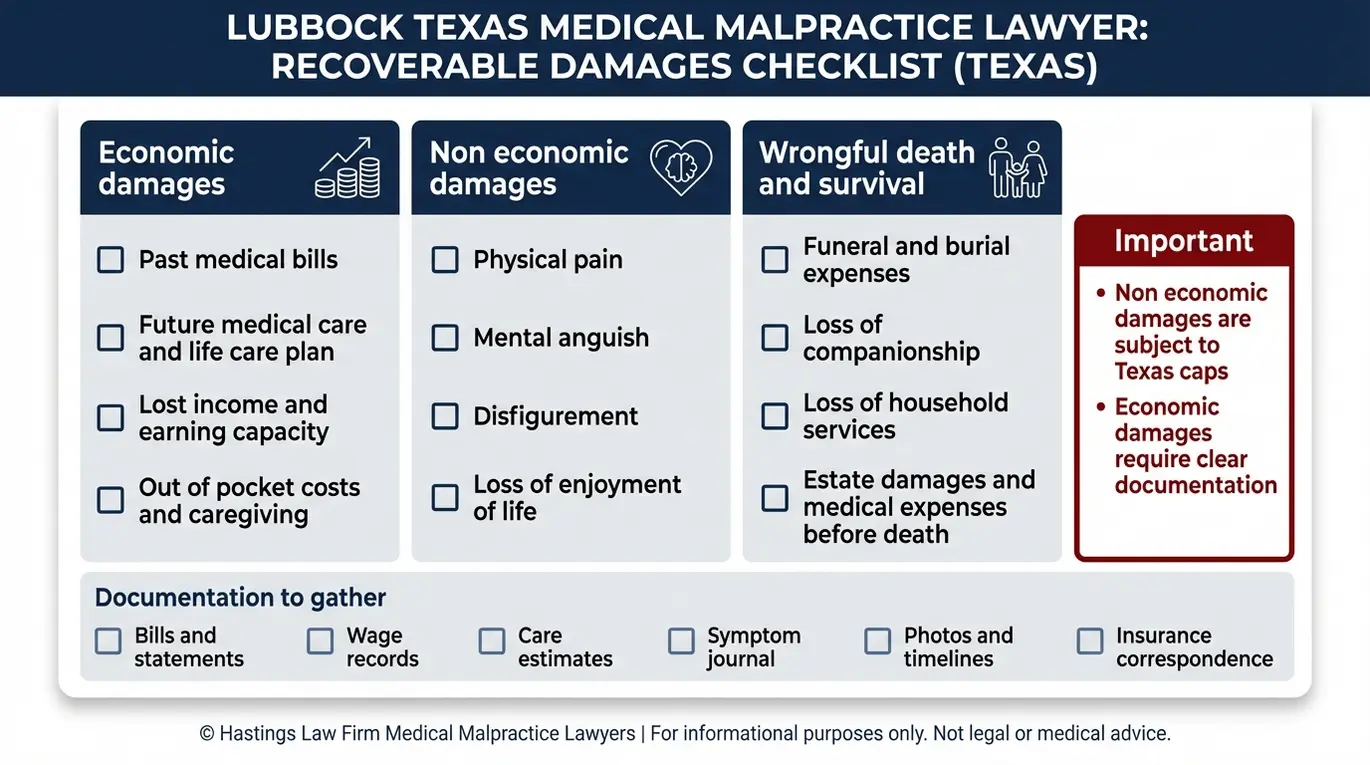
Texas law allows patients to recover economic damages for measurable financial losses and non-economic damages for pain and suffering, though non-economic awards are subject to statutory caps.
Understanding what compensation may be available is an important part of deciding whether to move forward with a claim. As a Lubbock medical malpractice lawyer team, we help clients identify every category of loss so nothing is overlooked.
Damages you may be entitled to recover:
- Past and future medical expenses: These include surgeries, rehabilitation, medications, and long-term care needs. We develop life care plans for catastrophic injuries such as hypoxic brain injury (oxygen deprivation) or brachial plexus injury (nerve damage affecting the shoulder, arm, and hand).
- Lost wages and earning capacity: Income lost during recovery and any reduction in your ability to earn in the future.
- Physical pain and mental anguish: The ongoing physical suffering and emotional distress caused by the injury.
- Disfigurement and physical impairment: Permanent changes to your body or limitations on your daily activities.
- Wrongful death damages: If a loved one died due to medical negligence, surviving family members may recover loss of companionship, funeral and burial costs, and lost financial support.
- Punitive damages: In rare cases involving especially egregious conduct, Texas courts may award punitive damages intended to deter similar behavior. These cases require a higher burden of proof.
Economic damages, such as medical bills and expenses and lost wages, have no cap under Texas law. Non-economic damages, however, are limited by statute. An experienced attorney for medical injuries can help you understand how these caps may apply and work to document the full scope of your losses.
Contact the Lubbock Healthcare Malpractice Attorneys at Hastings Law Firm Today for Help
If you or someone in your family was harmed by a medical error in Lubbock, you deserve answers. The team at Hastings Law Firm is here to listen, review your medical records, and give you an honest assessment of your legal options.
We work on a contingency fee basis, which means you pay no attorney fees and no costs unless we recover compensation on your behalf. Your initial consultation is free and completely confidential.
Taking this step doesn’t mean committing to a lawsuit. It means getting the information you need to make an informed decision about your future. As a Lubbock Texas medical malpractice lawyer team built around medical professionals and experienced trial attorneys, we are ready to help you find out what happened and what comes next.
Call us today or fill out our online form to schedule your free case evaluation.
Frequently Asked Questions About Medical Malpractice in Lubbock


This content was researched and written by the Hastings Law Firm editorial team, which includes attorneys, medical professionals, and experienced researchers. Our writing is informed by internal knowledge and practical experience, and we cross-check critical details against authoritative sources cited throughout. Every piece undergoes human-led fact-checking and legal review. Because legal and medical information can change, if you spot an error, please contact us. Learn more about our content standards and review process on our editorial policy page.

Tommy Hastings, founder of Hastings Law Firm, is a board-certified personal injury trial lawyer dedicated exclusively to healthcare injury cases. Since 2001, he has represented injured patients and families in litigation against major hospital systems, pharmaceutical companies, and negligent healthcare providers nationwide. He has handled numerous high-profile cases that have drawn national media attention and resulted in multi-million dollar recoveries. He draws on that experience in his writing, helping readers understand how these cases work and what options may be available to them.
