


Texas Emergency Room Malpractice Lawyer
Emergency room negligence can leave families facing serious injury, life threatening consequences, and lasting uncertainty about what went wrong. In Texas, emergency care is shaped by federal EMTALA duties to screen and stabilize patients and by a heightened willful and wanton negligence standard that can make accountability harder to prove. Liability may involve hospitals, independent contractor physicians, staffing companies, or mid level providers, and special rules can apply to government and VA facilities. If you or a loved one were harmed or worse due to emergency room negligence in Texas, contact Hastings Law Firm for a free, confidential case review.

Last Updated: July 27, 2026
Trusted Texas Medical Attorneys for Emergency Room Negligence Claims
When you or a loved one suffers harm in an emergency room, the experience can leave you feeling confused, frustrated, and unsure of what went wrong. Emergency departments operate under EMTALA, the Emergency Medical Treatment and Labor Act. This federal law requires every ER to provide a medical screening examination (a focused evaluation to identify any emergency medical condition) and stabilizing treatment to anyone who comes through the door, regardless of ability to pay. When that duty is not met, the consequences can be devastating.
As a Texas emergency room malpractice lawyer, Hastings Law Firm focuses exclusively on medical negligence. Our team of attorneys, in-house nurses, and former defense counsel knows how to investigate what happened, identify where the standard of care broke down, and hold the responsible parties accountable. If you believe an ER error caused serious harm, we can review the facts and explain your legal options at no cost.

Understanding the Willful and Wanton Negligence Standard in Texas
In Texas, emergency room malpractice cases often require proving “willful and wanton” negligence rather than ordinary negligence, meaning the provider must have consciously disregarded an extreme risk to the patient. This distinction is one of the most significant hurdles families face after an ER injury.
Under Civil Practice and Remedies Code Chapter 74, Texas applies a heightened standard of proof when the care at issue was delivered during a bona fide medical emergency. In a typical medical negligence case, you must show that the provider failed to meet the accepted standard of care, which is the level of treatment a reasonably competent professional would have provided in similar circumstances. In an ER setting, the burden of proof often goes further. You may need to demonstrate that the provider’s actions reflected a conscious indifference to an extreme degree of risk, a level sometimes described as gross negligence.
This higher bar exists because lawmakers recognized that emergency physicians work under time pressure and incomplete information. While that protection has merit, it can disadvantage patients who suffered real harm from clear errors. Proving willful and wanton negligence requires immediate, thorough investigation and a legal team experienced in building these cases.
We must act quickly to preserve temporary records, secure staffing logs, and interview witnesses before memories fade, as these pieces of evidence are often the only way to prove a gross deviation from the standard of care occurred. Without this proactive approach, the elevated protections for doctors can effectively block valid claims from moving forward.
For claims involving federal facilities, separate rules under 28 CFR Part 14 (Administrative Claims Under the Federal Tort Claims Act) apply, adding another layer of procedural requirements.
Here is how the two standards compare:
| Factor | Standard Medical Negligence | Willful and Wanton Negligence |
|---|---|---|
| Mental State | Failure to exercise reasonable care | Conscious disregard of an extreme risk |
| Standard of Proof | Preponderance of the evidence | Higher threshold showing gross deviation |
| When It Applies | Most medical malpractice claims | Bona fide emergency care in Texas ERs |
| Evidence Focus | Deviation from accepted practice | Awareness of risk and failure to act |
| Why It Matters | Easier for patients to establish | Requires specialized legal strategy |
Because of this elevated standard, working with a Texas emergency room malpractice attorney who understands the medical and legal details of these cases is essential. At Hastings Law Firm, we begin building the evidence from day one so that nothing is lost.
Common Types of Emergency Room Errors Our Firm Handles
Common ER errors include diagnostic failures, triage mistakes, medication errors, and failure to stabilize patients before discharge or transfer. Each of these breakdowns can turn a treatable condition into a life-threatening one, often requiring the intervention of a Texas emergency room malpractice lawyer to uncover the truth.
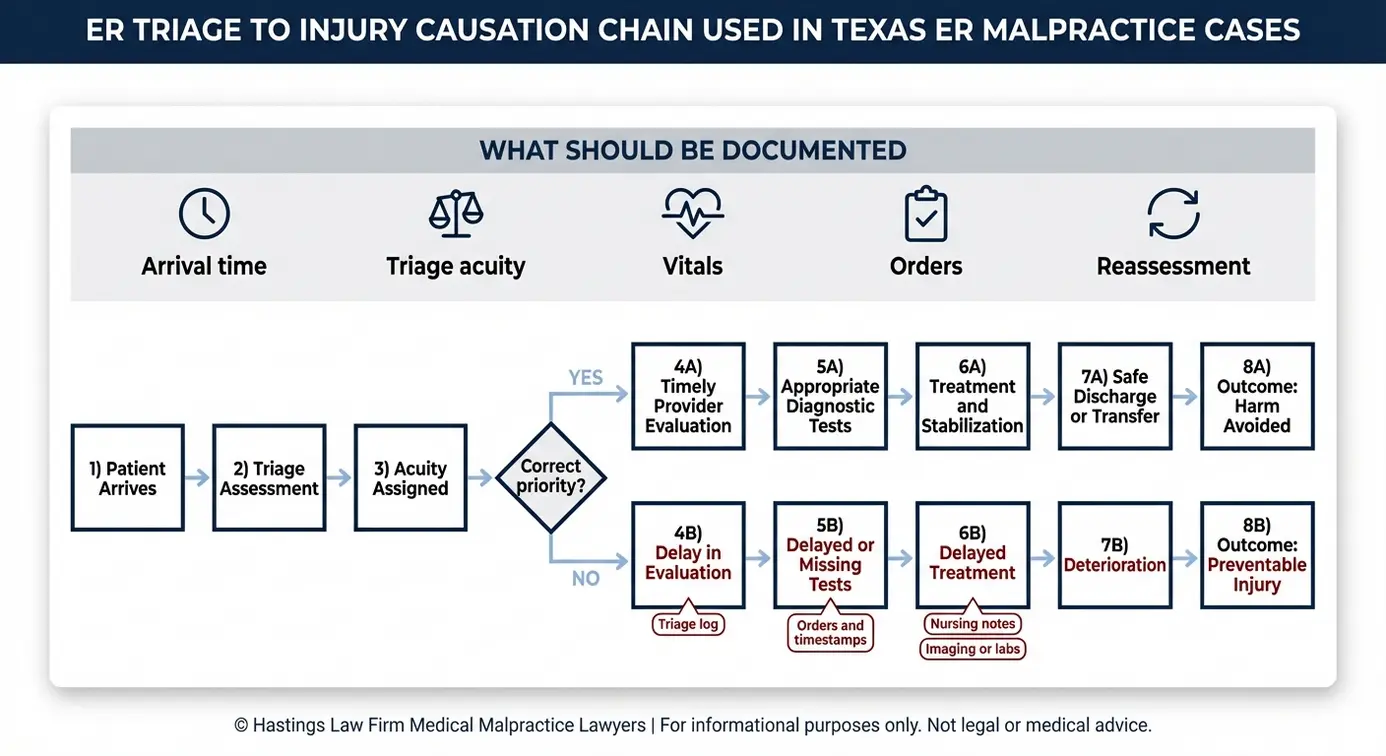
Triage Errors happen in the ER when a patient’s condition is not correctly classified at intake. A patient presenting with chest pain and shortness of breath, for example, may be assigned a lower priority and left waiting while their condition deteriorates. These mistakes in the triage process can delay critical care by minutes or hours.
Diagnostic Failures are among the most common sources of ER harm. The Agency for Healthcare Research and Quality (AHRQ) Patient Safety Network primer on Diagnostic Errors states that missed or delayed diagnoses contribute significantly to patient injury in emergency settings. When an ER physician fails to order appropriate diagnostic tests, such as CT scans, blood panels, or imaging studies, conditions like stroke, pulmonary embolism, or internal bleeding can go undetected, leading to a dangerous misdiagnosis.
Procedural Errors include mistakes during hands-on interventions in emergency care. Rapid sequence intubation (RSI), a method used to quickly secure a patient’s airway, carries serious risks when performed incorrectly. IV mistakes and surgical errors during emergency procedures also fall into this category.
Failure to Stabilize and Discharge Errors occur when an ER patient is sent home or transferred before their condition is under control. Failure to stabilize means a patient’s emergency medical condition was not adequately treated before the ER released them. This can violate both the standard of care and federal EMTALA requirements.
The table below outlines common ER errors and the types of harm they can cause:
| Error Type | Examples | Potential Consequences |
|---|---|---|
| Triage Errors | Misclassification of severity; delayed assessment | Delayed treatment of heart attack, stroke, sepsis |
| Diagnostic Failures | Missing test orders; misreading imaging | Undetected fractures, blood clots, cancer |
| Procedural Errors | Intubation errors; IV infiltration | Airway damage, tissue injury, medication complications |
| Discharge Errors | Premature release; inadequate follow-up instructions | Condition worsening at home; preventable death |
Obtaining Triage Logs to Reconstruct the Timeline
When we evaluate an ER malpractice claim, triage logs are one of the first records we examine to identify breaches in protocol. A triage log documents when a patient arrived, how their condition was assessed, and what Emergency Severity Index (ESI) level, a five-level system used to rank patients from most to least urgent, was assigned.
These records allow us to reconstruct a minute-by-minute timeline of what happened and identify gaps between when care should have been delivered and when it actually was. If a triage log shows that a patient with serious symptoms waited an unreasonable amount of time before being seen, that gap can be evidence of a departure from the standard of care. As experienced attorneys, we know exactly where to look in these records and how to interpret what we find.
The Hastings Law Firm Difference
Results matter, but what truly sets us apart is how we achieve them. Every verdict, every settlement, and every Texas courtroom victory comes from one guiding promise: To treat each client’s fight for justice as if it were our own.
This balance of skill, experience, and empathy reflects our core philosophy that justice should not only compensate the injured, but also make health care safer nationwide.

Determining Liability in Complex Hospital Systems
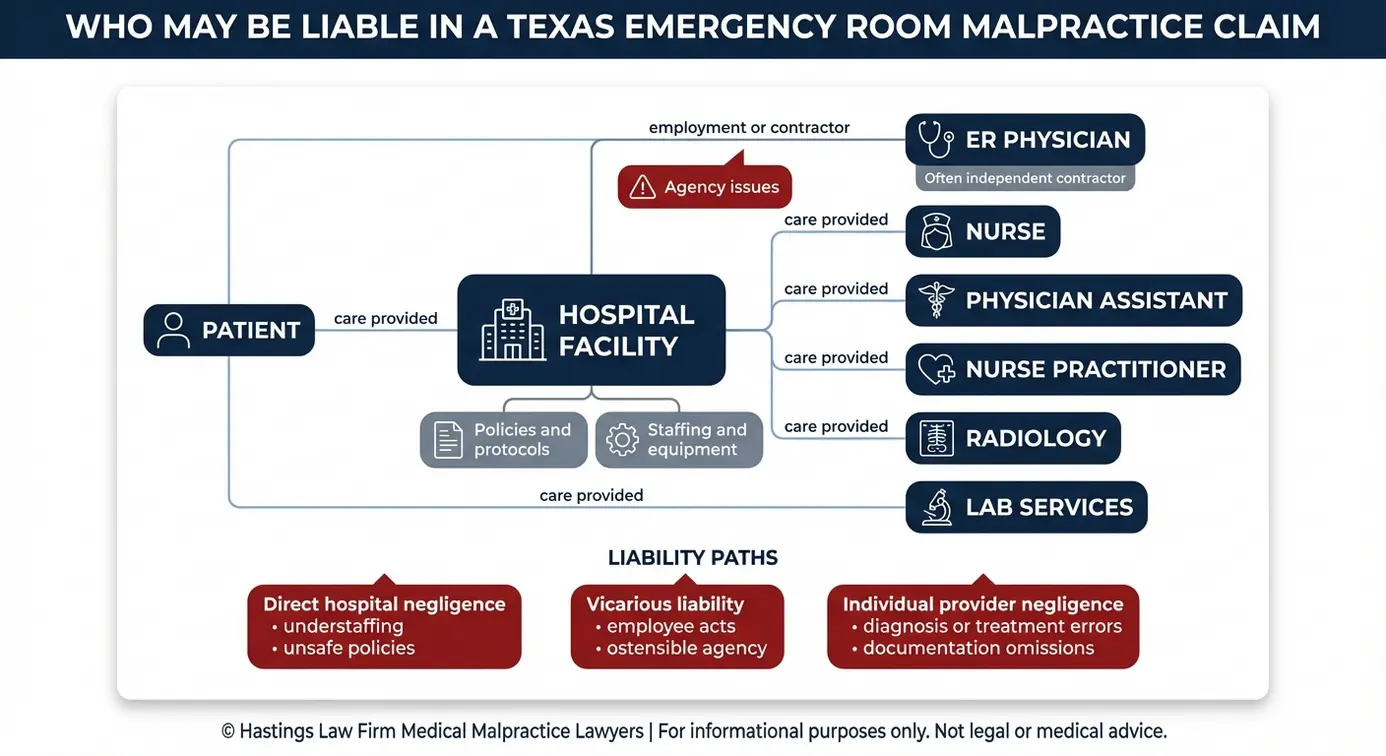
Liability in ER cases may fall on the hospital for systemic failures or on individual doctors who are often independent contractors, requiring a careful legal analysis of employment status and agency relationships.
Hospital vs. Doctor Liability: Many emergency room physicians are not hospital employees. They work as independent contractors through staffing companies, which can complicate the question of who is legally responsible. However, if the hospital held the doctor out as its own staff member, and you reasonably believed you were being treated by hospital personnel, a legal theory called “ostensible agency” may still allow you to hold the hospital accountable. The Texas Department of Insurance’s medical billing guidelines can provide insight into how provider relationships and billing structures are documented.
Systemic Negligence: Hospitals can be directly liable when their own policies or conditions contributed to the error. This is often referred to as hospital negligence. Emergency department (ED) crowding, which refers to the dangerous overloading of an ER beyond its functional capacity, and patient boarding, the practice of holding admitted patients in the ER because no inpatient beds are available, are institutional problems that can lead to delayed care and missed diagnoses.
Mid-Level Provider Errors: Nurse practitioners and physician assistants play an increasing role in emergency departments. When these providers make errors, liability may extend to the supervising physician or the hospital, depending on the employment and oversight structure.
Potential defendants in an ER malpractice case may include:
- The emergency room physician
- The hospital or health system
- The ER staffing company
- Nurse practitioners or physician assistants
- Supervising or consulting physicians
- Radiology, laboratory, or other ancillary departments
An experienced ER malpractice attorney in Texas will investigate each of these relationships to identify every responsible party and build the strongest possible case.
Claims Against Government and VA Hospitals
Claims against government-run ERs or VA facilities follow different rules, including the Texas Tort Claims Act or the Federal Tort Claims Act (FTCA), which impose strict notice deadlines and immunity limitations.
Sovereign Immunity is the legal doctrine that prevents you from suing a government entity unless it has waived that protection. In Texas medical liability cases, county hospitals and university teaching hospitals operate under sovereign immunity, meaning your right to bring a claim is limited by the Texas Tort Claims Act. This law caps the amount you can recover and requires specific procedural steps before a lawsuit can move forward.
VA and Military Hospital Claims are handled through the federal system. If you or a loved one was harmed in a VA emergency room, you generally cannot file a lawsuit directly. Instead, you must first submit an administrative claim using a Standard Form 95 (SF-95) to the appropriate federal agency.
Only after that claim is denied, or after six months without a response, can you file suit in federal court under the FTCA. Cases involving active duty personnel or veterans often involve complex military malpractice regulations.
Strict Deadlines are one of the biggest risks in government claims. While Texas medical malpractice cases generally allow two years to file, claims against state and local government entities under the Texas Tort Claims Act require written notice within six months of the incident, and federal FTCA claims must be filed with the appropriate agency within two years. These shorter windows catch many families off guard, as they are still grieving or recovering when the deadline passes. Missing that window can permanently bar your case, regardless of how strong the evidence may be.
Because these claims involve additional procedural layers and shorter deadlines, having a Texas emergency room malpractice lawyer who understands both state and federal processes is critical to protecting your rights.
Damages and Compensation Caps Under Texas Law
Texas law allows patients to recover economic damages like medical bills and lost wages, as well as non-economic damages for pain and suffering, though the latter is subject to specific statutory caps.
Economic Damages cover the financial losses directly tied to the injury in Texas malpractice lawsuits. These include past and future medical expenses, rehabilitation costs, lost income, and reduced earning capacity. There is no cap on economic damages in Texas medical malpractice cases, meaning you can seek full reimbursement for every dollar the injury has cost you and will cost you going forward.
Non-Economic Damages compensate for medical injuries that do not have a specific dollar amount, such as pain and suffering, mental anguish, physical impairment, and loss of enjoyment of life. Under Texas Civil Practice and Remedies Code § 74.301, non-economic damages are capped at $250,000 for all individual physicians or healthcare providers and $250,000 per healthcare institution, with an aggregate cap of $500,000 for all healthcare institutions involved.
These damage caps apply regardless of the severity of the injury, limiting what juries can award for human suffering.
Wrongful Death Claims arise when a loved one dies because of emergency room negligence. Surviving family members may recover damages for lost financial support, loss of companionship, and funeral expenses. These cases involve their own set of statutory requirements and timelines.
The key categories of recoverable damages include:
- Past and future medical expenses
- Lost wages and diminished earning capacity
- Physical pain and suffering
- Mental anguish and emotional distress
- Loss of consortium and companionship
- Funeral and burial costs (in wrongful death cases)
A Texas emergency room malpractice lawyer can evaluate the full scope of your losses and pursue every category of compensation the law allows.
How Our Trial-Ready Approach Secures Justice
We prepare every ER malpractice claim for trial from day one, working with board-certified experts and building detailed medical reconstructions that position your case for a fair resolution.
Chapter 74 Expert Reports: For a medical malpractice case, you must serve a qualified expert report within 120 days of each defendant’s original answer. This report must identify the standard of care, explain how it was breached, and connect that breach to the injury. Our firm handles the cost and coordination of expert testimony, working with our national network of physicians who review the medical evidence and provide credible, objective opinions.
The Trial-Ready Philosophy: At Hastings Law Firm, we do not prepare for settlement and hope it works. We prepare for trial and let that preparation drive the outcome. Our team, which includes former defense attorneys who know exactly how the other side builds its case, reconstructs the clinical timeline, secures critical records, and retains qualified experts before the defense has a chance to control the narrative. This thorough preparation signals to insurance carriers that we are fully prepared to take the case to a jury.
No Fees Unless We Recover: We operate on a contingency fee basis. You pay nothing upfront, and we advance all costs for expert testimony, court filings, and investigation. Medical malpractice cases are expensive to litigate, often requiring tens of thousands of dollars in expert fees and administrative costs.
Our model ensures that financial barriers never prevent a family from seeking justice. If we do not secure a recovery for you, you owe us nothing.
As a Texas Emergency Room Malpractice Lawyer, Tommy Hastings and the team at Hastings Law Firm have spent over two decades holding negligent providers accountable. That experience is available to you.
Contact the Texas Healthcare Malpractice Attorneys at Hastings Law Firm Today for Help
Texas emergency room malpractice cases involve strict filing deadlines, a heightened negligence standard, and the need for qualified expert testimony early in the process. Waiting too long can mean lost evidence and expired legal rights.
You do not have to carry this alone. Hastings Law Firm exists to take the legal burden off your shoulders so you can focus on healing. Our team of attorneys, nurses, and medical experts will investigate what happened, identify who is responsible, and pursue the truth on your behalf.
Every case we take is driven by two goals: securing the compensation you need and making sure the same mistake does not happen to someone else.
Contact us today for a free, confidential case evaluation. There is no fee unless we win.
Frequently Asked Questions About Emergency Room Malpractice in Texas


This content was researched and written by the Hastings Law Firm editorial team, which includes attorneys, medical professionals, and experienced researchers. Our writing is informed by internal knowledge and practical experience, and we cross-check critical details against authoritative sources cited throughout. Every piece undergoes human-led fact-checking and legal review. Because legal and medical information can change, if you spot an error, please contact us. Learn more about our content standards and review process on our editorial policy page.

Gabe Sassin has focused exclusively on medical malpractice law since 2007. After spending more than a decade as a malpractice defense attorney, he knows exactly how the other side works. He has seen firsthand how healthcare providers, insurers, corporate defendants, and their legal teams think, prepare, and build their defense against claims. That knowledge works for the people who need it most today, injured patients and their families. His unique experience shapes everything he writes, giving readers a look at how these cases actually work from someone who has handled them from both sides.
