


Texas Sepsis Malpractice Lawyer
A missed or delayed sepsis diagnosis can turn a treatable infection into a life threatening emergency with lasting organ damage, prolonged intensive care, or fatal outcomes. Sepsis can worsen within hours, so recognizing warning signs and starting timely testing and treatment can be the difference between recovery and catastrophic harm. Disputes often focus on whether clinicians connected the clinical pattern to infection, escalated care appropriately, and followed accepted sepsis protocols. If you or a loved one were harmed or worse due to failure to diagnose sepsis in Texas, contact Hastings Law Firm for a free, confidential case review.

Last Updated: July 27, 2026
Trusted Texas Medical Attorneys for Failure to Diagnose Sepsis Claims
When someone you love is hospitalized with an infection and their condition spirals out of control, the questions come fast. Was the infection caught in time? Should the doctors have acted sooner? Could this have been prevented?
These are painful questions, and you deserve honest answers. Sepsis moves quickly, and when healthcare providers fail to recognize the warning signs or delay treatment, the consequences can be devastating. If your family is dealing with the aftermath of a missed or delayed sepsis diagnosis, a Texas sepsis malpractice lawyer can help you understand what happened and whether the care fell below accepted medical standards.
At Hastings Law Firm, led by board-certified trial lawyer Tommy Hastings, our team focuses exclusively on medical negligence. We can review what happened, examine the medical records, and explain your legal options in a free, confidential consultation.

Understanding Sepsis and Septic Shock in a Medical Legal Context
Sepsis is a life-threatening reaction to an infection that triggers a chain reaction throughout the body, potentially leading to tissue damage, organ failure, and death if not treated immediately. Sepsis is a medical emergency where the body overreacts to an infection, potentially causing life-threatening organ failure. It begins with an underlying infection, such as pneumonia or a urinary tract infection, causing the immune system to damage its own organs.
If not controlled, sepsis can advance to septic shock, where blood pressure drops dangerously low and organs shut down. The medical community describes this urgency as “time is tissue,” meaning every hour without treatment increases the risk of permanent damage. For a Texas sepsis malpractice lawyer, the speed of deterioration and the medical team’s response time are critical factors in determining whether organ dysfunction was preventable.
According to The Third International Consensus Definitions for Sepsis and Septic Shock (Sepsis-3), sepsis is clinically defined as life-threatening organ dysfunction caused by a dysregulated host response to infection. This definition is the current medical standard used in both clinical practice and legal analysis.
The Clinical Distinction Between SIRS and Sepsis
Doctors historically relied on Systemic Inflammatory Response Syndrome (SIRS) to identify patients mounting a widespread inflammatory response. SIRS is identified when a patient meets two or more criteria: elevated heart rate, abnormal temperature, rapid breathing, or abnormal white blood cell count.
However, SIRS alone does not confirm sepsis, as it can occur after exercise or the flu. The critical difference is whether the response is tied to an infection with organ dysfunction. A sepsis lawyer in Texas examines whether the clinical team recognized the shift from a general inflammatory state to true sepsis.
- SIRS (Systemic Inflammatory Response Syndrome): Two or more signs of systemic inflammation (fever, elevated heart rate, rapid breathing, abnormal white blood cell count). Can occur without infection.
- Sepsis: SIRS criteria present *plus* a confirmed or suspected infection causing organ dysfunction. Requires immediate intervention.
- Septic Shock: Sepsis with persistent low blood pressure that does not respond to fluid resuscitation, combined with elevated lactate levels. Carries the highest mortality risk.

Recognizing the Symptoms of Sepsis and Septic Shock
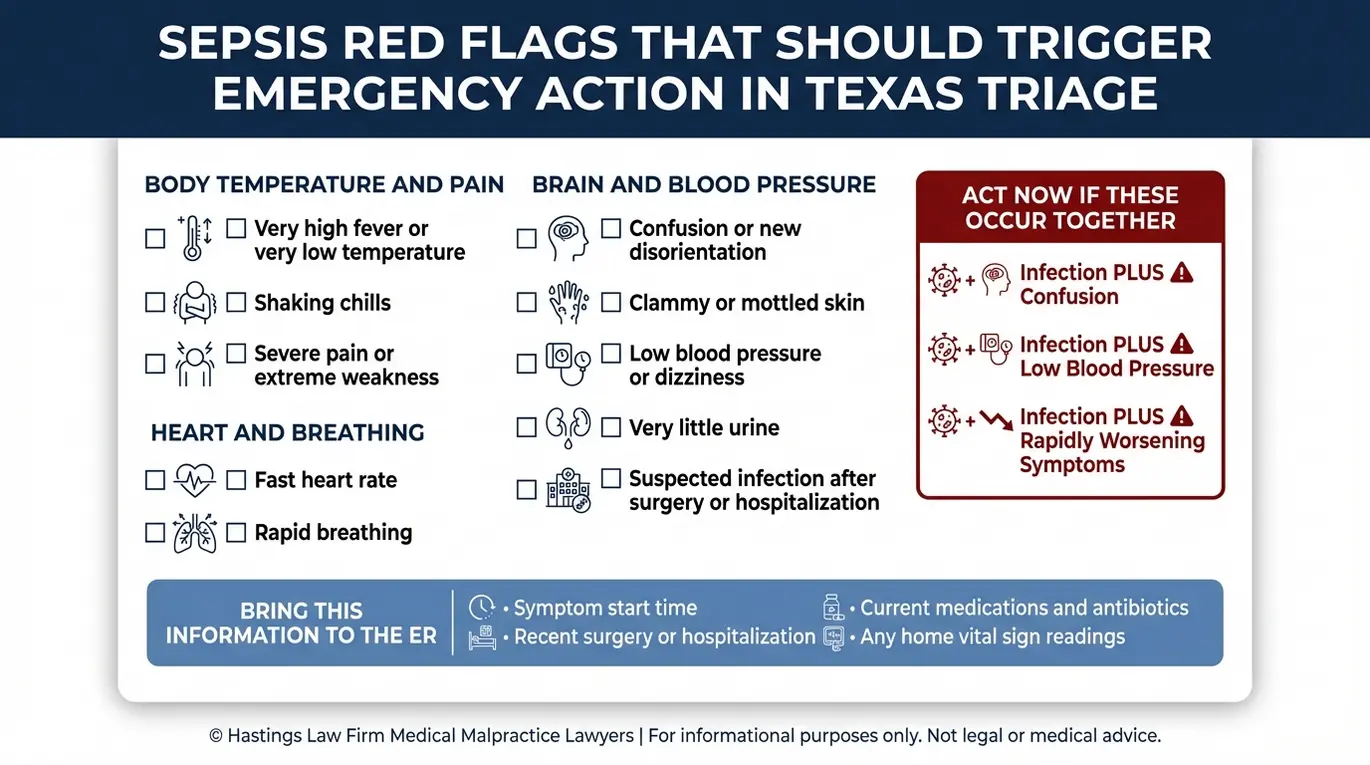
Common symptoms of sepsis include high fever, shivering, extreme pain, clammy skin, confusion, and a rapid heart rate, which can progress to septic shock characterized by dangerously low blood pressure. These symptoms can appear suddenly and worsen within hours, which is why accurate triage in the emergency room is so critical.
A sepsis malpractice lawyer looks at whether the medical team identified and responded to these warning signs in a timely manner. Screening tools like the quick Sequential Organ Failure Assessment (qSOFA), a bedside scoring system that evaluates mental status, respiratory rate, and blood pressure, help clinicians rapidly identify patients at risk. The more detailed Sequential Organ Failure Assessment (SOFA) score measures organ function across six systems to gauge the severity of sepsis. Research published in the JAMA Network Open has examined how these tools compare in predicting sepsis outcomes.
When vital signs are recorded during ER triage but the clinical team does not connect the pattern, a triage error creates a dangerous gap between the clinical data and the treatment the patient receives. A Texas sepsis attorney will examine the triage records, nursing assessments, and physician notes to determine whether the documented symptoms should have triggered an immediate workup. Identifying these red flags early is the only way to prevent the cascade into septic shock. A delayed response to these specific markers is often the focal point of litigation.
Red Flag Symptoms That Should Trigger Immediate Action:
- Fever above 101°F (38.3°C) or temperature below 96.8°F (36°C)
- Heart rate above 90 beats per minute
- Respiratory rate above 20 breaths per minute
- Altered mental status, confusion, or difficulty staying awake
- Clammy or mottled skin
- Severe pain or discomfort disproportionate to the known condition
- Systolic blood pressure dropping below 100 mmHg
- Little or no urine output
Any combination of these symptoms alongside a known or suspected infection should prompt immediate evaluation for sepsis. When that evaluation does not happen, the consequences can be severe.
The Hastings Law Firm Difference
Results matter, but what truly sets us apart is how we achieve them. Every verdict, every settlement, and every Texas courtroom victory comes from one guiding promise: To treat each client’s fight for justice as if it were our own.
This balance of skill, experience, and empathy reflects our core philosophy that justice should not only compensate the injured, but also make health care safer nationwide.

When Failure to Diagnose Sepsis Becomes Medical Malpractice
Medical malpractice occurs when a healthcare provider deviates from the accepted standard of care by failing to recognize clear signs of infection or delaying necessary testing, directly causing harm to the patient. Not every bad outcome is malpractice. But when a provider ignores clinical indicators or fails to follow established protocols, and the patient suffers as a result, there may be a valid legal claim for medical negligence.
A Texas sepsis malpractice lawyer evaluates several common patterns that can indicate negligence in sepsis cases. These include failing to order basic diagnostic tests like blood cultures or lactate levels when infection is suspected, misdiagnosing a serious infection as a minor illness, discharging a patient prematurely, or delaying the administration of broad-spectrum antibiotics.
For example, consider a patient presenting with high fever and confusion. If the physician dismisses these signs as a viral illness without ordering blood work, a classic failure to diagnose occurs. If the patient later suffers organ failure, the delayed diagnosis may form the basis of a valid claim. Broad-spectrum antibiotics are powerful medications designed to target a wide range of bacteria, and delays in administering them can be fatal.
The Golden Hour and Antibiotic Treatment Windows
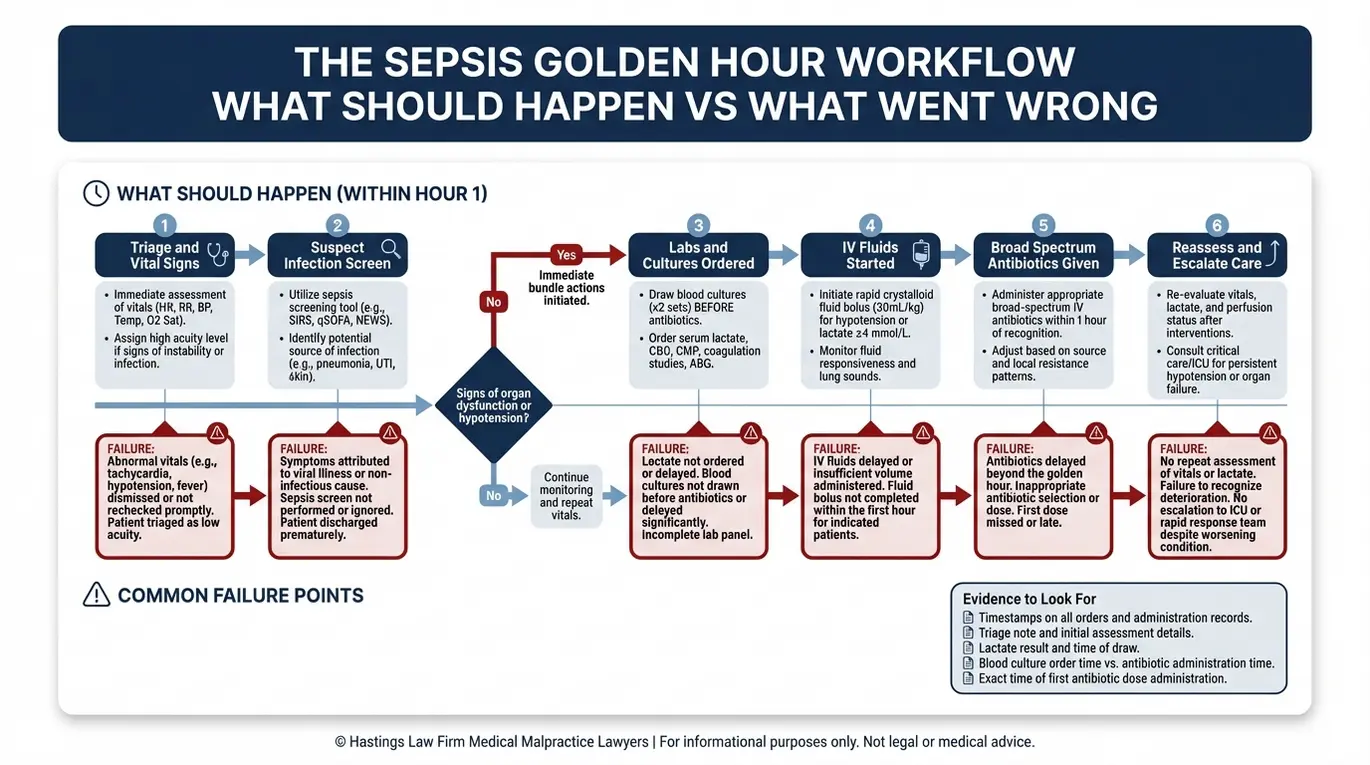
One of the most well-established benchmarks in sepsis treatment is the Surviving Sepsis Campaign Hour-1 Bundle. The Hour-1 bundle represents a set of critical medical steps that should be performed within sixty minutes of identifying sepsis. This set of guidelines, developed by critical care experts, requires that specific interventions begin within one hour of sepsis recognition. These steps include measuring lactate levels, drawing blood cultures before starting antibiotics, administering broad-spectrum antibiotics, beginning rapid fluid resuscitation if blood pressure is low, and applying vasopressors if shock persists.
The Surviving Sepsis Campaign hour-1 bundle guidelines make clear that delays in any of these steps can significantly reduce a patient’s chance of survival. Each hour that antibiotics are delayed after the onset of septic shock has been associated with increased mortality.
When a malpractice lawyer for sepsis investigates a case, we build a minute-by-minute timeline from the medical records to determine whether the treatment team met these benchmarks. If a patient presented with signs of infection and the Hour-1 Bundle was not initiated, that gap between recognition and response is often the point where the malpractice occurred.
A sepsis negligence attorney will work with qualified medical experts to compare what actually happened against what should have happened under the circumstances. This process is how we establish whether the standard of care was met, or whether a preventable delay caused the patient’s injuries or death.
Proving Liability and the Standard of Care for Sepsis Treatment in Texas
To prove liability, a plaintiff must demonstrate that a doctor or hospital had a duty of care, breached that duty by failing to follow accepted protocols, and that this breach directly caused the patient’s injury or death. In Texas malpractice cases, evidence must show that a provider’s error directly caused the patient’s harm.
The first element, duty of care, is typically established by confirming a doctor-patient relationship existed. Once a patient is triaged or admitted, the providers owe that patient a duty of care consistent with accepted standards. Our firm prepares every case with a trial-ready approach, investigating every detail from the start as if it will go before a jury.
The second element, breach, is where the case often turns. A Texas sepsis malpractice lawyer examines whether the clinical team failed to follow sepsis screening and treatment protocols. Ignoring elevated lactate levels, failing to draw blood cultures before starting antibiotics, or not escalating care when a patient’s condition worsened can all indicate a breach.
The third element, causation, is often the most contested. Defense teams frequently argue the patient would have died regardless of intervention. Proving causation requires demonstrating that timely treatment would have, more likely than not, changed the outcome. Qualified medical experts are necessary to establish this link.
Essential Laboratory Testing Used to Diagnose Sepsis
Specific hard evidence in sepsis negligence cases often comes from laboratory testing. Healthcare providers use diagnostic tests to determine the severity of an infection and its impact on the body. A lawyer for sepsis negligence will focus on whether these tests were ordered and how results were interpreted:
- Lactic acid (lactate) levels: Elevated levels, typically above 2 mmol/L, signal organs are not receiving adequate blood flow.
- Blood cultures: Samples drawn to identify bacteria. These should be collected before antibiotics are administered.
- Procalcitonin levels: A biomarker that rises in response to bacterial infections.
- White blood cell (WBC) count: Abnormally high or low WBC counts can indicate serious infection.
When these tests are not ordered, or when abnormal results are ignored, those gaps become central evidence. Our medical staff includes former hospital nurses who review records to identify charting inconsistencies alongside our sepsis malpractice attorneys.
Recoverable Damages for Sepsis Victims Under Texas Law
Victims of sepsis malpractice in Texas can recover economic damages for medical bills and lost wages, as well as non-economic damages for pain, suffering, and physical impairment, subject to state-imposed caps. Economic damages represent measurable financial losses, while non-economic damages address intangible impacts like pain and suffering. Sepsis injuries are often catastrophic, involving amputations, prolonged ICU stays, organ damage, and in the worst cases, wrongful death. The financial and emotional toll on families can be enormous.
Data from the Healthcare Cost and Utilization Project (HCUP) shows that inpatient stays involving sepsis are among the most costly hospitalizations in the country. High costs highlight the significant financial burden these cases place on patients and families.
A Texas sepsis malpractice lawyer will pursue the full scope of recoverable damages, which generally fall into two categories:
- Economic Damages: Past and future medical expenses, rehabilitation and long-term care costs, lost wages and reduced earning capacity, and costs related to prosthetics or home modifications following amputations.
- Non-Economic Damages: Physical pain and suffering, mental anguish, disfigurement, loss of consortium, and reduced quality of life.
Texas law imposes caps on non-economic damages in medical malpractice cases under House Bill 4 (HB 4). For claims against individual physicians and healthcare providers other than healthcare institutions, non-economic damages are generally capped at $250,000 per claimant, regardless of the number of defendant physicians. These caps can significantly limit recovery in cases of severe disability, making accurate calculation of economic damages even more more critical. A sepsis injury lawyer can explain how these caps apply to your specific situation.
Filing a Sepsis Malpractice Lawsuit in Texas: Procedures and Timelines
Filing a lawsuit involves strictly adhering to the two-year statute of limitations and fulfilling pre-suit notice requirements under Texas Civil Practice and Remedies Code Chapter 74. Missing these deadlines can permanently bar your claim, regardless of the strength of the underlying evidence.
The general rule is that you must file your medical malpractice lawsuit within the statute of limitations, which is usually two years from the date the negligence occurred. Texas courts apply the “discovery rule” narrowly, making early legal consultation vital.
Before filing, Texas law requires plaintiffs to provide at least 60 days’ written notice to each healthcare provider being sued. After the lawsuit is filed, the patient must serve a qualified expert report within 120 days after the date each defendant’s original answer is filed. This report, prepared by a physician familiar with the relevant standard of care, must identify the specific breach, explain how the provider’s actions fell below accepted standards, and establish a causal connection to the patient’s injuries or death. Failure to serve a compliant expert report can result in dismissal of the case.
Sepsis malpractice lawyers in Texas understand these procedural requirements and begin building the expert foundation from day one to establish physician and hospital liability. For access to public filings and court records related to Texas medical malpractice cases, the Texas State Law Library Court Records Guide provides a helpful starting point.
Contact the Texas Healthcare Malpractice Attorneys at Hastings Law Firm Today for Help
Sepsis errors are often preventable. When healthcare providers fail to recognize the signs of infection or delay treatment that guidelines say should begin within the first hour, families are left dealing with consequences that should never have happened.
If you have lost a loved one or are caring for someone who suffered serious harm from a missed sepsis diagnosis, you do not have to face this alone. At Hastings Law Firm, our team of attorneys, in-house medical professionals, and former defense counsel is built specifically for cases like these. We prepare every case as if it is going to trial, because that preparation is what drives fair results.
There is no fee unless we recover compensation for you. Contact our Texas sepsis malpractice lawyer team today for a confidential case evaluation. Let us review the medical records, identify what went wrong, and explain your options.
Frequently Asked Questions About Sepsis Malpractice in Texas


This content was researched and written by the Hastings Law Firm editorial team, which includes attorneys, medical professionals, and experienced researchers. Our writing is informed by internal knowledge and practical experience, and we cross-check critical details against authoritative sources cited throughout. Every piece undergoes human-led fact-checking and legal review. Because legal and medical information can change, if you spot an error, please contact us. Learn more about our content standards and review process on our editorial policy page.

Brady D. Williams is a nationally recognized medical malpractice attorney who has spent his career handling high-stakes litigation for injured patients and families across the country. Licensed in both Texas and California, Brady draws on experience from hundreds of resolved medical cases to break down complex legal and medical topics for the people who need that information most. His writing reflects the same attention to detail and commitment to clarity that he brings to every case he handles.
