


Fort Worth Medical Malpractice Lawyer
Written by: Hastings Law Firm | Reviewed by: Gabe Sassin | Updated: July 27, 2026
Medical negligence can leave patients and families facing lasting harm, uncertainty, and a difficult search for clear answers. In Fort Worth, medical malpractice claims often turn on whether a provider fell below the accepted standard of care and whether that lapse caused measurable injury. These cases can involve individual mistakes, institutional failures, or systemic pressures that contribute to preventable errors. Understanding liability, proof requirements, and limits on damages can shape what recovery is possible. If you or a loved one were harmed or worse due to medical malpractice in Fort Worth, Texas, contact Hastings Law Firm for a free, confidential case review.

Trusted Legal Representation for Healthcare Negligence in Fort Worth
What You Should Know About Healthcare Negligence Claims in Fort Worth:
- Recovery can depend on showing that a healthcare provider fell below the accepted standard of care and that the lapse caused injury or death.
- Options can be lost entirely if required early claim actions are missed, since Texas courts can dismiss a case permanently.
- Financial exposure can increase if an expert report is not served on time, because the patient may be ordered to pay the defendant attorney fees and costs.
- Liability can extend beyond a single clinician, since hospitals, nursing staff, and product manufacturers may share responsibility depending on the facts.
- Severe harm can be tied to systemic breakdowns, since burnout and understaffing can contribute to preventable errors and support institutional responsibility.
- Compensation can be limited for non economic losses, since Texas generally caps pain and suffering style damages while leaving economic losses uncapped.
- The ability to pursue a claim can be barred by time limits, since missing the statute of limitations or the statute of repose can permanently end the claim.
- Disputes can focus on causation, since the injury must be linked to the breach rather than the underlying illness.
- Case outcomes can hinge on expert support, since Texas requires expert testimony to establish key issues in a medical malpractice claim.
- Clarity about what happened can depend on medical documentation, since records are central to evaluating care and identifying responsible parties.

A Healthcare Focused Law Firm
When a medical professional’s error changes your life or the life of someone you love, the confusion and frustration can feel overwhelming. You may sense that something went wrong during your care, yet proving it against a well-funded hospital system can seem like an impossible task. You are not alone in feeling that way, and your instinct to ask questions deserves to be taken seriously.
Founded by board-certified trial lawyer Tommy Hastings, our firm focuses exclusively on representing patients and families harmed by medical negligence. Our team of trial attorneys, former defense lawyers, and in-house nurse consultants works together to uncover what happened and hold the responsible parties accountable. If you believe you or a loved one was injured by a preventable medical error, we welcome you to contact us for a free, confidential case evaluation. There is no fee unless we recover compensation for you.
Common Types of Medical Malpractice Cases in Fort Worth
Medical malpractice occurs when a healthcare professional deviates from the accepted standard of care, the level of treatment a reasonably competent provider would deliver under similar circumstances, and that deviation causes patient injury or death. Not every poor medical outcome qualifies as malpractice. The key distinction is whether the provider’s actions fell below what their peers would consider acceptable practice.
Medical malpractice lawyers in Fort Worth handle a broad range of cases involving preventable harm. Some of the most common include:
- Surgical errors: Wrong-site surgeries, nerve damage, or a retained surgical item (RSI), which is any instrument, sponge, or device accidentally left inside a patient’s body after a procedure.
- Misdiagnosis and failure to diagnose: Delayed cancer diagnoses, missed heart attacks, or strokes that go unidentified until permanent damage has occurred.
- Birth injuries: Preventable harm during labor and delivery, including conditions like hypoxic-ischemic encephalopathy (HIE), a type of brain damage caused by oxygen deprivation during birth.
- Anesthesia errors: Dosage miscalculations, failure to review a patient’s medical history, or inadequate monitoring during surgery.
- Medication errors: Prescribing the wrong drug, incorrect dosages, or dangerous drug interactions that could have been avoided with proper review.
- Hospital errors: Institutional failures such as patient falls, infections from poor sanitation, or communication breakdowns between care teams.
- Nursing home abuse & neglect: Failure to provide basic needs, medication errors in long-term care facilities, or physical mistreatment of elderly residents.
- Wrongful death: Cases where a preventable medical error results in the loss of a patient’s life, leaving families to seek answers and accountability.
A Fort Worth medical malpractice attorney can help you determine whether the harm you experienced resulted from a genuine complication or from a provider’s failure to meet the standard of care. That distinction is the foundation of every case we evaluate. We are committed to investigating all forms of negligence to ensure patients receive the justice they deserve.
Mandatory Steps to File a Medical Malpractice Claim in Texas
Texas law requires plaintiffs to provide written notice of the claim to all defendants at least 60 days before filing suit and to serve a qualified expert report within 120 days after the date each defendant’s original answer is filed. These are not optional formalities. Failing to meet either deadline can result in your case being dismissed entirely.
Dismissed with prejudice means the case is closed permanently and cannot be filed again in the future. Here is what the process requires under the Texas Civil Practice and Remedies Code, Chapter 74.051:
- Pre-suit written notice: Before you can file a health care liability claim, you must send a formal letter to each defendant notifying them of the claim. This triggers a mandatory 60-day waiting period designed to allow for early resolution.
- Authorization for medical records: Along with the notice, you must provide a written authorization allowing the defendant to obtain your relevant medical records for review.
- Expert report requirement: Under Texas Civil Practice and Remedies Code Section 74.351, the patient must serve each defendant with a report authored by a qualified medical expert. This report must identify the applicable standard of care, explain how the provider breached it, and describe how that breach caused your injury. The deadline is 120 days after the date each defendant’s original answer is filed.
- Consequences of missing deadlines: If the expert report is not served on time, the court must dismiss the case with prejudice and must require the patient to pay the defendant’s reasonable attorney fees and costs.
A medical malpractice attorney serving Fort Worth families can manage these complex pre-suit requirements from the start. We work to ensure that no deadline is missed and that your claim is built on solid ground.

The Hastings Law Firm Difference
Results matter, but what truly sets us apart is how we achieve them. Every verdict, every settlement, and every Fort Worth courtroom victory comes from one guiding promise: To treat each client’s fight for justice as if it were our own.
This balance of skill, experience, and empathy reflects our core philosophy that justice should not only compensate the injured, but also make healthcare safer nationwide.

How to Prove Negligence and The Standard of Care
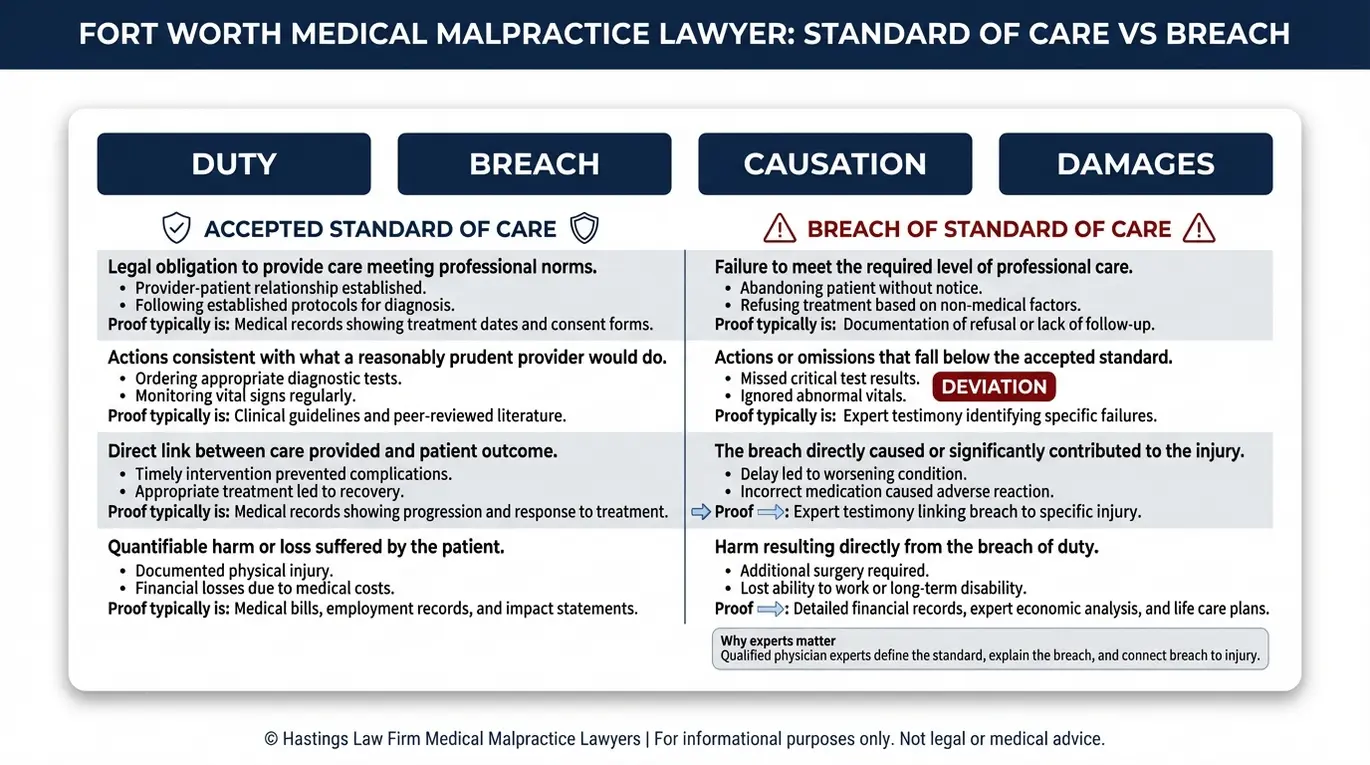
To prove a case, the plaintiff must demonstrate that a doctor-patient relationship existed, the provider breached the standard of care, and this breach directly caused specific injuries or damages. Meeting the burden of proof in Texas medical malpractice claims requires establishing four legal elements, each of which must be supported by evidence.
Duty is established by the doctor-patient relationship. Once a provider agrees to treat you, they owe you a duty of competent care. Breach means the provider failed to act as a reasonably prudent professional in the same specialty would have under similar circumstances.
This could involve something as specific as a failure to perform medication reconciliation. This is the process of comparing a patient’s medication orders against all medications they are currently taking. It could also involve failing to prevent anesthesia awareness (intraoperative awareness), a traumatic event where a patient remains conscious during surgery.
Causation requires showing that the provider’s breach, such as a failure to treat an emerging condition, directly led to the injury rather than the underlying illness. And damages are the actual losses you suffered, whether physical, financial, or emotional.
Under the Texas Civil Practice and Remedies Code, Chapter 74.051, expert testimony is required to establish these elements. Expert testimony involves a professional in the same field explaining the medical facts of the case. Fort Worth medical malpractice lawyers work with qualified physicians who can review medical records and identify where the standard of care was violated.
Identifying Liable Parties in Fort Worth Healthcare Systems
Liability can extend well beyond the individual doctor to include hospitals, nursing staff, pharmaceutical companies, and medical device manufacturers, depending on employment status and the nature of the error. Our team includes former hospital nurses and defense attorneys who understand the systems they now challenge, providing a strategic advantage in identifying charting errors or protocol violations. Identifying every liable party is one of the most important steps in building a complete case.
A medical malpractice lawyer in Fort Worth will evaluate whether liability falls on:
- The treating physician, based on their individual clinical decisions or their status as an independent contractor. An independent contractor is a professional who provides services but is not a direct employee of the facility.
- The hospital or health system, for institutional negligence such as unsafe protocols, credentialing and privileging errors, or hospital liability related to inadequate staffing. Credentialing is the process by which a facility verifies a provider’s qualifications.
- Nursing or support staff, for failures in monitoring, documentation, or medication administration.
- Pharmaceutical or device manufacturers, involving medical product liability when a defective product or contaminated drug causes an adverse event. The Agency for Healthcare Research and Quality (AHRQ) PSNet defines an adverse event as harm to a patient resulting from medical care rather than the patient’s underlying condition.
Physician Burnout and Systemic Errors
Some errors are not isolated mistakes by a single provider. Physician burnout, a state of chronic physical and emotional exhaustion often linked to excessive workloads, can impair clinical judgment and increase the risk of preventable harm. Understaffing, where patient-to-provider ratios exceed safe levels, compounds the problem.
Our team investigates these systemic causes because they can establish institutional liability. This refers to the legal responsibility of a hospital for its own operational failures. We work to demonstrate that patient safety was compromised by the facility’s own lack of oversight.
Recoverable Damages and Texas Caps
Patients harmed by medical negligence may recover economic damages for medical bills and lost wages, which are uncapped, and non-economic damages for pain and suffering, which are generally capped at $250,000 against all individual providers in Texas. Non-economic damages cover intangible losses that do not have a specific bill attached, such as mental anguish.
| Damage Type | What It Covers | Texas Cap |
|---|---|---|
| Economic Damages | Past and future medical bills, lost wages, lost earning capacity, rehabilitation, and a life care plan (a detailed projection of the patient’s future medical and personal care needs and associated costs) | No cap |
| Non-Economic Damages | Pain and suffering, mental anguish, physical impairment, disfigurement, loss of companionship | $250,000 for all individual providers combined; $250,000 per health care institution (up to $500,000 for multiple institutions); $750,000 aggregate maximum |
| Wrongful Death Damages | Losses suffered by surviving family members, including loss of financial support and loss of consortium | Subject to non-economic caps |
Healthcare costs continue to rise, as documented by the Centers for Medicare & Medicaid Services (CMS) National Health Expenditure Data, making the accurate calculation of future economic damages essential. Our medical malpractice legal team works closely with medical and financial experts to document the full scope of a patient’s losses. We ensure that damage caps are properly applied.
Texas Statute of Limitations for Medical Injury Claims
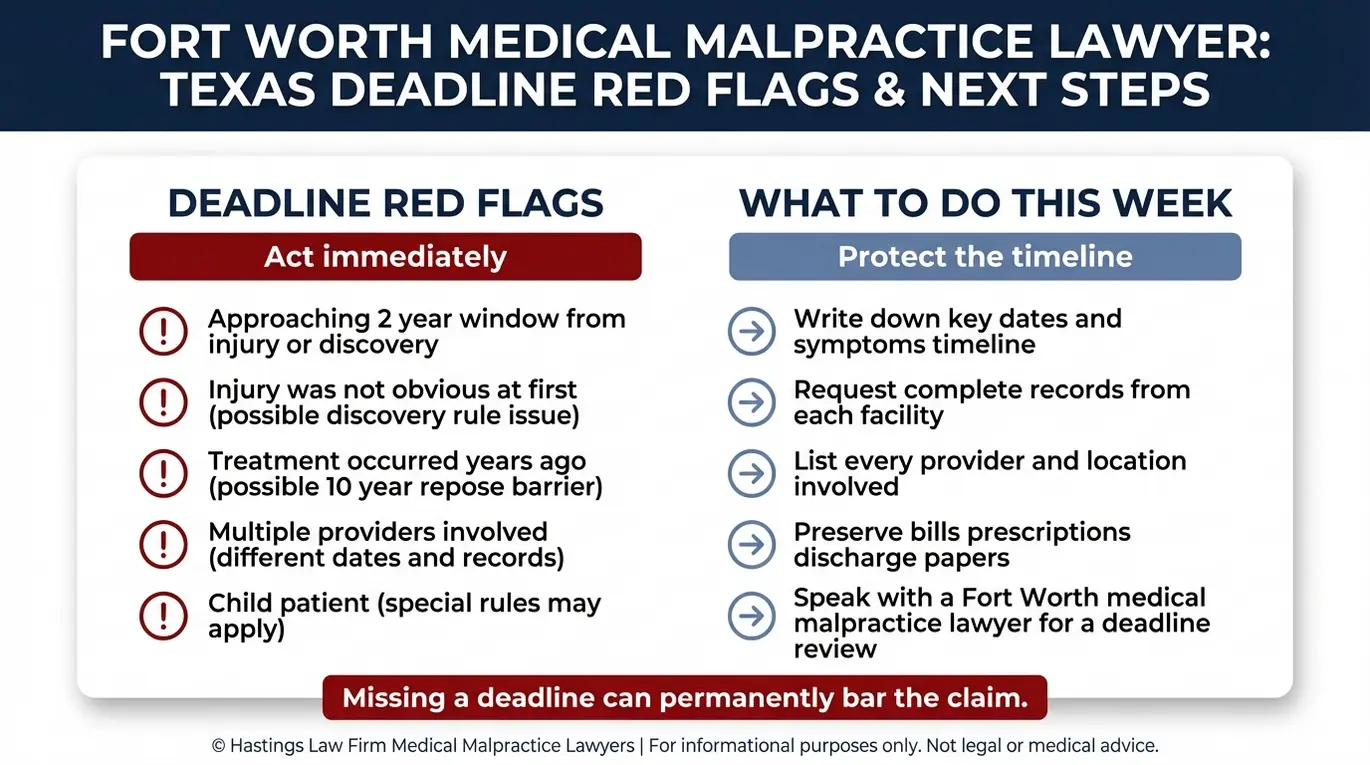
In Texas, the statute of limitations for medical malpractice is generally two years from the date of the injury or the date the injury could have reasonably been discovered. Missing this deadline almost always bars the claim permanently.
⚠️ Critical Deadline Warning: Texas imposes a strict 10-year statute of repose that bars most claims filed more than 10 years after the medical act in question, regardless of when the injury was discovered. The only exception applies to minors under the age of 12, who have until their 14th birthday to file. Do not assume you have more time than the law allows.
The discovery rule can extend the two-year window in situations where the injury was not immediately apparent, such as a retained surgical instrument found years later. However, this exception is narrow and heavily litigated. Filing procedures in Texas courts follow specific requirements outlined by the Texas Judicial Branch’s eFiling guide.
Electronic filing, or eFiling, is the process of submitting legal documents to the court through an online system. Fort Worth medical malpractice attorneys at our firm evaluate your timeline during the initial consultation. We want to ensure you understand exactly where you stand before any deadline passes.
Contact the Fort Worth Healthcare Malpractice Attorneys at Hastings Law Firm Today for Help
No amount of money can undo what happened. But compensation is the only tool the legal system offers to secure your future and hold negligent providers accountable so the same mistake is less likely to harm someone else.
At Hastings Law Firm, we focus our entire practice on medical malpractice. Our specialized background in medical negligence gives our clients a meaningful advantage in and out of the courtroom. We are dedicated to providing clear answers and a clear path forward for families in need.
We handle cases on a contingency fee basis, which means you pay no attorney fees or costs unless we recover compensation for you. If you or a loved one was harmed by a medical error in the Fort Worth area, a Fort Worth medical malpractice lawyer at our firm is ready to listen. Contact us for a free, confidential case evaluation and let us help you find the answers you deserve.
Frequently Asked Questions About Medical Malpractice in Fort Worth


This content was researched and written by the Hastings Law Firm editorial team, which includes attorneys, medical professionals, and experienced researchers. Our writing is informed by internal knowledge and practical experience, and we cross-check critical details against authoritative sources cited throughout. Every piece undergoes human-led fact-checking and legal review. Because legal and medical information can change, if you spot an error, please contact us. Learn more about our content standards and review process on our editorial policy page.

Gabe Sassin has focused exclusively on medical malpractice law since 2007. After spending more than a decade as a malpractice defense attorney, he knows exactly how the other side works. He has seen firsthand how healthcare providers, insurers, corporate defendants, and their legal teams think, prepare, and build their defense against claims. That knowledge works for the people who need it most today, injured patients and their families. His unique experience shapes everything he writes, giving readers a look at how these cases actually work from someone who has handled them from both sides.
