


Texas Telehealth Malpractice Lawyer
Telehealth can make care easier to access, but a virtual visit can still lead to serious harm when a provider misses key symptoms, prescribes without adequate review, or fails to direct a patient to in person care. Texas law treats telemedicine like in office medicine for the duty of care, so the same expectations apply even when care happens through a screen. These cases often turn on what the provider did during the encounter and what the digital records show. If you or a loved one were harmed or worse due to telehealth malpractice in Texas, contact Hastings Law Firm for a free, confidential case review.

Last Updated: July 27, 2026
Trial-Ready Legal Representation for Virtual Care Negligence in Texas
Telehealth has made healthcare more accessible for millions of Texans. But when a virtual visit leads to a missed diagnosis, a dangerous prescription, or a delayed referral, the consequences are just as real as any in-office medical error.
If you or a loved one was harmed during a telemedicine appointment, you may be unsure whether the same legal protections apply. They do. A doctor who treats you through a screen owes you the same duty of care as one sitting across the exam table.
Hastings Law Firm focuses exclusively on medical malpractice, and our team of attorneys, nurse consultants, and former defense lawyers understands how to investigate virtual care failures. As a Texas telehealth malpractice lawyer, we review the digital evidence, identify where the standard of care broke down, and hold negligent providers accountable.
If something went wrong during a virtual medical visit, we can review what happened and explain your options at no cost and no obligation.

What Qualifies as Telehealth Malpractice in Texas
Telehealth malpractice occurs when a healthcare provider fails to meet the accepted standard of care during a virtual consultation, and that failure directly causes patient harm. The legal framework is the same whether the appointment took place in a clinic or over a video call.
Once a provider agrees to evaluate or treat you remotely, a provider-patient relationship is established. That relationship creates a legal duty of care, meaning the doctor must act with the same skill and diligence expected of a reasonably competent physician in similar circumstances. If the provider breaches that duty and the breach causes injury, it qualifies as virtual doctor negligence. The Texas Department of Insurance confirms that telemedicine visits carry the same regulatory expectations as traditional office visits.
This applies to both live video consultations and asynchronous telehealth, a model where patients submit symptoms through online questionnaires and receive a diagnosis or prescription without a real-time conversation. Asynchronous care can be especially risky because the provider has no opportunity to ask follow-up questions, observe nonverbal cues, or catch a drug-drug interaction, a harmful reaction between two or more medications.
Whether your appointment involved a live video call or a questionnaire-based platform, the provider was still obligated to deliver competent care. A Texas telehealth malpractice lawyer evaluates whether that obligation was met and whether the facts support filing a telemedicine lawsuit.
Common Medical Errors During Virtual Visits
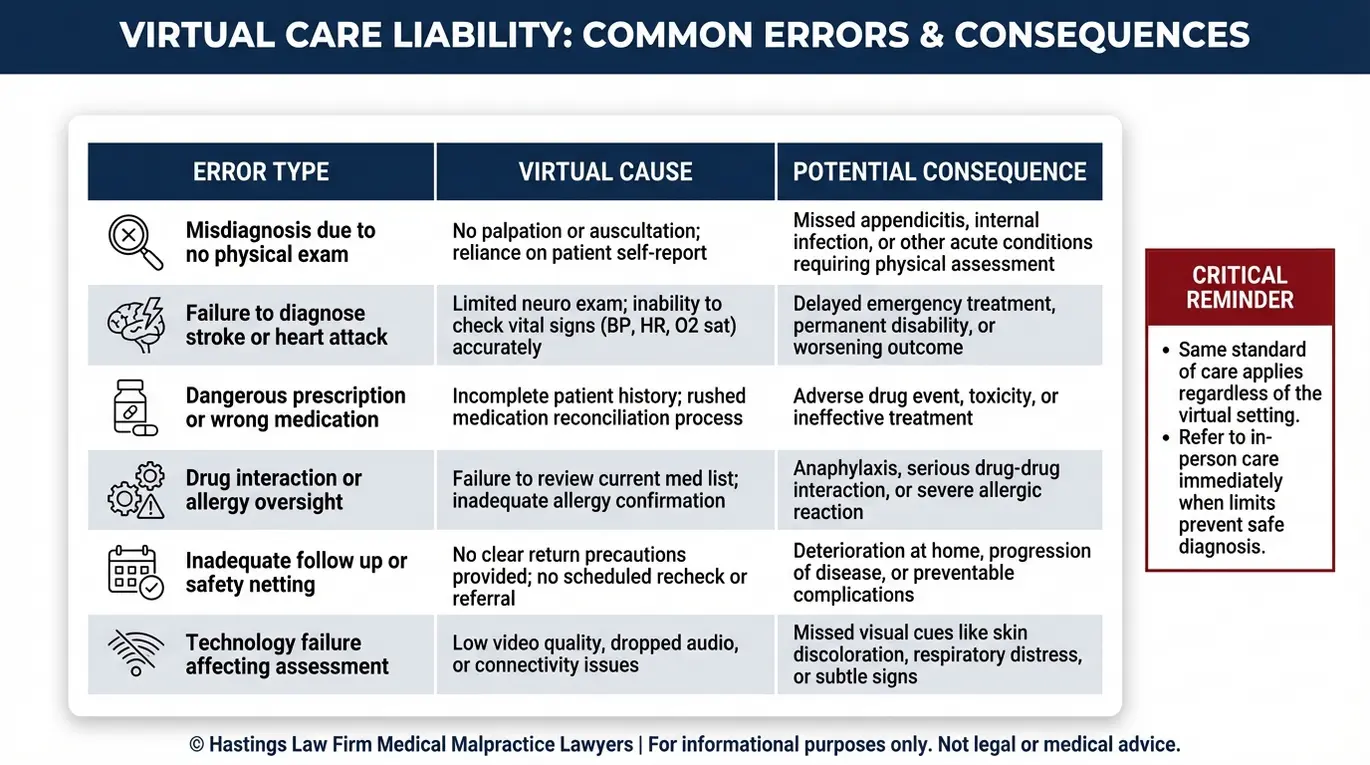
The most frequent telemedicine errors involve misdiagnosis due to the absence of a physical examination, prescribing dangerous medications without reviewing a patient’s full history, and technical failures that prevent accurate clinical assessment.
Diagnostic Failures
In an office setting, a physician relies on palpation, the practice of pressing on the body to detect abnormalities, and auscultation, listening to internal sounds with a stethoscope. Neither is possible through a screen. A patient reporting abdominal pain may be told they have indigestion when the actual cause is appendicitis or an ectopic pregnancy. Chest tightness may be attributed to anxiety when an in-person exam would reveal signs of a cardiac event. According to the National Academies of Sciences, Engineering, and Medicine’s analysis of the diagnostic process, diagnostic error is already one of the most common and harmful types of medical mistakes. Telehealth can amplify that risk by removing essential clinical tools from the equation.
Prescription Errors
Some virtual providers prescribe medications after only a brief questionnaire or short video call. Without reviewing a complete medical history, the physician may not catch a drug-drug interaction, which occurs when two or more medications interfere with each other in harmful ways. This mirrors the risks associated with “pill mill” operations, where prescriptions are issued without adequate evaluation. Our legal team has direct experience in cases involving the over-prescription of dangerous drugs, focusing on identifying where a provider failed to perform an adequate evaluation before issuing a prescription.
Technical Failures
Poor video resolution, dropped connections, and audio lag can all prevent a doctor from observing important visual cues, such as skin discoloration, swelling, or signs of distress. If the technology fails during a visit and the provider still renders a diagnosis, that decision may fall below the standard of care for an accurate clinical assessment.
| Error Type | Virtual Cause | Potential Consequence |
|---|---|---|
| Misdiagnosis or failure to diagnose | No physical exam (palpation, auscultation) | Delayed treatment for stroke, heart attack, infection |
| Prescription error | Incomplete medical history review | Adverse drug reaction or dangerous drug interaction |
| Missed visual symptoms | Poor video quality or dropped connection | Failure to identify skin conditions, swelling, discoloration |
| Inadequate follow-up | No clear referral pathway to in-person care | Condition worsens without timely intervention |
If you suspect that virtual care negligence caused your injury, a Texas telehealth malpractice lawyer can analyze the digital records to determine whether the provider’s decisions fell short and discuss the process of suing a remote doctor.
The Hastings Law Firm Difference
Results matter, but what truly sets us apart is how we achieve them. Every verdict, every settlement, and every Texas courtroom victory comes from one guiding promise: To treat each client’s fight for justice as if it were our own.
This balance of skill, experience, and empathy reflects our core philosophy that justice should not only compensate the injured, but also make health care safer nationwide.

Does the Standard of Care Change for Online Doctors
No. The standard of care in telemedicine does not change simply because a doctor treats you through a screen. If a provider cannot safely diagnose or treat a condition via telehealth, they are legally required to direct the patient to in-person care or emergency services.
Under Texas Occupations Code Chapter 111, physicians who deliver care through telemedicine must meet the same professional standards as those providing treatment in person, upholding the duty of care. This Texas Occupations Code Chapter 111 requirement is sometimes called the “same standard” rule: a virtual doctor must act with the same skill and prudence as an in-person doctor treating the same condition under similar circumstances.
This creates a clear duty to refer. If a patient presents with symptoms that cannot be properly evaluated without hands-on examination, such as chest pain, severe abdominal symptoms, or neurological changes, treating the condition virtually instead of directing the patient to an in-person consultation may constitute negligence. This process of determining whether a condition can be managed remotely is called tele-triage, or remote triage, and it demands careful clinical judgment.
There is also a distinct informed consent obligation in virtual care. Telehealth informed consent, the requirement that a provider explain the limitations of the technology before treatment begins, is critical. Did the doctor tell you what they could not see, hear, or assess through the screen? The American Psychological Association’s informed consent checklist for telehealth outlines these disclosure requirements, and similar principles apply across medical disciplines. If a provider failed to disclose those limitations or schedule necessary follow-up sessions, that gap in informed consent can support a malpractice claim.
A Texas telehealth malpractice lawyer examines whether the provider’s treatment plan accounted for the known limitations of virtual care, or whether those limitations were ignored.
Navigating Jurisdiction and Cross-State Liability
You can generally file a lawsuit in the state where the patient was physically located during the telehealth appointment, but these cases require working through licensing requirements and cross-state telemedicine laws.
In most telehealth malpractice claims, the patient’s location at the time of the virtual visit determines which state’s laws apply. If you were in Texas when the appointment occurred, Texas medical malpractice law typically governs your case, even if the doctor was sitting in another state, making an out-of-state doctor lawsuit possible. Texas courts can exercise jurisdiction over an out-of-state provider who delivered care to a Texas patient.
The Interstate Medical Licensure Compact (IMLC) has made it easier for physicians to obtain licenses in multiple states, which has expanded cross-border telehealth, though concerns regarding HIPAA, patient privacy, and confidentiality remain. But that expanded access also means more situations where a patient in one state receives care from a doctor licensed in several others. The licensing status of the provider and the location of the patient both affect where and how a claim can be filed.
One of the more challenging aspects of these cases is determining who to sue. Many telehealth appointments are arranged through platforms like Teladoc or Amwell, but the physician providing care is often classified as an independent contractor rather than a platform employee. That distinction matters because it can limit the platform’s direct legal exposure. However, if the platform failed to properly verify a physician’s credentials, additional claims may be available against the corporate entity.
Key factors a Texas telehealth malpractice lawyer evaluates in cross-state cases:
- Where the patient was physically located during the appointment
- Whether the provider held a valid Texas medical license at the time of treatment
- Whether the telehealth platform played a role in credentialing or supervising the provider
- Which state’s statute of limitations and procedural rules apply
- Whether the provider’s IMLC compact license covered Texas
These jurisdictional questions can shape the entire case strategy, and getting them right early is essential.
Proving Negligence in Telemedicine Cases
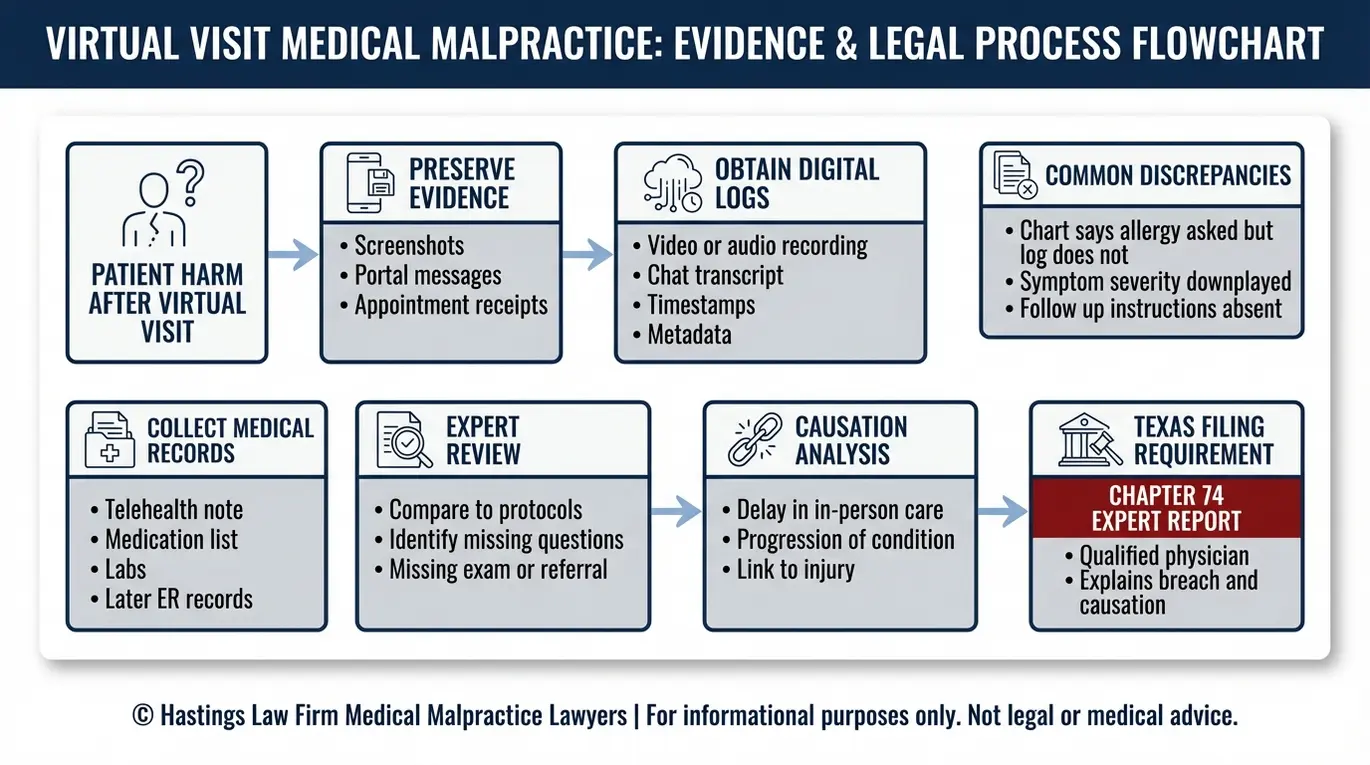
Proving medical malpractice in a telehealth case requires securing digital logs, chat transcripts, and platform metadata to show that the provider breached the standard of care by failing to ask critical questions, order appropriate testing, or recommend in-person evaluation.
The evidence in a telemedicine case differs from a traditional malpractice claim. Instead of handwritten chart notes, the documentation and medical records exist as electronic health records, and it can be more detailed than many providers realize.
Step 1: Digital Evidence Collection
The first step is preserving the telemedicine evidence. This includes video recordings (if the platform retains them), chat logs, timestamps, and metadata, which refers to the background data that records the time, duration, and technical details of the virtual session. We also request the audit trail, which is the platform’s internal log showing every action taken during the encounter, from login to sign-off. These records can reveal whether the provider spent adequate time on the visit or skipped essential screening questions.
Step 2: Expert Review
Texas law requires a Chapter 74 Expert Report in all medical malpractice cases. This report must be prepared by a qualified physician and served within 120 days of the defendant filing an original answer. The expert compares what the telehealth provider did against what the standard of care required, given the same symptoms and clinical information. Our team secures medical expert testimony from a national network of professionals who understand both the capabilities and limitations of virtual care platforms.
Step 3: Establishing Causation
The final step is linking the provider’s failure to the patient’s injury, a process known as establishing causation. If the doctor dismissed symptoms that should have triggered a referral to an emergency room, we build a timeline showing how the delay in hands-on evaluation contributed to the harm. This often involves identifying charting inconsistencies, such as a provider claiming they asked about allergies or current medications when the session logs show they did not.
As a Texas telehealth malpractice lawyer, our in-house medical staff, including nurse practitioners and Board Certified Patient Advocates, reviews every telehealth record alongside our attorneys. Our team includes former defense counsel who know exactly how hospitals and insurers try to minimize these claims, which gives us a strategic advantage in anticipating their arguments before they are raised.
Recoverable Damages for Telehealth Injuries
Patients harmed by telehealth negligence may recover compensation for medical errors, including medical bills, lost wages, future care costs, and non-economic damages like pain and suffering.
Economic Damages
These cover the measurable financial losses caused by the malpractice, which are known as economic damages. If a missed telehealth diagnosis led to an emergency hospitalization, corrective surgery, or extended treatment that would not have been necessary with a timely and competent diagnosis, those costs are recoverable. Lost income from time away from work, reduced earning capacity, and future medical costs all fall into this category.
Non-Economic Damages
Telehealth malpractice often carries a distinct emotional toll, and patients may seek non-economic damages for these losses. Many patients describe feeling dismissed or unheard during a brief virtual encounter, only to learn later that their condition was serious. Pain and suffering, mental anguish, and diminished quality of life are all recognized non-economic damages under Texas law. These claims are especially relevant when a patient raised concerns during the visit and was told nothing was wrong.
Wrongful Death
In the most tragic cases, a telehealth provider’s failure to recognize a life-threatening condition and direct the patient to emergency care results in wrongful death. Texas law allows surviving family members to pursue a wrongful death claim for their loss, including loss of companionship, lost financial support, and funeral expenses.
Every telehealth malpractice case is different, and the full scope of available damages depends on the specific facts. A Texas telehealth malpractice lawyer can help you understand what compensation may apply to your situation.
Contact the Texas Healthcare Malpractice Attorneys at Hastings Law Firm Today for Help
Telehealth has made medical care more convenient, but convenience should never come at the expense of safety. When a virtual provider fails to meet the standard of care, patients deserve the same legal protections they would have in any other medical setting.
If you believe a telemedicine visit led to a misdiagnosis, a harmful prescription, or a dangerous delay in treatment, Hastings Law Firm is here to help. As a Texas telehealth malpractice lawyer with a team dedicated exclusively to medical malpractice, we have the medical knowledge, legal experience, and digital forensics capability to investigate what happened during your virtual visit. Our founding attorney, Tommy Hastings, is board-certified in Personal Injury Trial Law, a distinction held by fewer than 2% of attorneys in the state.
Our medical malpractice attorneys in Texas offer a free, confidential case evaluation. There is no fee unless we recover compensation on your behalf. Regardless of whether a local physician or a remote doctor through a telemedicine platform provided your care, we can review the records, consult with qualified medical experts, and explain your legal options.
Contact our virtual doctor malpractice law firm today to speak with a telemedicine negligence attorney who understands these cases.
Frequently Asked Questions About Telehealth Malpractice in Texas


This content was researched and written by the Hastings Law Firm editorial team, which includes attorneys, medical professionals, and experienced researchers. Our writing is informed by internal knowledge and practical experience, and we cross-check critical details against authoritative sources cited throughout. Every piece undergoes human-led fact-checking and legal review. Because legal and medical information can change, if you spot an error, please contact us. Learn more about our content standards and review process on our editorial policy page.

Brady D. Williams is a nationally recognized medical malpractice attorney who has spent his career handling high-stakes litigation for injured patients and families across the country. Licensed in both Texas and California, Brady draws on experience from hundreds of resolved medical cases to break down complex legal and medical topics for the people who need that information most. His writing reflects the same attention to detail and commitment to clarity that he brings to every case he handles.
