


Texas Pain Management Center Malpractice Lawyer
Negligence in a pain management clinic can leave patients facing new injuries, addiction, or worse after seeking relief. The topic often involves unsafe prescribing, inadequate monitoring during sedation, and preventable mistakes during interventional procedures near the spinal cord. These events can be difficult to untangle when symptoms overlap with chronic pain and when records or explanations feel incomplete. Understanding how standards of care apply in pain treatment can clarify whether harm was preventable and what accountability may look like. If you or a loved one were harmed or worse due to pain management center malpractice in Texas, contact Hastings Law Firm for a free, confidential case review.

Last Updated: July 27, 2026
Trial-Ready Representation for Pain Clinic Negligence in Texas
If you or someone you love has been harmed by negligent care at a pain management clinic, you are not alone, and your concerns are understandable. Many patients walk into these facilities trusting that their chronic pain will be managed safely, only to leave with new injuries, addiction, or worse. The confusion and frustration that follow can be overwhelming, especially when the very providers you trusted seem unwilling to acknowledge what went wrong.
As a Texas pain management center malpractice lawyer, Hastings Law Firm focuses exclusively on medical malpractice. Our team includes in-house medical professionals and former defense attorneys who understand how these cases are built and how they are defended. If something went wrong during your pain treatment, we can review what happened and explain your options in a free, confidential case evaluation.

Defining Medical Malpractice in a Pain Clinic Setting
Medical malpractice in a pain clinic occurs when a physician, nurse, or specialist deviates from the accepted standard of care during pain treatment, directly causing patient injury, addiction, or death. Not every poor outcome qualifies. Pain treatment is inherently difficult, and sometimes therapies simply do not produce the desired relief. The legal question is whether the provider made a preventable error that a competent pain specialist would not have made under the same circumstances.
Pain clinic negligence generally falls into two broad categories. The first involves procedural errors during interventional treatments like epidural steroid injections (ESIs), spinal cord stimulator (SCS) implants, which are devices placed under the skin to send electric currents to the spinal cord, or intrathecal drug delivery pumps, which are surgically implanted devices that deliver medication directly into the spinal fluid. Mistakes during these procedures can cause nerve damage, infection, or paralysis. The second category involves prescription management failures, including the dangerous overprescribing of opioids or operating what is functionally a pill mill.
Under Texas law, pain management specialists owe a duty of care to every patient they treat. This duty is the legal obligation to provide treatment consistent with what a reasonably prudent pain specialist would offer in similar circumstances. Because pain doctors routinely prescribe high-risk medications and perform procedures near the spinal cord, that duty carries significant weight. When a provider falls short of it and a patient is harmed, a Texas pain management center malpractice lawyer can help determine whether a valid claim exists for medical negligence under Texas Civil Practice and Remedies Code Chapter 74. This legal framework allows people to seek justice when standard protocols are ignored.
Common Errors Committed by Pain Management Doctors
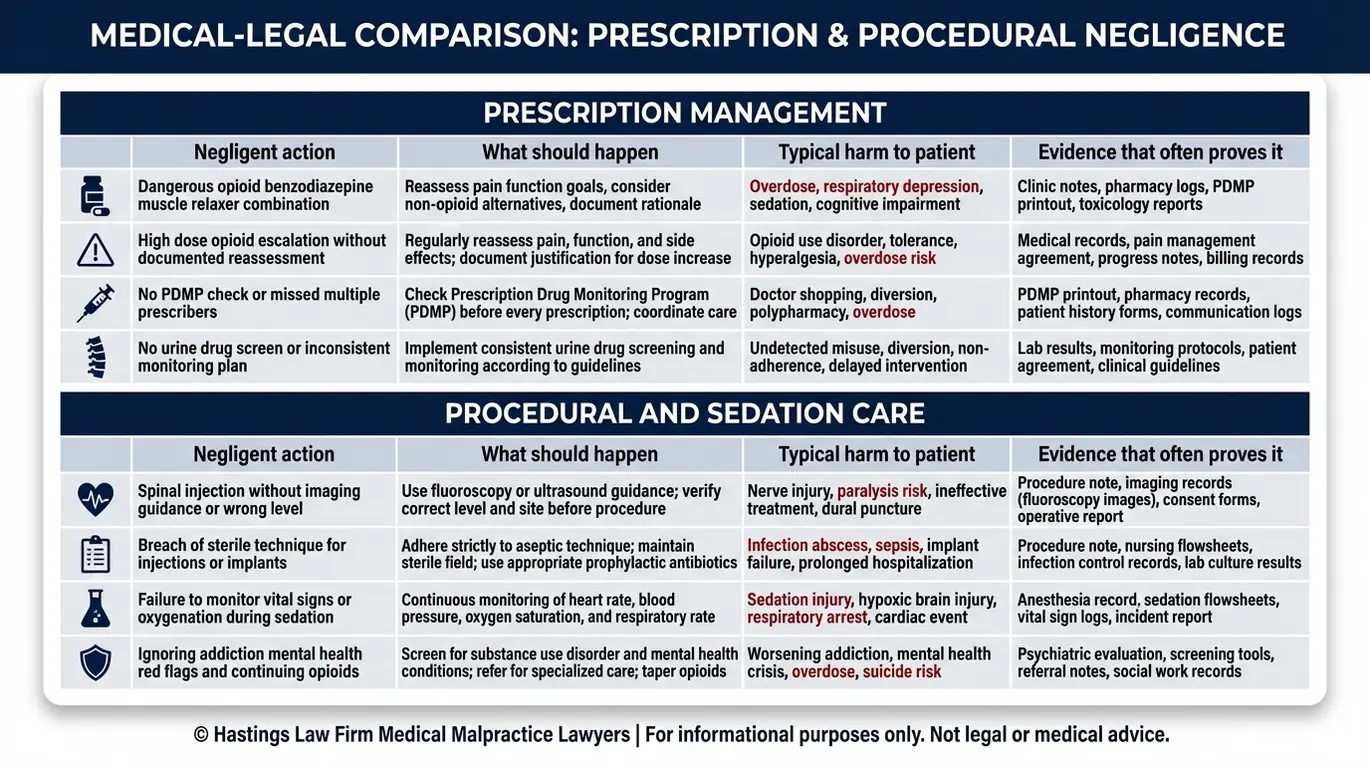
Common errors include negligent overprescribing of opioids, failure to monitor vital signs during sedation, nerve damage during spinal injections, and failure to recognize signs of addiction or infection. These pain management errors can be grouped into medication failures, procedural mistakes, and monitoring breakdowns, each carrying its own pattern of injury.
Medication Errors
One of the most dangerous prescription drug errors in pain clinic negligence involves the so-called “Holy Trinity“, a combination of opioids, benzodiazepines, and muscle relaxants prescribed together. This combination dramatically increases the risk of respiratory failure and death. The U.S. Food and Drug Administration now requires a Boxed Warning on benzodiazepines because of the serious risks of abuse, misuse, addiction, physical dependence, and withdrawal, as well as the life-threatening dangers of co-prescribing these drugs with opioids.
When a pain clinic continues prescribing this combination without proper justification or monitoring, it mimics the practices of a pill mill, a clinic that dispenses controlled substances with little or no legitimate medical oversight.
Procedural Errors
Interventional pain procedures carry inherent risks, but those risks increase substantially when proper technique and imaging guidance are not used. Epidural steroid injections (ESIs), which involve injecting corticosteroids near the spinal cord to reduce inflammation, can cause nerve damage, spinal headaches, or epidural abscess if performed incorrectly. Nerve block procedures and spinal cord stimulator placements carry similar risks when sterile technique is not followed or anatomical landmarks are missed. Informed consent means the doctor explained the procedure’s risks and the patient agreed to proceed.
Failure to Monitor
High-volume pain clinics sometimes fail to monitor patients adequately during and after sedation. Missing changes in vital signs, oxygen levels, or consciousness during a procedure can lead to brain injury or cardiac arrest. After discharge, failing to track a patient’s response to new medications or ignoring red flags such as signs of opioid addiction can be equally harmful.
The table below outlines common negligent actions and the injuries they typically produce:
| Negligent Action | Typical Injury/Outcome |
|---|---|
| Prescribing opioids with benzodiazepines without monitoring | Respiratory depression, overdose, death |
| Performing spinal injection without imaging guidance | Nerve damage, paralysis, chronic pain worsening |
| Ignoring signs of patient addiction or drug-seeking behavior | Opioid use disorder, overdose |
| Failing to monitor vitals during sedation | Brain injury, cardiac arrest |
| Poor sterile technique during nerve block or pump implant | Infection, abscess, meningitis |
| Prescribing above safe dosage thresholds without documentation | Organ damage, fatal overdose |
Claims arising from these errors are governed by Texas Civil Practice and Remedies Code Chapter 74, which establishes the procedural framework for medical malpractice lawsuits in the state.
Failure to Reassess Opioid Therapy and Monitor Mental Health
Pain management doctors have a unique and ongoing duty to reassess whether opioid therapy is still effective and appropriate for each patient. Chronic pain treatment is not a “set it and forget it” arrangement. The standard of care generally requires periodic reevaluation of dosage, function, and risk.
This includes screening for opioid use disorder (OUD), a medical condition characterized by the compulsive use of opioids despite harmful consequences. It also means watching for signs of respiratory depression, a potentially fatal slowing of breathing caused by opioid overuse. CDC guidelines recommend that clinicians reassess patients on opioid therapy at regular intervals and taper or discontinue medications when the risks outweigh the benefits.
Mental health monitoring is equally important. Depression, anxiety, and suicidal ideation can develop or worsen during long-term opioid use. A pain specialist who fails to screen for these changes, or who continues escalating doses without addressing the underlying behavioral health picture, may be falling below the expected standard of care.
The Hastings Law Firm Difference
Results matter, but what truly sets us apart is how we achieve them. Every verdict, every settlement, and every Texas courtroom victory comes from one guiding promise: To treat each client’s fight for justice as if it were our own.
This balance of skill, experience, and empathy reflects our core philosophy that justice should not only compensate the injured, but also make health care safer nationwide.

Proving Negligence Against a Pain Management Specialist
To prove negligence, a plaintiff must demonstrate that the pain specialist established a doctor-patient relationship, breached the standard of care, and that this breach directly caused specific, identifiable damages. Texas medical malpractice cases require proof of each element, and the absence of any one of them can prevent recovery.
The core elements of proof in a pain management malpractice case include:
- Duty of care: The doctor-patient relationship existed, creating a legal obligation to treat the patient competently.
- Standard of care: A reasonably prudent pain management specialist, facing the same clinical situation, would have acted differently.
- Breach of duty: The provider’s specific actions or omissions fell below that standard.
- Causation: The breach directly caused the patient’s injury, not the underlying condition or an unavoidable risk.
- Damages: The patient suffered actual harm, whether physical, financial, or emotional.
The standard of care is measured by what a reasonably prudent pain specialist would have done under similar circumstances. This is not a general medicine standard. It reflects the specialized training and knowledge a pain management physician is expected to bring to every clinical decision.
The breach is where specific conduct comes into focus. A provider who ignores established CDC prescribing guidelines, skips required imaging during a spinal procedure, or fails to document informed consent may have fallen below the accepted standard.
To substantiate this, we work with qualified professionals who serve as an expert witness to validate these failures. The U.S. Food and Drug Administration’s safety communication requiring label changes for epidural corticosteroid injections is one example of the regulatory guidance that might be cited in expert testimony. Securing a favorable expert report is also an important step in proving the breach of duty.
Causation is often the most contested element, particularly when the patient already had chronic pain or pre-existing conditions. Defense attorneys will argue that the injury was a natural progression of the underlying disease. To counter this, our team works with qualified medical experts who can trace the timeline of harm and distinguish between a pre-existing condition and a new, provider-caused injury.
Using CDC Opioid Prescribing Guidelines as a Benchmark
The CDC’s clinical practice guidelines for opioid prescribing have become an important benchmark in medical malpractice litigation involving pain management. While not technically binding law, these guidelines represent a widely accepted consensus on safe prescribing practices and are frequently cited by expert witnesses to establish what the standard of care should look like.
Key provisions include recommended dosage thresholds measured in morphine milligram equivalents (MME), a standardized unit used to compare the potency of different opioid medications. The guidelines caution against prescribing above certain MME levels without careful justification and warn specifically against co-prescribing opioids and benzodiazepines. This means prescribing both drug classes to the same patient simultaneously. When a pain specialist routinely exceeds these thresholds without documented clinical reasoning, experts may point to these guidelines as evidence that the provider’s conduct fell below the accepted standard.
Compensation Available for Victims of Pain Clinic Malpractice
Victims may recover economic damages for medical bills and lost wages, non-economic damages for pain and suffering, and potentially punitive damages if the clinic’s conduct was grossly negligent. The specific compensation depends on the severity of the injury, the extent of ongoing medical needs, and the circumstances surrounding the negligent care.
Economic damages cover the measurable financial losses tied to the malpractice. These often include:
- Past and future medical expenses, including addiction treatment, revision surgeries, and rehabilitation
- Lost wages and reduced earning capacity
- Cost of assistive devices, home modifications, or long-term care
- Prescription and therapy costs related to the injury
Non-economic damages address the personal toll of the injury:
- Physical pain and suffering
- Mental anguish and emotional distress
- Loss of enjoyment of life
- Loss of consortium, which compensates a spouse or family for the loss of companionship and support
Wrongful death damages apply when a patient dies due to a pain clinic’s negligence, such as a fatal overdose resulting from overprescribing or a procedural complication that was not properly managed. Surviving family members may seek compensation for funeral expenses, loss of financial support, loss of companionship, and the mental anguish of losing a loved one.
In rare cases involving conduct that goes beyond ordinary negligence, punitive damages may be available. These are not designed to compensate the patient but to penalize extreme or grossly negligent behavior and discourage similar conduct in the future.
Whether a case resolves through settlement or proceeds to trial, the goal is to secure compensation that reflects the full scope of harm. At Hastings Law Firm, every case is prepared from the outset as if it will go before a jury, which strengthens our firm’s position during negotiations.
Hospital Safety Grades and Provider Understaffing
Systemic issues within pain management clinics can also contribute to negligence. High patient volumes, inadequate staffing, and provider burnout may create conditions where errors become more likely. When a clinic schedules too many procedures in a single day without sufficient nursing support, or when a physician’s caseload prevents meaningful follow-up with individual patients, the risk of harm increases.
These institutional factors can become part of the evidence in a malpractice investigation. Staffing records, scheduling logs, and internal communications may reveal patterns that suggest a breakdown in safety protocols. If those systemic failures contributed to a patient’s injury, both the individual provider and the corporate entity operating the clinic may be held accountable through a theory of corporate negligence.
Statute of Limitations for Pain Clinic Lawsuits in Texas
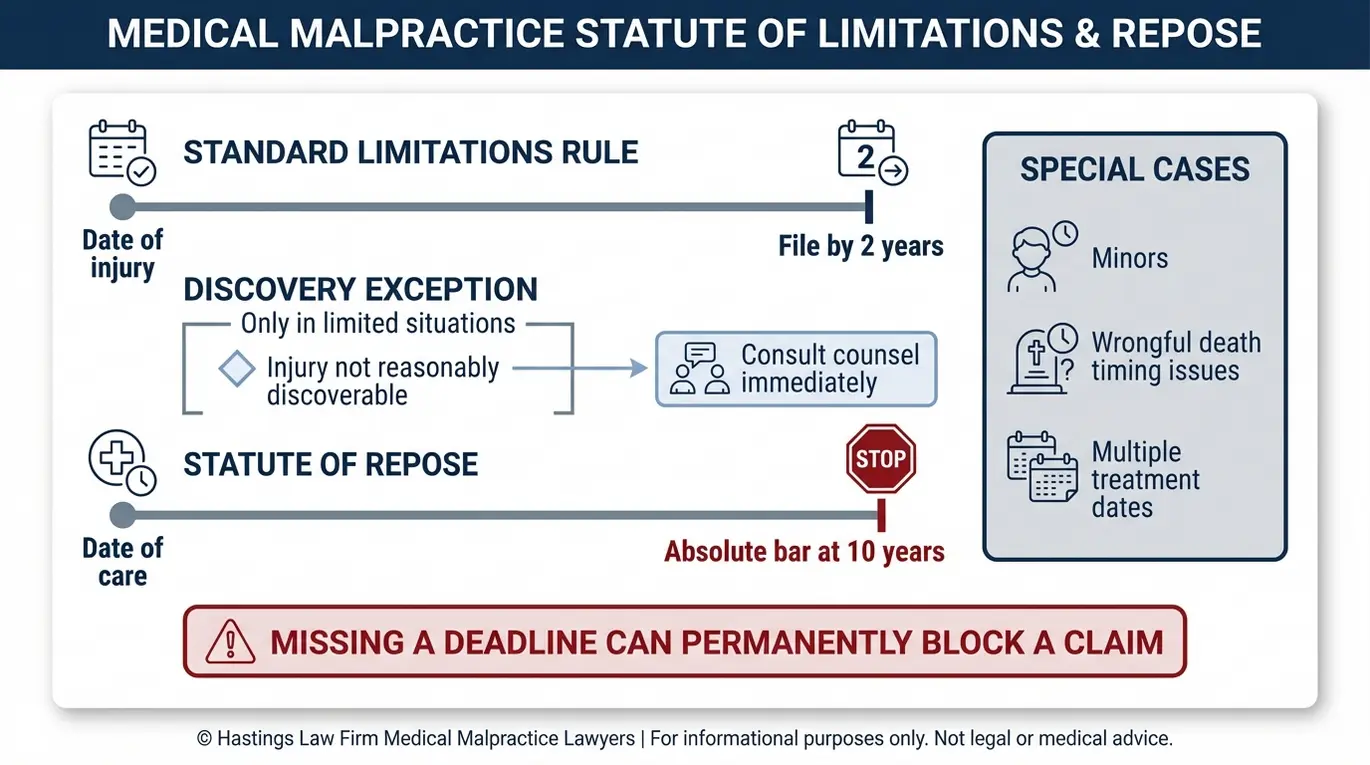
In Texas, the statute of limitations for medical malpractice is generally two years from the date of the injury, though exceptions may apply depending on the circumstances. Missing this deadline almost always means losing the right to file a claim entirely, regardless of how strong the evidence may be.
The two-year window is a firm deadline under Texas law. The clock typically starts on the date the negligent act occurred or, in some cases, on the date of the last treatment in a continuing course of care. Once that period expires, courts will generally dismiss the case.
The Discovery Rule
In limited situations, the discovery rule may extend the filing deadline. This rule allows more time if a patient could not have known they were injured at the time of the procedure. For example, if a surgical instrument was left inside a patient during a pump implantation and the problem only surfaced years later, the two-year clock might begin on the date the injury was actually found. Texas courts apply this exception narrowly, so it should never be relied upon as a reason to delay.
Claims Involving Minors
Special rules apply when the injured patient is a child. For minors under the age of 12, the statute of limitations is extended until the child’s 14th birthday. This gives families additional time, but it does not eliminate the deadline entirely.
Because these filing deadlines are strict and the consequences of missing them are permanent, early legal consultation and investigation are some of the most important steps a patient or family can take.
Texas Statute of Repose and the Ten-Year Limit
Even when exceptions to the standard two-year deadline apply, Texas imposes an absolute 10-year statute of repose. This means that no medical malpractice lawsuit may be filed more than 10 years after the date the negligent act occurred, regardless of when the injury was discovered.
The statute of repose functions as a hard outer boundary. Unlike the statute of limitations, it is generally not subject to tolling or extension. If a patient does not discover their injury until 11 years after the procedure, the claim is barred. This makes it essential to investigate potential malpractice as early as possible, even when symptoms seem minor or ambiguous.
Investigating Pain Clinics Evidence and Expert Review
A thorough investigation involves securing all medical records, analyzing prescription logs for patterns of overprescribing, and obtaining an expert report to validate the claim before the case can move forward. As a Texas pain management center malpractice lawyer, Hastings Law Firm approaches every investigation with a structured, step-by-step process.
Step 1: Secure the Complete Medical Record
The first priority is obtaining the full medical chart, not just the clinic summary or discharge paperwork. This includes procedure notes, nursing documentation, anesthesia records, imaging studies, informed consent forms, and all internal communications. Gaps or inconsistencies in the record can be just as revealing as the documented entries themselves.
Step 2: Analyze Prescription and Pharmacy Records
Prescription drug monitoring data and pharmacy dispensing logs are cross-referenced with the clinic’s chart notes. This process can reveal whether prescriptions were issued without adequate examination, whether dosages exceeded safe thresholds, or whether multiple controlled substances were prescribed simultaneously without clinical justification. According to the CDC’s report on drug overdose deaths in the United States, 2023-2024, overdose remains a leading cause of preventable death, reinforcing why prescribing patterns demand close scrutiny.
Step 3: Obtain and Submit the Expert Report
Texas law requires that a qualified medical expert review the case and produce a written report identifying the standard of care, the breach, and how the breach caused the patient’s injury. This report must be served on the defendant within 120 days of the defendant filing an original answer. Our in-house medical staff, which includes nurse practitioners and board certified patient advocates, works closely with our national network of pain management experts to build this analysis.
Step 4: Build the Timeline
Every investigation includes constructing a detailed, minute-by-minute timeline of the patient’s treatment. This timeline helps identify exactly where the standard of care was breached and connects specific provider decisions to the resulting injury. By overlaying the patient’s complaints of increasing pain or side effects with the clinic’s decision to escalate dosages rather than investigate the cause, we can demonstrate a clear pattern of negligence that juries can understand.
The Process of Suing a Pain Management Center in Texas
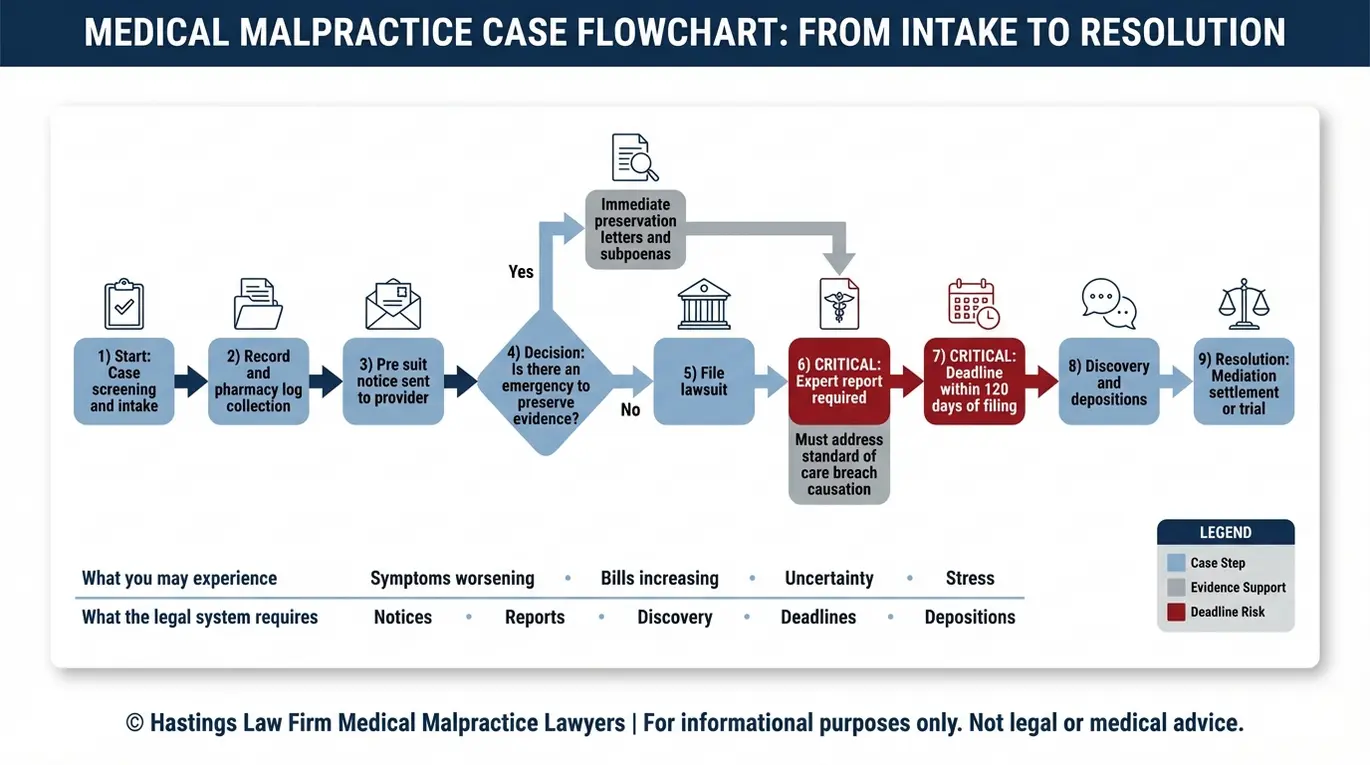
Suing a pain center involves an initial case screening, filing a notice of claim, submitting an expert report within 120 days, and proceeding through discovery toward settlement or trial. Understanding the sequence of events during litigation can help reduce uncertainty during what is already a stressful time.
Pre-Suit Notice
Before a medical malpractice lawsuit can be filed in Texas, the law requires that the patient send a pre-suit notice letter via certified mail to each healthcare provider being sued. This notice must be sent at least 60 days before the lawsuit is filed. Once sent, the statute of limitations is tolled for 75 days, giving both sides a brief window to evaluate the claim before litigation begins.
Filing the Lawsuit and the 120-Day Expert Report Deadline
After the pre-suit notice period, the lawsuit is formally filed. From that point, the plaintiff has a 120-day deadline after the defendant files an original answer to serve the required Chapter 74 expert report. This report, written by a qualified medical expert, must identify the applicable standard of care, explain how the defendant breached that standard, and describe how the breach caused the patient’s injuries. Failure to meet this deadline results in dismissal of the case, so preparation must begin well before the suit is filed.
Discovery and Case Development
Once the expert report is accepted by the court, the case enters discovery. This phase involves depositions of the treating physicians, requests for internal clinic documents, and analysis of staffing and scheduling records. We also demand access to electronic metadata, email correspondence between staff members regarding the patient, and the employment files of the treating practitioners to check for prior disciplinary actions. Both sides then exchange evidence and build their positions.
Mediation and Trial
Most Texas medical malpractice cases go through mediation before trial. Mediation is a structured negotiation session where both parties attempt to reach a settlement with the help of a neutral mediator. At Hastings Law Firm, we prepare every case as though it will go to a jury. That level of preparation gives our clients a stronger position at mediation and signals to the defense that we are ready to try the case if a fair resolution is not offered.
Contact the Texas Healthcare Malpractice Attorneys at Hastings Law Firm Today for Help
If you believe you or a loved one was harmed by negligent care at a pain management clinic, time is limited to protect your legal rights. The strict filing deadlines in Texas mean that early action matters.
Hastings Law Firm handles nothing but medical malpractice. Our team includes in-house nurses, board certified patient advocates, and former defense attorneys who know how hospitals and clinics defend these cases. Founder Tommy Hastings, a board-certified trial attorney and Texas pain management center malpractice lawyer, has built a national reputation for holding negligent providers accountable.
Contact us today for a free, confidential case evaluation. You will speak directly with a team member who understands what you are going through. There is no fee unless we recover compensation for you.
Frequently Asked Questions About Pain Management Center Malpractice in Texas


This content was researched and written by the Hastings Law Firm editorial team, which includes attorneys, medical professionals, and experienced researchers. Our writing is informed by internal knowledge and practical experience, and we cross-check critical details against authoritative sources cited throughout. Every piece undergoes human-led fact-checking and legal review. Because legal and medical information can change, if you spot an error, please contact us. Learn more about our content standards and review process on our editorial policy page.

Gabe Sassin has focused exclusively on medical malpractice law since 2007. After spending more than a decade as a malpractice defense attorney, he knows exactly how the other side works. He has seen firsthand how healthcare providers, insurers, corporate defendants, and their legal teams think, prepare, and build their defense against claims. That knowledge works for the people who need it most today, injured patients and their families. His unique experience shapes everything he writes, giving readers a look at how these cases actually work from someone who has handled them from both sides.
