


Texas Shoulder Dystocia Birth Injury Lawyer
Shoulder dystocia is a delivery emergency that can become life altering when warning signs are missed or the response is mishandled. The condition can involve umbilical cord compression and rapid oxygen deprivation, and improper traction or unsafe techniques can cause serious harm to an infant and significant injury to a mother. Risk factors documented in prenatal history can make anticipation and planning especially important, and medical records often show whether accepted maneuvers and protocols were followed. If you or a loved one were harmed or worse due to shoulder dystocia birth injury in Texas, contact Hastings Law Firm for a free, confidential case review.

Last Updated: July 27, 2026
Trial-Ready Representation for Preventable Birth Injuries in Texas
When your child suffers a birth injury during delivery, the confusion and heartbreak can feel overwhelming. You may sense that something went wrong, that the medical team should have acted differently, but you may not know how to confirm that or what steps to take next. Those instincts deserve to be heard.
Shoulder dystocia injuries are among the most well-documented preventable complications in obstetric medicine. When a delivering physician fails to recognize the warning signs or mismanages the emergency, the consequences for both infant and mother can be life-altering. A Texas shoulder dystocia birth injury lawyer at Hastings Law Firm can help you understand whether the care your family received fell below the accepted medical standard.
Our team includes in-house nurse consultants, former defense attorneys, and board-certified trial lawyers who focus exclusively on medical malpractice. If you believe your child’s birth injury could have been prevented, we welcome the chance to review what happened and explain your options in a free, confidential case evaluation.

Understanding Shoulder Dystocia and Anterior Shoulder Entrapment
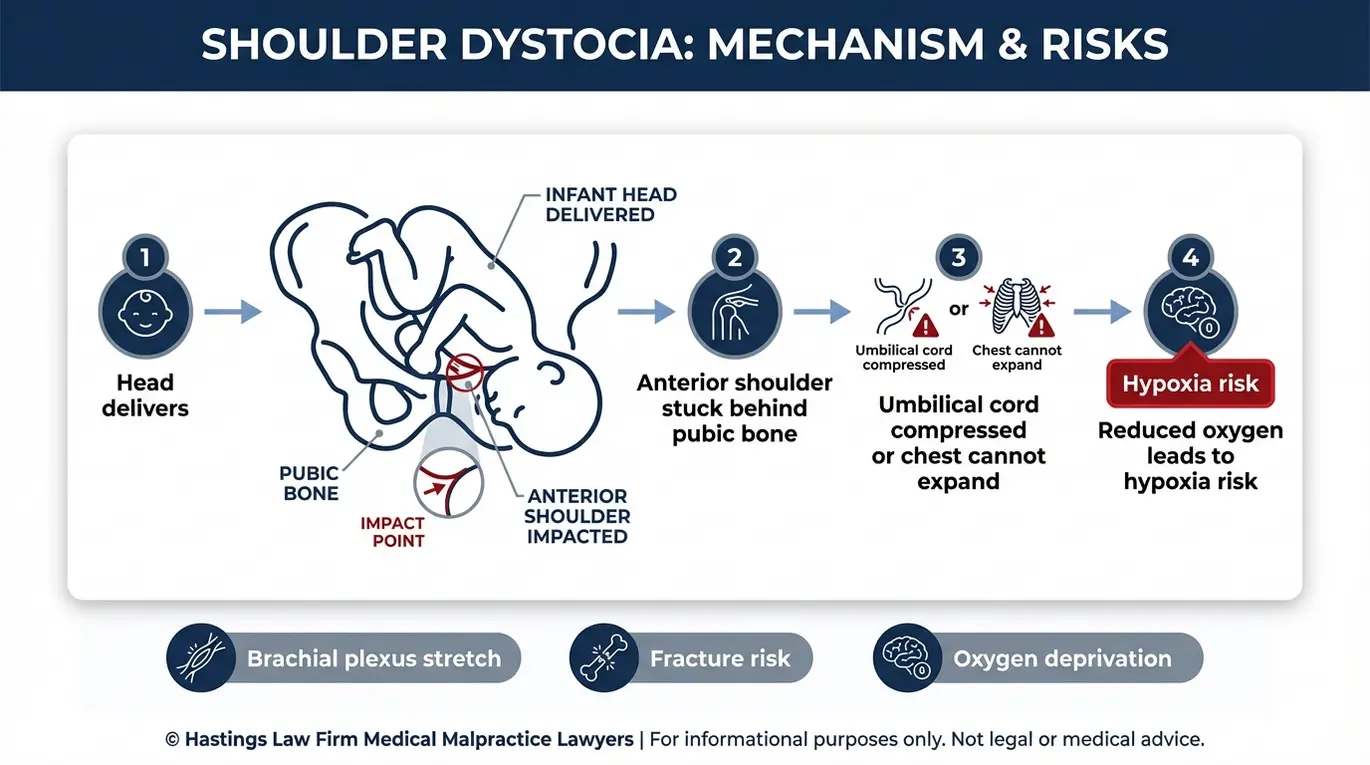
Shoulder dystocia is a delivery emergency in which the infant’s head is delivered but the anterior shoulder becomes lodged behind the mother’s pubic bone, preventing the rest of the body from being born. Anterior shoulder entrapment, the physical mechanism behind this complication, occurs when the baby’s shoulder catches on the pelvic structure and cannot pass through the birth canal without specific medical intervention.
The danger is immediate. Once the head delivers and the shoulder is trapped, the umbilical cord can become compressed between the baby’s body and the birth canal. This umbilical cord compression restricts blood flow and oxygen, and within minutes, oxygen deprivation can begin causing irreversible harm to the brain and nervous system. Every second counts from the moment the shoulder fails to deliver.
This is not a rare or untracked event. The Agency for Healthcare Research and Quality (AHRQ) Patient Safety Indicators include birth trauma as a monitored safety metric across U.S. hospitals, confirming that preventable birth injuries are a recognized and measurable problem. These benchmarks confirm that medical providers must remain vigilant to avoid errors. As a Texas birth injury attorney for shoulder dystocia cases, we use this type of data to help establish that the standard of care was understood and should have been followed.
Recognizing the Warning Signs in the Delivery Room
The most well-known clinical indicator of shoulder dystocia is the “Turtle Sign,” a visible retraction of the baby’s head back against the perineum after it emerges, resembling a turtle pulling into its shell. This sign signals that the shoulder has not followed the head through the birth canal.
Trained labor and delivery nurses and obstetricians are expected to recognize this and other warning signs promptly. According to the National Center for Biotechnology Information (NCBI) clinical overview of shoulder dystocia, the condition requires immediate identification and a coordinated team response.
Key clinical signs that the delivery team should be monitoring for include:
- Turtle Sign: The baby’s head delivers but then retracts tightly against the perineum.
- Failure of restitution: After the head delivers, the baby does not rotate naturally to one side, meaning the external rotation that normally follows delivery of the head is absent.
- Prolonged second stage of labor: The pushing phase extends well beyond expected timelines, which can indicate the baby is not descending properly.
Each of these signs provides an opportunity for the medical team to act before the situation becomes more dangerous. Under Texas Civil Practice and Remedies Code Chapter 74, medical professionals can be held accountable when they fail to meet the standard of care, including recognizing and responding to clinical warning signs during delivery.
The Hastings Law Firm Difference
Results matter, but what truly sets us apart is how we achieve them. Every verdict, every settlement, and every Texas courtroom victory comes from one guiding promise: To treat each client’s fight for justice as if it were our own.
This balance of skill, experience, and empathy reflects our core philosophy that justice should not only compensate the injured, but also make health care safer nationwide.

Risk Factors Your Obstetrician Should Have Identified
Doctors are expected to screen for risk factors such as macrosomia (an estimated fetal weight above 4,000 grams, or roughly 8 pounds 13 ounces), gestational diabetes (a form of diabetes that develops during pregnancy and can cause the baby to grow larger than normal), and maternal obesity, all of which significantly increase the likelihood of shoulder dystocia.
The legal issue in many of these cases is not simply that the shoulder became stuck. It is the failure to anticipate the complication when the risk factors were clearly present in the prenatal history. A shoulder dystocia lawyer in Texas evaluates whether the delivering physician reviewed the chart, recognized the elevated risk, and adjusted the delivery plan accordingly.
Risk factors generally fall into two categories:
| Pre-Labor Risk Factors | Intrapartum (During Labor) Risk Factors |
|---|---|
| Gestational diabetes | Use of forceps or vacuum extraction |
| Maternal obesity | Induced or augmented labor |
| History of macrosomic babies | Prolonged second stage of labor |
| Prior shoulder dystocia | Epidural use affecting pushing efficacy |
| Excessive maternal weight gain | Rapid descent after prolonged stall |
When multiple risk factors are documented in the chart, the obstetrician has a duty to consider alternatives, including a planned cesarean delivery. Failing to weigh those risks against the decision to proceed with operative vaginal delivery is often the first point of failure that our medical team examines.
The Standard of Care and Proper Management Maneuvers
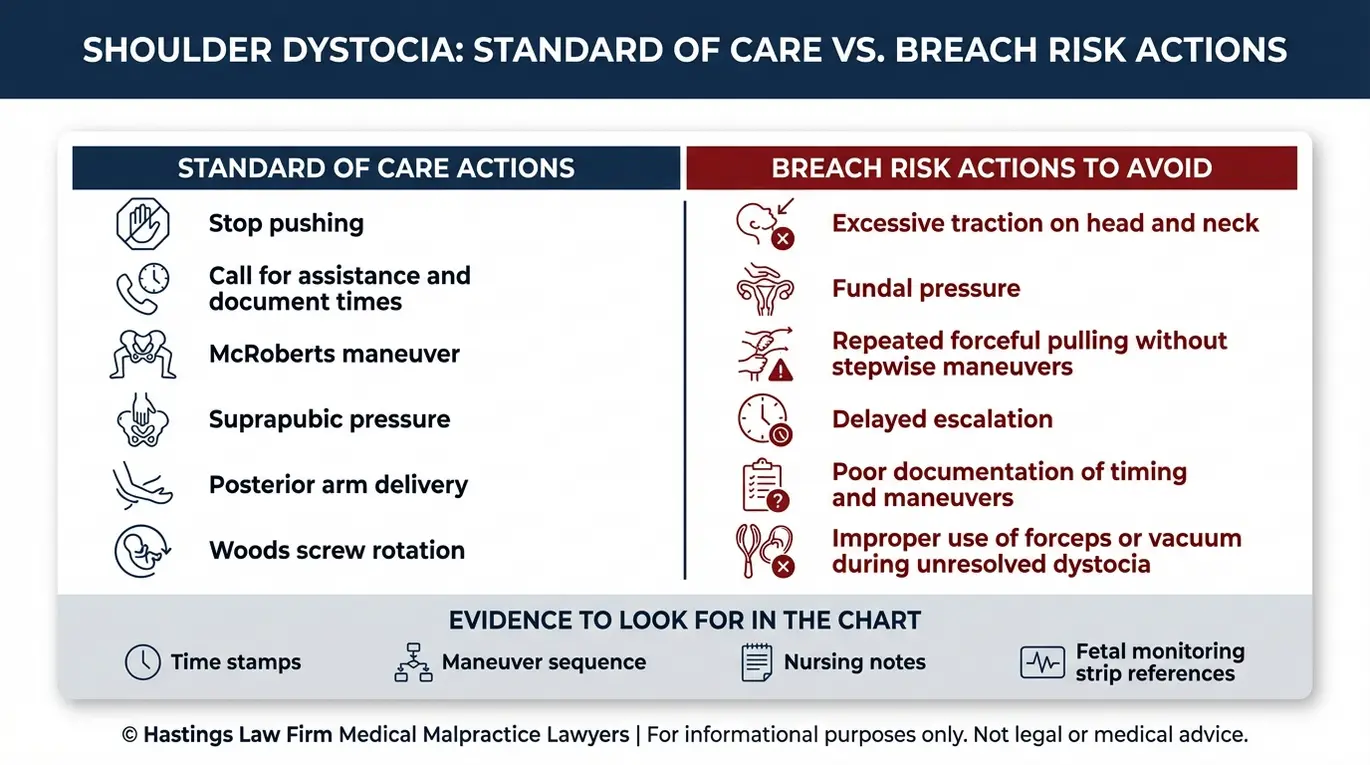
The standard of care requires obstetricians to immediately stop pushing and begin specific relief maneuvers when shoulder dystocia is identified, while strictly avoiding excessive traction on the baby’s head or neck.
Two first-line maneuvers form the foundation of proper management. The McRoberts maneuver involves sharply flexing the mother’s legs back toward her abdomen, which changes the angle of the pelvis and can free the trapped shoulder. Suprapubic pressure is applied by a nurse or assistant pressing downward just above the mother’s pubic bone to push the baby’s anterior shoulder out from behind the bone.
If those steps do not resolve the dystocia, additional maneuvers such as the Woods’ screw (using internal hand placement to apply pressure on the anterior aspect of the posterior shoulder to rotate the baby) or delivery of the posterior arm may be attempted. These are well-established techniques taught in obstetric training programs across the country.
The distinction between proper and improper management is critical to any malpractice claim:
| Accepted Maneuvers | Prohibited or Dangerous Actions |
|---|---|
| McRoberts maneuver (flexing legs) | Fundal pressure (pushing on top of the uterus) |
| Suprapubic pressure | Excessive lateral traction on the head or neck |
| Woods’ screw rotation | Pulling forcefully before the shoulder is freed |
| Posterior arm delivery | Continuing to coach aggressive pushing |
Fundal pressure, which involves pushing down on the top of the mother’s belly, can worsen the impaction and increase the risk of nerve damage and fractures. Excessive traction on the baby’s head is one of the most common causes of brachial plexus injuries.
As a Texas birth injury legal team, we work to obtain internal hospital protocols and peer-review documents. Under the Texas Occupations Code Chapter 160, the Texas Medical Board maintains oversight of physician conduct, and hospitals are expected to maintain written protocols for obstetric emergencies. When a doctor violates their own facility’s guidelines, that evidence can be powerful in establishing a breach of the standard of care. Our role as a lawyer for shoulder dystocia cases is to build a record that connects the specific actions taken during delivery to the injury your child suffered.
Severe Complications for Mother and Infant
Improper management of shoulder dystocia can cause permanent brachial plexus palsy (Erb’s Palsy) or cerebral palsy in infants, and uterine rupture or hemorrhage in mothers. A brachial plexus injury occurs when the network of nerves running from the neck through the shoulder and down the arm is stretched, compressed, or torn during delivery. Erb’s palsy, the most common form, affects the upper nerves and can result in weakness or paralysis of the arm and shoulder.
According to a comprehensive literature review published in PubMed Central, shoulder dystocia is associated with a range of severe outcomes when not properly managed.
Infant complications may include:
- Brachial plexus palsy or Klumpke’s palsy (lower brachial plexus injury affecting the hand and forearm)
- Nerve avulsion or rupture requiring surgical repair
- Fractured clavicle or humerus
- Oxygen deprivation leading to hypoxic brain injury or cerebral palsy
- In the most severe cases, intrapartum fetal death
Maternal complications may include:
- Postpartum hemorrhage
- Uterine rupture
- Third- or fourth-degree perineal tears
- Lasting psychological and emotional trauma
The severity of these injuries is what makes early legal evaluation so important. A shoulder dystocia injury attorney can help identify whether the harm your family experienced was the result of preventable errors during delivery.
Establishing Liability and Medical Malpractice
Medical malpractice occurs when a healthcare provider deviates from the accepted standard of care, such as applying excessive force or failing to perform a C-section when risks were evident, directly causing the birth injury. In shoulder dystocia cases, this can mean failing to perform timely relief maneuvers or disregarding warning signs.
These injuries are not simply “bad luck” or an unavoidable complication. When the medical records show that warning signs were present and proper protocols were not followed, there is a basis for investigating whether negligence occurred.
Liability can extend to multiple parties. The obstetrician may be responsible for decisions made during the delivery itself. Labor and delivery nurses can be held accountable if they failed to recognize fetal distress patterns on monitoring strips or did not alert the physician in time. The hospital may bear responsibility for inadequate staffing, lack of proper emergency protocols, or failure to ensure its team was trained for shoulder dystocia emergencies.
Our medical malpractice attorney team in Texas approaches each case by reconstructing the delivery timeline minute by minute. We review fetal heart rate tracings, nursing notes, physician orders, and hospital policies. Our in-house nurse consultants and national network of obstetric experts evaluate whether the actions taken during your child’s birth constituted a breach of duty. That foundation is how we build a strong claim as your Texas shoulder dystocia birth injury lawyer that can withstand scrutiny from the defense.
Recoverable Damages for Birth Injury Families
Families may recover compensation for past and future medical expenses, life care planning costs, pain and suffering, lost earning capacity, and parental mental anguish. The full scope of damages in a birth injury case reflects not just what has already been spent, but what the child and family will need for decades to come.
Economic damages cover the measurable financial costs of the injury:
- Past and future surgeries, including nerve repair or reconstruction
- Costs for physical, occupational, and speech therapy
- Adaptive equipment such as braces, modified vehicles, or assistive devices
- Special education or developmental support services
- Lost wages for parents who must reduce work to provide care
- Lost future earning capacity for the child
Non-economic damages address the human cost:
- Physical pain and suffering
- Emotional distress and mental anguish for both child and parents
- Disfigurement or physical limitation
- Loss of enjoyment of life
Developing a life care plan is a key part of our legal strategy. This document, prepared by medical and economic experts, projects the total cost of care the child will need from the present through their expected lifespan, often into their 80s. Without this analysis, families risk settling for an amount that falls far short of what their child will actually require or failing to secure full compensation for birth injury needs.
Texas Time Limits for Filing a Birth Injury Claim
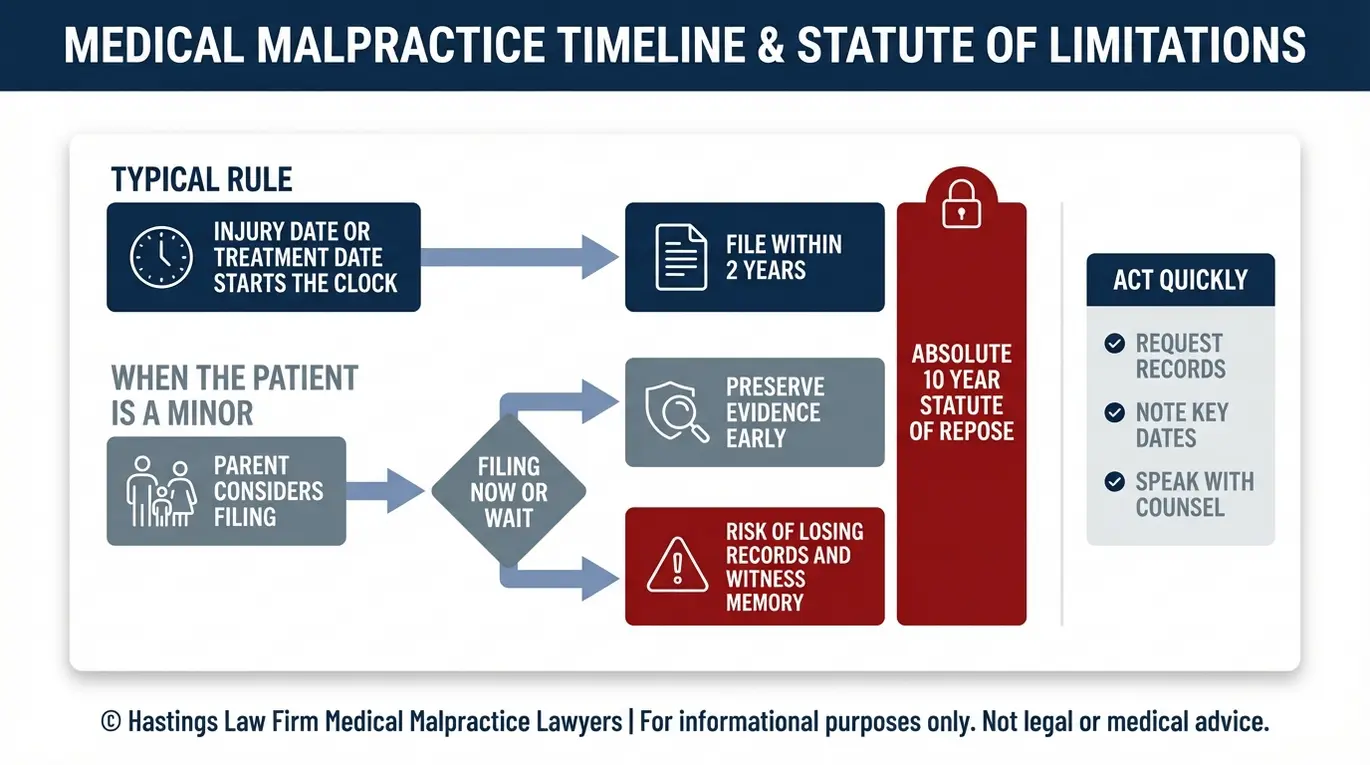
Generally, Texas requires medical malpractice claims to be filed within two years of the injury, but specific exceptions exist for minors that may extend this deadline significantly.
The standard rule: The statute of limitations for a birth injury in Texas is two years. For most adults, this deadline runs from the date of the medical event or, in limited circumstances, from the date the injury was discovered.
The minors exception: Because infants cannot file claims on their own behalf, Texas tolling rules may extend the filing deadline. This minors exception means parents may have until the child’s 14th birthday to bring a claim. However, waiting until close to that deadline is strongly discouraged. Medical records can be lost, witnesses’ memories fade, and critical evidence becomes harder to obtain over time.
The statute of repose: Texas imposes an absolute 10-year outer limit on medical malpractice claims. Regardless of other exceptions, no claim can be filed more than 10 years after the date of the alleged negligence.
These deadlines are strict, and missing them can permanently bar your family’s right to seek accountability. If you have any concern about timing, consulting with an attorney as early as possible protects your ability to pursue a claim.
Contact the Texas Birth Injury Attorneys at Hastings Law Firm Today for Help
If your child was injured during delivery due to shoulder dystocia, you deserve answers about what happened and why. Many of these injuries are preventable, and families have the right to hold medical providers accountable when the standard of care is not met.
Contact a Texas shoulder dystocia birth injury lawyer at Hastings Law Firm for a free, confidential case evaluation. Your initial consultation is led by a patient advocate who will listen to your experience, review the circumstances of the delivery, and help determine whether your family may have a claim.
We work on a contingency fee basis, which means you pay no attorney fees or costs unless we recover compensation for your family. Our team of trial attorneys, in-house nurses, and former defense lawyers is built to handle exactly these cases.
Help from our medical malpractice team begins with a single conversation. Hastings Law Firm was founded by Tommy Hastings, a board-certified trial lawyer. Tommy is a 2025 inductee into the American Board of Trial Advocates, an invitation-only organization for elite trial lawyers. If you are ready to take that first step, call us or complete our online form today.
Frequently Asked Questions About Shoulder Dystocia Birth Injury in Texas


This content was researched and written by the Hastings Law Firm editorial team, which includes attorneys, medical professionals, and experienced researchers. Our writing is informed by internal knowledge and practical experience, and we cross-check critical details against authoritative sources cited throughout. Every piece undergoes human-led fact-checking and legal review. Because legal and medical information can change, if you spot an error, please contact us. Learn more about our content standards and review process on our editorial policy page.

Tommy Hastings, founder of Hastings Law Firm, is a board-certified personal injury trial lawyer dedicated exclusively to healthcare injury cases. Since 2001, he has represented injured patients and families in litigation against major hospital systems, pharmaceutical companies, and negligent healthcare providers nationwide. He has handled numerous high-profile cases that have drawn national media attention and resulted in multi-million dollar recoveries. He draws on that experience in his writing, helping readers understand how these cases work and what options may be available to them.
