


Texas Urgent Care Center Malpractice Lawyer
Urgent care and walk in clinics are meant to provide quick treatment, but errors can happen when serious symptoms are missed, testing is limited, or a patient is not transferred for higher level care. These mistakes can lead to delayed treatment, worsening injury, and lasting physical and emotional harm. Responsibility may involve an individual provider, the clinic, or a corporate owner depending on staffing, supervision, and safety practices. If you or a loved one were harmed or worse due to urgent care center malpractice in Texas, contact Hastings Law Firm for a free, confidential case review.
Last Updated: September 20, 2026
Trusted Legal Representation for Walk-In Clinic Errors in Texas
When you visit an urgent care center, a walk-in clinic designed for non-life-threatening conditions, you expect competent medical attention. You trust that the provider will accurately assess your symptoms, run the right tests, often involving Point-of-care testing (POCT), rapid diagnostic analysis performed directly at the clinic, and refer you to a hospital if something serious is going on. When that trust is broken and a preventable error causes real harm, the confusion and frustration that follow can feel overwhelming.
You may not be sure whether what happened qualifies as malpractice, or whether a walk-in clinic can even be held accountable. Those are fair questions, and a Texas urgent care center malpractice lawyer can help you answer them. At Hastings Law Firm, our team of attorneys, nurse consultants, and patient advocates focuses exclusively on medical malpractice. If you believe a clinic error caused you or a loved one harm, we can review what happened and explain your legal options at no cost.

Common Errors Committed at Walk-In Clinics
Urgent care malpractice often occurs when providers fail to recognize emergency conditions, misdiagnose severe ailments as minor illnesses, or neglect to transfer patients to a hospital when higher-level care is required. According to research published on the NCBI Bookshelf, diagnostic errors remain one of the most common sources of patient harm in outpatient and acute care settings.
Walk-in clinics are built around speed and accessibility. In Texas, these errors often lead to serious complications because urgent care facilities are meant for low-acuity cases, not complex emergencies. A proper triage process, the initial assessment that determines the severity and priority of a patient’s condition, is essential. When a triage failure occurs, everything that follows can go wrong.
A Texas urgent care center malpractice lawyer often sees these common errors when evaluating cases:
- Misdiagnosis or diagnostic error: A provider may confuse symptoms of a heart attack with acid reflux, or dismiss early signs of meningitis as a common flu. Without a thorough differential diagnosis, the process of systematically ruling out conditions that share similar symptoms, serious illnesses can be missed entirely.
- Staffing and supervision gaps: Many walk-in clinics rely heavily on Nurse Practitioners or Physician Assistants without consistent physician oversight. While these providers are trained professionals, failure to diagnose complex or evolving conditions can occur when cases fall outside their experience and no supervising doctor is available to consult.
- Equipment and testing limitations: Some clinics lack imaging, advanced lab capabilities, or the ability to run certain tests on-site. The error isn’t the absence of equipment itself; it is the failure to refer the patient to a facility that has it. When a provider skips necessary testing simply because the clinic cannot perform it, the result can be a missed or delayed diagnosis.
If any of these scenarios sound familiar, an urgent care malpractice attorney can review your records and help determine whether the care you received fell below the standard. Suing an urgent care in Texas starts with understanding exactly where the breakdown occurred, and a walk-in clinic lawyer experienced in these cases knows where to look.
Establishing Liability for Negligence in Urgent Care Settings
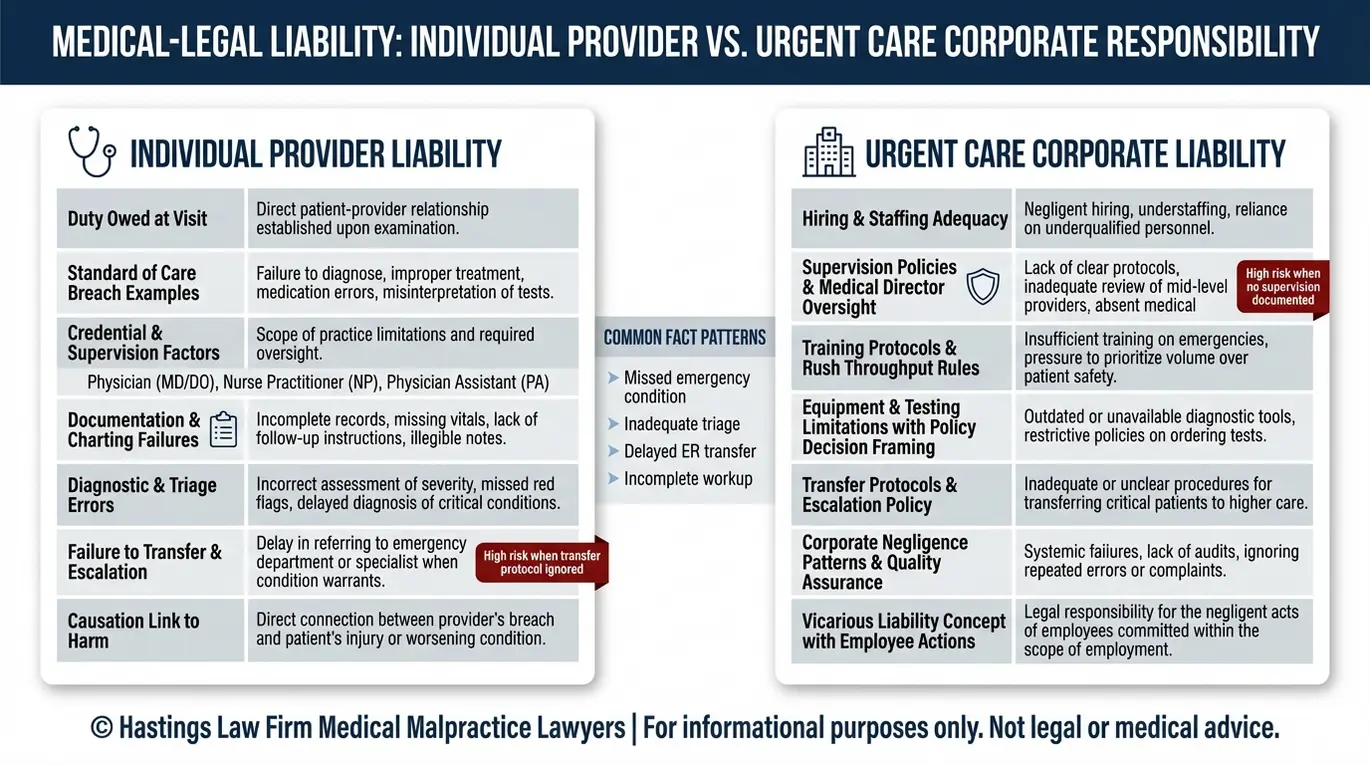
Liability may extend beyond the individual provider to include the corporate entity that owns the urgent care franchise, particularly if it failed to enforce safety protocols or adequately staff the facility. In these cases, we look at how the facility is organized to determine who is legally responsible for your care. Understanding urgent care franchise liability and who is responsible is one of the first things a Texas urgent care center malpractice lawyer will evaluate.
Under Texas Civil Practice and Remedies Code, Chapter 74, medical malpractice claims require proof that a provider breached the standard of care and that the breach caused the patient’s injury. The standard of care is the legal baseline for acceptable medical treatment that a similar provider would have followed. In urgent care cases, liability can fall on different parties depending on how the clinic is structured, who provided the care, and what systems were in place.
A Nurse Practitioner (NP), an advanced-practice registered nurse licensed to diagnose and treat patients, and a Physician Assistant (PA), a medical professional who practices under a physician’s authority, are common providers at walk-in clinics. Cases often involve nurse practitioner liability or physician assistant negligence, and when one of these mid-level providers makes an error, both the individual and the clinic may bear responsibility. As outlined on the NCBI Bookshelf, the legal doctrine of vicarious liability holds an employer responsible for the mistakes of its employees.
| Liability Type | Individual Provider | Corporate / Franchise Entity |
|---|---|---|
| Basis of Claim | Direct negligence by the treating NP, PA, or physician | Failure to staff, train, supervise, or enforce clinical protocols |
| Common Examples | Misreading symptoms, skipping exams, ordering wrong tests | Inadequate staffing ratios, no physician on-site, volume quotas |
| Legal Theory | Breach of individual standard of care | Corporate negligence or vicarious liability for employee actions |
An urgent care negligence lawyer will examine both the clinical decisions and the institutional policies behind them. A medical malpractice attorney for clinic errors can identify whether systemic failures, such as insufficient training or high patient volume protocols, contributed to the harm. Liability for urgent care errors is rarely limited to one person when the system itself is flawed.
The Hastings Law Firm Difference
Results matter, but what truly sets us apart is how we achieve them. Every verdict, every settlement, and every Texas courtroom victory comes from one guiding promise: To treat each client’s fight for justice as if it were our own.
This balance of skill, experience, and empathy reflects our core philosophy that justice should not only compensate the injured, but also make health care safer nationwide.

Critical Steps to Take After a Walk-In Clinic Mistake
Immediate action is required to preserve evidence; patients should seek a second opinion from a specialist, request a full copy of their medical records immediately, and avoid speaking with the clinic’s risk managers before consulting counsel. Following these steps helps ensure your medical records accurately reflect the timeline of events in your potential Texas clinic negligence claim. A Texas urgent care center malpractice lawyer will tell you that early preservation of evidence and careful documentation are among the most important things you can do.
Here is a step-by-step checklist to protect yourself and your case:
- Seek corrective medical care right away. If your condition is worsening or the original diagnosis does not seem right, go to a hospital emergency room. Emergency room transfer protocols, the set guidelines dictating when a patient must be moved to a hospital, exist because urgent care clinics are not equipped to handle every condition. A second opinion at a higher level of care creates a documented comparison between what the clinic told you and what was actually going on.
- Request your complete medical records from the clinic. Ask for copies of all visit notes, test results, prescriptions, and imaging orders in writing as soon as possible. Medical chart review is the process of examining every entry in your medical file for inconsistencies. Our team performs this review to help prevent any gaps in the narrative.
- Document your symptoms and timeline. Write down when your symptoms started, what you told the provider, what they said, and what treatment you received. Include any red-flag symptoms, warning signs such as chest pain, sudden weakness, high fever, or confusion, that may have been minimized or ignored.
- Do not sign any release forms or accept refunds from the clinic. If the facility’s risk management team contacts you, politely decline to discuss the situation until you have spoken with an attorney. Signing paperwork or accepting compensation from the clinic could affect your legal rights.
- Consult a lawyer for medical errors before the trail goes cold. Evidence is easier to preserve and evaluate when it is fresh. An urgent care injury lawyer can begin reviewing your case quickly, and a clinic malpractice attorney can advise you on next steps before any deadlines are missed.
Damages and Compensation in Clinic Negligence Cases
Patients harmed by urgent care negligence may recover economic damages for medical bills and lost wages, as well as non-economic damages for pain, suffering, and physical impairment caused by a delay in proper treatment. Recovering compensation for medical negligence in Texas helps families cover the high cost of corrective treatment. The type and amount of compensation depends on the specific harm and how it has affected your life.
Economic damages are the measurable financial losses you face. These can include the cost of corrective hospital stays, surgeries, medications, rehabilitation, and any future medical costs tied to the original error. If the misdiagnosis or delayed treatment caused a long-term disability, lost earning capacity may also be part of the claim. A Texas urgent care center malpractice lawyer will work with medical and financial experts to calculate the full scope of these losses, potentially creating a life care plan.
Non-economic damages account for the harm that does not come with a receipt. Physical pain, emotional distress, loss of quality of life, and the anxiety of learning your condition was mishandled all carry real weight in a claim for compensation for medical negligence. In an urgent care lawsuit settlement, these damages often reflect the gap between what should have happened and the suffering caused by what actually did.
Every case is different, and the damages for misdiagnosis in one claim may look very different from another. Our team builds a detailed picture of how the error affected you, both now and in the future, so that any recovery reflects the true cost.
Wrongful Death Claims Against Urgent Care Centers
When a walk-in clinic’s failure to transfer a patient to an emergency room or recognize a life-threatening condition results in death, surviving family members may have grounds for a wrongful death claim. These cases often involve fatal medical errors where a timely transfer could have changed the outcome. Texas law allows eligible family members to seek compensation for their loss, and our firm has the experience to handle these sensitive cases with the care they require.
Why Choose Hastings Law Firm for Your Claim
We are a specialized boutique firm that dedicates its entire practice to medical malpractice, offering board-certified leadership and a track record of challenging powerful healthcare systems. We do not handle car accidents, slip-and-falls, or general personal injury. Every attorney, nurse consultant, and staff member at our firm works on medical malpractice cases, and that focus makes a difference when going up against hospitals, clinics, and their insurers.
Our founder, Tommy Hastings, is a board-certified malpractice attorney, a distinction held by fewer than 2% of Texas lawyers, requiring rigorous peer review and exam qualification. He has recovered tens of millions of dollars for clients harmed by medical errors, and he is a recognized authority in the field, having served as Course Director for the State Bar of Texas Medical Torts Seminar. As a Texas urgent care center malpractice lawyer, Tommy and our team bring both legal strategy and clinical insight to every case.
Our legal team includes former defense attorneys who previously represented hospitals and healthcare systems. That background gives us a clear understanding of how the other side builds its case. We also have in-house nurses and board-certified patient advocates who analyze medical records and identify where the standard of care was broken.
We work on a contingency fee basis, essentially a no win no fee arrangement, which means you pay nothing unless we recover compensation for you. If you are looking for an experienced attorney to handle your claim, we welcome the chance to review your case. As a specialized medical law firm, we are built for exactly this kind of work.
Contact the Texas Hospital Malpractice Attorneys at Hastings Law Firm Today for Help
If a walk-in clinic’s negligence caused you or a loved one harm, you do not have to face their legal team alone. The medical and legal systems can feel stacked against you, but having the right team on your side changes that equation.
As an experienced Texas urgent care center malpractice lawyer, Hastings Law Firm has the clinical knowledge, legal resources, and trial preparation to hold negligent clinics accountable. Our urgent care malpractice law firm is ready to review your medical records, consult with qualified experts, and give you an honest assessment of your case.
The consultation is free, and you will not owe us a fee unless we win. Call us today or fill out our online contact form to get started. Let us help you find the answers you deserve.
Frequently Asked Questions About Urgent Care Center Malpractice in Texas


This content was researched and written by the Hastings Law Firm editorial team, which includes attorneys, medical professionals, and experienced researchers. Our writing is informed by internal knowledge and practical experience, and we cross-check critical details against authoritative sources cited throughout. Every piece undergoes human-led fact-checking and legal review. Because legal and medical information can change, if you spot an error, please contact us. Learn more about our content standards and review process on our editorial policy page.

Brady D. Williams is a nationally recognized medical malpractice attorney who has spent his career handling high-stakes litigation for injured patients and families across the country. Licensed in both Texas and California, Brady draws on experience from hundreds of resolved medical cases to break down complex legal and medical topics for the people who need that information most. His writing reflects the same attention to detail and commitment to clarity that he brings to every case he handles.
