


El Paso Texas Medical Malpractice Lawyer
Medical malpractice can leave patients and families facing unexpected costs, lasting pain, and life changing consequences when preventable errors occur in healthcare settings. In Texas, a claim depends on showing that a provider breached the accepted standard of care and that the breach caused measurable harm, not simply that the outcome was poor. The process can also be shaped by limits on certain damages and strict procedural requirements that can end a case if missed. If you or a loved one were harmed or worse due to medical malpractice in El Paso, Texas, contact Hastings Law Firm for a free, confidential case review.

Last Updated: July 27, 2026
Trusted Legal Representation for Healthcare Negligence in El Paso
What You Should Know About Healthcare Negligence Claims in El Paso:
- Recovery can be unavailable when harm cannot be tied to a breach of the accepted standard of care rather than an adverse event or known treatment risk.
- Options can narrow quickly because Texas imposes strict filing and litigation requirements that can end a claim if not met.
- Compensation for pain and suffering can be limited in Texas, which can affect the overall value of a medical malpractice claim.
- Financial recovery can depend heavily on documented economic losses because economic damages are not capped under Texas law.
- Accountability can extend beyond the treating physician when hospitals, nursing staff, or facilities contribute through staffing or safety protocol failures.
- Hospital responsibility can turn on whether the treating physician was an employee or an independent contractor.
- A claim can be dismissed permanently if a required expert report is not served on time.
- The ability to file can be lost even if an injury is discovered later because Texas includes a hard cutoff that can override delayed discovery.
- A child injury claim can have different timing rules in Texas, which can affect whether the claim remains viable.
- Case evaluation can depend on what medical records show, including nursing notes and anesthesia records.

A Healthcare Focused Law Firm
When a doctor, nurse, or hospital causes harm through a preventable error, the aftermath can leave you feeling overwhelmed and unsure of what to do next. You may be dealing with unexpected medical costs, lasting pain, or the loss of someone you love. These situations raise difficult questions, and you deserve honest answers from a legal team that focuses entirely on medical malpractice.
Hastings Law Firm represents patients and families across El Paso who have been harmed by healthcare negligence. As an El Paso Texas medical malpractice lawyer team, we bring the resources of a national firm and the focused attention of a practice built exclusively around medical liability cases. Our in-house medical staff and former defense attorneys know how to identify what went wrong and build the evidence to prove it.
If you believe you or a loved one was harmed by a medical error, we offer a free, confidential case evaluation to review what happened and explain your options.
Defining Medical Malpractice Under Texas Law
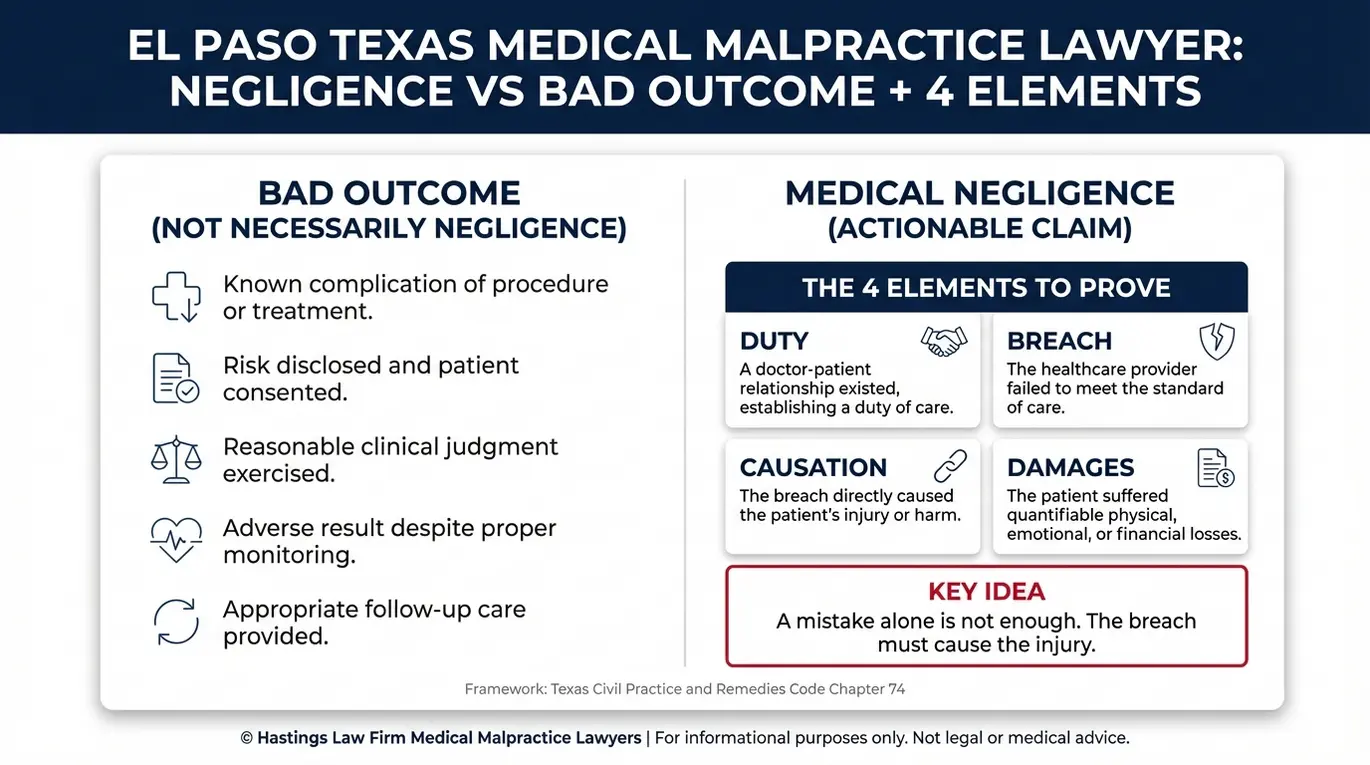
Medical malpractice in Texas occurs when a healthcare professional deviates from the accepted standard of care, directly causing injury or death to a patient. Not every poor health outcome qualifies. The distinction between an adverse event, which is an unintended harm resulting from medical care rather than the patient’s underlying condition, and medical negligence depends on whether the provider made an error that a competent professional would have avoided.
Texas medical malpractice claims are governed by Chapter 74 of the Texas Civil Practice and Remedies Code, which sets strict requirements for how these cases must be filed and proven. To succeed, a patient or their family must establish four legal elements against the provider or facility:
- Duty: The provider had a professional obligation to treat the patient according to accepted medical standards.
- Breach of duty: The provider failed to meet the standard of care, meaning the level of treatment a reasonably competent professional would have delivered under similar circumstances.
- Causation: That specific breach directly caused the patient’s injury or worsened their condition.
- Damages: The patient suffered real, measurable harm, whether physical, financial, or emotional.
A sentinel event, which is an unexpected occurrence involving death or serious injury not related to the patient’s illness, can sometimes signal a breach. But a medical malpractice lawyer in El Paso must still connect each element in the chain. A bad outcome alone, without evidence of a breach that caused harm, does not support a claim.
Common Medical Errors and Negligence Cases We Handle
Common medical negligence cases involve surgical mistakes, misdiagnosis, and medication errors that result in preventable harm to patients in hospitals or clinics, instances often involving hospital negligence. These errors are not rare. According to the Agency for Healthcare Research and Quality’s Patient Safety Network (PSNet), adverse events in healthcare remain a leading concern nationwide, and many are avoidable with proper protocols.
As an El Paso medical malpractice attorney team handling medical negligence cases across the region, we represent patients and families affected by a wide range of preventable errors, including:
- Surgical errors: Wrong-site surgery (operating on the wrong body part or the wrong patient) and retained surgical items (RSIs), where instruments or sponges are left inside the body after a procedure.
- Diagnostic errors: Delayed diagnosis or failure to diagnose conditions like cancer, stroke, or heart attack, where earlier detection could have changed the outcome.
- Birth injuries: Preventable harm to mothers and newborns, including hypoxia (oxygen deprivation), cerebral palsy, and failure to perform a timely C-section when fetal distress is present.
- Medication errors: Improper prescriptions, incorrect dosages, or administration mistakes in hospital and clinical settings.
- Anesthesia errors: Overdosing, failure to monitor vital signs, or failure to review a patient’s medical history before administering anesthesia.
- Emergency room errors: Misreading symptoms, premature discharge, or failure to order appropriate testing in time-sensitive situations.
Understanding the Impact of Wrongful Death
A wrongful death claim is a legal action filed by surviving family members when negligence leads to a fatality. When medical negligence results in the death of a patient, surviving family members may have grounds for a claim. These cases can involve hospital negligence, nursing home neglect, or a failure to rescue, which refers to a provider’s inability to recognize and respond to a patient whose condition is rapidly deteriorating. Wrongful death claims allow families to seek accountability and recover compensation for funeral costs, lost income, and the emotional toll of their loss.
The Hastings Law Firm Difference
Results matter, but what truly sets us apart is how we achieve them. Every verdict, every settlement, and every El Paso courtroom victory comes from one guiding promise: To treat each client’s fight for justice as if it were our own.
This balance of skill, experience, and empathy reflects our core philosophy that justice should not only compensate the injured, but also make health care safer nationwide.

Understanding the Texas Cap on Non-Economic Damages
Texas law imposes a cap on non-economic damages, limiting compensation for pain and suffering to specific amounts depending on the number of defendants. These caps were enacted as part of the 2003 tort reform legislation and are outlined in Section 74.301 of the Texas Civil Practice and Remedies Code. Understanding how these limits work and the impact of Texas damage caps is essential to setting realistic expectations for your case.
There are two categories of damages in a Texas medical malpractice case:
| Damage Type | Description | Cap |
|---|---|---|
| Economic Damages | Medical bills, lost wages, future care costs, and other measurable financial losses | No cap |
| Non-Economic Damages | Pain and suffering, mental anguish, loss of companionship, and disfigurement | Capped (see below) |
For non-economic damages, the damage caps work as follows: a maximum of $250,000 against all physicians or doctors involved, and a separate $250,000 cap against each hospital or healthcare institution, with an aggregate institutional cap of $500,000. The total non-economic recovery in most cases cannot exceed $750,000.
These caps make it harder to bring smaller cases to trial, which is one reason experienced medical malpractice lawyers carefully evaluate the full scope of economic losses. Lost future earnings, the cost of ongoing medical care, and other financial damages remain uncapped. Thorough documentation of these losses often provides cases with their true value.
Identifying Liable Parties in El Paso Healthcare Facilities
Liability can extend beyond the treating doctor to include hospitals, nursing staff, and medical facilities that failed to enforce safety protocols or maintain adequate staffing. Identifying liable parties is one of the first steps a malpractice lawyer in El Paso will take when evaluating your case.
In many situations, the doctor who treated you may be an independent contractor rather than a hospital employee. This distinction affects whether the hospital is liable. If the physician is employed by the facility, the hospital may bear responsibility through vicarious liability. This means the employer is legally responsible for the actions of its employees.
If not, the facility may still be liable for its own systemic failures. These include poor triage, which involves prioritizing care based on severity, or improper medication reconciliation, which is the process of verifying all medications a patient is taking. These failures are forms of facility negligence.
Claims can also be brought against nursing homes for abuse or neglect. The Texas Health and Human Services Nursing Facility Directory lists licensed facilities across the state, and regulatory records can reveal patterns of violations. If you are considering suing a hospital, a physician group, or a long-term care facility, identifying every responsible party early strengthens the foundation of your case.
The Critical Role of Expert Reports in Texas Litigation
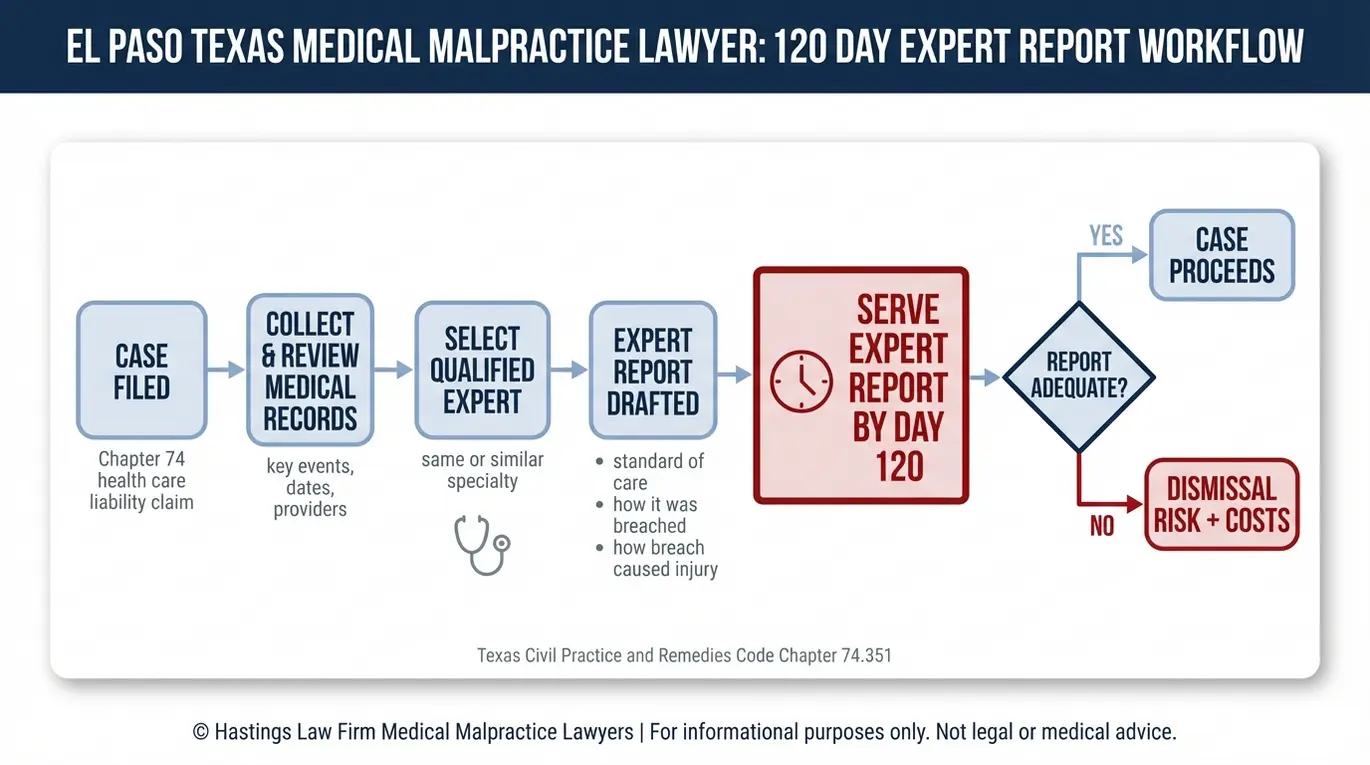
Texas law requires plaintiffs to serve an expert report within 120 days after the defendant’s original answer is filed, detailing the standard of care and how it was breached. This requirement, established under Texas Chapter 74 and Section 74.351 of the Texas Civil Practice and Remedies Code, is one of the strictest procedural hurdles in medical malpractice litigation. Missing the deadline results in dismissal of the case with prejudice, with attorney’s fees and costs awarded to the defendant.
Here is how the expert report process works for an El Paso medical malpractice law firm handling your case:
- Retain a qualified expert witness. Under Chapter 74, the expert must be a physician who is practicing medicine at the time of testimony or was practicing at the time the claim arose, with knowledge and training or experience in the same field or a substantially similar specialty as the provider being sued. Expert witness requirements in Texas are specific, and a general practitioner typically cannot opine on a surgical error.
- Conduct a thorough records review. The expert examines all relevant medical records, including nursing notes and electronic fetal monitoring (EFM) strips. These strips are continuous recordings of fetal heart rate during labor. They also review anesthesia records, which are detailed logs of drugs administered, dosages, and patient vitals.
- Prepare and serve the report. The expert report must identify the applicable standard of care, explain how it was breached, and establish how that breach caused the patient’s injury.
- Meet the 120-day deadline. The report must be served on each provider within 120 days after the defendant’s original answer is filed. Failure to comply is not a technicality; it ends the case.
This is why early legal consultation matters. Building a credible expert report takes time, and waiting too long to contact an attorney can put you at serious risk of missing this window.
The Texas Statute of Limitations and Statute of Repose
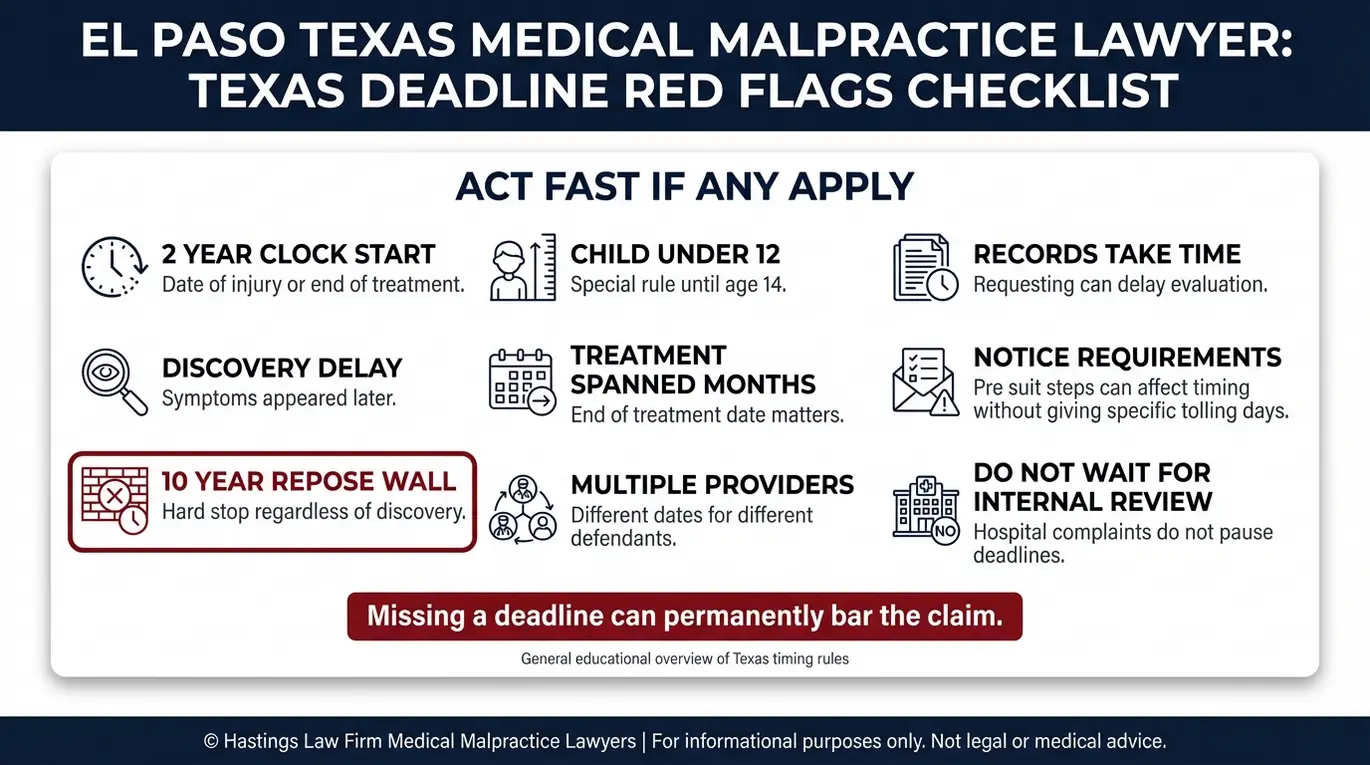
Generally, patients have two years from the date of the injury to file a medical malpractice claim in Texas. Identifying the correct statute of limitations for your specific situation is critical because these deadlines are unforgiving, particularly for minors.
The general rule gives you two years from the date the negligence occurred or from the date treatment by the same provider ended, whichever is later.
The discovery rule may extend the deadline in limited situations where the injury could not reasonably have been discovered right away, such as when a surgical tool is left inside the body and symptoms do not appear for months.
The statute of repose**** overrides the discovery rule entirely. No matter when the injury is discovered, no claim may be filed more than ten years after the date of the negligent act. This is a hard cutoff with very few exceptions.
Time-sensitive warning: If you suspect medical negligence but are unsure of the exact date of the error, do not wait. The two-year and ten-year deadlines run whether or not you are aware of them. Consulting with an attorney promptly protects your right to file.
Addressing the Special Limitations for Minors
Texas law provides special protections for minors injured by medical negligence. Tolling is a legal term meaning the statute of limitations period is paused for a specific reason. For children under the age of 12, the statute of limitations is tolled until the child turns 12, giving them until their 14th birthday to file a claim. This provision ensures that pediatric malpractice claims are not lost simply because parents did not immediately recognize the scope of the harm.
Why Choose Our Team to Represent Your Family
We combine the resources of a national firm with the specialized focus of a medical-legal team that handles nothing but malpractice cases. Every attorney, nurse consultant, and patient advocate at Hastings Law Firm is dedicated to one area of law: holding healthcare providers accountable when preventable errors cause harm.
Our founder, Tommy Hastings, is Board Certified in Personal Injury Trial Law by the Texas Board of Legal Specialization, a distinction held by fewer than 2% of Texas attorneys. In 2025, he was inducted into the American Board of Trial Advocates (ABOTA), an invitation-only organization recognizing elite trial lawyers. As an El Paso Texas medical malpractice lawyer team, we prepare every case from day one as if it will go to a jury, and that preparation is what allows us to negotiate from a position of strength.
Our team includes former defense attorneys who once represented hospitals, giving us direct insight into how the other side builds its case. We also employ in-house nurse practitioners and board certified patient advocates who analyze your medical records and help us identify exactly where care broke down.
We work on a contingency fee basis. We offer a free consultation, and you pay no attorney fees or costs unless we recover compensation for you.
Contact the El Paso Healthcare Malpractice Attorneys at Hastings Law Firm Today for Help
Texas imposes strict deadlines and procedural requirements on medical malpractice claims, from the two-year statute of limitations to the 120-day expert report rule. The sooner you reach out, the more time your legal team has to investigate, secure expert opinions, and build a strong case.
If you or a loved one has been harmed by a medical error in El Paso, Hastings Law Firm is here to listen. Our patient advocates offer a free, confidential case evaluation where we review your medical records, explain what we find, and outline your legal options with no obligation.
You do not have to carry this alone. As a dedicated El Paso Texas medical malpractice lawyer team, we are here to help you find the answers you deserve and take the first step toward holding the responsible parties accountability. Contact us today to schedule your risk-free consultation.
Frequently Asked Questions About Medical Malpractice in El Paso


This content was researched and written by the Hastings Law Firm editorial team, which includes attorneys, medical professionals, and experienced researchers. Our writing is informed by internal knowledge and practical experience, and we cross-check critical details against authoritative sources cited throughout. Every piece undergoes human-led fact-checking and legal review. Because legal and medical information can change, if you spot an error, please contact us. Learn more about our content standards and review process on our editorial policy page.

Gabe Sassin has focused exclusively on medical malpractice law since 2007. After spending more than a decade as a malpractice defense attorney, he knows exactly how the other side works. He has seen firsthand how healthcare providers, insurers, corporate defendants, and their legal teams think, prepare, and build their defense against claims. That knowledge works for the people who need it most today, injured patients and their families. His unique experience shapes everything he writes, giving readers a look at how these cases actually work from someone who has handled them from both sides.
