


Texas Anesthesia Error Lawyer
Anesthesia errors can leave patients and families facing sudden, life changing harm with limited clarity about what went wrong. Common problems described include dosage mistakes, intubation errors, and monitoring failures, along with anesthesia awareness that can cause lasting psychological trauma. Severe complications can involve permanent disability, brain injury, stroke, cardiac arrest, or worse, and liability may extend beyond a single provider depending on the care team and facility. If you or a loved one were harmed or worse due to an anesthesia error in Texas, contact Hastings Law Firm for a free, confidential case review.

Last Updated: July 27, 2026
Trusted Legal Representation for Anesthesia Negligence in Texas
Anesthesia is one of the most carefully controlled aspects of any surgical procedure, and when something goes wrong, the consequences can be severe and life-altering. If you or someone in your family was seriously harmed by an anesthesia error during a medical procedure, you may be dealing with questions that feel impossible to answer on your own. You may not know exactly what happened, but you know that something was not right.
As a Texas anesthesia error lawyer, Hastings Law Firm focuses exclusively on medical malpractice. Our team, which includes board-certified trial attorneys, former defense counsel, and in-house nurse consultants, knows how to obtain and interpret the anesthesia record. This detailed flow sheet documents every drug, dosage, and vital sign reading throughout your procedure to determine whether the care you received fell below the accepted medical standard.
If you have concerns about what happened during or after a procedure, we are here to review your case and explain your legal options at no cost and no obligation.

Common Types of Anesthesiologist Negligence in Texas
Anesthesia errors occur when a provider deviates from the standard of care, often involving dosage miscalculations, failure to monitor vital signs, improper intubation, or equipment malfunction. Understanding the type of error that may have occurred is an important first step in evaluating a potential claim with a Texas anesthesia malpractice attorney.
Dosage Errors
A dosage miscalculation, meaning the administration of too much or too little anesthetic medication relative to a patient’s weight, age, and medical history, is one of the most common forms of anesthesia negligence. Anesthesiologists must strictly adhere to protocols based on body mass index and metabolism rates to avoid toxicity or awareness.
An overdose can cause slowed breathing, toxic reactions, or cardiac arrest. Too little medication can result in the patient regaining consciousness during surgery, a distressing experience discussed in more detail below.
Intubation Errors
Improper intubation occurs when the breathing tube is placed into the esophagus instead of the trachea, or when the process causes physical injury such as broken teeth or airway trauma. Esophageal intubation, if not identified quickly through capnography (end-tidal CO2 monitoring that confirms the tube is correctly placed in the airway), can cut off oxygen to the brain within minutes.
Monitoring Failures
Anesthesia providers are responsible for continuously tracking a patient’s oxygen saturation, blood pressure, heart rate, and respiratory function. Modern operating rooms rely on pulse oximetry and electrocardiograms to provide real-time data that must be interpreted instantly.
Failure to recognize and respond to dropping oxygen levels or dangerous changes in blood pressure can lead to irreversible injury. Research published by the American Society of Anesthesiologists through a closed claims analysis has shown that adverse respiratory events, several of which are preventable, remain a leading source of anesthesia-related injury.
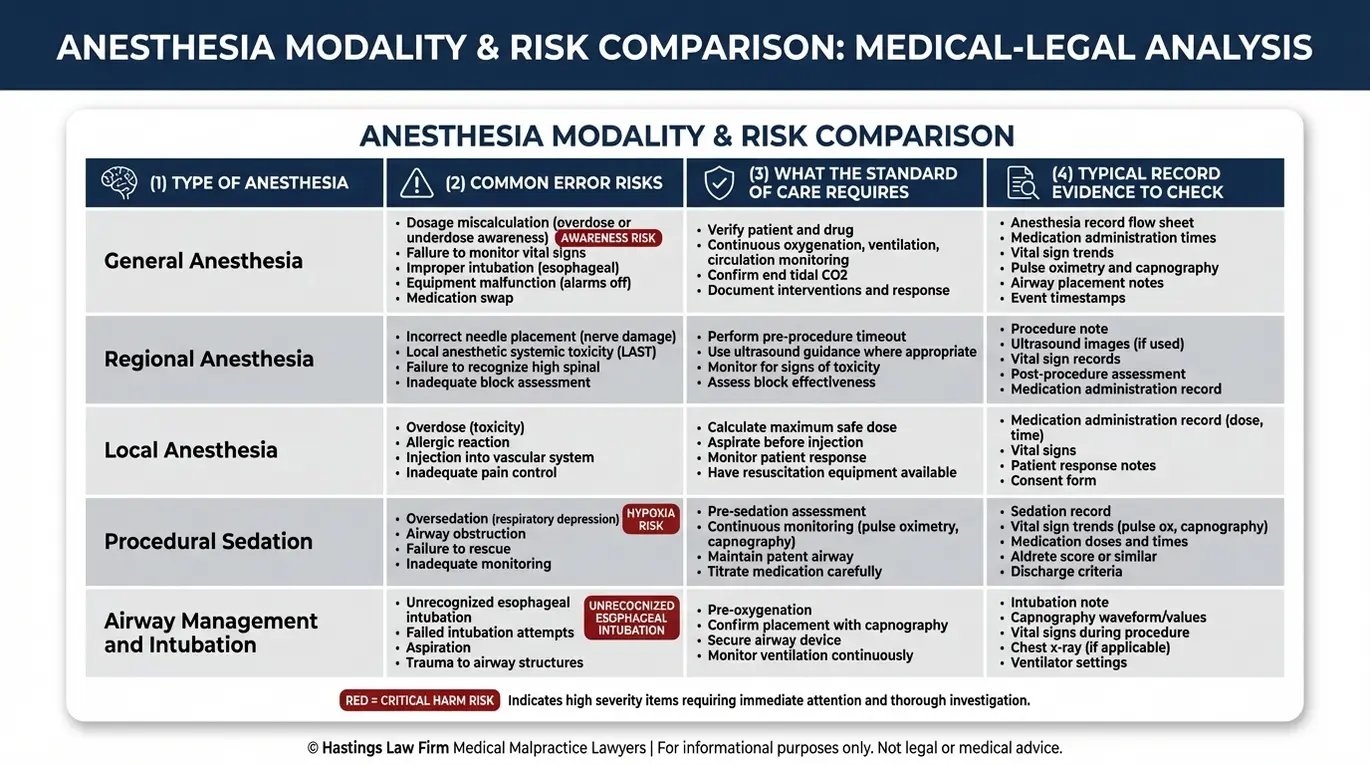
The type of anesthesia used also affects the specific risks involved:
| Type of Anesthesia | Description | Common Error Risks |
|---|---|---|
| General Anesthesia | Renders the patient fully unconscious | Dosage miscalculation, intubation failure, monitoring lapses, awareness |
| Regional Anesthesia | Numbs a large area of the body (e.g., epidural, spinal block) | Nerve damage from needle placement, incorrect injection site, inadequate effect |
| Sedation | Reduces consciousness but does not fully eliminate awareness | Over-sedation leading to respiratory arrest, under-sedation causing awareness and distress |
Anesthesia Awareness and Psychological Trauma
Anesthesia awareness is a specific and deeply distressing complication in which a patient regains partial or full consciousness during surgery while under general anesthesia. Often in these situations, the patient has also been given a neuromuscular blockade, which is a paralytic agent that prevents voluntary muscle movement. This means they cannot move, speak, or signal to the surgical team that they are awake.
Patients who experience awareness may feel pressure, pain, or hear conversations, all while being physically unable to respond. The psychological aftermath can be severe. Many patients develop post-traumatic stress, persistent anxiety around medical settings, sleep disturbances, and long-term mental anguish. These injuries are real, compensable, and deserve serious legal attention. An experienced anesthesia negligence lawyer can help connect the clinical evidence to the psychological impact.
Catastrophic Injuries Caused by Anesthesia Complications
Negligent anesthesia administration can lead to permanent disabilities, including hypoxic brain injury, stroke, cardiac arrest, nerve damage from positional errors, and wrongful death. Because anesthesia directly affects the body’s most essential functions, including breathing, circulation, and consciousness, even brief lapses in care can produce devastating outcomes. These complications are life-threatening events that require immediate legal investigation.
Hypoxia and Brain Damage
Hypoxia, a condition where the brain is deprived of adequate oxygen, is among the most serious anesthesia-related injuries. It can result from improper intubation, where the breathing tube is mistakenly placed in the esophagus instead of the trachea, ventilator malfunction, or a delayed response to falling oxygen levels. When the brain goes without oxygen for even a few minutes, the damage can be irreversible, potentially resulting in a coma or vegetative state.
Cardiovascular Events
Unmonitored blood pressure fluctuations during surgery can trigger heart attacks or strokes. Patients with pre-existing heart conditions are especially vulnerable if those risks are not properly accounted for in the anesthesia plan. A sudden drop in blood pressure can decrease blood flow to vital organs, causing a medical crisis that the anesthesia team must identify and treat immediately to prevent permanent harm.
Death
In tragic cases, an anesthesia error results in the patient’s death. When the care team fails to rescue a patient from a deteriorating situation, whether through delayed intervention or inadequate monitoring, families are left searching for answers. Establishing causation in these cases is critical to holding the provider accountable.
The long-term effects of anesthesia complications can include:
- Permanent cognitive impairment or memory loss
- Inability to return to work or live independently
- Chronic pain or nerve dysfunction
- Need for lifelong medical care and rehabilitation
- Severe emotional and psychological distress for the patient and family
If you or a loved one suffered a catastrophic outcome after a procedure, an anesthesia injury law firm with the medical knowledge to trace the injury back to a specific failure can help determine whether you have a viable claim. At Hastings Law Firm, our in-house medical staff reviews the clinical timeline and works alongside our attorneys to identify exactly where the standard of care broke down.
The Hastings Law Firm Difference
Results matter, but what truly sets us apart is how we achieve them. Every verdict, every settlement, and every Texas courtroom victory comes from one guiding promise: To treat each client’s fight for justice as if it were our own.
This balance of skill, experience, and empathy reflects our core philosophy that justice should not only compensate the injured, but also make health care safer nationwide.

Liability in the Operating Room: Anesthesiologists vs. CRNAs
Liability in an anesthesia injury case can extend to the anesthesiologist (an MD or DO specializing in anesthesiology), the Certified Registered Nurse Anesthetist (CRNA), a master’s- or doctoral-level nurse licensed to administer anesthesia, and the hospital or outpatient facility, depending on the employment relationship and supervision model used during the procedure. We scrutinize the contracts and protocols in place to identify every potential source of compensation.
The Anesthesia Care Team Model
Many hospitals use an anesthesia care team model, sometimes called medical direction or supervision, where a single anesthesiologist oversees several CRNAs simultaneously. In this structure, the physician may not be physically present in the operating room at all times.
If a CRNA encounters a complication while the supervising doctor is attending to another case, delays in response can contribute to patient harm. Determining liability often involves analyzing the specific hospital staffing model to see if the facility can be held responsible for the actions of a contracted group. Vicarious liability may apply if the hospital held the providers out as its own employees.
Outpatient Surgical Centers
Outpatient surgical centers and ambulatory facilities present unique risks. These centers may have fewer staff, less monitoring equipment, and limited emergency resources compared to full-service hospitals.
The Centers for Medicare & Medicaid Services (CMS) Ambulatory Surgical Center Quality Reporting program tracks safety measures at these facilities. Gaps in compliance can be relevant evidence in a malpractice case. If you were injured at an outpatient center, a CRNA malpractice lawyer experienced in these cases knows where to look for institutional failures.
Pre-Operative Screening Failures
Before any anesthesia is administered, the provider has a duty to screen the patient for risk factors through a pre-operative assessment. Conditions like obstructive sleep apnea or susceptibility to malignant hyperthermia, a rare but potentially fatal reaction to certain anesthetic agents, must be identified before the procedure begins.
Failure to ask the right questions or review the patient’s history can set the stage for a preventable crisis. When evaluating a potential claim, we examine whether the pre-operative assessment met the standard of care, and whether suing an anesthesiologist in Texas, the CRNA, or the facility itself is the appropriate course of action.
Texas Laws Governing Anesthesia Malpractice Claims
Texas law imposes strict regulations on malpractice claims, including a two-year statute of limitations, caps on non-economic damages, and the mandatory Chapter 74 expert report which must be served within 120 days after the defendant files an original answer. Missing any of these deadlines can end your case before it begins, which is why early legal consultation matters.
Statute of Limitations
Under Texas Civil Practice and Remedies Code § 74.251, a patient generally has two years from the date of the anesthesia error to file a health care liability claim. This strictly enforced timeframe is often referred to as the 2-year rule.
Two years may seem like a long time, but building a complex medical negligence case takes months of preparation. There are narrow exceptions, such as the discovery rule, but the safest approach is to contact an attorney as soon as you suspect something went wrong.
The Chapter 74 Expert Report
One of the most demanding anesthesia error lawsuit requirements in Texas is the Chapter 74 written expert report. Under Texas Civil Practice and Remedies Code § 74.351, the plaintiff must serve a report from a qualified medical professional within 120 days after the defendant files an original answer.
For an anesthesia case, this typically means obtaining a report from a board-certified anesthesiologist. This expert must identify the standard of care, explain how it was breached, and show how that breach caused the injury. This report is a gatekeeping measure to screen out frivolous claims, but it also places a heavy burden on victims.
Damage Caps
Texas medical malpractice laws cap non-economic damages, which cover pain and suffering, mental anguish, and loss of companionship, at $250,000 for all individual physicians or health care providers combined and $250,000 per hospital, with an aggregate cap of approximately $750,000 total. These caps were implemented as part of tort reform but can feel unjustly limiting to those who have lost a loved one or suffered profound trauma.
Economic damages, such as medical bills, lost wages, and the cost of future care, are not capped and can be recovered in full. Full recovery of economic damages is necessary because anesthesia injuries frequently require extensive, long-term medical treatment.
Key Deadlines to Remember:
- 2 years from the date of injury to file a claim (statute of limitations)
- 120 days after the defendant files an original answer to serve the Chapter 74 expert report
- 10-year statute of repose as the outer boundary, even if the injury was not immediately discovered

Why Choose Hastings Law Firm for Your Anesthesia Case
Hastings Law Firm offers a trial-ready approach with a team of board-certified attorneys and medical experts who focus exclusively on medical negligence, ensuring no detail is missed in complex anesthesia litigation. This is not a general practice firm that occasionally handles malpractice. Every member of our team, from our attorneys to our in-house nurse consultants and patient advocates, works on medical malpractice cases every day.
As a Texas anesthesia error lawyer, founder Tommy Hastings, a board-certified trial attorney and 2025 inductee into the American Board of Trial Advocates, has built the firm around a single principle: prepare every case as though it is going to trial. Our reputation is built on our willingness to take cases to verdict.
Legal opponents recognize which firms are prepared to go to verdict and which firms seek a quick settlement. By preparing for trial from day one, we position your case for the maximum possible recovery. We operate on a contingency fee model, meaning our interests are fully aligned with yours.
To help you begin, we provide a free evaluation of your claim. When searching for the best medical malpractice attorney Texas residents can rely on, experience matters. Our team also includes former defense attorneys who previously represented hospitals and healthcare systems. That background gives us direct insight into how the other side builds its case, allowing us to anticipate and counter their arguments early.
Contact the Texas Healthcare Malpractice Attorneys at Hastings Law Firm Today for Help
Texas law places firm deadlines on your ability to take legal action after an anesthesia injury. The two-year statute of limitations and the 120-day expert report requirement mean that critical evidence, including anesthesia records, equipment logs, and staffing documentation, needs to be preserved and reviewed as early as possible.
Hastings Law Firm offers a free, confidential case evaluation led by a patient advocate who can help you understand whether you have a claim. There is no financial risk. We work on a contingency fee basis, which means you owe nothing unless we secure a recovery on your behalf.
If you or a loved one suffered a serious injury or loss due to an anesthesia error, contact our team today. Let us review the facts, answer your questions, and explain your options.
Frequently Asked Questions About Anesthesia Error in Texas


This content was researched and written by the Hastings Law Firm editorial team, which includes attorneys, medical professionals, and experienced researchers. Our writing is informed by internal knowledge and practical experience, and we cross-check critical details against authoritative sources cited throughout. Every piece undergoes human-led fact-checking and legal review. Because legal and medical information can change, if you spot an error, please contact us. Learn more about our content standards and review process on our editorial policy page.

Brady D. Williams is a nationally recognized medical malpractice attorney who has spent his career handling high-stakes litigation for injured patients and families across the country. Licensed in both Texas and California, Brady draws on experience from hundreds of resolved medical cases to break down complex legal and medical topics for the people who need that information most. His writing reflects the same attention to detail and commitment to clarity that he brings to every case he handles.
