


Texas Medical Malpractice Wrongful Death Explained
Written by: Hastings Law Firm | Reviewed by: Tommy Hastings | Updated: July 23, 2026
Losing a loved one to a preventable medical error is devastating, and the legal questions that follow can feel overwhelming. In Texas, a death caused by medical malpractice can create two separate claims, a wrongful death claim for the family’s losses and a survival claim for what the person endured before death. A separate damages cap applies, and the filing deadline generally runs from the date of the negligent act rather than the date of death. If you or a loved one were harmed or worse due to medical malpractice in Texas, contact Hastings Law Firm for a free, confidential case review.
What You Should Know About a Medical Malpractice Wrongful Death Claim in Texas:
- A Texas medical malpractice death can create two separate legal claims: a wrongful death claim for the family and a survival action for the estate.
- Only the surviving spouse, children, and parents can bring a wrongful death claim. If none of them files within three months, the estate’s representative must.
- Winning the case requires proving duty, breach, causation, and damages, backed by a mandatory expert report.
- Recoverable damages include lost financial support, loss of companionship, mental anguish, funeral costs, and the losses your family member endured before death.
- Death cases fall under a different, inflation-adjusted damages cap than injury cases, and necessary medical and custodial care costs are excluded from it entirely.
- The filing deadline runs from the date of the negligent act, not the date of death, so the clock may already be running before a family realizes anything happened.
- Sending required pre-suit notice before filing adds 75 days to the deadline.
- Preserving medical records and contacting an attorney promptly protects your family’s ability to bring a claim.
What is a Wrongful Death Claim from Medical Malpractice?
A wrongful death claim from medical malpractice arises when a health care provider’s negligence, a failure to meet the accepted standard of care, directly causes a patient’s death. Under Texas Civil Practice and Remedies Code §71.002, the surviving family can hold that provider financially accountable for the harm their negligence caused.
This is a civil claim, not a criminal one. A wrongful death lawsuit does not punish a provider the way a criminal charge would. It seeks compensation for the losses your family has suffered because of a death that should not have happened. The standard of care at the center of every claim is the level of skill and judgment a competent provider in the same field would have used under the same circumstances, and a claim exists only when a provider’s conduct fell short of it.
A death caused by medical negligence in Texas can give rise to two separate legal claims, not one, an important difference from how a Texas medical malpractice claim works when the patient survives. Most families have never heard of the second claim, and it is often the most misunderstood part of an already difficult process.
Wrongful Death and the Survival Action Are Two Separate Claims
Most families don’t know this, and no one tells them at the moment they need to know it most. A medical malpractice death in Texas creates two legally separate claims. One belongs to your family. One belongs to your loved one’s estate. Both arise from the same negligent act, and both can be pursued together, but they compensate different losses and belong to different people.
The wrongful death claim, brought under §71.004, exists for the surviving spouse, children, and parents. It compensates your own losses, the financial support you counted on, the companionship and guidance you lost, and the grief you carry. The survival action, brought under §71.021, is different. It is your family member’s own personal injury claim, and it does not end at death. It passes to the estate and compensates the pain, suffering, and medical expenses they experienced between the negligent act and the moment they died.
| Wrongful Death Claim (§71.004) | Survival Action (§71.021) | |
|---|---|---|
| Who brings it | Surviving spouse, children, or parents | The estate’s heirs or legal representatives |
| What it recovers | The family’s own losses: lost financial support, loss of companionship, mental anguish | The patient’s own losses before death: pain and suffering, mental anguish, medical expenses |
| Purpose | Compensates the family for what they lost | Compensates for what they endured |
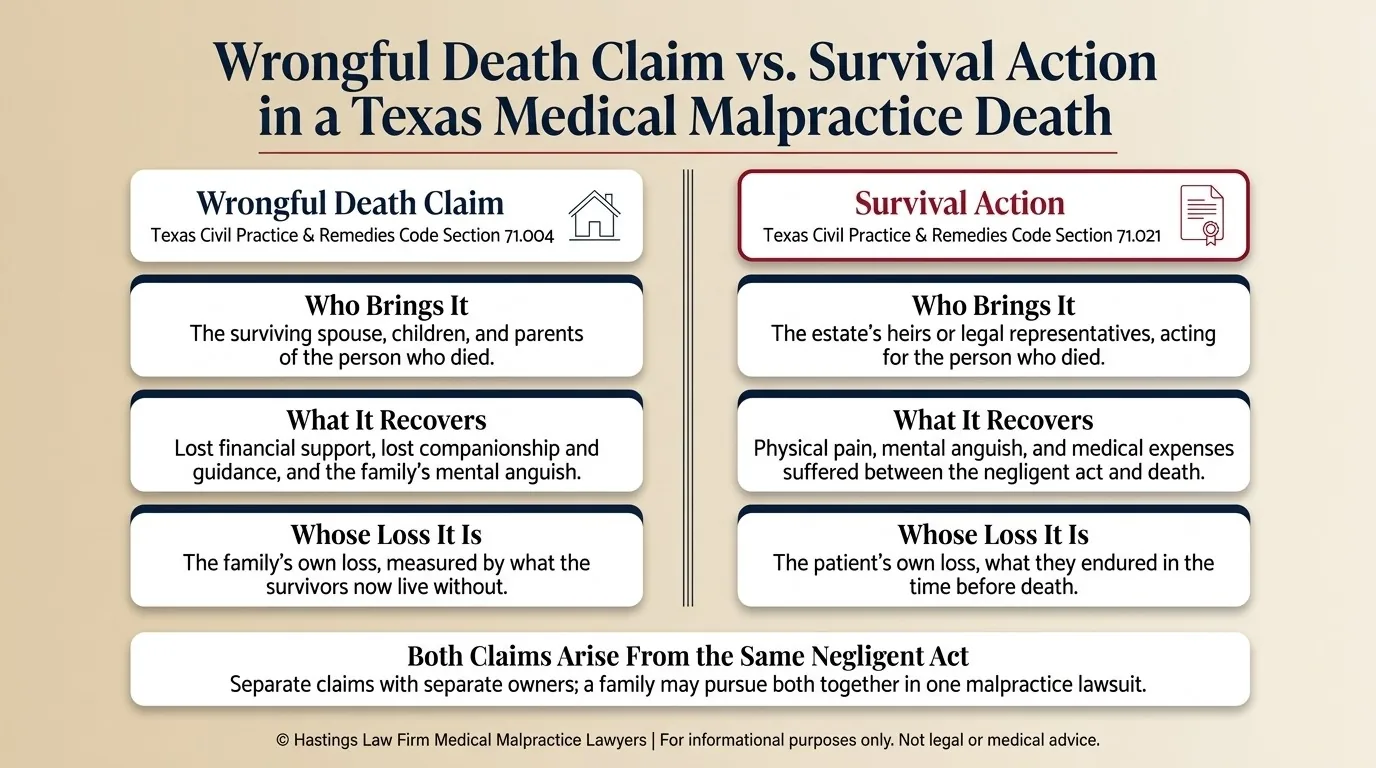
Filing both claims together, when the facts support it, is often what gives a family the fullest possible recovery. What they endured in their final days or weeks does not disappear from the law’s view just because they are no longer here to describe it.
Medical Errors That Lead to Wrongful Death Claims in Texas
Every wrongful death claim starts with a specific failure, a moment when a provider’s care fell below what was medically required and a life was lost as a result. These errors take many forms, and knowing which pattern matches what happened to your family member is often the first step toward understanding whether you have a claim.
- Surgical errors: wrong-site surgery, anesthesia failures, retained instruments, or post-operative complications that go unmonitored.
- Misdiagnosis and delayed diagnosis: a missed heart attack, stroke, sepsis, cancer, or pulmonary embolism, where timing can be the difference between recovery and death.
- Medication and anesthesia errors: the wrong drug, the wrong dose, a dangerous interaction, or an anesthesia overdose.
- Birth and maternal complications: oxygen deprivation during delivery, a failure to respond to fetal distress, or maternal hemorrhage and sepsis that goes unaddressed. These cases can lead to an infant wrongful death claim or a maternal wrongful death claim.
- Failure to treat or monitor: a provider recognizes a dangerous condition but does not act, or discharges a patient before it is safe to do so.
- Nursing home negligence: untreated infections, medication mismanagement, or a failure to prevent a fall that leads to a fatal injury. These situations can support a nursing home wrongful death claim.
Our firm has represented families across all these categories and have recovered numerous seven- and eight-figure verdicts and settlements.
Who Can File a Wrongful Death Lawsuit in Texas?
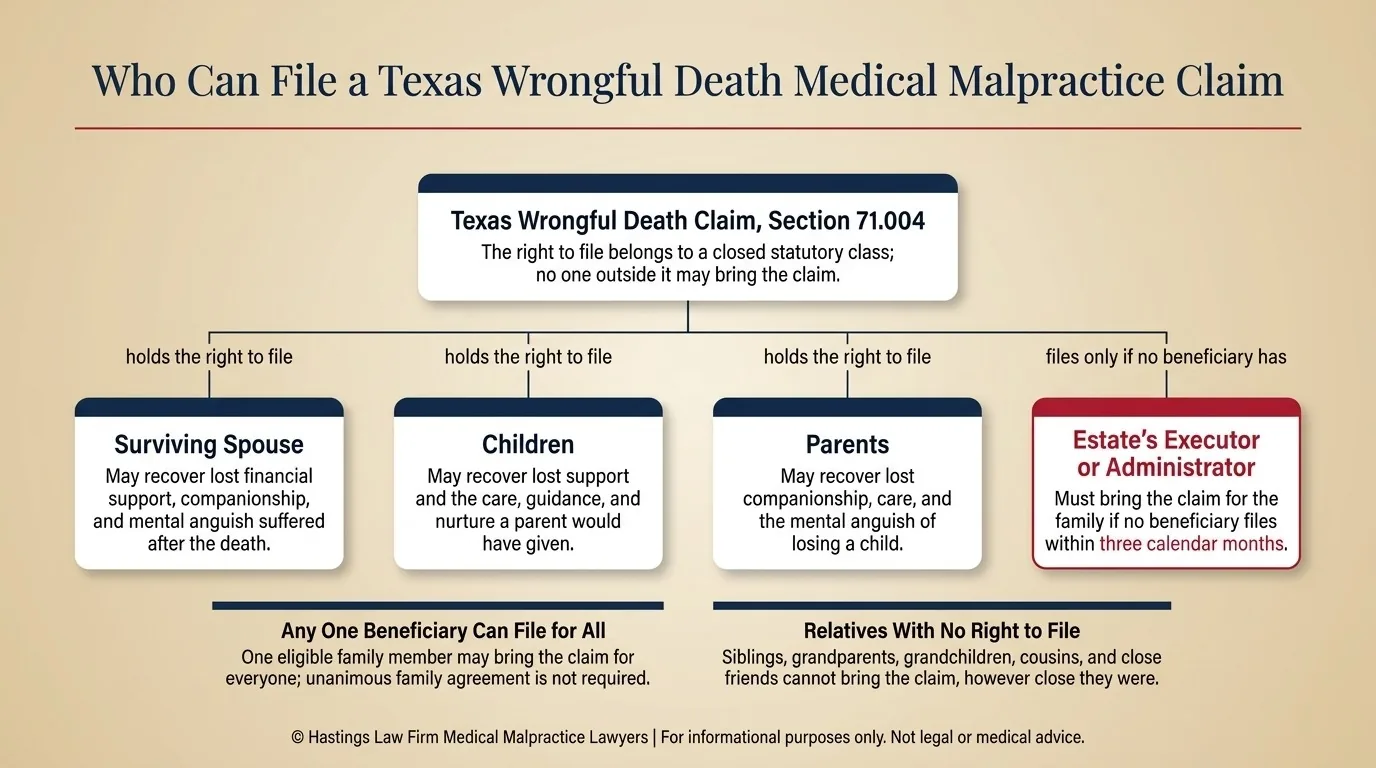
Texas law names exactly who may bring a wrongful death claim, and if you are not on that list, you cannot file, no matter how close you were to the person who died. Under §71.004(a), the right belongs exclusively to the surviving spouse, children, and parents of the person who died.
That list does not include siblings, grandparents, grandchildren, cousins, or close friends, regardless of how deeply they were involved in your family member’s life or care. We know that exclusion can feel like its own injustice on top of an already devastating loss, and we are not going to pretend otherwise.
Any one of the eligible beneficiaries can bring the claim on behalf of all of them, so the family does not need unanimous agreement to get started. There is, however, a real deadline built into this rule. If none of the eligible beneficiaries files within three calendar months of the death, §71.004(c) requires the estate’s executor or administrator to bring the claim on the family’s behalf instead. That window often passes while a family is still absorbing the loss, so acting sooner rather than later protects the family’s control over the claim.
The survival action works differently. Because it belongs to the estate rather than to specific family members, standing there is broader, and we cover it in full above.
What Damages Can a Family Recover in a Texas Wrongful Death Case?
A successful wrongful death case in Texas can include compensation for the family’s own losses, the estate’s losses, and in rare cases, additional damages for especially egregious conduct.
Wrongful death damages, for the family:
- Medical expenses the family paid related to the fatal injury or illness
- Funeral and burial costs
- Lost financial contributions your family member would have provided, including wages, benefits, and household services
- Loss of companionship, care, guidance, and nurture, for a child who lost a parent, a parent who lost a child, or a spouse who lost a partner
- Mental anguish suffered by the surviving family
Survival action damages, for the estate:
- Physical pain and suffering your family member endured between the negligent act and their death
- Mental anguish during that same period
- Medical expenses incurred before death
- Lost earnings from the time of the injury until death
Exemplary damages. In rare cases involving gross negligence, conduct that reflects conscious indifference to a patient’s safety, Texas law allows for additional exemplary damages, also called punitive damages, meant to punish especially reckless conduct rather than simply compensate for loss.
All of these damages, including exemplary damages, are subject to a separate cap under Texas law when the claim involves a death. We explain exactly how that cap works, and what it does not touch, in the next section.
The Texas Wrongful Death Cap Under Section 74.303
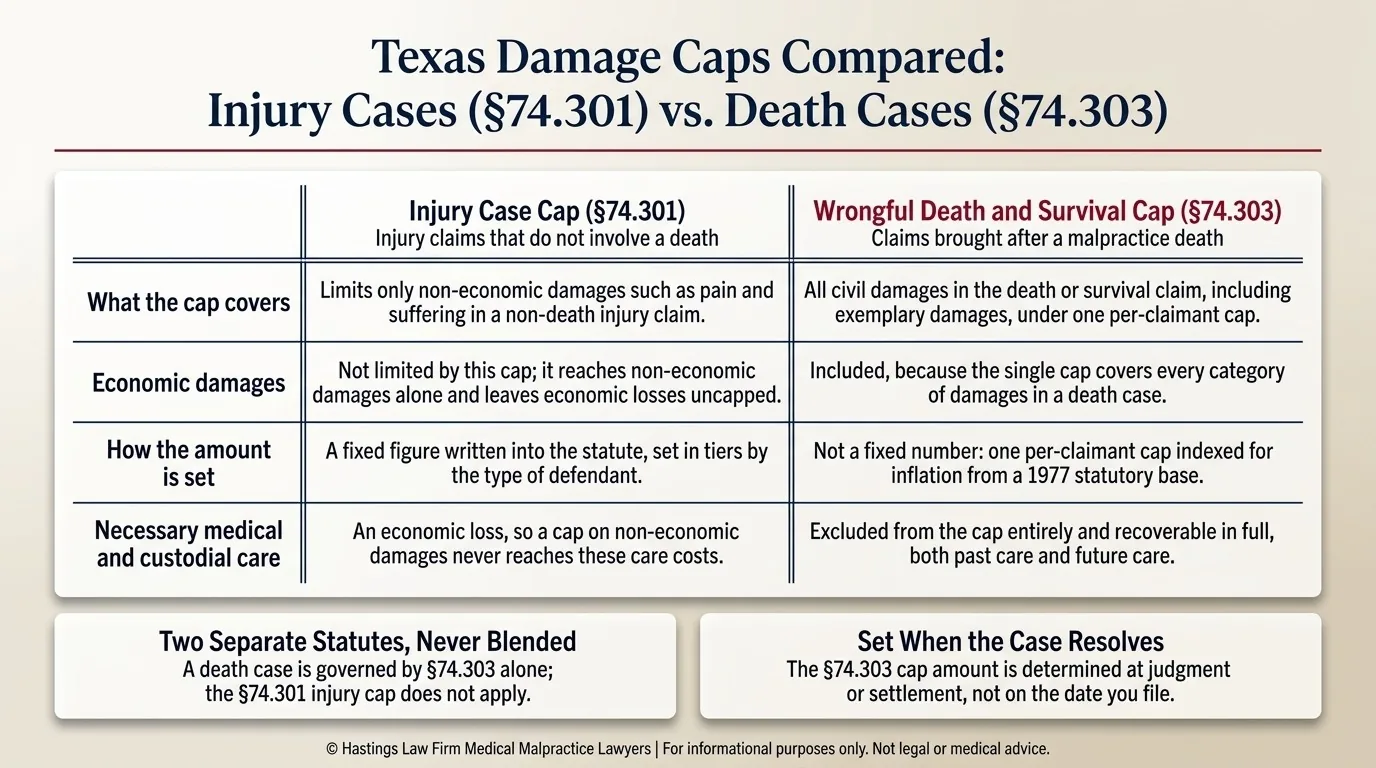
A wrongful death or survival claim from medical malpractice is not capped the same way an injury claim is. A separate statute, §74.303, governs death cases, and it covers all damages, not only non-economic ones.
Under §74.303(a), all civil damages in a wrongful death or survival case, including exemplary damages, fall under a single per-claimant cap. That cap is not a fixed number. Under §74.303(b), the statutory base amount is adjusted for inflation using the Consumer Price Index for Urban Wage Earners and Clerical Workers, running from 1977 to the date your case is resolved. Because the figure depends on the current index and is set only at the time of judgment or settlement, not when you file, we do not quote a single number here and calculate it directly instead.
What the cap does not touch matters just as much as what it limits. Under §74.303(c), the cost of necessary medical, hospital, and custodial care your family member received before judgment, or will need in the future, is excluded from the cap entirely and can be recovered in full, on top of the capped amount.
This is a different rule from the cap that applies to injury cases that do not involve a death. That cap, under §74.301, limits only non-economic damages like pain and suffering. §74.303 is broader because it applies to every category of damages in a death case. These are two separate statutes for two separate situations, and we never blend them.
Because the exact figure depends on when your case resolves, the clearest way to see where your family stands is to use our Texas Wrongful Death Cap Calculator, which runs the current CPI-adjusted number.
What Must a Family Prove to Win a Wrongful Death Case in Texas?
Winning a wrongful death case from medical malpractice requires proving four elements, and falling short on any one of them can end a claim no matter how strong the others are.
- Duty. A provider-patient relationship existed, so the provider owed your family member care that met the accepted medical standard.
- Breach. The provider’s conduct fell below what a competent professional in the same field would have done under the same circumstances.
- Causation. The breach is what actually caused the death, not merely a factor alongside it. This is usually the most contested part of any wrongful death case, and it is where a qualified medical expert becomes essential.
- Damages. The death caused real, compensable losses, whether to the surviving family or to the estate.
The expert report deadline. Under §74.351, the report must be served on each defendant within 120 days after that defendant files their original answer, not 120 days from when you file suit. If it is not served in time, Texas courts must dismiss the case with prejudice and can order the family to pay the provider’s attorney’s fees. One 30-day extension is available if the report needs to be corrected.
Because that deadline runs from each defendant’s answer rather than from your own filing date, it is not something a family can track on its own, which is one reason contacting an attorney early matters.
The Filing Deadline Runs From the Date of the Negligent Act
Most families assume they have two years from the date of death to file a claim. That assumption is often wrong, and it is one of the most important things to understand early. In Texas, the medical malpractice statute of limitations runs from the date of the negligent act, not from the date of death, and those two dates can be months or even years apart.
Under §74.251, the two-year clock begins at the negligent act or omission, or when the relevant course of treatment ends. If a provider made a fatal error well before your family member died, during a procedure, a missed diagnosis, or a course of treatment that went wrong, your filing deadline may fall earlier than two years from the date of your loss.
An illustrative example. If a patient is misdiagnosed in one month and their condition goes untreated until they die several months later, the two-year clock starts running from the date of the misdiagnosis, not from the date of death. A family who assumes they have two full years from their loss may have significantly less time to act than they realize.
Texas law also gives families one tool to extend that window. Before filing suit, you are required to send written pre-suit notice to each defendant at least 60 days in advance. Under §74.051(c), giving that notice tolls the limitations period by 75 additional days, so acting on this requirement early can meaningfully extend your deadline rather than shorten it.
No claim can be brought more than 10 years after the negligent act, under §74.251(b), an absolute outer limit called the statute of repose, regardless of any other extension. Texas also does not apply a general discovery rule in medical malpractice cases. The clock runs from the act itself, not from when your family learned that something had gone wrong. In narrow situations where an injury was genuinely undiscoverable in time, the open-courts provision of the Texas Constitution may offer relief, but this is not a routine extension, and it never reaches past the 10-year outer limit.
Because the exact start date of your deadline depends on facts specific to your case, the safest step is to speak with an attorney as soon as you can. Learn more about Texas medical malpractice deadlines in general, or see our full breakdown of Texas medical malpractice damage caps for how the §74.301 and §74.303 caps compare.
The Hastings Law Firm Difference
Results matter, but what truly sets us apart is how we achieve them. Every verdict, every settlement, and every courtroom victory comes from one guiding promise: To treat each client’s fight for justice as if it were our own.
This balance of skill, experience, and empathy reflects our core philosophy that justice should not only compensate the injured, but also make healthcare safer nationwide.

Steps to Take After a Medical Malpractice Death in Texas
If you believe your family member died because of a medical error, what you do in the weeks immediately after matters, both for your own understanding and for your family’s ability to bring a claim.
- Request and preserve the medical records. Ask the treating facility for the complete record from the relevant episode of care, and do this promptly. Some records become harder to obtain, or are amended, as time passes.
- Do not discard any documents or devices. Discharge instructions, prescription bottles, paperwork from the provider, and any related communications should be kept exactly as they are.
- Write down what you remember. Dates, names, conversations, and observations fade quickly. Documenting them now, even informally, preserves details that matter later.
- Ask about the death certificate and consider an autopsy. In some cases, the stated cause of death does not fully reflect what happened. An independent autopsy may be worth discussing with an attorney before that option is no longer available.
- Contact an attorney before the deadline. Because your filing deadline may be running from a date earlier than you realize, speaking with a lawyer promptly is the most protective step you can take. When you reach out to our firm, our in-house medical professionals, board-certified patient advocates, and former defense attorneys begin reviewing what the records show, at no cost to your family.
Talk to a Texas Wrongful Death Attorney About Your Case
Nothing we do can undo your loss. What we can do is help you understand exactly what happened, hold the responsible parties accountable, and help your family find its footing again. Medical malpractice is all we do, and we have stood beside grieving families since 2005.
If you believe medical negligence played a role in the death of someone you love, we can review the records and give you an honest answer about whether you have a claim, even when that answer is no. Reaching out costs you nothing and commits you to nothing. Case reviews are free and confidential, and if we take your case, you pay no attorney fees or costs unless we recover for you.

This content was researched and written by the Hastings Law Firm editorial team, which includes attorneys, medical professionals, and experienced researchers. Our writing is informed by internal knowledge and practical experience, and we cross-check critical details against authoritative sources cited throughout. Every piece undergoes human-led fact-checking and legal review. Because legal and medical information can change, if you spot an error, please contact us. Learn more about our content standards and review process on our editorial policy page.

Tommy Hastings, founder of Hastings Law Firm, is a board-certified personal injury trial lawyer dedicated exclusively to healthcare injury cases. Since 2001, he has represented injured patients and families in litigation against major hospital systems, pharmaceutical companies, and negligent healthcare providers nationwide. He has handled numerous high-profile cases that have drawn national media attention and resulted in multi-million dollar recoveries. He draws on that experience in his writing, helping readers understand how these cases work and what options may be available to them.
