


Texas Medical Malpractice Damage Caps Explained
Written by: Hastings Law Firm | Reviewed by: Tommy Hastings | Updated: July 17, 2026
Learning that Texas limits certain malpractice damages can be discouraging for a family already coping with a serious injury. Texas caps non-economic damages such as pain and suffering, generally at $250,000 against physicians and up to $500,000 against health care institutions, for a combined maximum of $750,000, while economic damages like medical bills and lost income are not capped. Different limits apply when malpractice causes a death. If you or a loved one were harmed or worse due to medical malpractice in Texas, contact Hastings Law Firm for a free, confidential case review.

What You Should Know About Medical Negligence Damage Caps in Texas:
- Texas law does not cap all damages. Only noneconomic damages, like pain and suffering, are capped. Medical bills and lost income are not.
- Noneconomic damages are capped at $250,000 against physicians and other providers, and up to $500,000 against institutions, for a combined maximum of $750,000.
- A jury is never told about the caps. If a jury awards more than the law allows, the judge reduces the award after the verdict.
- When medical negligence causes a death, Section 74.303 caps all damages, including punitive damages, using a figure that rises with inflation.
- Necessary future medical and custodial care stays outside the wrongful death cap, even though nearly everything else in that case is capped.
- Punitive damages are rare and require clear and convincing evidence of gross negligence, not just an error in judgment.
- Because economic damages are uncapped, the evidence behind medical bills, lost income, and future care often decides the real size of a recovery.
What Are Medical Malpractice Damage Caps in Texas?
Texas medical malpractice damage caps are limits the law places on certain categories of compensation a jury can award, regardless of what the evidence shows. They do not touch every dollar a patient or family can recover. They apply to one category only, noneconomic damages, the human losses like pain and suffering that a jury translates into a dollar figure rather than a receipt.
Every dollar in a Texas malpractice case falls into one of two buckets, economic or noneconomic damages, and that split is the single most important idea on this page. Economic damages carry no ceiling under Texas law. Noneconomic damages, the pain, mental anguish, and similar harm that never shows up on an invoice, are the ones limited by statute.
These limits go back to 2003, when the Texas Legislature passed House Bill 4 as part of a larger package of medical liability reform, and voters approved Proposition 12, a constitutional amendment shielding the caps from legal challenge. Lawmakers argued the caps would stabilize malpractice insurance costs and keep physicians practicing in the state. Whatever view you take of that reasoning, the caps have applied to Texas claims since September 1, 2003.
Economic Damages vs. Noneconomic Damages in Texas
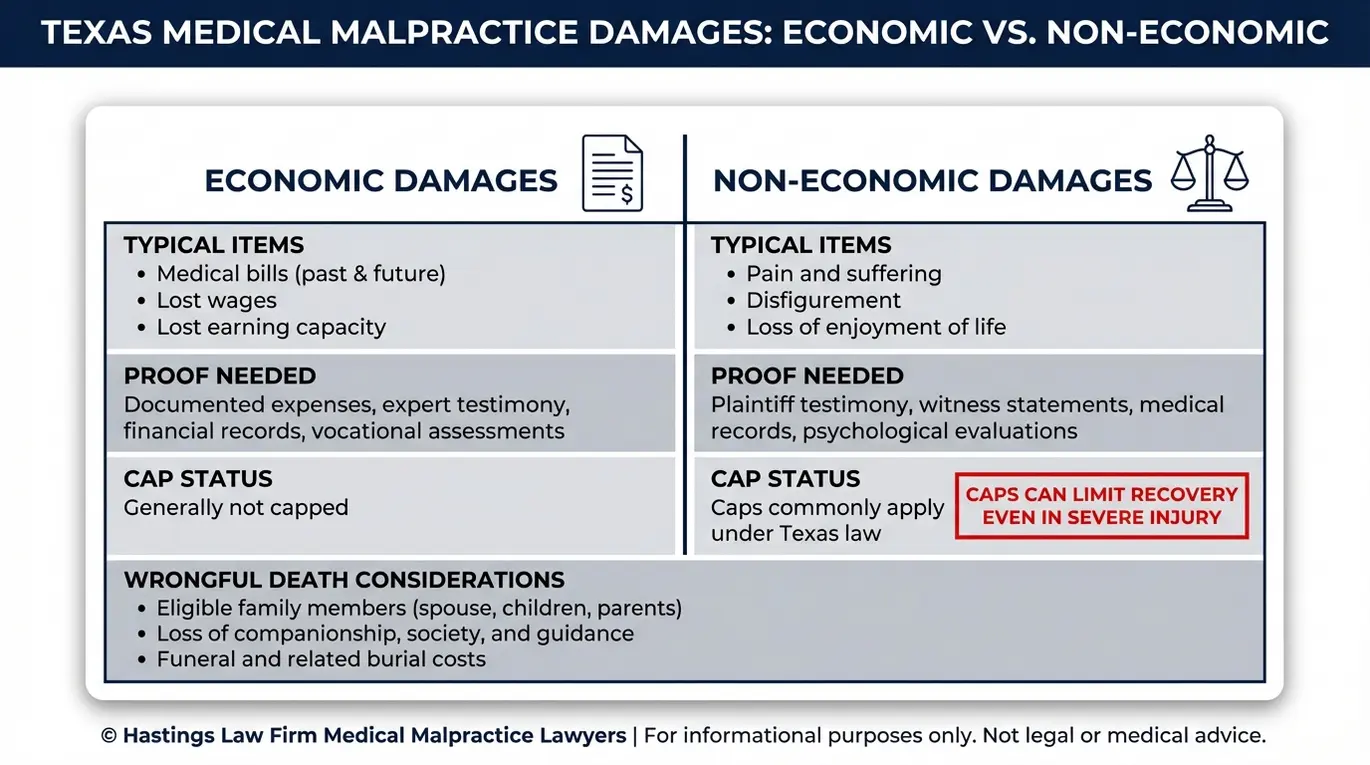
Understanding your own case starts with knowing which category a loss falls into, because Texas treats economic and noneconomic damages very differently. Economic damages are the losses you can put a number on, and Texas law does not limit what a jury can award for them.
Noneconomic damages are harder to price because they are not tied to an invoice. A jury decides what they are worth in a given case, and they are the losses the Texas cap actually limits.
Economic damages include:
- Past and future medical expenses
- Lost wages and lost earning capacity
- Rehabilitation costs and in-home or long-term care
- Home and vehicle modifications made necessary by the injury
Noneconomic damages include:
- Physical pain and suffering
- Mental anguish
- Physical impairment
- Disfigurement
- Loss of consortium (a spouse’s claim for lost companionship and support)
This distinction is why we build every serious case around detailed evidence of future costs and lost earning capacity. It is the uncapped category, and in cases involving significant future medical needs, it is often where the largest part of a recovery lives.
What is the Noneconomic Damages Cap in Texas Medical Malpractice Cases?
The noneconomic damages cap in a Texas medical malpractice case depends on who you are suing. Section 74.301 of the Texas Civil Practice and Remedies Code sets the limit in tiers, one tier for physicians and other non-institutional providers, and a separate tier for health care institutions, and it applies per claimant, not per defendant. If your case names three physician defendants, you still face a single $250,000 ceiling against all three combined, not $250,000 for each one.
| Defendant Type | Noneconomic Cap Per Claimant | Notes |
|---|---|---|
| Physician or other health care provider (non-institution) | $250,000 | One limit regardless of the number of physician defendants |
| Single health care institution | $250,000 | Per claimant |
| Multiple health care institutions | $500,000 combined | All institutions together, $250,000 per institution |
| Maximum noneconomic exposure | $750,000 | Physician tier plus institutional tier combined |
| Economic damages | No cap | Medical bills, lost income, and future care costs |
Texas law does not let the jury in on any of this. Jurors decide what a case is worth without being told the caps exist, and a finding of negligence cannot rest on a bad outcome alone. If a jury’s award for noneconomic damages exceeds what the law allows, the judge reduces it after the verdict, outside the jury’s view.
One detail rarely gets mentioned. The $250,000 figure has not been adjusted for inflation since it took effect in 2003, so its real value has eroded substantially even though the number on paper has not moved.
What Do Noneconomic Damages Cover in Texas?
Noneconomic damages cover the categories of harm that never show up on a bill or a pay stub, but Texas law still recognizes them as real, compensable injuries.
- Pain and suffering. The physical pain caused by the injury and by the treatment needed to address it.
- Mental anguish. The anxiety, depression, and emotional toll that often follows a serious medical injury.
- Physical impairment. A reduced ability to do the everyday things you could do before the injury.
- Disfigurement. A lasting change to your appearance caused by the negligence.
- Loss of consortium. A spouse’s claim for the loss of companionship and support the injury caused, governed by its own separate set of rules.
The cap does not mean these losses have no value. It means the maximum a jury’s award in this category can pay out is limited, and reaching anywhere near that maximum still requires a jury to see the full weight of what was lost. How this part of a case gets built and presented matters as much as the facts themselves.
How is the Wrongful Death Cap Different Under Texas Law?
When a patient dies because of medical negligence, the cap that applies to your case changes entirely. Section 74.303 governs wrongful death and survival claims arising from medical malpractice, and its limit covers all damages in the case, including exemplary damages, not just noneconomic losses, a meaningful difference from Section 74.301, where economic damages are excluded from the cap entirely. The one exception is the cost of necessary medical, hospital, and custodial care the patient received before judgment or will need in the future, which stays outside the cap even in a wrongful death case.
The dollar figure works differently too. Rather than a flat statutory number, Section 74.303 uses a base amount set in 1977 that rises over time with the Consumer Price Index for All Urban Wage Earners and Clerical Workers, the federal inflation measure the Bureau of Labor Statistics publishes. The adjusted figure is calculated as of the date damages are awarded, a judgment or a settlement, not fixed today, so the limit that applies to a given case is not known until then. Because that number depends on the judgment date and the current index, we do not quote a single figure here. As with the noneconomic cap, the jury is never told about the limit either.
For the actual math on your situation, our Texas medical malpractice wrongful death cap calculator walks through the current indexed figure. If your family lost someone to medical negligence, our wrongful death medical malpractice Texas guide covers the full claim.
Can You Recover Punitive Damages in a Texas Medical Malpractice Case?
Punitive damages are rarely available in a Texas medical malpractice case, and the law sets a genuinely high bar. Texas Civil Practice and Remedies Code Section 41.003 requires clear and convincing evidence of fraud, malice, or gross negligence, meaning proof of a conscious indifference to the rights, welfare, or safety of others, not a lapse in judgment or a missed diagnosis. Most malpractice claims, including many strong ones, do not meet that bar, and we tell clients that honestly rather than promise otherwise.
How punitive damages interact with the caps depends on whether the case involves a death. In a wrongful death case, any punitive damages awarded fall inside the Section 74.303 cap, not on top of it. In a case that does not involve a death, punitive damages are evaluated separately under Chapter 41 rather than the Section 74.301 noneconomic cap, though the same demanding evidentiary standard still applies.
The Hastings Law Firm Difference
Results matter, but what truly sets us apart is how we achieve them. Every verdict, every settlement, and every courtroom victory comes from one guiding promise: To treat each client’s fight for justice as if it were our own.
This balance of skill, experience, and empathy reflects our core philosophy that justice should not only compensate the injured, but also make healthcare safer nationwide.

Why Uncapped Economic Damages Matter Most in Serious Cases
The caps apply to pain and suffering. They do not apply to your medical bills, your lost wages, or the cost of care you will need for the rest of your life. In cases involving a serious, lasting injury, that uncapped category is usually where the real value of a case lives, often dwarfing the $750,000 noneconomic ceiling.
Building that side of a case well takes real work. Life care planners project decades of future medical costs, and vocational economists calculate what an injury costs a person in lost earning capacity over a career. Our in-house medical professionals, board-certified patient advocates, and former defense attorneys work through the medical record early, so the economic damages picture is built on solid ground from the start.
We have seen what a well-documented economic damages case can produce. In a case involving contaminated over-the-counter medication that injured and killed children, Mr. Hastings secured settlements totaling $17,385,000 and helped convict the company’s CEO. In a case involving a veteran who fatally overdosed on medication from an illegal pain clinic, a jury awarded $10,000,000, including punitive damages, driven largely by future care and lost earning capacity the medication error evidence supported. Individual results vary and past results do not guarantee a similar outcome, but both verdicts show the scale uncapped economic damages can reach. Read more on our case results page.
The caps shape settlement negotiations differently than a verdict, worth understanding before you decide how to move forward.
How Do Damage Caps Affect Your Recovery?
The caps work differently depending on whether your case settles or goes to trial. At trial, the noneconomic cap functions as a hard ceiling. The jury awards a number without being told about the cap, and the judge reduces any excess after the verdict.
In a settlement, the caps are not applied mechanically. Defense counsel weighs them alongside the uncapped economic exposure a case could produce at trial, and that risk often moves the number more than the noneconomic ceiling does.
In a wrongful death case, the Section 74.303 cap applies to all damages including exemplary damages, which gives the defense a ceiling even on punitive exposure, though necessary medical and custodial care stays outside the cap regardless of how the case resolves. These caps have survived legal challenge in Texas since Proposition 12 passed in 2003, and short of a new constitutional amendment, they are unlikely to change.
None of this matters if you miss the deadline to file, which Texas measures independently of the caps discussed here. See our Texas medical malpractice statute of limitations guide for how that clock works.
Talk to a Board-Certified Texas Medical Malpractice Lawyer About Your Case
If you have been told Texas caps what you can recover and are not sure what that means for your situation, the honest answer is usually more encouraging than the headline suggests. The cap applies to one category of damages. It does not touch your medical bills, your lost income, or the cost of care you will need going forward, and in a serious case, that uncapped side often carries most of the value.
Tommy Hastings is Board Certified in Personal Injury Trial Law by the Texas Board of Legal Specialization, a distinction held by less than 2% of Texas attorneys, and our firm has represented patients and families harmed by medical negligence since 2005. A Texas medical malpractice lawyer can help you understand what your case may be worth. A free, confidential case review, sometimes called a consultation, costs nothing and commits you to nothing, and if we take your case, you pay no fees or costs unless we recover for you.

This content was researched and written by the Hastings Law Firm editorial team, which includes attorneys, medical professionals, and experienced researchers. Our writing is informed by internal knowledge and practical experience, and we cross-check critical details against authoritative sources cited throughout. Every piece undergoes human-led fact-checking and legal review. Because legal and medical information can change, if you spot an error, please contact us. Learn more about our content standards and review process on our editorial policy page.

Tommy Hastings, founder of Hastings Law Firm, is a board-certified personal injury trial lawyer dedicated exclusively to healthcare injury cases. Since 2001, he has represented injured patients and families in litigation against major hospital systems, pharmaceutical companies, and negligent healthcare providers nationwide. He has handled numerous high-profile cases that have drawn national media attention and resulted in multi-million dollar recoveries. He draws on that experience in his writing, helping readers understand how these cases work and what options may be available to them.
