


The Woodlands Medical Malpractice Lawyer
Written by: Hastings Law Firm | Reviewed by: Brady D. Williams | Updated: August 27, 2026
Medical malpractice claims can arise when a healthcare provider fails to meet the accepted standard of care and a patient is injured. In Texas, these cases often turn on proving duty, breach, causation, and damages, with disputes frequently focused on whether an error actually changed the outcome. Documentation, communication, and medication safety issues can be central, and liability may involve both individual clinicians and hospitals depending on employment and control. If you or a loved one were harmed or worse due to medical malpractice in The Woodlands, Texas, contact Hastings Law Firm for a free, confidential case review.

Top Rated Medical Malpractice Lawyers Serving The Woodlands Community
What You Should Know About Healthcare Negligence Claims in The Woodlands:
- Options can be lost if Texas medical malpractice procedural requirements are not met, even when the underlying care appears negligent.
- Recovery can depend on proving causation, since disputes often focus on whether the outcome would have been the same without the alleged error.
- Accountability can be limited or expanded based on whether a clinician was a hospital employee or an independent contractor.
- Compensation for non economic harms can be restricted by Texas caps, even when the injury is severe.
- Economic losses can remain recoverable without a cap when they are documented as medical expenses or lost income.
- Case viability can end if required expert support is not provided in the required form and timeframe.
- Severe harm can result from diagnostic errors when delays allow a treatable condition to become life threatening.
- Permanent disability or death can result from surgical and anesthesia errors, especially when multiple providers share responsibility.
- Proof can hinge on what the electronic health record shows, since gaps or inconsistencies may indicate substandard charting or communication.
- Patient safety can be compromised by medication reconciliation failures, which can lead to dangerous drug interactions or dosing errors.

A Healthcare Focused Law Firm
When a medical professional you trusted causes harm instead of healing, the weight of that experience can feel impossible to carry alone. You may have questions about what went wrong, whether anyone will believe you, and what options you have going forward. These feelings are valid, and you deserve honest answers.
Hastings Law Firm is a plaintiff trial firm that handles nothing but medical malpractice cases. Our team of attorneys, in-house nurses, and board-certified patient advocates works exclusively with patients and families affected by medical negligence. As a dedicated The Woodlands medical malpractice lawyer team headquartered right here in the community, we understand the local healthcare landscape and the courts where these cases are heard.
If you believe you or a loved one was harmed by a medical error, we offer a free, confidential case evaluation. We can review what happened and explain your options with no obligation and no upfront cost.
Understanding Medical Malpractice Laws in The Woodlands and Texas
Medical malpractice occurs when a healthcare provider deviates from the accepted standard of care and causes injury to a patient through negligence or omission. Texas law treats cases involving medical negligence differently from other personal injury cases, and understanding the framework is the first step toward protecting your rights.
At the center of every medical malpractice claim is the standard of care, the level of treatment that a reasonably competent medical professional in the same specialty would have provided under similar circumstances. This standard is not a single fixed rule. It varies depending on the patient’s condition, the provider’s specialty, and the clinical setting. When a doctor, nurse, or other healthcare provider fails to meet this standard, that failure is called a breach of duty, and it forms the legal foundation of a negligence claim.
Texas medical malpractice claims are governed by the Texas Civil Practice and Remedies Code, Chapter 74, also known as the Texas Medical Liability Act. This law imposes specific procedural requirements that do not apply to other types of injury claims. Among these is the requirement that patients provide written notice to the healthcare provider at least 60 days before filing suit, and that a qualified expert report be served within 120 days of each defendant’s original answer being filed.
Managing these local procedural hurdles requires an experienced attorney in The Woodlands who understands the specific tendencies of Montgomery County judges. A The Woodlands medical malpractice lawyer who handles these cases exclusively, rather than as a sideline, is better equipped to manage those realities and avoid procedural pitfalls that can delay or invalidate a valid claim.
Another critical concept is informed consent, the process in which your doctor explains the risks and alternatives of a procedure before you agree to move forward. If a provider failed to disclose known risks and you were harmed, that failure may also support a malpractice claim.
Here is a quick reference for the core requirements of a valid medical malpractice claim in Texas:
- A doctor-patient or provider-patient relationship existed
- The provider breached the accepted standard of care
- The breach directly caused the patient’s injury
- The patient suffered measurable damages as a result
- The claim was filed within the applicable statute of limitations
- A qualified expert report was timely served under Chapter 74
Proving the Four Elements of Negligence in Texas Courts
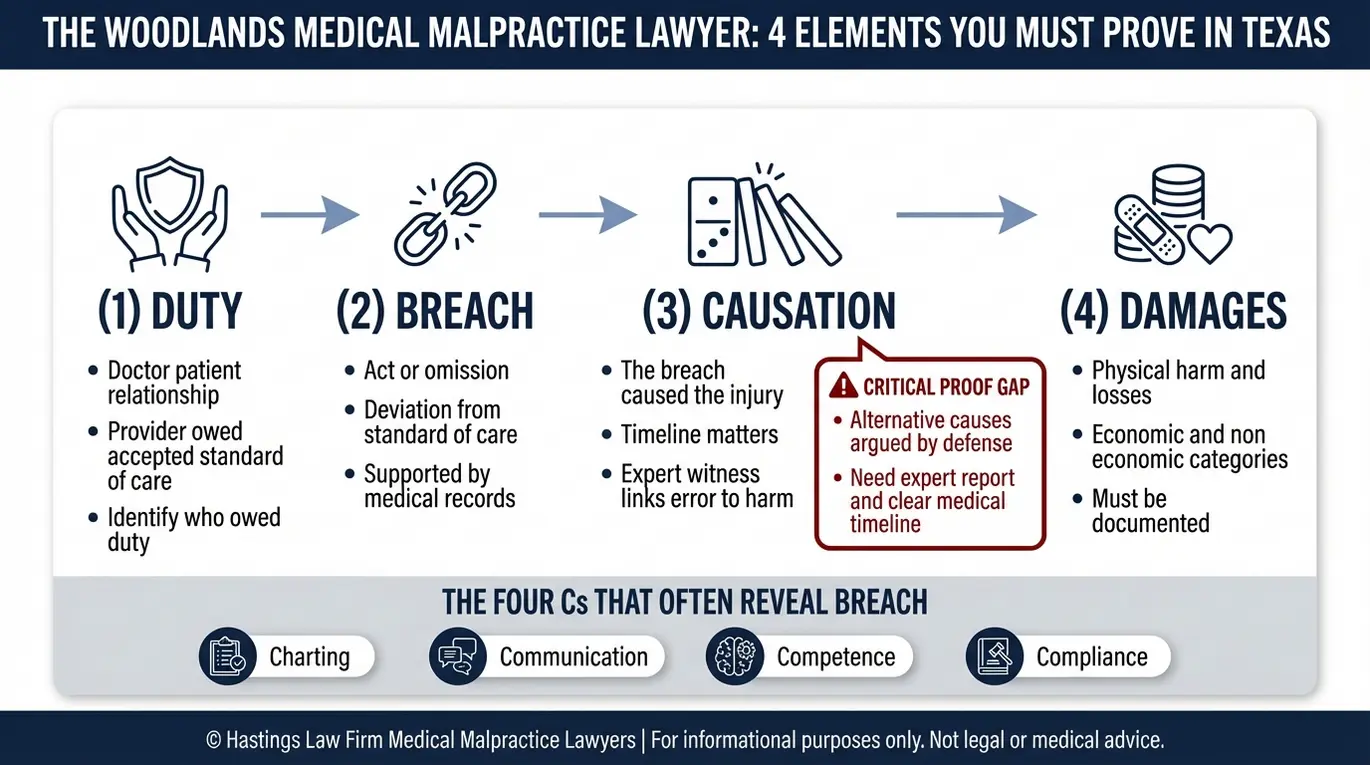
To win a malpractice case in Texas, a plaintiff must prove four elements: the existence of a duty, a breach of duty, causation linking the breach to the injury, and resulting damages. In Texas, these components are required to prove that a medical error occurred and caused specific harm. Missing any one of these elements can result in dismissal, which is why each must be supported with medical evidence and qualified expert witness testimony.
Duty of care is typically the simplest element to establish. It arises the moment a doctor-patient relationship begins. Once a healthcare provider agrees to treat you, they owe you a professional obligation to deliver care consistent with accepted medical standards.
The dispute usually starts at the element of Breach. This element requires showing that the provider’s actions, or failure to act, fell below what a competent professional in the same field would have done. For example, a missed differential diagnosis, the systematic process of ruling out conditions based on symptoms and test results, can be the basis of a breach claim. According to the Agency for Healthcare Research and Quality (AHRQ) Patient Safety Network, diagnostic errors remain one of the most common and harmful categories of medical mistakes.
Causation is often the most contested element. It is not enough to show that the provider made an error. You must also show that the error directly caused or materially contributed to your injury. Defense attorneys frequently argue that the patient’s outcome would have been the same regardless of the alleged breach. Overcoming this argument requires detailed medical records analysis and expert testimony that traces a clear line from the error to the harm.
Damages are the measurable consequences of the injury, including medical costs, lost income, physical pain, and emotional suffering. Adverse drug event (ADE), harm caused by the use of a medication including wrong dosages or dangerous drug interactions, is one example of an injury that can produce both immediate and long-term damages.
Medical malpractice lawyers in The Woodlands rely on all four of these elements to build a case capable of withstanding aggressive defense challenges. An experienced The Woodlands medical malpractice attorney can help manage these complex elements to build a persuasive claim.
The Critical Role of Charting and Communication
Poor documentation is one of the most telling indicators of substandard care. In medical malpractice litigation, what was recorded in the medical records, and what was left out, often tells the story of what went wrong.
The legal and medical communities sometimes refer to the “Four C’s of Malpractice”: Charting, Communication, Competence, and Compliance. Breakdowns in any of these areas can support a claim, but charting and communication failures are especially common.
Electronic health record (EHR), the digital system where providers document patient assessments, orders, vitals, and treatment plans, is critical evidence. Gaps, late entries, or charting inconsistencies in the EHR can suggest that proper protocols were not followed. Similarly, medication reconciliation, the process of verifying a patient’s complete medication list at each transition of care, is a frequent point of failure. When this step is skipped or done incorrectly, dangerous drug interactions or dosing errors can result.
Our team includes former defense attorneys and experienced nurses who previously worked in hospital settings. They know how charting should look, and they know how to identify when it does not match the clinical picture. As a The Woodlands medical malpractice lawyer team, we use this insider perspective to reconstruct timelines and pinpoint where communication broke down.
The Hastings Law Firm Difference
Results matter, but what truly sets us apart is how we achieve them. Every verdict, every settlement, and every The Woodlands courtroom victory comes from one guiding promise: To treat each client’s fight for justice as if it were our own.
This balance of skill, experience, and empathy reflects our core philosophy that justice should not only compensate the injured, but also make healthcare safer nationwide.

Common Medical Errors Committed in Montgomery County Facilities
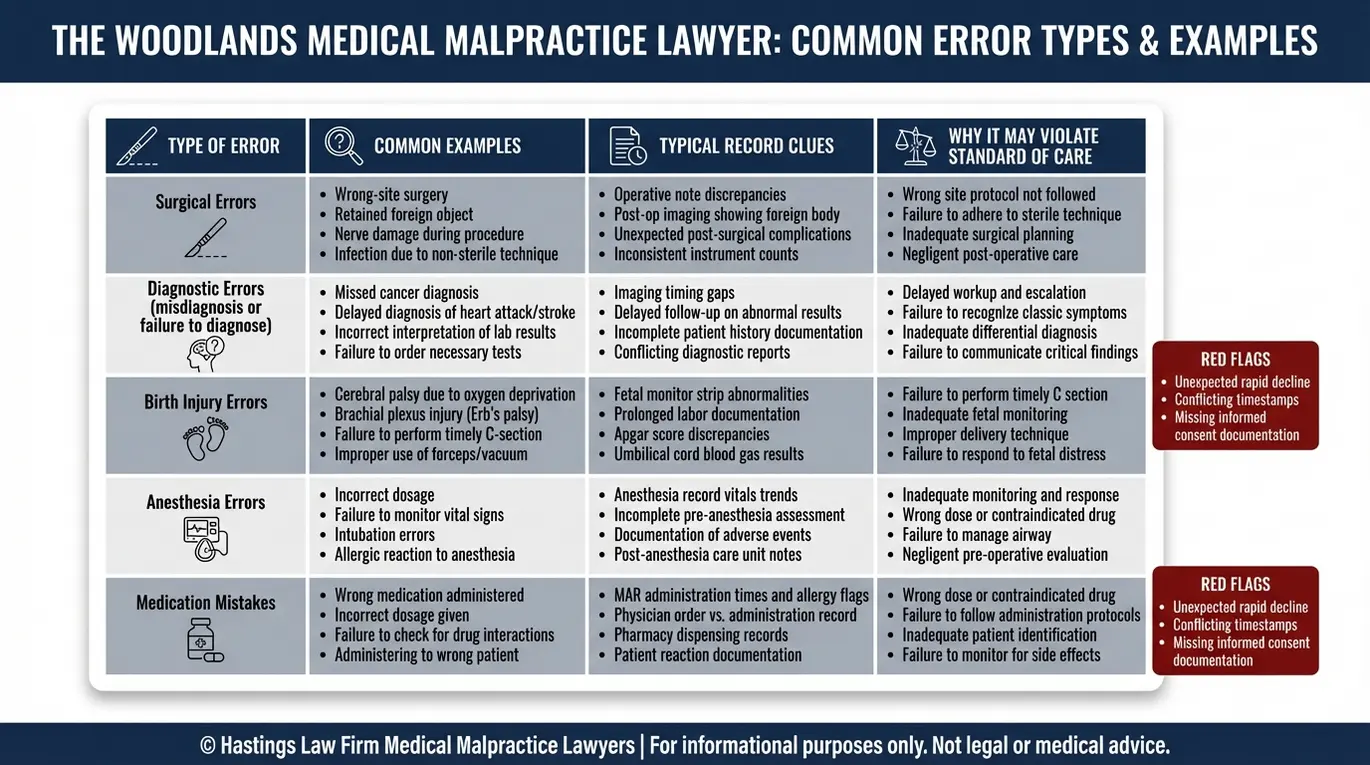
Frequent medical errors seen in malpractice cases include surgical mistakes, misdiagnosis of critical conditions, birth injuries caused by negligence, and medication administration errors. These are not rare events. They occur in hospitals, surgical centers, and clinics throughout Montgomery County and the greater Houston area. If you suspect negligence, consulting a medical malpractice lawyer in The Woodlands is essential to preserving evidence.
The Texas Department of State Health Services publishes definitions and guidance on Reportable Preventable Adverse Events, providing a framework for identifying the types of errors that should never occur in a properly functioning healthcare environment.
Below is a breakdown of the most common categories we encounter:
| Type of Error | Common Examples |
|---|---|
| Surgical Errors | Wrong-site surgery, instruments or sponges left inside the body, known as a retained surgical item (RSI), nerve damage, anesthesia errors |
| Diagnostic Errors | Missed or delayed cancer diagnosis, failure to diagnose stroke or heart attack, misinterpretation of lab results or imaging |
| Birth Injuries | Cerebral palsy from oxygen deprivation, brachial plexus injuries, delayed or failure to perform emergency C-section |
| Medication Mistakes | Wrong drug or dosage administered, failure to account for allergies, IV pump programming errors |
| Anesthesia Errors | Overdose, failure to monitor airway, unrecognized intubation complications |
A diagnostic error, a mistake taking the form of a misdiagnosis or a complete failure to diagnose, is among the most dangerous types of medical mistakes. Conditions like cancer, pulmonary embolism, and heart attack have significantly better outcomes when caught early. Delayed diagnosis can allow a treatable condition to become life-threatening, often depriving the patient of a cure that would have been possible with timely intervention.
Surgical errors, including anesthesia errors, can result in permanent disability or death. These cases often involve multiple providers and complex chains of responsibility. Retained surgical items are particularly egregious because they are considered “never events,” which are errors that should essentially never happen if standard safety protocols are followed.
Birth injury cases carry a particular emotional weight. When a child suffers preventable harm during labor or delivery, the consequences may last a lifetime. Our medical malpractice lawyers serving The Woodlands community investigate these cases by examining fetal monitoring strips, nursing logs, and delivery records to determine whether the standard of care was met. Families dealing with the aftermath of a birth injury face immense uncertainty, and securing financial support for the child’s future care is often the primary motivation for seeking legal counsel.
Distinguishing Between Hospital Liability and Physician Negligence
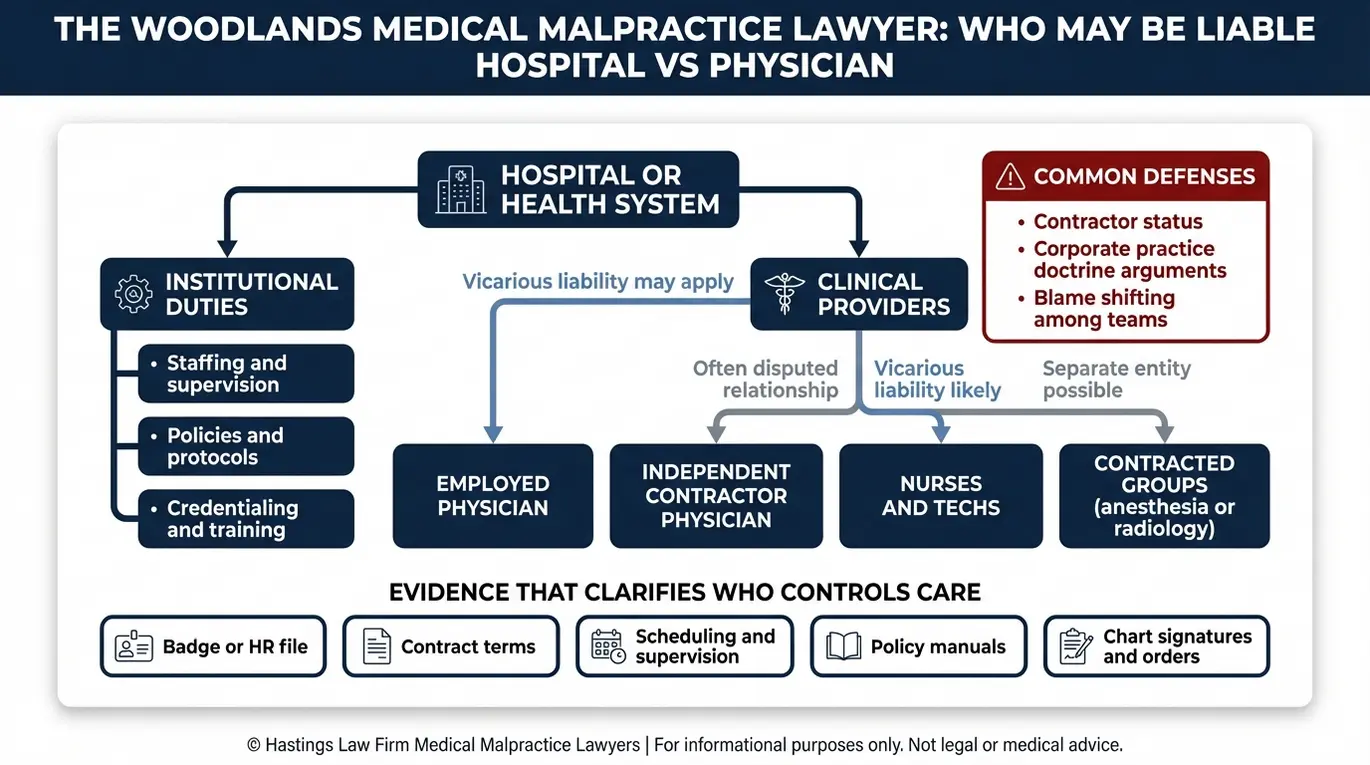
Hospitals can be held liable for institutional failures like inadequate staffing or unsafe protocols, while physicians are typically responsible for their own independent clinical errors, unless they are directly employed by the facility. Understanding this distinction is critical because it determines who you can hold accountable and how the case is structured.
In many hospitals, doctors are not employees. They are independent contractors who have been granted privileges to practice at the facility. Under a legal principle called vicarious liability, a hospital is generally responsible for the actions of its employees, such as nurses, technicians, and staff physicians. But when an independent healthcare provider operates as a contractor, the hospital may argue it is not responsible.
Texas adds another layer of complexity through the Corporate Practice of Medicine Doctrine. While this doctrine generally prohibits corporations from practicing medicine or directly employing physicians, Texas law provides notable exceptions that allow hospitals and certain other entities to employ physicians. Despite these exceptions, many Texas hospitals still structure some physician relationships as independent contracts. Defense attorneys use this structure to shield hospitals from liability for physician errors.
The Texas Supreme Court addressed employment status and control-based liability analysis in Painter v. Amerimex Drilling I, Ltd., a case that clarified how courts evaluate vicarious liability once an employer-employee relationship is established. While not a medical case, the legal framework applies to malpractice liability disputes.
There are important exceptions to hospital protections:
- Negligent credentialing and privileging, the hospital’s process for verifying a physician’s qualifications and granting them the right to practice at the facility. If a hospital grants privileges to an unqualified or impaired physician, the hospital itself can be liable.
- Institutional failures such as dangerously low nurse-to-patient ratios, the number of patients assigned to a single nurse, broken equipment, or failure to implement safety protocols.
- Apparent agency, where the hospital held out a doctor as part of its team and the patient had no reason to know otherwise.
Major facilities in the area, including Houston Methodist The Woodlands and Memorial Hermann, employ thousands of clinical staff while also contracting with independent physician groups. A medical malpractice lawyer in The Woodlands must investigate each provider’s employment status and contractual relationship to identify every responsible party. A qualified attorney in The Woodlands can help disentangle these corporate relationships.
At Hastings Law Firm, our attorneys include former defense counsel who previously represented hospitals. That background gives us direct insight into the strategies defense teams use to deflect institutional responsibility.
Utilizing Expert Witnesses to Establish the Standard of Care
Texas law requires that a qualified expert report be served within 120 days of each defendant’s original answer being filed in a medical malpractice lawsuit. In medical malpractice cases, these professionals explain what a doctor should have done differently to avoid an injury. These experts provide the medical bridge between clinical errors and legal liability, ensuring that a claim is based on objective standards. Under Chapter 74 of the Texas Civil Practice and Remedies Code, failure to serve a compliant expert report within that window can result in dismissal of the case and an order to pay the defendant’s attorney fees.
The expert report must identify the applicable standard of care, explain how the defendant breached that standard, and describe how the breach caused the patient’s injury. The expert must review the complete set of medical records to form a valid opinion.
The expert who writes the report must practice in the same medical specialty as the defendant, or have sufficient training and knowledge in the relevant area of medicine. For instance, if the negligence involves a cardiologist, the plaintiff typically needs a cardiologist to author the report. Courts scrutinize these qualifications closely, and defense attorneys routinely challenge expert reports as insufficient or filed by unqualified professionals.
Choosing a The Woodlands medical malpractice lawyer with an established expert network is important for this reason. Hastings Law Firm maintains relationships with top-tier medical experts across the country who provide objective case reviews and credible trial testimony. When the defense challenges an expert’s qualifications, our team is prepared to respond with professionals whose credentials and clinical experience withstand judicial scrutiny.
The litigation process in Texas medical malpractice cases depends heavily on the strength and timing of this expert opinion. A medical malpractice lawyer in The Woodlands who does not have an expert lined up early in the case is already behind. Our approach is to secure expert involvement during the investigation phase, well before suit is filed, so that the report is ready when the clock starts.
Calculating Economic and Non-Economic Damages in Your Case
Damages in medical malpractice cases cover both economic losses, like medical bills and lost wages, and non-economic harms such as pain and suffering, which are subject to statutory caps in Texas.
Economic damages represent the financial losses you can document. These are not capped under Texas law and may include:
- Past and future medical expenses, including surgeries, rehabilitation, medications, and long-term care
- Lost wages and reduced future earning capacity
- The cost of assistive devices, home modifications, or in-home nursing
- Out-of-pocket expenses related to the injury
Non-economic damages compensate for losses that cannot be easily measured in dollars, including physical pain, emotional distress, disfigurement, and loss of consortium (the impact on your relationship with a spouse). Texas caps non-economic damages at $250,000 per claimant against all physicians or individual providers combined and $250,000 per healthcare institution, with a total aggregate cap of $750,000 in cases involving both providers and multiple institutions. This means that regardless of the severity of the injury or the depth of the suffering, the amount a jury can award for these intangible losses is strictly limited by statute.
In wrongful death cases, surviving family members may pursue both economic and non-economic claims. These cases involve additional categories of loss, including funeral costs, loss of financial support, and loss of companionship and guidance.
A The Woodlands medical malpractice lawyer should be calculating the full scope of damages from the start of the case. At Hastings Law Firm, we work with medical professionals, life care planners, and economists to project future costs accurately. This preparation strengthens settlement negotiation and ensures we present a complete picture if the case goes to trial. Consulting with a knowledgeable medical malpractice attorney in The Woodlands is essential to maximize your potential recovery within these legal bounds.
Our firm handles every case on a contingency fee basis, which means you pay no attorney fees unless we recover compensation on your behalf.
Steps to Filing a Medical Malpractice Lawsuit in The Woodlands
The filing process begins with an initial case evaluation, followed by gathering medical records, obtaining an expert opinion, and filing a petition before the statute of limitations expires. Each step has specific legal requirements that must be handled correctly to keep the case viability.
- Free, Confidential Case Evaluation. The process begins with a screening led by one of our patient advocates. During this evaluation, we review the facts of your situation to determine whether the case meets the legal threshold for medical negligence. We work on a contingency fee basis, so there is no cost to you for this review.
- Investigation and Medical Records Review. Once we accept your case, our in-house medical team conducts a thorough review of your records, including EHRs, imaging, lab results, and provider notes. Under federal law, you have the right to access your own health information, as outlined by the U.S. Department of Health and Human Services’ guidance on individuals’ rights under HIPAA. We handle the difficult task of gathering these medical records and coordinating the analysis.
- Pre-Suit Notice and Expert Report. Before filing suit, Texas law requires that we send written notice to each healthcare provider at least 60 days in advance. After filing, the Chapter 74 expert report must be served within 120 days of each defendant’s original answer. Our national expert network allows us to secure qualified opinions early in the process.
- Litigation, Discovery, and Resolution. Once the lawsuit is filed, the case moves into discovery. During the litigation process, both sides exchange evidence, take depositions, and build their arguments. Because we prepare every case as though it will go to a jury trial, we approach settlement negotiation from a position of strength. This trial-ready approach signals to defense counsel and insurers that we will not accept less than fair value.
Working with a The Woodlands medical malpractice lawyer who follows this process from day one helps protect your claim against procedural challenges and positions your case for the best possible outcome.
Contact the The Woodlands Healthcare Malpractice Attorneys at Hastings Law Firm Today for Help
If you or someone in your family was harmed by a healthcare provider or facility in The Woodlands or anywhere in the greater Houston metro, we can help you understand what happened and whether negligence played a role. We offer a free, risk-free case evaluation where we listen to your story, review the medical facts, and give you honest answers about whether you have a case. You pay nothing unless we recover compensation on your behalf. If we move forward together, you pay no attorney fees or costs unless we recover compensation on your behalf. Call or use the contact form on this page to schedule your free case review.
Frequently Asked Questions About Medical Malpractice in The Woodlands


This content was researched and written by the Hastings Law Firm editorial team, which includes attorneys, medical professionals, and experienced researchers. Our writing is informed by internal knowledge and practical experience, and we cross-check critical details against authoritative sources cited throughout. Every piece undergoes human-led fact-checking and legal review. Because legal and medical information can change, if you spot an error, please contact us. Learn more about our content standards and review process on our editorial policy page.

Brady D. Williams is a nationally recognized medical malpractice attorney who has spent his career handling high-stakes litigation for injured patients and families across the country. Licensed in both Texas and California, Brady draws on experience from hundreds of resolved medical cases to break down complex legal and medical topics for the people who need that information most. His writing reflects the same attention to detail and commitment to clarity that he brings to every case he handles.
