


What Qualifies as Medical Malpractice in Texas?
Something went wrong during medical care, and now a patient or family is left trying to understand whether it was simply a hard outcome or something that should not have happened. The difference matters, because accepted risks and preventable mistakes can look alike from the outside. Recovery, new expenses, and changes to work and family life can make that question feel urgent. Knowing what qualifies as medical malpractice in Texas gives a family a clear way to tell an unavoidable outcome from a preventable one.
Last Updated: October 22, 2026
What You Should Know About What Qualifies as Medical Malpractice in Texas:
- Texas law treats a medical malpractice claim as a health care liability claim under Chapter 74 of the Texas Civil Practice and Remedies Code.
- A claim requires care that departed from accepted standards and proximately caused injury or death.
- The law covers many providers beyond doctors, including nurses, dentists, pharmacists, and hospitals, with nursing homes expressly included among covered institutions.
- Not every injury in a medical setting is a health care liability claim. A safety claim needs a substantive connection to the provision of healthcare.
- Recognized patient-safety problems include diagnostic, surgical, medication, and infection-related events.
- Medical malpractice is negligence and does not require intent to harm. Gross negligence is a more serious form that requires clear and convincing evidence.
- A bad outcome or known complication alone does not prove malpractice. The question is whether the care met the standard and caused the harm.
- Inadequate disclosure of risks that could affect a reasonable person’s decision can support a negligence claim, subject to Texas disclosure rules and causation.
- The filing deadline is generally two years from the negligent act or the treatment or hospitalization at issue, not from discovery.
What is Considered Medical Malpractice Under Texas Law?
Medical malpractice in Texas is a health care liability claim, defined in Texas Civil Practice and Remedies Code §74.001(a)(13) as a claim against a physician or health care provider involving treatment, lack of treatment, or other departure from accepted standards of medical care, health care, safety, or professional or administrative services directly related to health care. The claim exists only when that departure proximately caused injury or death.
For a patient, what qualifies as medical malpractice in Texas comes down to a covered provider, care that fell short, and harm the shortfall actually caused. The Texas Supreme Court, in Windrum v. Kareh, describes the standard of care as what an ordinarily prudent doctor in the relevant field would or would not have done under the circumstances. For example, a doctor might skip a test others in the field would ordinarily order while the patient’s condition worsens.
What constitutes medical malpractice in court is proven through the four elements Windrum names: duty, breach, proximate cause, and damages. When malpractice causes a death, the resulting wrongful death and survival claims have their own rules.
Who Counts as a Healthcare Provider in a Texas Malpractice Claim?
A health care provider under Texas Civil Practice and Remedies Code §74.001 includes registered nurses, dentists, pharmacists, podiatrists, chiropractors, optometrists, and health care institutions, plus specified employees and agents within statutory limits, and Chapter 74 covers physicians under a separate definition. Covered institutions expressly include public and private hospitals, nursing homes, hospices, and ambulatory surgical centers.
Claims involving doctors, nurses, pharmacists, and nursing homes can qualify. A hospital can answer for its own conduct, its employees and agents, and a non-employed doctor through proven actual or ostensible agency.
Not every injury at a hospital is a malpractice claim. Under Ross v. St. Luke’s Episcopal Hospital, the safety standard must have a substantive connection to the provision of healthcare, and otherwise a hospital injury may involve an ordinary premises claim. A government hospital claim must meet the Texas Tort Claims Act, since Chapter 74 does not waive immunity.
What Types of Medical Malpractice Claims Arise in Texas?
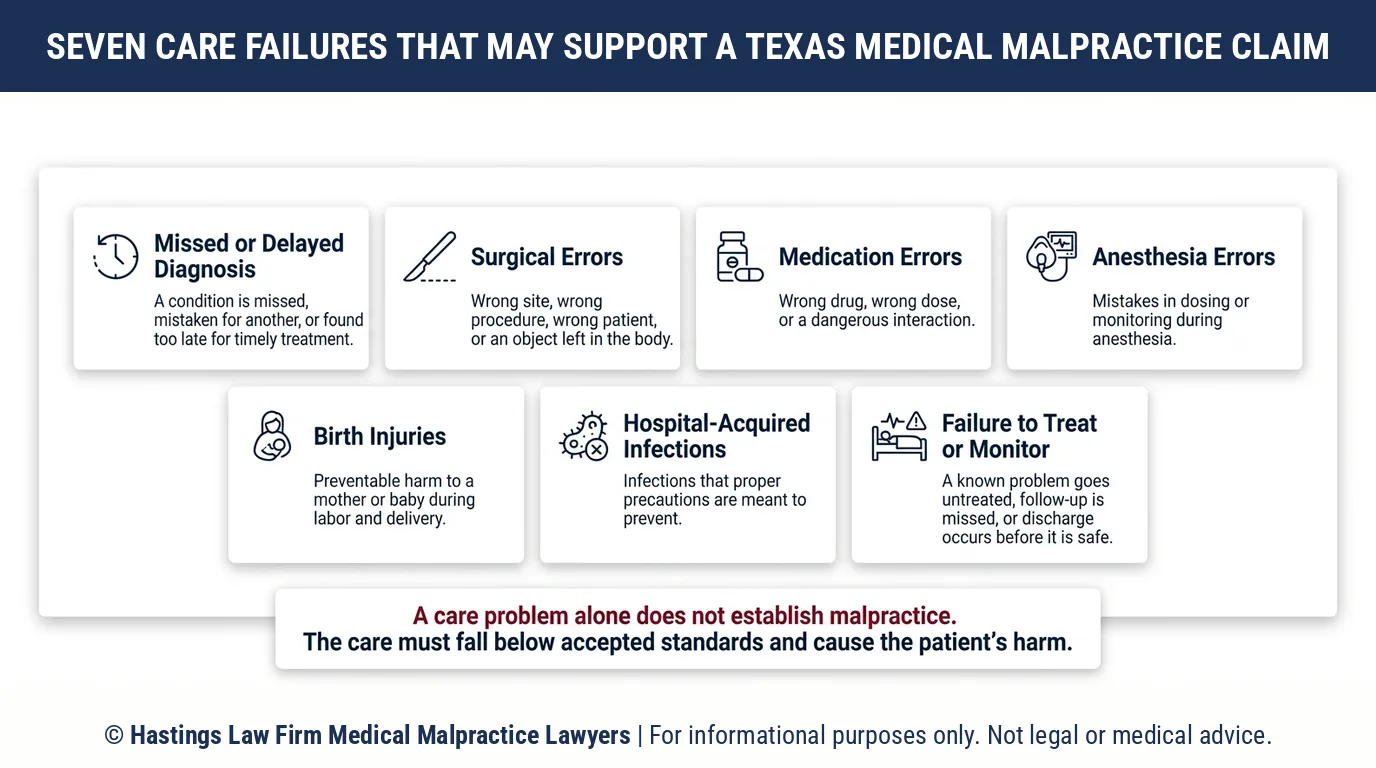
The types of medical malpractice claims in Texas include diagnostic, surgical, medication, and infection-related events, which AHRQ Patient Safety 101, a primer from the federal Agency for Healthcare Research and Quality, identifies as recognized patient-safety problems. Each type becomes a malpractice claim only when the care fell below the accepted standard and that failure caused the patient’s harm.
What is classified as medical malpractice still depends on the standard of care, and claims can involve:
- Misdiagnosis or delayed diagnosis: a condition is missed, mistaken for another, or found too late for timely treatment.
- Surgical errors: including wrong-site surgery, which AHRQ addresses with wrong-procedure and wrong-patient errors, and objects left in the body.
- Medication errors: the wrong drug, the wrong dose, or a dangerous interaction, from a prescriber, a pharmacy, or hospital staff.
- Anesthesia errors: mistakes in dosing or monitoring a patient under anesthesia.
- Birth injuries: preventable harm to a mother or baby during labor and delivery.
- Hospital-acquired infections: infections that proper precautions are meant to prevent.
- Failure to treat, monitor, or follow up: a known problem goes untreated, or a patient is discharged before it is safe.
Emergency care is judged differently. Under §74.153, qualifying emergency care in a hospital emergency department, or in an obstetrical unit or surgical suite right after emergency evaluation, must be shown by a preponderance of the evidence to involve willful and wanton negligence, a higher bar for emergency room claims.
What is the Difference Between Medical Negligence and Malpractice in Texas?
Medical malpractice in Texas is negligence by a healthcare provider in the course of care, and proving it does not require showing any intent to harm. Texas Civil Practice and Remedies Code §74.001 frames the claim as a departure from accepted standards of care, and the elements a patient proves are duty, breach, proximate cause, and damages.
Neither term is the lesser claim, and the more serious form is gross negligence. Under §41.001, gross negligence involves an extreme risk the provider actually knew about and treated with conscious indifference, and requires clear and convincing evidence, a higher level of proof, before exemplary damages are possible.
Is a Bad Outcome or Known Complication Always a Malpractice Case in Texas?
A bad outcome or known complication alone does not prove medical malpractice in Texas. Texas Civil Practice and Remedies Code §74.303(e)(2) requires jurors to be instructed that a bad result alone cannot establish negligence, though they may weigh it with other evidence. A malpractice claim needs care below the accepted standard that more likely than not caused the harm.
Medicine carries risk, and some complications happen even with careful treatment. The question is whether the care met what an ordinarily prudent provider would do under the circumstances, and whether the failure was a substantial factor in causing the harm. Answering whether you have a medical malpractice case starts with the medical records and a qualified expert, whose early report Texas ordinarily requires within 120 days after each defendant’s original answer, subject to written extensions and statutory alternatives.
Can a Lack of Informed Consent Count as Medical Malpractice in Texas?
A lack of informed consent can count as medical malpractice in Texas when a provider negligently failed to disclose risks or hazards that could have influenced a reasonable person deciding whether to agree to the care. Texas Civil Practice and Remedies Code §74.101 sets that standard, and the nondisclosure must have caused legally compensable harm.
The Texas Medical Disclosure Panel sets lists of risks to disclose, and under §§74.102 to 74.106, following or departing from those lists creates a rebuttable presumption, one that evidence can overcome, with exceptions for emergencies and medical infeasibility. Not being told about a known risk can support an informed consent claim in Texas.
The Hastings Law Firm Difference
Results matter, but what truly sets us apart is how we achieve them. Every verdict, every settlement, and every courtroom victory comes from one guiding promise: To treat each client’s fight for justice as if it were our own.
This balance of skill, experience, and empathy reflects our core philosophy that justice should not only compensate the injured, but also make health care safer nationwide.

What Should You Do If You Suspect Medical Negligence in Texas?
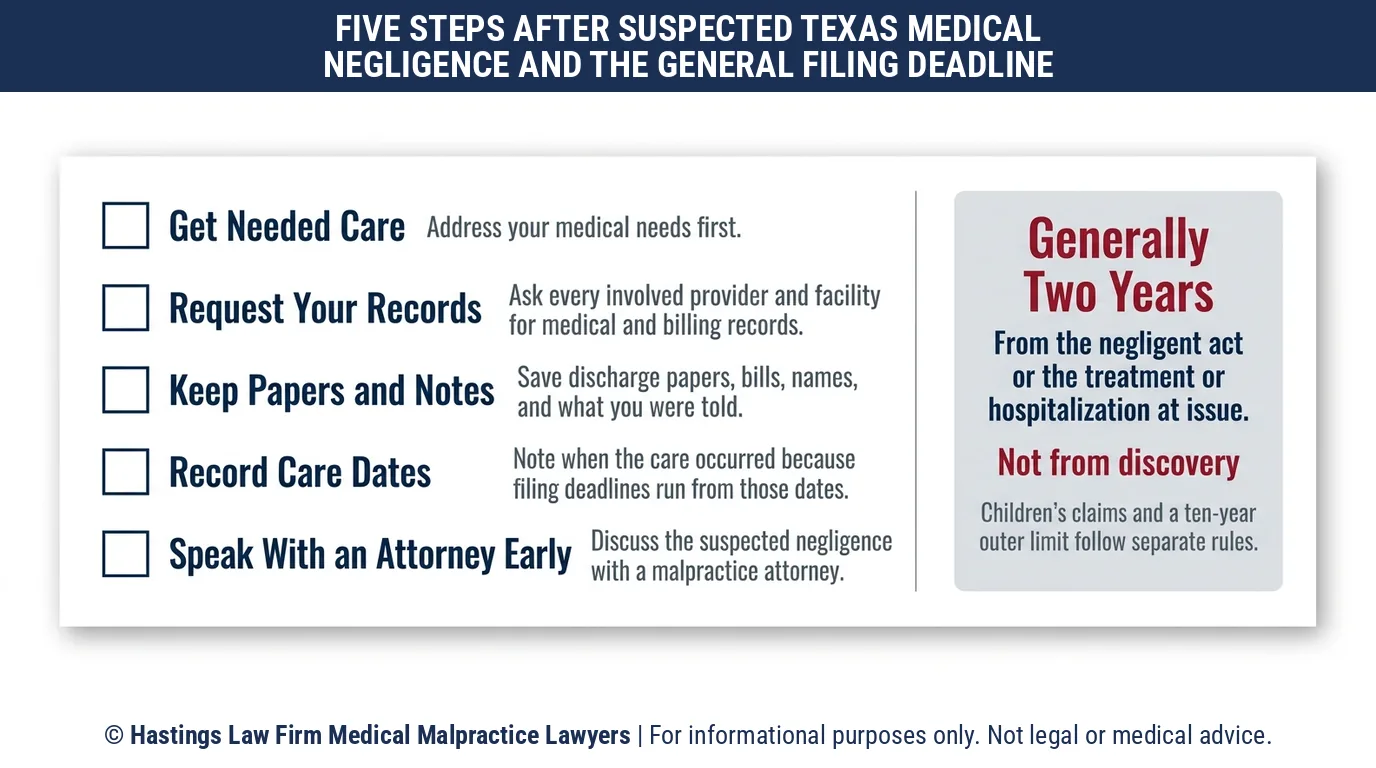
If you suspect medical negligence in Texas, get the care you need, then request your medical and billing records from each provider and facility involved. HIPAA rules and, for physicians, Texas Occupations Code §§159.005 to 159.006 give patients access to those records, with limited exceptions.
- Keep discharge papers, bills, and notes of dates, names, and what you were told.
- Note the dates of the care, since the filing deadline runs from them.
- Speak with a malpractice attorney early.
The Texas filing deadline is generally two years from the negligent act or the treatment or hospitalization at issue, not from discovery. Children’s claims and a ten-year outer limit follow separate rules.
Talk to a Texas Medical Malpractice Lawyer About Whether You Have a Case
If you are trying to understand whether what happened to you or someone you love qualifies as medical malpractice, we perform a free, confidential case review. We listen to what you experienced, review the medical records, and give an honest answer about whether there is a claim.
Our medical malpractice lawyers are experienced in handling medical malpractice claims for patients and families across Texas. We understand that a preventable injury can bring additional recovery time, new medical costs, and changes to work and family life. Hastings Law Firm has been dedicated exclusively to medical malpractice since 2005, and we work on a no-win, no-fee basis, so if we do not win the case, you pay nothing. Contact us now for a free, confidential case review.
Sources
- Texas Civil Practice and Remedies Code Chapter 74, defining a health care liability claim | Texas Legislature
- Chapter 74 provisions on covered providers, the bad-result instruction, and informed consent | Texas Legislature
- Texas Supreme Court opinion stating the standard of care and malpractice elements | Supreme Court of Texas
- Texas Supreme Court opinion on when a hospital safety claim involves healthcare | Supreme Court of Texas
- Federal overview of recognized patient-safety problems, including diagnostic and medication errors | Agency for Healthcare Research and Quality
- Federal primer on wrong-site, wrong-procedure, and wrong-patient surgery | Agency for Healthcare Research and Quality
- Texas Civil Practice and Remedies Code §41.001, defining gross negligence | Texas Legislature
- Federal guidance on a patient’s HIPAA right to access medical records | U.S. Department of Health and Human Services
- Texas Occupations Code §§159.005 to 159.006 on physicians furnishing patient records | Texas Legislature

This content was researched and written by the Hastings Law Firm editorial team, which includes attorneys, medical professionals, and experienced researchers. Our writing is informed by internal knowledge and practical experience, and we cross-check critical details against authoritative sources cited throughout. Every piece undergoes human-led fact-checking and legal review. Because legal and medical information can change, if you spot an error, please contact us. Learn more about our content standards and review process on our editorial policy page.

Tommy Hastings, founder of Hastings Law Firm, is a board-certified personal injury trial lawyer (by the Texas Board of Legal Specialization) dedicated exclusively to healthcare injury cases. Since 2001, he has represented injured patients and families in litigation against major hospital systems, pharmaceutical companies, and negligent healthcare providers nationwide. He has handled numerous high-profile cases that have drawn national media attention and resulted in multi-million dollar recoveries.
