


Can You Sue a Texas Hospital for Medical Malpractice?
A hospital stay is supposed to make things better, and when it ends in new harm, patients and families are left with more treatment, lost time, and questions about who was responsible. A hospital is staffed by many people, some employed by it and some not, and that can make it hard to know where accountability lies. The answer often depends on details that only the records reveal. Understanding when a hospital in Texas can be held responsible for medical negligence gives a family a clear starting point for finding out what happened.
Last Updated: October 30, 2026
What You Should Know About Suing a Hospital in Texas:
- A Texas hospital can be sued for medical malpractice when its own conduct, its employees or agents, or a doctor it held out as its own caused the injury.
- A hospital can be liable for the negligence of its nurses, other employees, and agents acting within the scope of their employment or agency. A badge or job title does not settle employment.
- A hospital does not ordinarily answer for a non-employed doctor unless actual or ostensible agency is proven, and ostensible agency requires a reasonable belief the hospital created and justifiable reliance on it.
- A hospital can be directly liable for its own failures, such as staffing, training, equipment, and policies. Credentialing claims require malice to overcome peer-review protection.
- Qualifying emergency care requires proof of willful and wanton negligence under §74.153, still by a preponderance of the evidence.
- Every provider whose care contributed to the harm can be named, and each must receive pre-suit notice and an expert report, ordinarily within 120 days after its original answer.
- §74.301 ordinarily limits non-economic damages to $250,000 combined for physicians and other non-institutional providers, with separate limits for each liable hospital, and does not cap economic damages.
- A claim against a government hospital must also meet the Texas Tort Claims Act, which allows such claims only narrowly and sets its own notice deadline and limits.
- The filing deadline is generally two years from the date of the negligent act, and qualifying pre-suit notice can pause it for 75 days.
When Can You Sue a Hospital for Negligence in Texas?
You can sue a hospital for medical malpractice in Texas when the hospital’s own conduct, its employees or agents, or a doctor it held out as its own caused the injury. Under Texas Civil Practice and Remedies Code Chapter 74, hospitals are health care providers, so whether a hospital is responsible depends on who made the mistake and how that person relates to the hospital.
Who employed the person who made a mistake is not always clear from a hospital bed, and the medical records help answer that question. A claim can follow three routes: the hospital’s employees, a doctor the hospital is responsible for, and the hospital’s own failures, such as staffing or equipment. Every route requires proof that the care fell below the accepted standard and more likely than not caused the harm, whatever form the medical negligence took.
Medicine carries risk, and a bad outcome is not always negligence. When an injury was preventable, the providers responsible should be held accountable.
A hospital owned by a government body is a different claim. It must meet Chapter 74 and also the Texas Tort Claims Act, which allows such claims only narrowly and sets its own notice deadline and limits.
Is a Texas Hospital Liable When Its Nurses or Staff Make an Error?
A Texas hospital can be held liable for the negligence of its nurses, other employees, and agents acting within the scope of their employment or agency, a doctrine courts call respondeat superior. The Texas Supreme Court’s opinion in Renaissance Medical Foundation v. Lugo states the rule, and the actual relationship and the hospital’s right to control the work both matter.
Nurses are among the staff a family sees through the day, and their notes are part of the medical record. Nurses and other staff can be hospital employees, but a badge or job title does not settle that. Federal hospital rules recognize employee, contract, and lease arrangements for nursing staff, so the actual relationship is something a claim investigates.
Staff failures that can lead to a claim include:
- Changes in vital signs or a worsening condition that were missed or never reported to the doctor
- A doctor’s orders that were not followed
- Medication given wrongly
- Fall and pressure injury precautions that were not taken
Our page on Texas nurse malpractice explains these claims. Doctors raise a different question. Texas restricts the corporate practice of medicine, with statutory exceptions, so a doctor working at a hospital may or may not be its employee.
Can You Sue a Texas Hospital for a Doctor’s Mistake?
You can sue a Texas hospital for a doctor’s mistake when the doctor acted as the hospital’s employee or agent, or when the hospital held a non-employed doctor out as its own. Under the Texas Supreme Court’s opinion in Baptist Memorial Hospital System v. Sampson, that second route requires proof of ostensible agency, which depends on what the patient reasonably believed and why.
Some Texas hospitals and health organizations do employ physicians under the statutory exceptions to that restriction, which include qualifying nonprofit health organizations and authorized hospital arrangements. Employment alone does not settle liability. Under Lugo, the question is whether the employer had the right to control the conduct at issue without interfering with the doctor’s independent medical judgment.
Other physicians practice at a hospital through their own groups, which can include emergency physicians, anesthesiologists, radiologists, and hospitalists. A hospital does not ordinarily answer for a non-employed doctor’s negligence unless actual agency or ostensible agency is proven, and a separate bill does not by itself settle a doctor’s status.
Ostensible agency means the hospital made a doctor appear to be its own. Under Sampson, the patient must have reasonably believed the doctor was the hospital’s agent, because the hospital held the doctor out that way or allowed it, and must have justifiably relied on that belief. Posted signs or a signed consent form naming the doctors as independent contractors bear on that belief, but such a notice is not immunity from every claim. The hospital’s own negligence is a separate question, and at a private hospital the doctor can also be sued directly, as our page on Texas doctor malpractice explains.
When is a Texas Hospital Responsible for Its Own Negligence?
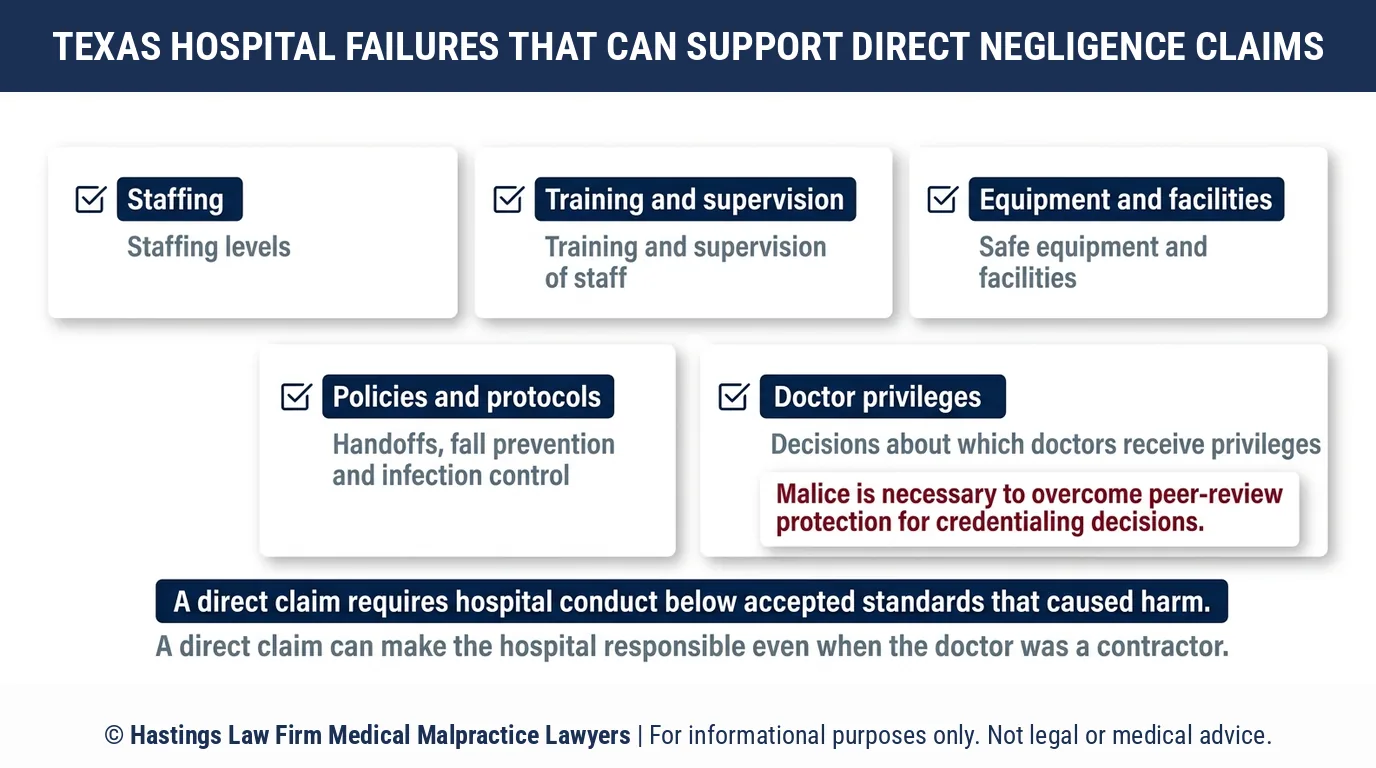
A Texas hospital is responsible for its own negligence when its own conduct, apart from any one employee’s error, fell below accepted standards and caused harm. Texas Civil Practice and Remedies Code §74.001 defines a health care liability claim to include departures from accepted standards of healthcare, safety, or professional or administrative services directly related to healthcare.
These failures sit in hospital records and policies, not a single chart entry, so investigation is what finds them. Claims over a hospital’s own conduct can involve:
- Staffing levels
- Training and supervision of staff
- Safe equipment and facilities
- Policies and protocols, such as handoffs, fall prevention, and infection control
- Decisions about which doctors receive privileges
A direct claim can make the hospital responsible even when the doctor involved was a contractor. Under federal Medicare rules, covered hospitals must also maintain nursing services and infection-prevention programs, though those requirements are not automatic proof of malpractice.
Claims over privileges face a higher bar. Texas law protects a hospital’s peer-review credentialing decisions made without malice, and the Texas Supreme Court’s opinion in Romero v. KPH Consolidation treats malice as necessary to overcome that protection. Ordinary negligence wording alone does not get past it, and that rule does not turn every direct claim against a hospital into a credentialing claim.
What Kinds of Hospital Errors Lead to Malpractice Claims in Texas?
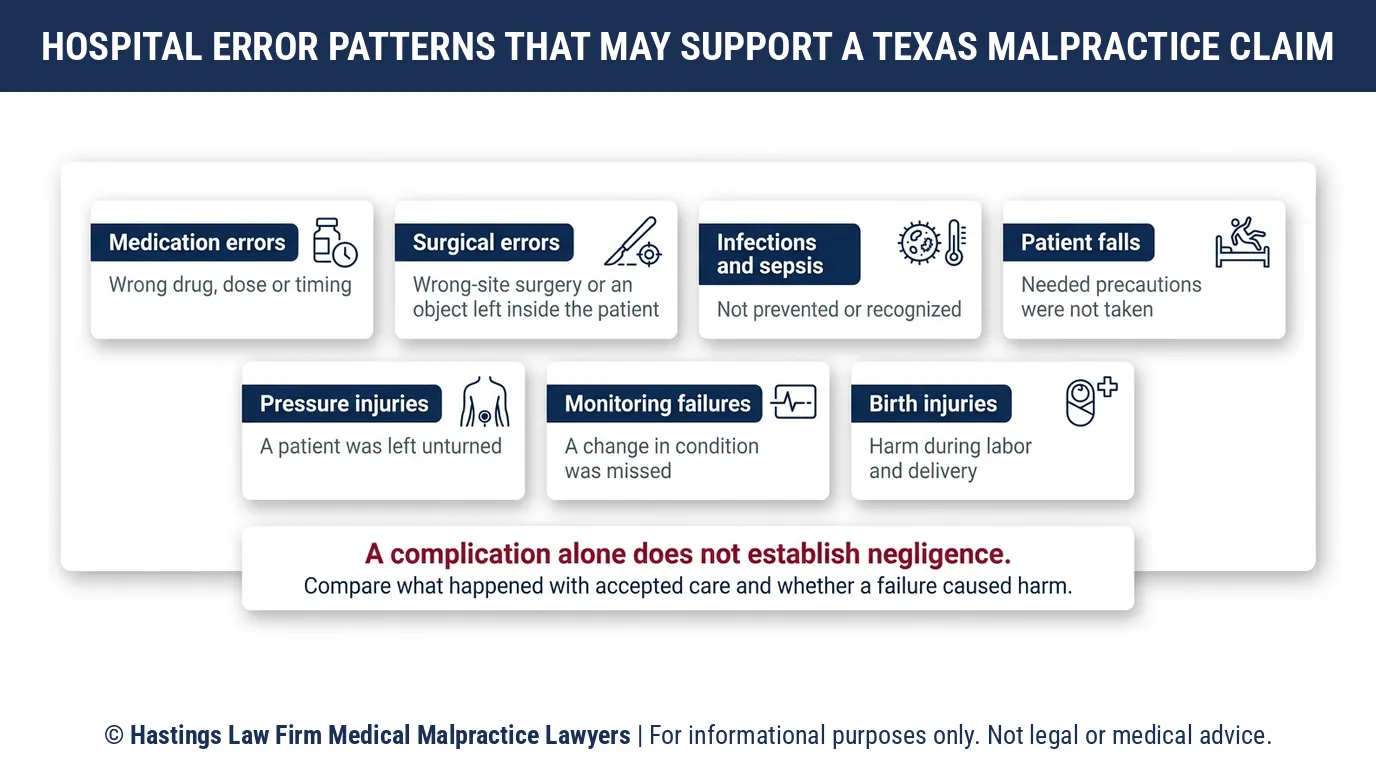
The hospital errors that can support a malpractice claim in Texas include medication-related harm, surgical errors, infections, falls, and pressure injuries, which the federal Agency for Healthcare Research and Quality (AHRQ) identifies among hospital safety concerns. A complication is not necessarily preventable or negligent, so a claim compares what happened with what accepted care required.
Hospital systems exist to prevent these errors, and a claim examines whether they failed.
- Medication errors: the wrong drug, dose, or timing
- Surgical errors, such as wrong-site surgery or an object left inside the patient
- Hospital-acquired infections and sepsis that went unprevented or unnoticed
- Patient falls without the precautions a patient needed
- Pressure injuries from a patient left unturned
- Failures to monitor a change in condition
- Birth injuries during labor and delivery
Is a Texas Hospital Liable for Emergency Room Negligence?
A Texas hospital can be liable for emergency room negligence, but Texas Civil Practice and Remedies Code §74.153 sets a heightened standard for qualifying emergency care. For care in a hospital emergency department, or in an obstetrical unit or surgical suite right after emergency department evaluation or treatment, §74.153 requires proof by a preponderance of the evidence that the provider acted with willful and wanton negligence.
That standard is one reason ER cases need early review of the records. It stops applying once the patient is stabilized and receiving nonemergency treatment, and it does not cover care unrelated to a medical emergency or a provider whose negligence caused a stable patient to need emergency care.
Emergency room claims can involve triage that underrates how sick a patient is, an unsafe discharge, or a missed diagnosis, as our page on Texas emergency room malpractice explains. Receiving care from an emergency room doctor does not by itself make that doctor the hospital’s agent.
Can You Sue a Hospital for Misdiagnosis in Texas?
You can sue a hospital for misdiagnosis in Texas when a missed or delayed diagnosis by someone the hospital is responsible for, or by a failure in the hospital’s own systems, more likely than not caused the harm. A misdiagnosis claim against a hospital is a health care liability claim under Texas Civil Practice and Remedies Code Chapter 74.
Under Bustamante v. Ponte, the delay need not be the only cause, but it must be a substantial factor without which the harm would not have happened. Hospital system failures can include a test result never passed on or a handoff that lost information, so a stroke, sepsis, or pulmonary embolism goes unrecognized.
Whether the error traces to the hospital or to a contractor doctor decides who the claim is against, as our page on Texas medical misdiagnosis explains.
Who Should Be Named in a Texas Hospital Negligence Lawsuit?
A Texas hospital negligence lawsuit can name every provider whose care contributed to the harm, including the hospital, the treating doctors, their physician groups, and any staffing company involved. Under Texas Civil Practice and Remedies Code Chapter 33, a jury divides responsibility among the defendants, settling persons, and properly designated responsible third parties.
A family does not always know at the start how many separate providers were involved, and that is understandable. Naming each one early still matters when suing a hospital. Each proposed defendant must receive written notice before suit, an expert report must be served on each one, and a provider identified late can be past the filing deadline. The records show who is who in a lawsuit against a hospital, from admission forms and the billing statements of separate physician groups to the names in the chart.
How Difficult is a Medical Malpractice Case Against a Texas Hospital?
A medical malpractice case against a Texas hospital is demanding, mainly because of the requirements of Texas Civil Practice and Remedies Code Chapter 74, and it is still possible when negligent care caused real harm. Chapter 74 requires an early expert report for each defendant and ordinarily caps non-economic damages.
Much of what makes it hard to sue a hospital comes early in a case. Under §74.351, each defendant must be served with an expert report and the expert’s curriculum vitae within the ordinary 120-day deadline after its original answer, subject to written extensions and the alternative deadlines in §74.353.
If that requirement is not met, the court must, on that defendant’s motion and subject to the cure provision, dismiss the claim against it and award its attorney fees and costs. A court may grant one 30-day extension to cure a deficient report, as our page on the Chapter 74 expert report and causation explains.
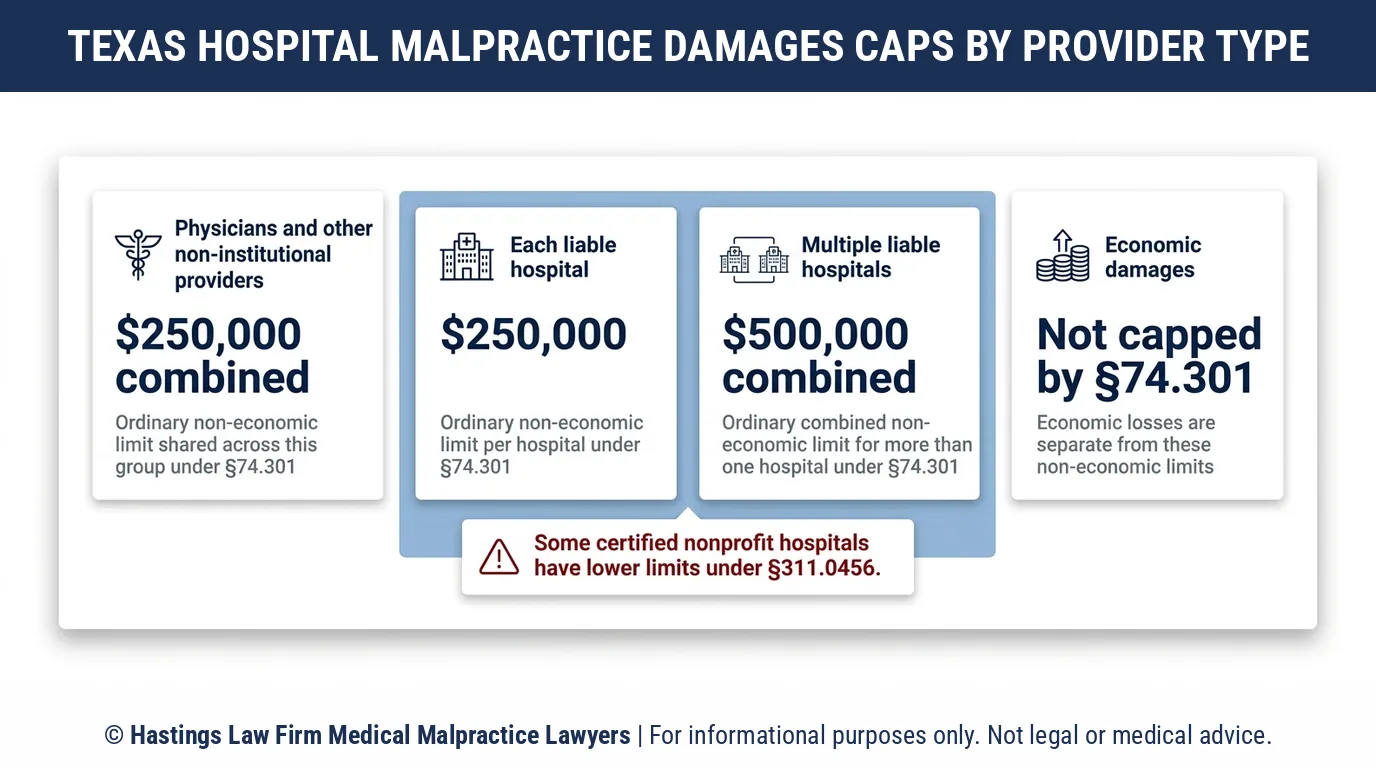
Non-economic damages, such as pain and suffering, are ordinarily capped by §74.301. Physicians and other non-institutional providers share one combined $250,000 limit, not one per doctor, and each liable hospital ordinarily has its own $250,000 limit, with $500,000 combined for more than one. Economic damages are not capped by §74.301, and some certified nonprofit hospitals have lower limits under Health and Safety Code §311.0456.
In a death case, §74.303 adds an inflation-adjusted limit that applies together with §74.301 in wrongful death claims. How much you can sue a hospital for depends on the losses and the Texas medical malpractice damage caps. Experts and records are also costly to obtain, which is part of why these cases are demanding.
The Hastings Law Firm Difference
Results matter, but what truly sets us apart is how we achieve them. Every verdict, every settlement, and every courtroom victory comes from one guiding promise: To treat each client’s fight for justice as if it were our own.
This balance of skill, experience, and empathy reflects our core philosophy that justice should not only compensate the injured, but also make health care safer nationwide.

How Do You Sue a Hospital in Texas?
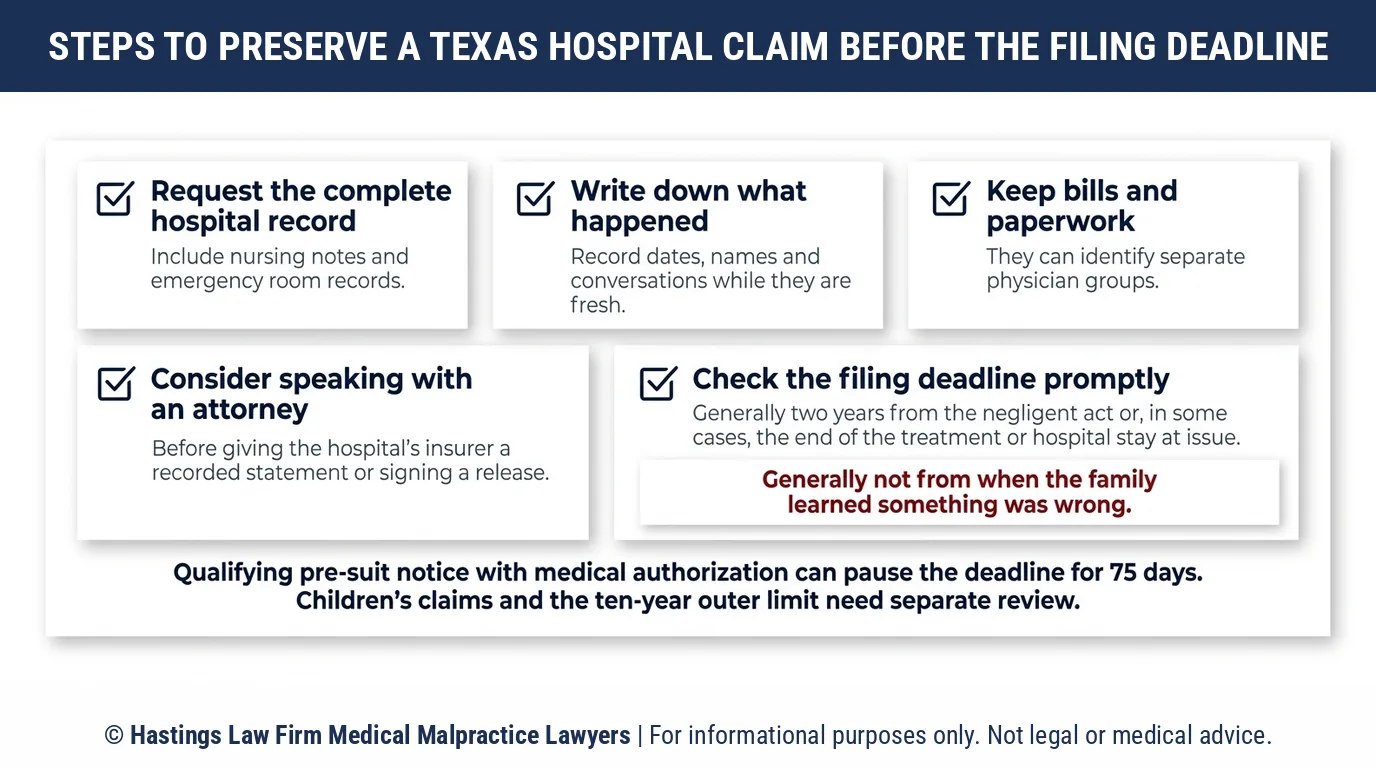
To sue a hospital in Texas, start by requesting the complete hospital records, writing down what happened, and speaking with a medical malpractice attorney before the filing deadline. Those first steps protect the evidence and the time a claim needs.
Those steps in practice:
- Request the complete record, including nursing notes and emergency room records. Patients generally have a right to their records under the federal HIPAA rule, 45 CFR §164.524.
- Write down dates, names, and conversations while they are fresh.
- Keep bills and paperwork, which show which physician groups were involved.
- Consider speaking with an attorney before giving the hospital’s insurer a recorded statement or signing a release.
The filing deadline is generally two years from the negligent act, or in some cases the end of the treatment or hospital stay at issue, not from when the family learned something was wrong. Qualifying pre-suit notice with the medical authorization can pause it for 75 days. Children’s claims and the ten-year outer limit need separate review, as our page on Texas medical malpractice deadlines explains.
Talk to a Texas Hospital Negligence Attorney About Your Case
If negligent care at a hospital harmed you or someone you love, Hastings Law Firm performs a free, confidential case review. We listen to what happened, review the medical records, and give you an honest answer about whether there is a claim.
Our medical malpractice lawyers are experienced in handling hospital negligence claims across Texas. We understand what a hospital’s failure can mean for a patient and family, from additional recovery time and more care to lost work and the loss of a loved one.
Our firm has been dedicated exclusively to medical malpractice since 2005, and we advance the cost of the medical experts a claim needs. We work on a no-win, no-fee basis, so if we do not win the case, you pay nothing. Our team is here for you, and you can learn more about our Texas hospital negligence lawyers.
Sources
- Chapter 74 health care liability rules, including §§74.001, 74.153, 74.301 and 74.351 | Texas Legislature
- Texas Tort Claims Act waiver, notice and limits for government claims | Texas Legislature
- Texas Supreme Court opinion on employer liability and the right of control | Supreme Court of Texas
- Medicare hospital conditions of participation for nursing and infection control, 42 CFR Part 482 | eCFR
- Texas Supreme Court opinion setting the elements of hospital ostensible agency | FindLaw
- Texas Supreme Court opinion on malice in hospital credentialing claims | Supreme Court of Texas
- AHRQ report on hospital-acquired conditions, including falls and pressure ulcers | Agency for Healthcare Research and Quality
- Patient safety primer on wrong-site, wrong-procedure and wrong-patient surgery | AHRQ PSNet
- Texas Supreme Court opinion on proving causation in medical malpractice cases | Justia
- Texas proportionate responsibility rules, Civil Practice and Remedies Code Chapter 33 | Texas Legislature
- Lower damages limits for certified nonprofit hospitals, Health and Safety Code §311.0456 | Texas Legislature
- HIPAA right of access to medical records, 45 CFR §164.524 | eCFR

This content was researched and written by the Hastings Law Firm editorial team, which includes attorneys, medical professionals, and experienced researchers. Our writing is informed by internal knowledge and practical experience, and we cross-check critical details against authoritative sources cited throughout. Every piece undergoes human-led fact-checking and legal review. Because legal and medical information can change, if you spot an error, please contact us. Learn more about our content standards and review process on our editorial policy page.

Tommy Hastings, founder of Hastings Law Firm, is a board-certified personal injury trial lawyer (by the Texas Board of Legal Specialization) dedicated exclusively to healthcare injury cases. Since 2001, he has represented injured patients and families in litigation against major hospital systems, pharmaceutical companies, and negligent healthcare providers nationwide. He has handled numerous high-profile cases that have drawn national media attention and resulted in multi-million dollar recoveries.
