


Texas Failure to Obtain Informed Consent Lawyer
Written by: Hastings Law Firm | Reviewed by: Gabe Sassin | Updated: July 27, 2026
Informed consent is meant to protect a patient’s right to make a real choice about medical care by receiving clear information about risks, benefits, and alternatives before a procedure. When that disclosure does not happen, people can be left with injuries they never agreed to risk, along with lasting physical and emotional consequences and sometimes fatal outcomes. Texas uses a reasonable person standard and recognizes that a signature alone does not prove meaningful consent. If you or a loved one were harmed or worse due to failure to obtain informed consent in Texas, contact Hastings Law Firm for a free, confidential case review.
Trusted Texas Medical Attorneys for Informed Consent Malpractice Claims
What You Should Know About Informed Consent Malpractice Claims in Texas:
- Recovery can depend on showing that an undisclosed material risk occurred and caused the injury.
- Options can be limited when a reasonable person standard applies to whether the procedure would have been refused with full information.
- Liability can still be possible even with a signed consent form when the underlying discussion was rushed, missing, or misleading.
- A presumption of negligence can arise in Texas when a required risk disclosure tied to the Texas Medical Disclosure Panel is omitted.
- Responsibility can remain with the physician because Texas treats the informed consent discussion as a non delegable duty.
- Claims can be jeopardized by Texas requirements that impose strict notice and filing related constraints.
- A case can be dismissed when a required expert report is not served on time under Texas medical liability rules.
- Compensation can include economic losses and non economic harms tied to the undisclosed complication.
- A wrongful death claim can be available when an unauthorized procedure results in a patient’s death.
- Disputes can turn on whether an emergency exception applied because consent may be implied in genuine life saving situations.

A Healthcare Focused Law Firm
Before any medical procedure, you have a legal right to understand what is being done to your body, why it is being recommended, and what could go wrong. When a doctor fails to provide that information and you are harmed as a result, the sense of betrayal can be overwhelming. You may feel like something was taken from you: not just your health, but your ability to choose.
If you or a loved one suffered injuries after a procedure you were not fully informed about, you may have grounds for a medical malpractice claim. As a Texas failure to obtain informed consent lawyer, Hastings Law Firm focuses exclusively on holding negligent healthcare providers accountable. Our founder, Tommy Hastings, is Board Certified in Personal Injury Trial Law by the Texas Board of Legal Specialization. Our team includes former defense attorneys and in-house nurse consultants who use their insider knowledge of hospital protocols to help you understand your legal options. Contact us for a free, confidential case evaluation.
Understanding Informed Consent Standards Under Texas Law
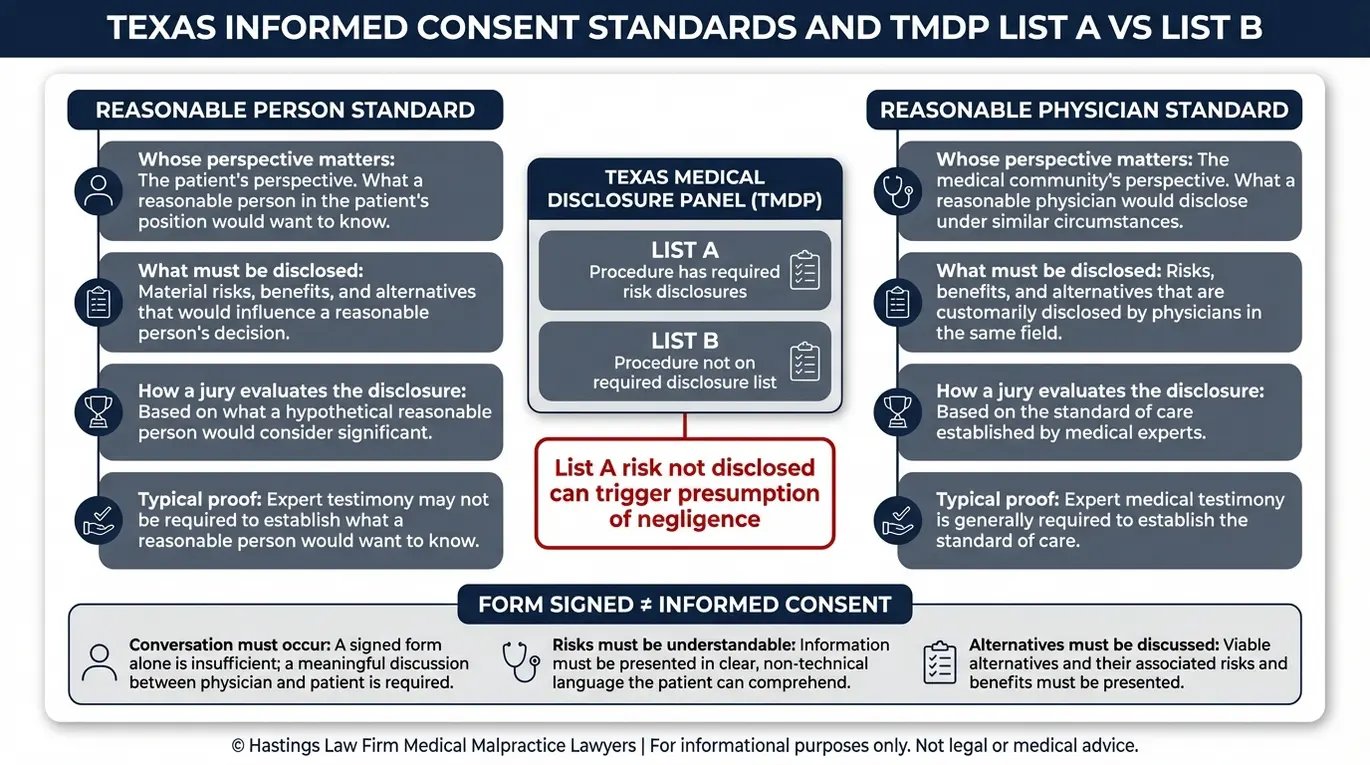
Informed consent is the legal requirement that a physician must disclose the risks, benefits, and alternatives of a medical procedure that a reasonable person would need to make a decision. In Texas, if a doctor fails to disclose a risk found on the Texas Medical Disclosure Panel list, it creates a rebuttable presumption that the physician failed to obtain informed consent. Under Texas law, if a doctor fails to disclose a material risk, one that a reasonable person would consider important when deciding whether to proceed, it can form the basis of a medical malpractice claim.
Texas applies what is known as the reasonable person standard, sometimes called the objective patient standard. This means the question is not whether *your* particular doctor thought the disclosure was adequate. The question is whether a reasonable person in the patient’s position would have wanted to know about the risk before agreeing to the procedure. This patient-centered standard protects individuals from a physician’s subjective judgment about what information to share or withhold.
A material risk is a potential complication that would influence a patient’s decision to undergo a procedure. A critical part of this framework is the Texas Medical Disclosure Panel (TMDP), a state body that categorizes medical and surgical procedures into two lists. List A identifies procedures that require specific risk disclosures. If a physician fails to disclose a List A risk and the patient is harmed, it creates a presumption of negligence. List B covers procedures where no specific disclosure is mandated by the panel, but the physician still has a general duty to inform the patient about foreseeable risks.
A signed consent form does not automatically protect the doctor. A form is only as valid as the conversation behind it. If the physician never actually explained the risks, rushed through the discussion, or provided misleading information, a signed document may not shield them from liability. Our medical malpractice lawyers for consent issues investigate whether the required conversation genuinely took place, not just whether a signature exists on paper.
What Texas Law Requires Physicians to Disclose:
- The nature of the proposed procedure or treatment
- The material risks and potential complications associated with the procedure
- The expected benefits of proceeding with treatment
- Reasonable alternative treatments, including non-surgical options
- The risks and benefits of those alternatives
- The risks associated with choosing no treatment at all
Texas Civil Practice and Remedies Code, Chapter 74, Subchapter C, establishes these requirements and outlines the legal consequences of failing to inform a patient. If you believe your doctor skipped or minimized any of these disclosures before your procedure, a lawyer for lack of informed consent can evaluate whether the standard of care was breached.
Common Scenarios Involving Failure to Obtain Consent
Common failures include performing a different procedure than what was discussed, failing to mention the risk of permanent nerve damage or infection, or neglecting to offer non-surgical alternatives. Patients have the legal right to decide what happens to their bodies, and physicians must respect that choice. These situations arise more often than most people realize, and they can leave patients dealing with injuries they never agreed to risk.
Here are examples of how a failure to obtain informed consent lawyer may see these cases present:
- Undisclosed complications: A surgeon knows that a procedure carries a measurable risk of stroke, organ perforation, or severe infection but never mentions it. The complication occurs, and the patient had no opportunity to weigh that risk before agreeing. In some cases, unexpected side effects related to anesthesia errors or medication interactions are omitted from the discussion.
- Unauthorized extension of surgery: While performing one procedure, a surgeon decides to address a separate issue, such as removing an organ or repairing a structure that was not part of the original plan, without the patient’s prior consent. Unless it qualifies as a genuine emergency, this may constitute an unauthorized medical procedure, meaning a procedure performed without the patient’s knowledge or agreement.
- Misrepresentation of credentials or experience: If a physician overstates their qualifications or experience level to persuade a patient to consent, the consent obtained may be considered invalid. This breaches the trust essential to all surgical procedures.
- Failure to discuss alternatives: A patient agrees to surgery without knowing that alternative treatments existed, such as medication management, physical therapy, or even watchful waiting. Alternative treatments include non-surgical options and the option of no treatment at all, and physicians are generally required to present them.
- Wrong-site surgery: In egregious cases, a breakdown in the consent process can lead to surgery being performed on the wrong body part entirely.
Each of these scenarios shares a common thread: the patient’s ability to make an informed choice was compromised. An attorney for unauthorized medical procedures can examine the medical records, consent documentation, and clinical notes to determine whether your physician met their disclosure obligations. By investigating these details, we uncover whether the care team respected your rights or simply rushed you through the process.
The Hastings Law Firm Difference
Results matter, but what truly sets us apart is how we achieve them. Every verdict, every settlement, and every Texas courtroom victory comes from one guiding promise: To treat each client’s fight for justice as if it were our own.
This balance of skill, experience, and empathy reflects our core philosophy that justice should not only compensate the injured, but also make healthcare safer nationwide.

Proving a Medical Malpractice Claim for Consent Violations
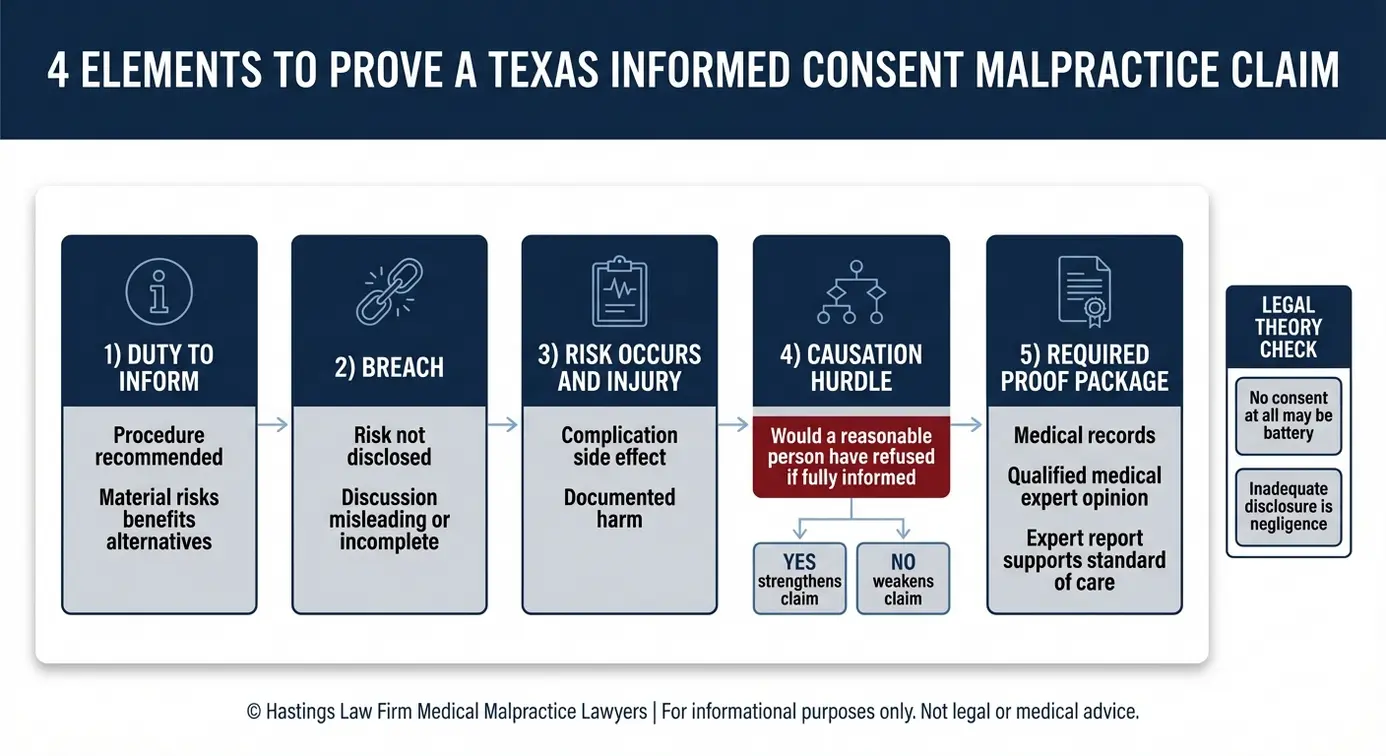
To succeed on a claim, the patient must prove that the doctor failed to disclose a material risk, that the undisclosed risk actually occurred and caused injury, and that a reasonable person in similar circumstances would have refused the procedure had they known about the risk. In Texas, proving lack of consent requires showing that a healthcare provider failed to communicate essential information.
This proof framework involves several distinct steps, and each one must be supported by evidence.
Step 1: Establish the Duty and the Breach
Proving a medical error requires showing that a doctor failed to meet the accepted standard of care. The standard of care is the level of care a prudent healthcare professional would provide under similar circumstances. The first step is showing that the healthcare provider had a duty to disclose specific risks and failed to do so. Medical records, consent forms, and clinical notes all become key evidence. A Texas failure to obtain informed consent attorney will review these documents to identify gaps between what was disclosed and what should have been disclosed under the standard of care.
Step 2: Prove the Injury Occurred
The undisclosed risk must have actually materialized. If a doctor failed to mention the risk of nerve damage and the patient suffered nerve damage, this element is met. If the undisclosed risk never occurred, there is no compensable claim, even if the disclosure was inadequate.
Step 3: Satisfy the Causation Requirement
Causation is often the most challenging hurdle in these cases. Texas uses the “reasonable person” standard for causation, which is an objective test. Causation connects the doctor’s failure to your specific injury. You must demonstrate that a reasonable person, meaning a typical patient facing the same decision with full knowledge of the material risks, would have declined the procedure.
It is not enough to say that you personally would have said no; the standard asks what a prudent person in your position would have done. This means you must show that the lack of information directly led to the harm you suffered. If you need legal help for informed consent malpractice, an experienced medical negligence lawyer can help articulate this argument.
Implied consent, the legal principle that consent is assumed in genuine medical emergencies when the patient cannot communicate, is a common defense raised in these cases. A lawyer can evaluate whether an emergency exception legitimately applied or whether it is being used to excuse a failure to communicate.
Step 4: Obtain the Required Expert Report
Under Texas Civil Practice and Remedies Code Chapter 74, every medical malpractice claim requires a qualified expert report. This chapter of the Texas Civil Practice and Remedies Code sets strict procedural requirements for medical liability claims. This report must identify the breach, explain how it caused the injury, and establish the applicable standard of care. Patients must serve this report within 120 days after each defendant’s original answer is filed. Reliance on strong expert opinions is essential; without them, the case can be dismissed.
The Distinction Between Battery and Negligence
Consent claims generally fall into two categories. When a physician performs a procedure with no consent at all, it may be classified as battery. When consent was obtained but the risk disclosure was inadequate or misleading, it is treated as negligence. The legal strategies and defenses differ depending on which theory applies.
The Physician’s Non-Delegable Duty
One issue that arises frequently in these cases is whether a doctor can shift responsibility for the informed consent conversation to the nursing staff. Under Texas law, the duty to explain risks, benefits, and alternatives belongs to the physician. It is a non-delegable duty, meaning the physician cannot assign it to someone else and then claim the obligation was met.
A nurse may hand a patient a form to sign, but the substantive discussion about what the procedure involves and what could go wrong must come from the doctor. If a physician relies entirely on a nurse to “get consent” without personally speaking with the patient, the consent may be legally insufficient. This distinction also affects hospital liability, because the institution may be implicated if its protocols allowed or encouraged this shortcut.
Recoverable Damages for Victims of Unauthorized Procedures
Victims can recover economic damages for medical bills and lost wages, as well as non-economic damages for pain, suffering, and physical impairment caused by the undisclosed complication. Patients can recover these costs when a procedure is performed without proper disclosure. The specific compensation depends on the severity of the injury and how it has affected the patient’s life.
| Economic Damages | Non-Economic Damages |
|---|---|
| Corrective or revision surgeries | Pain and suffering |
| Ongoing medical treatment and rehabilitation | Mental anguish and emotional distress |
| Lost wages and reduced earning capacity | Loss of enjoyment of life |
| Long-term care or in-home assistance | Physical disfigurement or impairment |
| Prescription medications and medical devices | Loss of consortium (for spouses) |
Economic damages represent the objective financial recovery of losses you have incurred. This includes past and future medical bills, lost income, and any care needs that result from the undisclosed complication, such as a severe infection requiring prolonged hospitalization. Damages also often account for the loss of future financial security if the injury prevents the patient from returning to their previous career or level of employment.
Non-economic damages address the personal toll: chronic pain, permanent injury, anxiety, and the diminished quality of life that follows. These damages acknowledge that the harm extends beyond bank accounts and into the patient’s daily existence. For example, physical impairment might prevent a patient from enjoying hobbies or caring for their children, a loss that requires fair compensation.
If the unauthorized procedure resulted in a patient’s death, the family may also pursue a wrongful death claim to recover funeral expenses, loss of financial support, and loss of companionship. A lawyer experienced in compensation for lack of informed consent can help calculate the full scope of damages in medical malpractice cases so that nothing is overlooked.
Texas Statutes and Limitations Affecting Your Claim
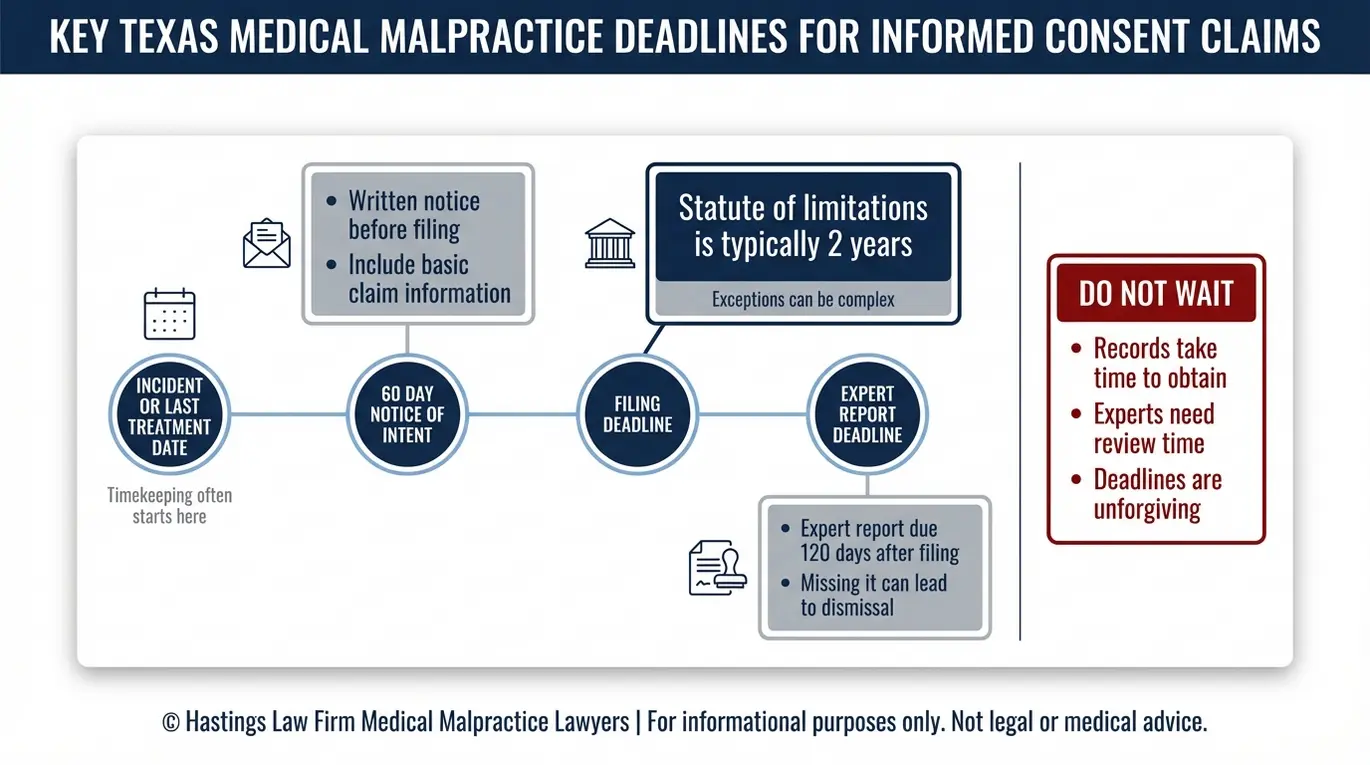
Texas imposes strict deadlines, including a two-year statute of limitations, and requires a 60-day notice of intent to sue before filing. This notice is a mandatory letter sent to healthcare providers before a lawsuit begins. Our in-house medical staff and nurse consultants assist in reviewing records to ensure every detail is addressed before these deadlines.
Before filing suit, Texas law mandates a notice of intent to sue be sent to the physician or healthcare provider you intend to claim against. This mandatory notice period gives the provider an opportunity to respond. Failing to comply can delay or jeopardize your case.
Once a lawsuit is filed, strict expert report requirements kick in. The patient must serve a qualified expert report within 120 days after each defendant’s original answer is filed. This report, required under Chapter 74, must identify the standard of care, explain how it was breached, and connect the breach to the patient’s injury. Missing this deadline can result in dismissal with prejudice.
Texas also imposes statutory caps, or legal limits, on non-economic damages in medical malpractice cases. The Texas Medical Disclosure Panel (TMDP) defines which procedures fall under List A, requiring specific disclosures, and List B, where no panel-mandated disclosures apply but general duties remain. Because these rules are unforgiving, early consultation with a Texas medical malpractice lawyer is essential to preserving your rights.
Contact the Texas Healthcare Malpractice Attorneys at Hastings Law Firm Today for Help
You had a right to know what was being done to your body and to decide whether to proceed. If that right was taken from you, Hastings Law Firm is here to help you find answers.
Our team of attorneys, former defense counsel, and in-house medical professionals focuses exclusively on medical malpractice. We investigate consent claims with the same rigor we bring to every case: gathering records, consulting qualified experts, and building a timeline of what was and was not disclosed.
As your Texas failure to obtain informed consent lawyer, we work on a contingency fee basis, which means you pay no attorney fees or costs unless we recover compensation on your behalf. If you believe you were harmed by a procedure you were not fully informed about, contact Hastings Law Firm for a free, confidential case evaluation. Let us help you understand what happened and what your options are.
Frequently Asked Questions About Failure to Obtain Informed Consent in Texas


This content was researched and written by the Hastings Law Firm editorial team, which includes attorneys, medical professionals, and experienced researchers. Our writing is informed by internal knowledge and practical experience, and we cross-check critical details against authoritative sources cited throughout. Every piece undergoes human-led fact-checking and legal review. Because legal and medical information can change, if you spot an error, please contact us. Learn more about our content standards and review process on our editorial policy page.

Gabe Sassin has focused exclusively on medical malpractice law since 2007. After spending more than a decade as a malpractice defense attorney, he knows exactly how the other side works. He has seen firsthand how healthcare providers, insurers, corporate defendants, and their legal teams think, prepare, and build their defense against claims. That knowledge works for the people who need it most today, injured patients and their families. His unique experience shapes everything he writes, giving readers a look at how these cases actually work from someone who has handled them from both sides.
