


What Are the Four Elements of Medical Malpractice in Texas?
Learning that an injury may have come from medical care raises questions that are hard to sort through alone. Patients and families can be left with new limitations, mounting costs, and uncertainty about whether what happened was an accepted risk or a preventable mistake. The law answers that question in a structured way, looking at the care piece by piece rather than at the outcome alone. Knowing the four elements a medical malpractice claim in Texas must prove gives a family a clear way to think about what happened.

Last Updated: October 22, 2026
What You Should Know About the Four Elements of a Texas Medical Malpractice Claim:
- A Texas medical malpractice claim must prove four elements: duty, breach, causation, and damages. A claim that fails any one of them fails.
- The burden of proof is a preponderance of the evidence, meaning each element is more likely true than not.
- Duty comes from the physician-patient relationship, which can arise through an implied agreement to provide and receive medical services.
- The standard of care is what an ordinarily prudent provider in the same field would have done under the same or similar circumstances. Qualifying emergency care requires proof of willful and wanton negligence, still by a preponderance of the evidence.
- Causation must be shown in reasonable medical probability: the breach was a substantial factor without which the harm would not have happened, and that kind of harm was foreseeable.
- Damages must be real harm. Economic and non-economic losses can be recovered, and §74.301 ordinarily limits non-economic damages to $250,000 combined for physicians and other non-institutional providers, with separate limits for healthcare institutions and a further limit in a death case.
- Fault can be shared among providers and the patient. A patient’s share reduces the recovery, and a share greater than 50% bars it.
- Breach and causation are proved through qualified medical experts, and the expert report is ordinarily due within 120 days after each defendant’s original answer, subject to written extensions and the alternative deadlines in §74.353.
- The filing deadline is generally measured from the negligent act or the relevant treatment or hospitalization, not from discovery, and qualifying pre-suit notice sent before it expires can add 75 days.
What Are the Four Elements You Must Prove in a Texas Medical Malpractice Claim?
The four elements of a medical malpractice claim in Texas are duty, breach, causation, and damages. The Supreme Court of Texas, in Windrum v. Kareh, describes them as a legal duty, a breach of that duty, and damages proximately caused by the breach. A patient or family bringing a claim under Texas Civil Practice and Remedies Code Chapter 74 must prove all four.
Each element is proven on its own. Strong evidence that care fell short does not save a claim if nothing connects that shortfall to an injury. What you have to prove in a medical malpractice case in Texas is all four elements, each backed by its own evidence.
Chapter 74 governs qualifying health care liability claims, the statute’s term for claims against physicians, hospitals, nurses, and other covered providers involving treatment, a failure to treat, or a departure from accepted standards of care. Not every injury that happens in a hospital fits that definition.
In plain terms, each element asks one question about your care:
- Duty. Did a healthcare provider agree, even informally, to care for you?
- Breach. Did the care fall below what a careful provider in the same field would have done?
- Causation. Did that shortfall cause your injury?
- Damages. What harm resulted?
Those four questions are answered from the records of your own care, one at a time.
What Does Duty of Care Mean in a Texas Medical Malpractice Case?
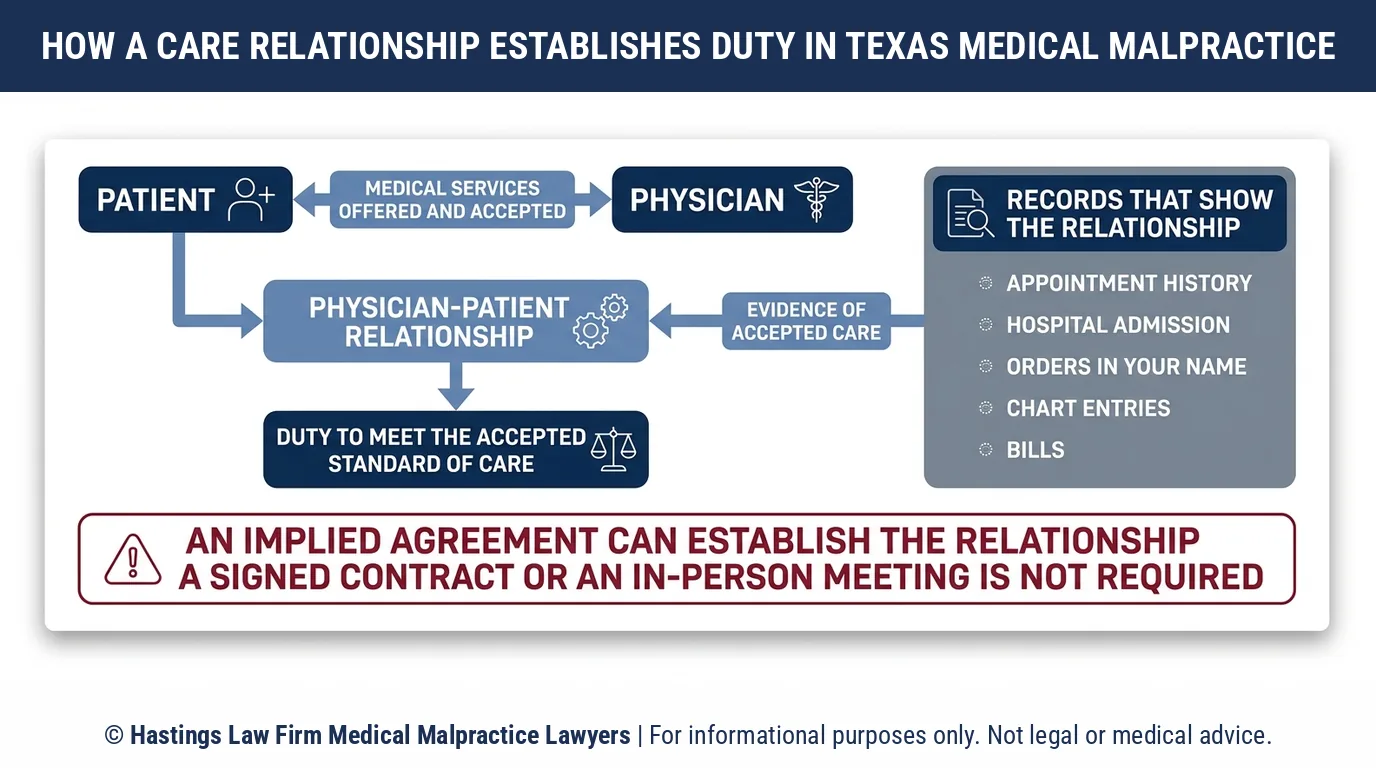
Duty of care in a Texas medical malpractice case means a healthcare provider owed the patient care that met the accepted standard, a duty that arises from the physician-patient relationship. The Supreme Court of Texas, in Lake Jackson Medical Spa v. Gaytan, recognizes that the relationship can arise through an implied agreement to provide and receive medical services, without the formalities of a contract.
The records of your care are where that relationship shows up. Appointment histories, an admission to the hospital, orders written in your name, chart entries, and bills each show that a provider took on your care and what that provider did.
Duty also runs from facilities, not only from the individual people who treat a patient. A hospital or other healthcare facility can owe duties of its own, and it can answer for its employees and agents, which matters once more than one provider is involved in the care.
When is Duty Disputed in a Texas Medical Malpractice Lawsuit?
Duty is disputed in a Texas medical malpractice lawsuit when a provider argues that no physician-patient relationship ever formed. Under Lake Jackson Medical Spa v. Gaytan, the Supreme Court of Texas looks at whether medical services were offered and accepted, an agreement that can be implied, rather than at whether the patient signed a contract or met the doctor in person.
Care delivered by video or phone raises the same question in a different form. For services covered by Texas Occupations Code §111.007, delivering care remotely does not lower the standard that applies to the same service in person, so telehealth care is measured the way an office visit would be.
What is the Standard of Care in a Texas Medical Negligence Claim?
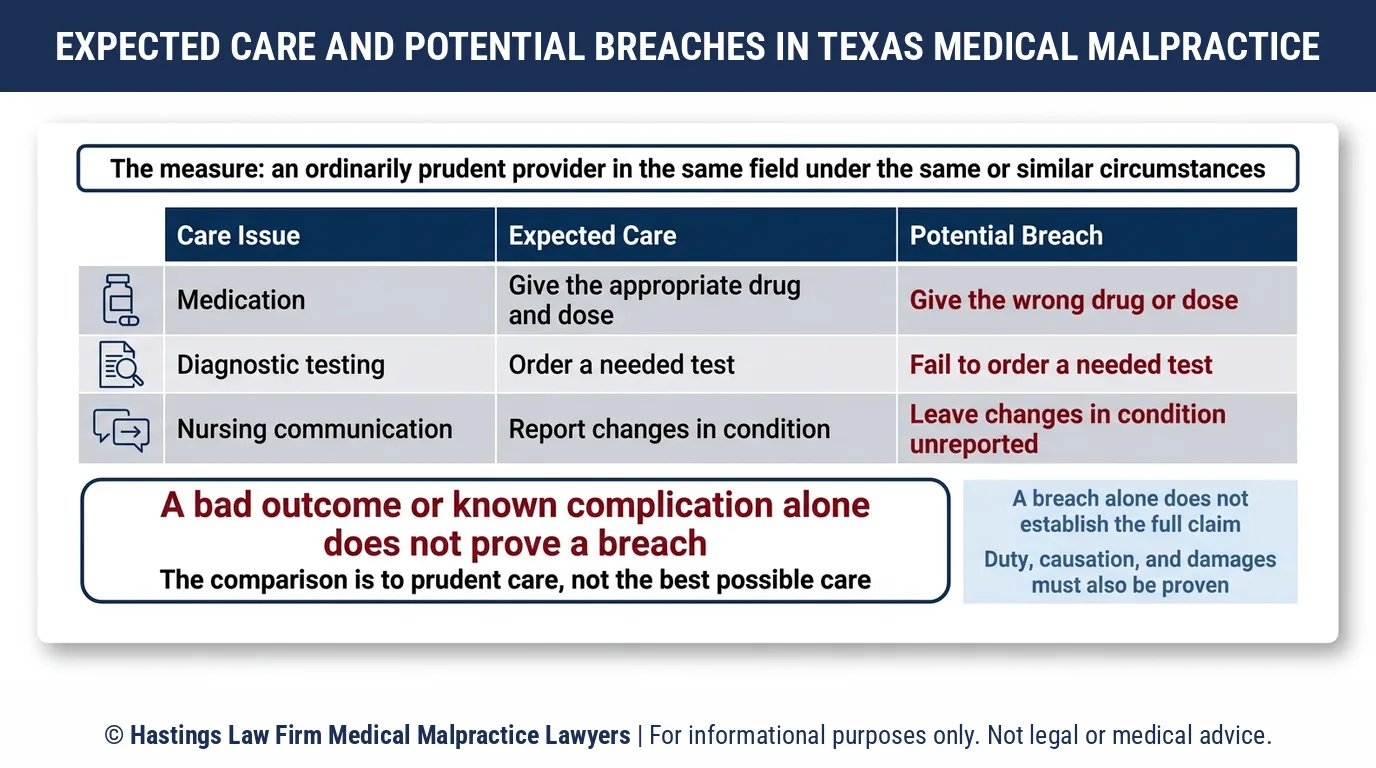
The standard of care in a Texas medical negligence claim is what an ordinarily prudent healthcare provider in the same field would or would not have done under the same or similar circumstances. The Supreme Court of Texas states that measure in Windrum v. Kareh, and the State Bar of Texas pattern jury charge on physician negligence uses the same ordinary-prudence comparison.
The comparison is not to the best possible care. The pattern charge commentary looks at a provider with skills relevant to the treatment involved, and what other providers customarily do can inform the question without settling it. Among the elements of medical negligence, the standard of care is the measuring stick, and it asks what a careful provider would have done, not whether the result was bad.
One rule changes what must be proven for emergency care. For qualifying emergency medical care in a hospital emergency department, an obstetrical unit, or a surgical suite immediately after emergency department evaluation or treatment, Section 74.153 of Chapter 74 requires proof that the provider departed from the standard with willful and wanton negligence. That heightened rule does not apply once the patient is stabilized and receiving nonemergency treatment, to care unrelated to the emergency, or to a provider whose negligence caused a stable patient to need emergency care. The burden of proof stays a preponderance of the evidence, so claims about emergency room care depend on exactly when and where the care happened.
What Counts as a Breach of the Medical Standard of Care in Texas?
A breach of the medical standard of care in Texas is care that falls below what an ordinarily prudent provider in the same field would have done under the same or similar circumstances, the measure the Supreme Court of Texas sets in Windrum v. Kareh. A breach can be an action, such as giving the wrong medication, or a failure to act, such as never ordering a needed test.
Breaches tend to fall into recognized categories:
- Misdiagnosis and delayed diagnosis, when a condition is missed or identified too late
- Surgical errors, during an operation or the monitoring after it
- Medication errors, such as the wrong drug or dose
- Anesthesia errors, in dosing or monitoring
- Birth injuries, when problems during delivery are not answered in time
- Nursing failures, such as changes in condition that go unreported
Failure to obtain informed consent is its own kind of breach. Informed consent means the provider explained the risks and you agreed to the treatment. Texas has specific rules about what must be disclosed, and inadequate disclosure can support a negligence claim when the required elements are established.
People use medical negligence and medical malpractice almost interchangeably, and in Texas the claim itself is a health care liability claim under Chapter 74. Medicine carries risk, and a bad outcome or a known complication is not by itself a breach. When an injury was preventable, the providers responsible should be held accountable.
How is Causation Proven in a Texas Medical Malpractice Lawsuit?
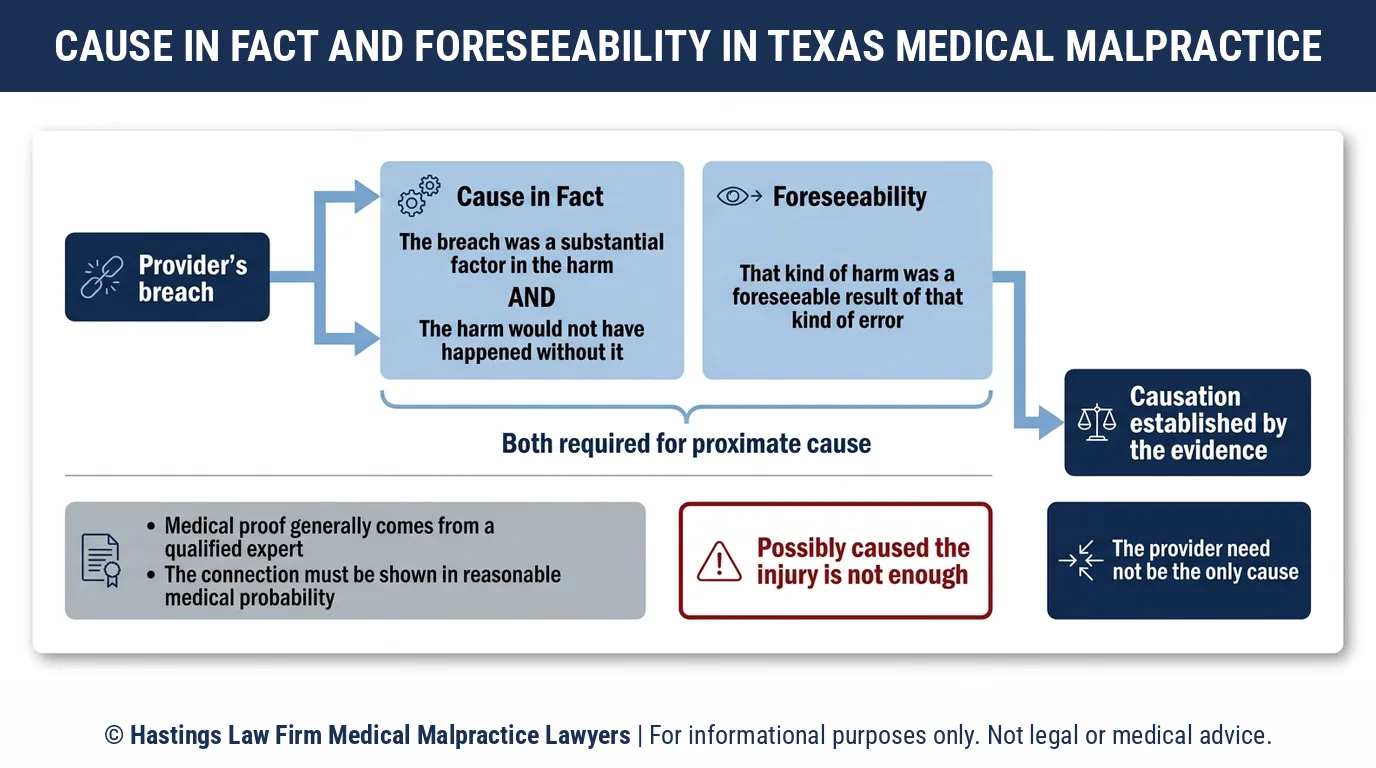
Causation is proven in a Texas medical malpractice lawsuit with evidence, generally from a qualified medical expert, that the provider’s breach more likely than not caused the patient’s injury. The Supreme Court of Texas, in Bustamante v. Ponte, requires that proof in reasonable medical probability and asks whether the breach was a substantial factor in the harm without which the harm would not have happened.
People researching their own situation often ask which is the hardest element to prove. Texas law ranks none of them, and each carries its own proof, but causation is the one that ties the care to the harm, which can be hard to picture when a patient was already sick before the error.
Texas calls this element proximate cause, and it has two parts. The first is cause in fact, which needs both pieces of the Bustamante test: the breach was a substantial factor in causing the harm, and the harm would not have happened without it. The second is foreseeability, which asks whether that kind of harm was a foreseeable result of that kind of error.
A provider does not have to be the only cause. When an illness, another provider, or the patient’s own condition also played a part, a breach that was a substantial factor can still meet the test. The expert’s opinion has to rest on reasonable medical probability, and an opinion that the breach possibly caused the injury does not meet that standard.
Delayed diagnosis claims show how the test works in practice. The question is what earlier care would have changed. If an infection went unrecognized for a day, the expert explains whether treatment on the earlier day would more likely than not have prevented the injury that followed.
Texas law also limits claims built on a lost chance. Bustamante reaffirms that a patient cannot recover where the negligence cost only a 50% or lower chance of avoiding the harm, and a bare reduction in the chance of a better outcome does not replace proof of probable causation. The substantial factor test and the role experts play are explained in depth on our page about proving causation in a medical malpractice case.
What Damages Must a Patient Show in a Texas Medical Malpractice Claim?
A patient in a Texas medical malpractice claim must show an actual injury caused by the provider’s negligence, because damages are one of the four elements of the claim, alongside duty, breach, and causation. Chapter 41 of the Texas Civil Practice and Remedies Code defines the economic and non-economic damages that can be recovered for that injury.
An error that caused no harm does not complete a claim, however serious the error was. Where there is an injury, the law recognizes two main kinds of loss.
Economic damages are compensation for actual economic or pecuniary loss, meaning money lost or spent. Depending on the facts, they can include proven medical expenses, lost earnings or earning capacity, and qualifying care costs. Non-economic damages cover losses that come with no receipt, such as physical pain, mental or emotional anguish, disfigurement, and physical impairment.
Each of these losses has to be proven, and not every category applies to every person. Medical bills, earnings records, and testimony about how your life has changed since the injury are how damages are shown rather than assumed.
Exemplary damages, also called punitive damages, are a separate and narrower category. Chapter 41 ordinarily requires clear and convincing evidence, a higher standard of proof, that the harm resulted from fraud, malice, or gross negligence. Ordinary negligence is not enough, and a statutory limit applies.
How Do Texas Damage Caps Limit Medical Malpractice Compensation?
Texas damage caps under Texas Civil Practice and Remedies Code §74.301 ordinarily limit non-economic damages in a medical malpractice claim to $250,000 combined for all physicians and other non-institutional providers, not $250,000 per doctor. Separate limits apply to health care institutions, $250,000 for one and $500,000 combined for more than one, so the $750,000 total is reached only when the necessary defendants are liable.
The limits apply per patient, not per family member, and §74.301 does not cap economic damages. In a death case, §74.303 adds a further inflation-adjusted limit on all damages, including exemplary damages, alongside §74.301, with an exclusion for necessary medical, hospital, and custodial care. Our page on Texas medical malpractice damage caps explains both.
Can a Family Bring a Medical Malpractice Claim in Texas After a Patient Dies?
A family can bring a medical malpractice claim in Texas after a patient dies, through a wrongful death claim and a survival claim under Chapter 71 of the Texas Civil Practice and Remedies Code. Both claims require proof of duty, breach, causation, and damages, and the wrongful death claim measures the family’s own losses while the survival claim measures what the patient suffered before death.
The wrongful death claim is brought for the surviving spouse, children, and parents, and any one or more of them can bring it for all. The survival claim carries the patient’s own claim forward for the heirs and estate. Our page on medical malpractice wrongful death in Texas covers both.
How is Fault Divided in a Texas Medical Malpractice Case?
Fault in a Texas medical malpractice case is divided by percentage under Chapter 33 of the Texas Civil Practice and Remedies Code, which governs proportionate responsibility. The jury assigns a share of responsibility that can include defendants, settling persons, and properly designated responsible third parties.
A claim does not need a single wrongdoer, and the patient’s own conduct can be weighed as well.
Can More Than One Healthcare Provider Be Liable for Medical Malpractice in Texas?
More than one healthcare provider can be liable for medical malpractice in Texas, because duty, breach, and causation are proven against each defendant separately. Under Bustamante v. Ponte, a provider need not be the sole cause of the harm, so a provider whose breach was a substantial factor can share responsibility even when another provider also made an error.
When a physician, a nurse, and a hospital all took part in the care, each one’s conduct is measured against its own standard. Under §33.013, a defendant is ordinarily liable only for its own share, but a defendant assigned more than 50% of the responsibility can face joint and several liability, meaning it can owe the full recoverable damages, subject to the applicable recovery rules and limits. A share of exactly 50% does not trigger that rule. A defendant can also designate a responsible third party who is not in the lawsuit.
A hospital can answer for the negligence of its employees and agents, and Texas law allows hospitals to employ physicians in some arrangements. For a physician who is not its employee, a hospital can answer through actual agency or through ostensible agency, which the Supreme Court of Texas described in Baptist Memorial Hospital System v. Sampson as arising when the hospital led the patient to reasonably believe the physician was its agent and the patient relied on that belief. The hospital’s own negligence is a separate question, covered on our page on whether you can sue a hospital for medical malpractice in Texas.
Can a Patient Who Was Partly at Fault Still Recover Damages in a Texas Malpractice Lawsuit?
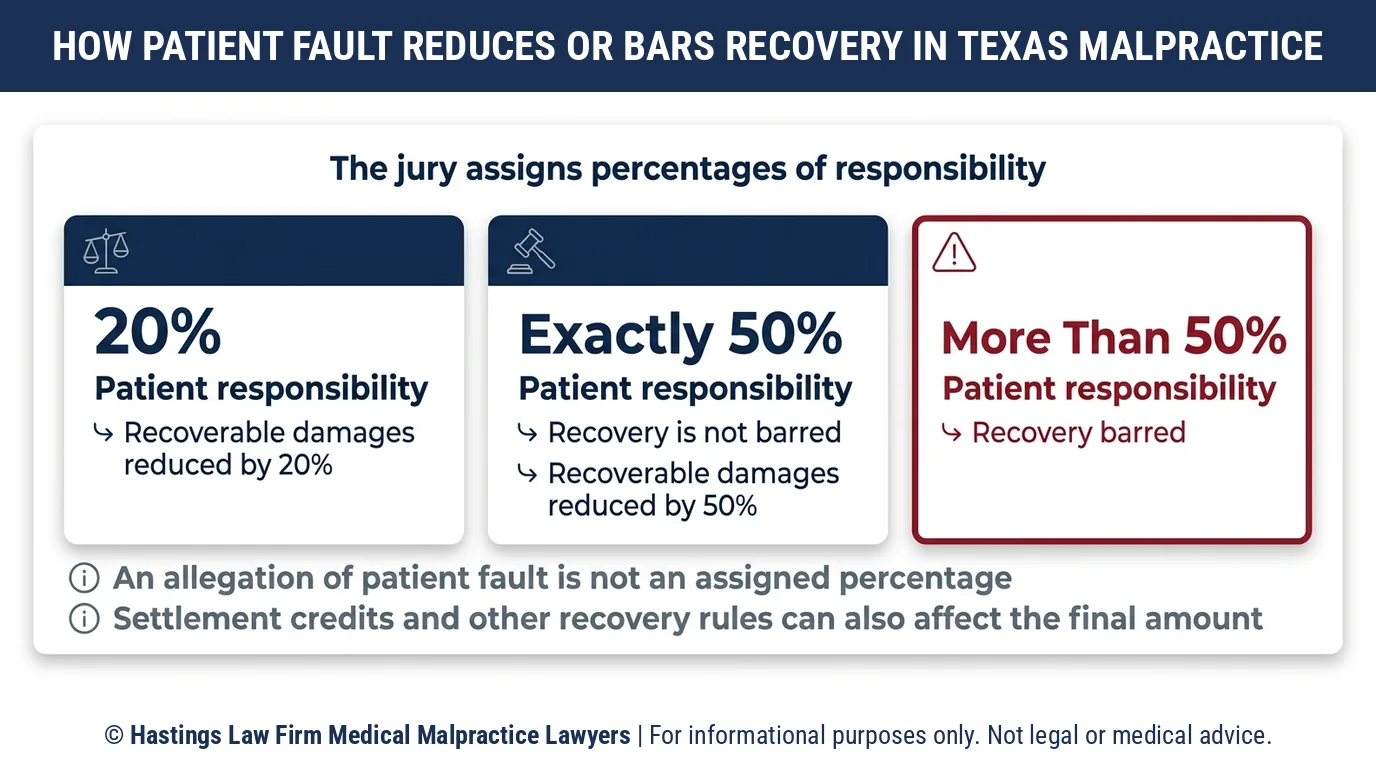
A patient who was partly at fault can still recover damages in a Texas malpractice lawsuit unless the patient’s share of responsibility is greater than 50%. Under Chapter 33 of the Texas Civil Practice and Remedies Code, §33.012 reduces the recovery by the patient’s percentage, and §33.001 bars recovery only when that percentage exceeds 50%, so a patient found exactly 50% responsible is not barred.
Many people worry that something they did, or did not do, ended their claim before it started. The defense may raise a missed follow-up appointment, discharge instructions that were not followed, or a symptom that was not mentioned when the provider took a history.
Raising those points is not the same as proving them. An allegation of patient fault is not an allocated percentage, and it does not erase a provider’s breach. The jury weighs the patient’s conduct against the providers’ conduct, and only the share it assigns reduces the recovery.
As a simple illustration, a patient found 20% responsible would have the recoverable damages reduced by 20%. Other Chapter 33 rules, including credits for settlements with other parties, can also affect the final amount. Questions about your own part in the care are answered with the records, not by assumption.
How Do You Prove Medical Malpractice in Texas?
Medical malpractice in Texas is proven with the medical records and qualified medical experts, who explain the standard of care, how it was breached, and how the breach caused the injury. Chapter 74 of the Texas Civil Practice and Remedies Code also requires an expert report, which the Supreme Court of Texas, in Bush v. Columbia Medical Center, treats as a preliminary showing distinct from the proof needed at trial.
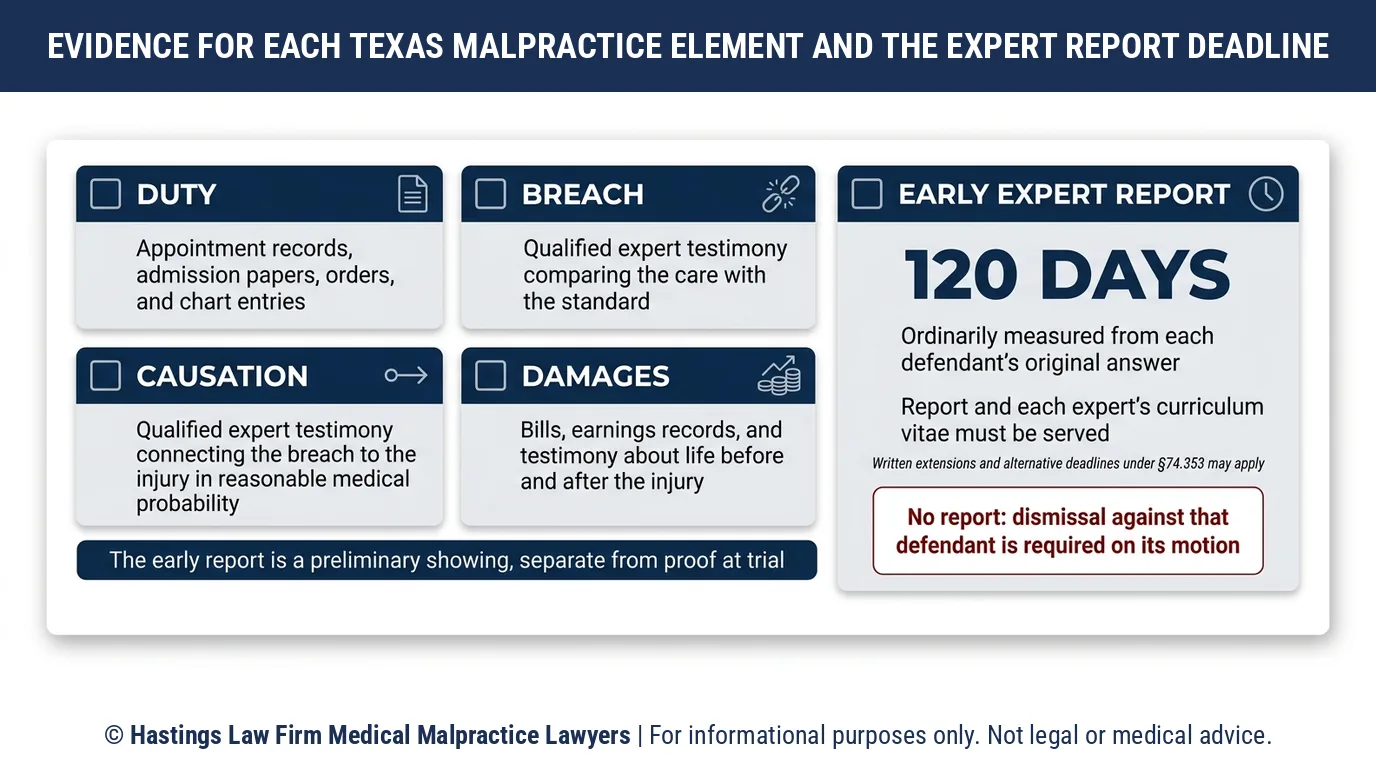
Knowing how to prove medical malpractice in Texas starts with evidence for each element:
- Duty. Appointment records, admission papers, orders, and chart entries show the relationship and what was done.
- Breach. Expert testimony sets out the standard of care and measures the care against it.
- Causation. Expert testimony connects the breach to the injury in reasonable medical probability.
- Damages. Bills, earnings records, and testimony about life before and after the injury show the losses.
Expert causation testimony is required for medical conditions outside jurors’ common knowledge, as confirmed in Gunn v. McCoy. A narrow exception exists for matters plainly within a layperson’s understanding, and that exception does not by itself remove the Chapter 74 report requirement.
Experts must meet the qualifications for their opinions under §74.401 and §74.402. Causation generally requires a qualified physician under §74.403, with exceptions for dentists, podiatrists, and chiropractors in claims against them.
Those experts also write the early report Chapter 74 requires. The expert report and each expert’s curriculum vitae, a summary of training and experience, must ordinarily be served no later than 120 days after each defendant files its original answer, subject to written extensions and the alternative deadlines in §74.353. If no report is served, the court must dismiss the claim against that defendant on its motion, and a court may grant one 30-day extension to cure a deficient report.
What is the Burden of Proof in a Texas Medical Negligence Case?
The burden of proof in a Texas medical negligence case is a preponderance of the evidence, which means the patient must show that duty, breach, causation, and damages are each more likely true than not. The Supreme Court of Texas applies that ordinary civil burden in Bustamante v. Ponte, and the bar is lower than the proof a criminal conviction requires.
Under Texas Penal Code §2.01, a criminal conviction requires proof beyond a reasonable doubt of every element of the offense. A malpractice claim does not require certainty or a calculated percentage. The expert’s causation opinion in reasonable medical probability is how the more-likely-than-not showing is made on the medical question.
Two rules sit alongside that burden. The emergency care rule changes what must be proven, willful and wanton negligence, while §74.153 keeps the burden at a preponderance. Exemplary damages carry the higher clear and convincing standard.
How Does the Defense Challenge Each Element of a Texas Medical Malpractice Claim?
The defense in a Texas medical malpractice claim can challenge duty, breach, causation, and damages, from denying that a physician-patient relationship existed to arguing that the care met the standard or that something else caused the harm. The State Bar of Texas pattern jury charge commentary explains that those arguments are judged under the governing legal standards, not by how many physicians favor a practice.
Each element draws its own kind of argument:
- Duty. The defense may argue that no physician-patient relationship formed. Records showing that care was offered and accepted answer that argument.
- Breach. Defendants can offer evidence that the care met the standard. That argument stays subject to the legal standard, since Hood v. Phillips rejected standards based on how many physicians favor a practice, such as a respectable minority or a consensus, and custom informs the evidence without being conclusive.
- Causation. The defense may point to a pre-existing condition or a known complication, or argue that the harm would have happened anyway. Defendants can offer another explanation for the harm, which Gunn v. McCoy addresses, but a known complication does not create automatic immunity. That another provider also erred does not by itself defeat causation, since a defendant need not be the sole cause.
- Damages. The defense may argue that the losses came from something else, are overstated, or are limited by the Chapter 74 caps.
- Shared fault. The defense may shift blame to another provider, to a physician who was not the hospital’s employee, or to the patient.
Some challenges are procedural. A defendant must file and serve any objections to the expert report within 21 days of the later of the report’s service or its answer, or the objections are waived. The filing deadline can also be raised as a defense.
Knowing these arguments early shapes how the records are gathered and which medical experts a claim needs.
The Hastings Law Firm Difference
Results matter, but what truly sets us apart is how we achieve them. Every verdict, every settlement, and every courtroom victory comes from one guiding promise: To treat each client’s fight for justice as if it were our own.
This balance of skill, experience, and empathy reflects our core philosophy that justice should not only compensate the injured, but also make health care safer nationwide.

What Should You Do First If You Suspect Medical Negligence in Texas?
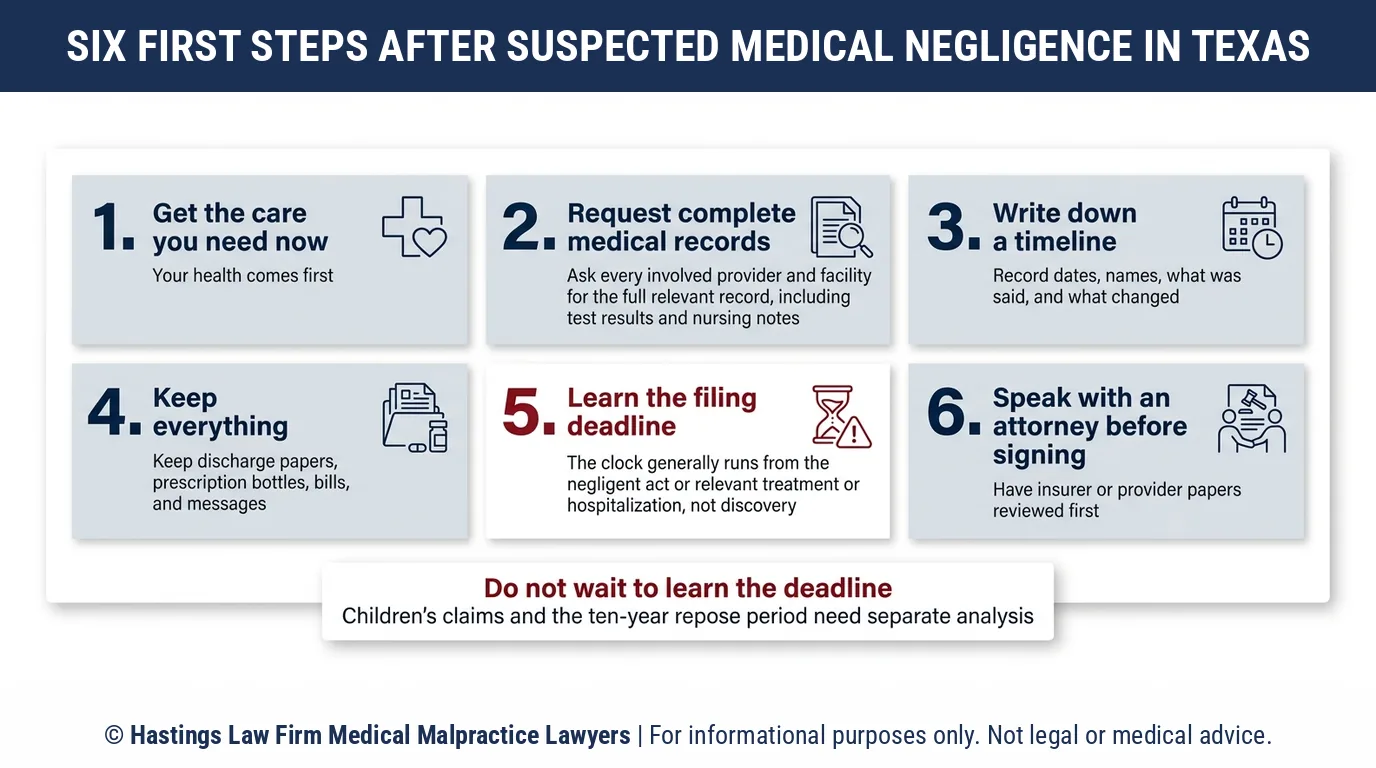
The first steps if you suspect medical negligence in Texas are to get the medical care you need, request your complete medical records, and write down what happened while the details are fresh. Keeping every document and learning the filing deadline early protects the ability to bring a claim, because the deadline is generally measured from the care itself rather than from when a problem is discovered.
Those steps, in order:
- Get the care you need now. Your health comes first, and a new provider can address what is happening today.
- Request the complete medical records. Ask each provider and facility involved for the full record of the relevant care, including test results and nursing notes.
- Write down a timeline. Dates, names, what was said, and what changed are easier to recall now than months from now.
- Keep everything. Discharge papers, prescription bottles, bills, messages, and any device involved should be kept exactly as they are.
- Learn the deadline. Texas generally measures the filing deadline from the negligent act or the relevant treatment or hospitalization, not from discovery. Children’s claims and the ten-year repose period, an outer limit on when a claim can be filed, need separate analysis. Pre-suit notice sent with the required medical authorization can add 75 days, but it must go out before the deadline expires. Our page on the Texas medical malpractice statute of limitations explains the rules.
- Talk to a medical malpractice attorney before signing anything. Papers from an insurer or a provider can affect a claim, so have them read first.
You can reach our intake team by phone or through our online contact form. A member of the team will ask about the care, when it happened, and who provided it, and we request the medical records at no cost to you.
Talk to a Texas Medical Malpractice Attorney About Your Claim
If you believe a healthcare provider’s care harmed you or someone you love, a free, confidential case review is the way to find out whether you have a claim. We listen to what you experienced, review the medical records, and give you an honest answer.
Our Texas medical malpractice lawyers are experienced in proving duty, breach, causation, and damages in claims across the state. We understand what each element asks of the medical record, and we work with medical experts who can explain the standard of care and connect a breach to the injury it caused. We know how the defense builds its case, and we prepare every claim with those arguments in mind.
Hastings Law Firm has been dedicated exclusively to medical malpractice since 2005. We work on a no-win, no-fee basis, so if we do not win the case, you pay nothing. Contact us now. Our team is here for you.
Sources
- Chapter 74 rules on health care liability claims, damage caps, and expert reports | Texas Legislature
- Windrum v. Kareh opinion stating the elements of a malpractice claim | Supreme Court of Texas
- Lake Jackson Medical Spa v. Gaytan on how a physician-patient relationship forms | Supreme Court of Texas
- Occupations Code §111.007 applying the in-person standard to telehealth services | Texas Legislature
- Pattern jury charge 50.1 defining physician negligence, archived 2014 edition | State Bar of Texas, archived by the University of North Texas
- Bustamante v. Ponte on proximate cause, medical probability, and lost chance | Justia
- Chapter 41 definitions of economic, non-economic, and exemplary damages | Texas Legislature
- Chapter 71 wrongful death beneficiaries and survival claims, §71.004 and §71.021 | Texas Legislature
- Chapter 33 proportionate responsibility, the patient fault bar, and joint liability | Texas Legislature
- Baptist Memorial Hospital System v. Sampson on hospital liability through ostensible agency | FindLaw
- Bush v. Columbia Medical Center on the Chapter 74 expert report standard | Supreme Court of Texas
- Gunn v. McCoy on when expert causation testimony is required | Supreme Court of Texas
- Penal Code §2.01 requiring proof beyond a reasonable doubt for conviction | Texas Legislature
- Pattern jury charge commentary on rejected standards and relevant skills, 2014 edition | State Bar of Texas, archived by the University of North Texas

This content was researched and written by the Hastings Law Firm editorial team, which includes attorneys, medical professionals, and experienced researchers. Our writing is informed by internal knowledge and practical experience, and we cross-check critical details against authoritative sources cited throughout. Every piece undergoes human-led fact-checking and legal review. Because legal and medical information can change, if you spot an error, please contact us. Learn more about our content standards and review process on our editorial policy page.

Tommy Hastings, founder of Hastings Law Firm, is a board-certified personal injury trial lawyer (by the Texas Board of Legal Specialization) dedicated exclusively to healthcare injury cases. Since 2001, he has represented injured patients and families in litigation against major hospital systems, pharmaceutical companies, and negligent healthcare providers nationwide. He has handled numerous high-profile cases that have drawn national media attention and resulted in multi-million dollar recoveries.
