


Proving Causation in a Texas Medical Malpractice Case
Proving causation is often the hardest part of a medical malpractice claim because a clear medical error is not enough without a direct link to the injury. Texas law focuses on whether the harm would have happened without the negligence and whether the general risk was foreseeable to a reasonable physician. Disputes often center on other possible causes such as pre existing conditions or later events. Complex cases may involve multiple providers and shared responsibility. If you or a loved one were harmed or worse due to medical malpractice causation issues in Texas, contact Hastings Law Firm for a free, confidential case review.

Last Updated: October 21, 2026
The Critical Link Between Medical Error and Patient Injury
What You Should Know About Claims in Texas:
- Recovery can be blocked even when an error is clear if the harm cannot be tied directly to the provider conduct.
- Options can narrow when the defense points to an independent cause such as a pre existing condition or a later event to break the causal chain.
- Liability can be divided among multiple providers when separate errors contribute to the same outcome.
- A claim can be lost permanently if a required expert report is not served on time.
- Causation opinions can be rejected when they are framed as possibility rather than reasonable medical probability.
- A case can be dismissed when an expert report is too vague to explain the standard of care breach and causal link.
- Recovery may be limited in delayed diagnosis cases because Texas courts are generally restrictive on loss of chance theories.
- The ability to prove causation can be undermined by waiting too long because medical review and records gathering may not be completed before the legal time limit expires.

A Healthcare Focused Law Firm
Not every medical mistake automatically gives rise to a legal claim. The hardest part of proving causation in a Texas medical malpractice case is establishing a direct connection between the provider’s error and the harm you or your loved one suffered.
This involves identifying the mechanism of injury, which is the specific biological or clinical pathway through which the negligence produced the damage. We support this with timing evidence showing the injury followed the error in a medically consistent sequence.
Many otherwise strong cases fall apart at this connection. The provider may have clearly made an error, but if you cannot show how that error caused the specific injury, the case will not survive.
If you believe a medical mistake led to serious harm, we can review what happened. We help you understand whether the evidence supports a claim.
Defining Proximate Cause Under the Texas Medical Liability Act
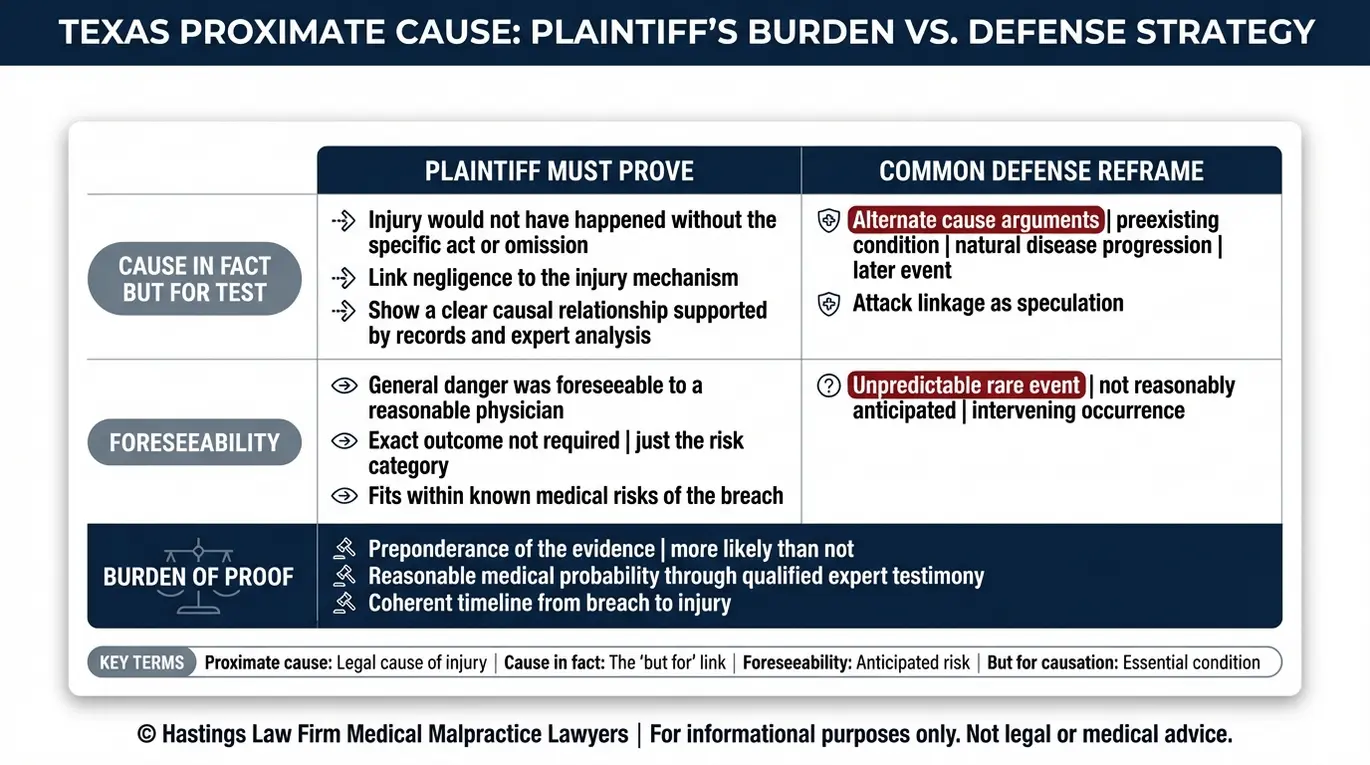
Proximate cause in Texas medical malpractice law requires proving two distinct elements: cause-in-fact, meaning the negligence was a substantial factor in causing the injury and the injury would not have occurred without it, and foreseeability, meaning a reasonable physician should have anticipated the danger. Both must be established by a preponderance of the evidence, which means you must show it is more likely than not that the negligence led to the injury.
This standard is distinct from criminal law’s “beyond a reasonable doubt.” You do not need to eliminate all uncertainty, but you must tip the scales in favor of your claim. Understanding how these two elements work together helps when proving causation in any Texas medical malpractice case.
Cause-in-Fact (Substantial Factor and But-For)
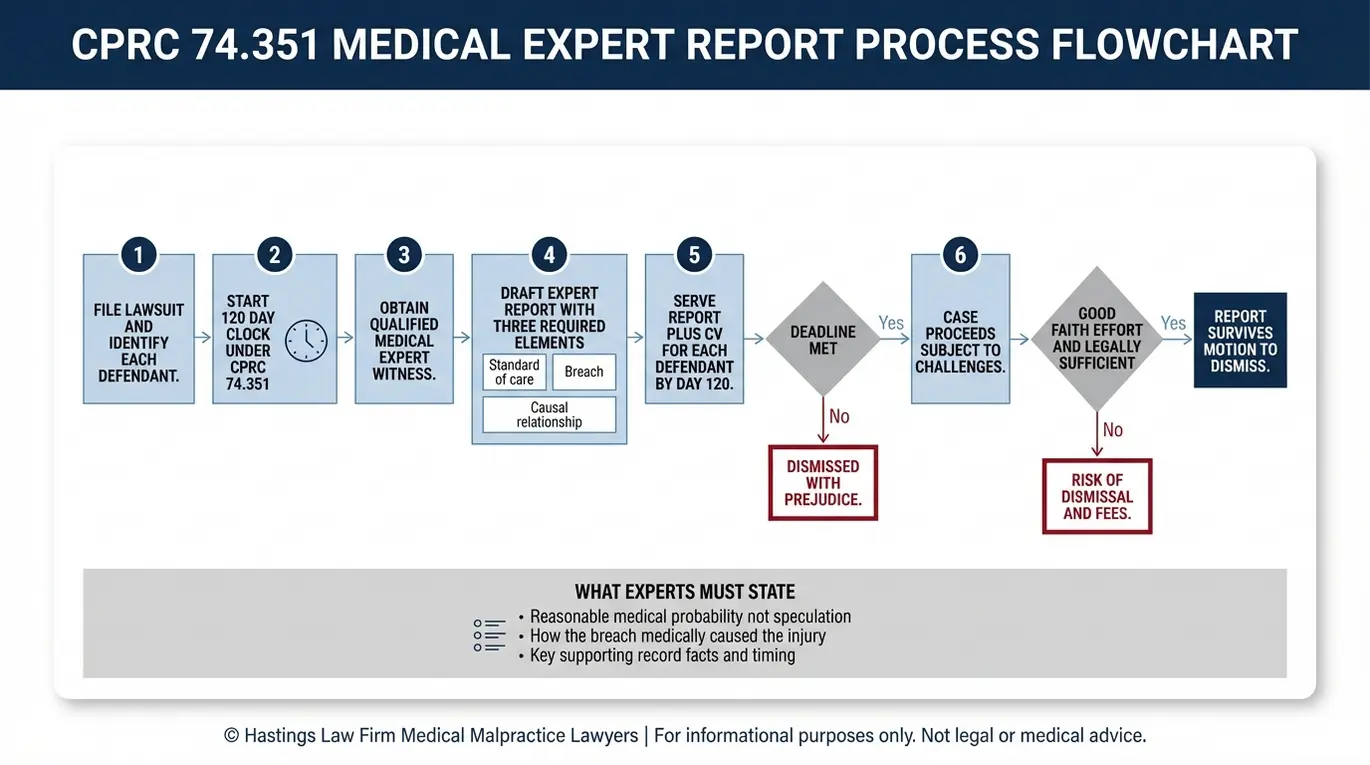
Cause-in-fact has two parts in Texas. The negligence must have been a substantial factor in bringing about the injury, and the injury would not have happened without it, which is the “but-for” part. For example, if a surgeon operated on the wrong side and damaged a healthy organ, the damage would not have happened but for that specific error. Texas courts have reinforced this standard consistently. In *A.W. v. Lancaster*, the court examined whether the patient’s expert evidence was legally sufficient to establish that a breach of duty directly caused the injury, showing how Texas applies this test. Foreseeability Foreseeability does not require the physician to have predicted the exact injury. It requires that the general type of danger was a known risk of the negligent act or omission. This is an objective standard based on what a prudent doctor in the same field would know. A doctor who fails to monitor a patient on a high-risk medication does not need to foresee the precise organ that fails. They only need to recognize that unmonitored use of that drug carries a foreseeable risk of serious harm. Here is how these two elements compare: Both elements must be proven together. Establishing one without the other is not enough to satisfy the proximate cause standard under the Texas Medical Liability Act. One of the most common defense tactics is to argue that something other than the doctor’s negligence caused the injury. Defense attorneys frequently point to a superseding cause, an independent event or condition that allegedly broke the chain between the original error and the harm. Pre-existing conditions, sometimes called comorbidities, are a favorite target. If a patient had diabetes, heart disease, or another chronic illness, the defense may claim that the underlying condition caused the outcome. In some cases, they argue that a later medical event or the patient’s own conduct was the true cause. These arguments do not automatically defeat a claim. Our team, which includes former defense attorneys and in-house medical professionals, anticipates these tactics and works to demonstrate that the provider’s negligence was a direct and foreseeable cause of the injury. Under Texas Civil Practice and Remedies Code (CPRC) §74.351, plaintiffs must ordinarily serve an expert report and the expert’s curriculum vitae within 120 days of the date each defendant’s original answer is filed, unless the deadline is extended in writing or Section 74.353 provides an alternative. The report details the standard of care, the breach, and the causal relationship between the failure and the injury. This requirement is one of the most consequential procedural hurdles when proving causation in a Texas medical malpractice case. The 120-Day Deadline Missing this deadline is not a technicality. The ordinary deadline can be extended by written agreement of the affected parties, and Section 74.353 provides alternative deadlines in qualifying circumstances. If no report is served on a defendant in time, the court must dismiss the claim against that defendant with prejudice when the defendant asks, meaning it cannot be refiled, and must award that defendant its reasonable attorney’s fees and court costs. A report that was served on time but falls short is different, because the court can grant one 30-day extension to cure it.
This makes early case preparation important. At Hastings Law Firm, we begin our medical investigation immediately so that the expert report is ready well before the deadline. Reasonable Medical Probability Expert testimony on causation cannot be based on speculation or possibility. At trial, the expert must establish to a reasonable medical probability, meaning more likely than not, that the provider’s negligence caused the injury. The earlier expert report is a lower bar. It must explain how and why the negligence caused the harm, based on the facts, without needing trial-level proof or any particular wording.
A qualified medical expert witness often reaches this conclusion through a process called differential diagnosis. This is a rule-in, rule-out analysis that systematically eliminates other potential causes of the injury until the most probable one remains. Surviving a Motion to Dismiss Expert reports must represent a good-faith effort to comply with the Chapter 74 requirements. Courts evaluate whether the document provides enough detail on the standard of care, breach, and causation to inform the defendant of the specific conduct at issue. A vague report can be found insufficient when a defendant objects in time, though the court can grant one 30-day extension to cure it.
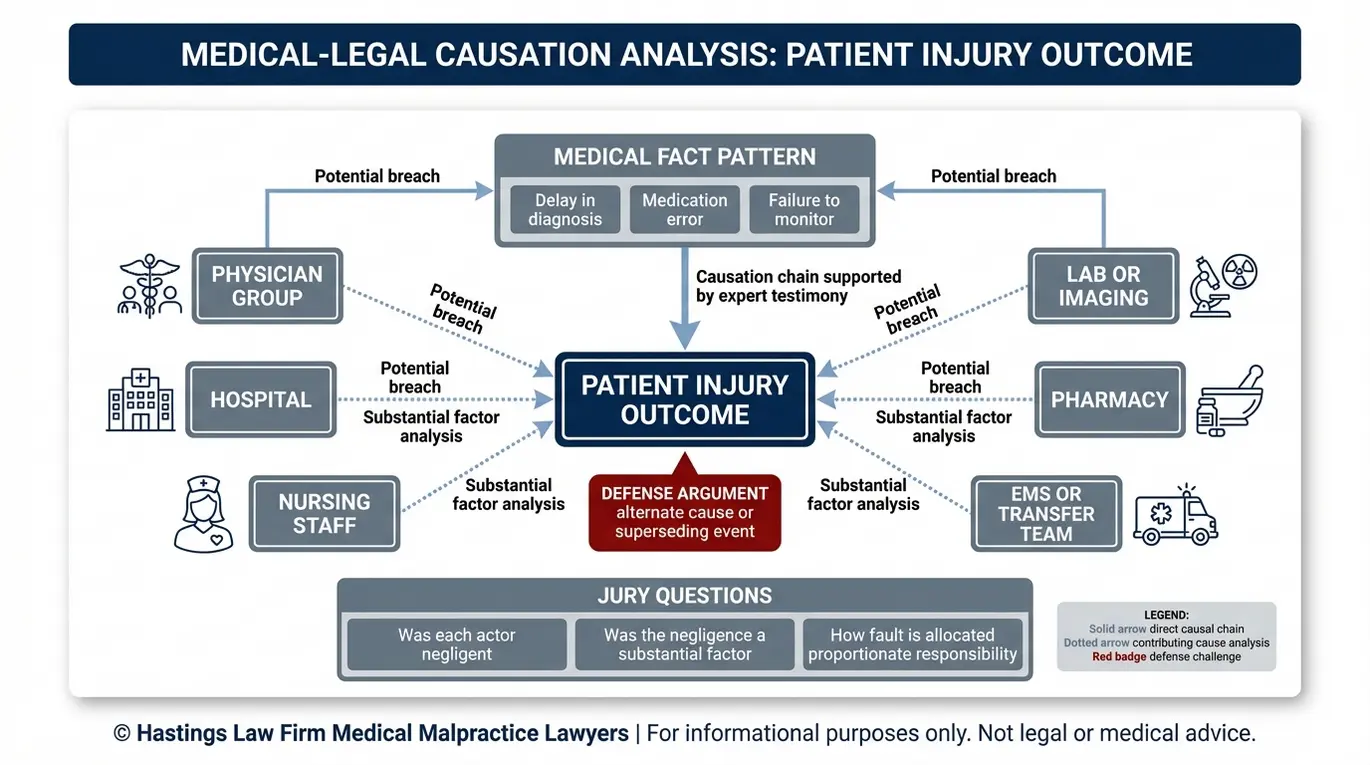
A Chapter 74 expert report must address each of these elements: Results matter, but what truly sets us apart is how we achieve them. Every verdict, every settlement, and every Texas courtroom victory comes from one guiding promise: To treat each client’s fight for justice as if it were our own. This balance of skill, experience, and empathy reflects our core philosophy that justice should not only compensate the injured, but also make health care safer nationwide. The substantial factor test is used when multiple causes or providers may have contributed to an injury, allowing a jury to find a defendant liable if their negligence was a significant factor in bringing about the harm, even if it was not the sole cause. This test is particularly relevant in cases involving concurrent causes and multiple defendants, such as when both a hospital and a treating physician made separate errors that contributed to the same outcome. Multiple Defendants and Proportionate Responsibility In multi-party liability cases, Texas applies a proportionate responsibility framework. Each defendant’s share of fault is assessed by the jury, and liability is divided accordingly. Proving causation in these situations requires showing that the negligence elements for each provider independently meet the substantial factor threshold. Data from the Texas Department of State Health Services Health Safety Network can help establish patterns of care and institutional factors that may support claims against facilities. The Loss of Chance Doctrine Some cases involve situations where a delayed diagnosis reduced a patient’s chance of survival rather than directly causing a new injury. The loss of chance doctrine addresses whether a provider can be held liable for reducing an already uncertain outcome. Texas courts have generally been restrictive on this issue, and we address it further in the FAQ below. Our team’s in-house medical staff and national network of medical expert witnesses allow us to trace the causal relationship and each provider’s role. This helps in building the evidence needed to establish proportionate responsibility across multiple defendants. The burden of proving causation in a Texas medical malpractice case is high. Strict deadlines, qualified expert testimony, and detailed medical evidence are all required before a case can move forward. These are not obstacles you need to face alone. Founded by board-certified trial attorney Tommy Hastings, our firm has focused exclusively on medical malpractice since 2005. Our team includes board-certified trial attorneys, former defense counsel, and in-house medical professionals who work together to build the causal link between a provider’s error and your injury. We prepare every case as if it is going to trial, and that preparation starts from the very first call. There is no fee unless we recover compensation for you. If you or a loved one suffered harm that you believe was caused by a medical mistake, contact us to schedule a free case evaluation with a board-certified attorney. We will review your records, explain your options, and help you decide on a path forward.
Superseding Cause and Defense Tactics
Fulfilling the Chapter 74 Expert Report Requirements
The Hastings Law Firm Difference

Applying the Substantial Factor Test in Complex Cases
Contact the Texas Healthcare Malpractice Attorneys at Hastings Law Firm Today for Help
Frequently Asked Questions About Medical Malpractice Causation in Texas


This content was researched and written by the Hastings Law Firm editorial team, which includes attorneys, medical professionals, and experienced researchers. Our writing is informed by internal knowledge and practical experience, and we cross-check critical details against authoritative sources cited throughout. Every piece undergoes human-led fact-checking and legal review. Because legal and medical information can change, if you spot an error, please contact us. Learn more about our content standards and review process on our editorial policy page.

Gabe Sassin has focused exclusively on medical malpractice law since 2007. After spending more than a decade as a malpractice defense attorney, he knows exactly how the other side works. He has seen firsthand how healthcare providers, insurers, corporate defendants, and their legal teams think, prepare, and build their defense against claims. That knowledge works for the people who need it most today, injured patients and their families. His unique experience shapes everything he writes, giving readers a look at how these cases actually work from someone who has handled them from both sides.
