


What to Do If You Suspect Medical Malpractice in Arizona
Living with a serious injury is hard enough without the worry that the medical care itself may have caused it. Patients and families in that position are often managing appointments, pain, and unexpected costs while questions about what happened go unanswered. In the middle of recovery, it is rarely clear what deserves attention first and what can wait. Taking things calmly and in order protects the healing that matters most and the answers a family may want later. A clear sense of what to do if you suspect medical malpractice in Arizona makes the road ahead more manageable.

Last Updated: November 4, 2026
What You Should Know If You Suspect Medical Malpractice in Arizona:
- The first steps to take if you suspect medical malpractice in Arizona are to get the care you still need, write down what happened, request your records from every provider, and keep every document and message.
- An Arizona medical malpractice lawsuit generally must be filed within two years, counted from when the patient knew or reasonably should have known the injury may have been caused by negligence.
- A claim against an Arizona public hospital or other public entity needs a written notice of claim within 180 days that states a specific dollar amount.
- Under A.R.S. 12-2293, an Arizona provider must respond within 30 calendar days to a written request for records made for a lawsuit.
- Under A.R.S. 12-2605, a provider’s apology, or even an acknowledgment of responsibility, after an unexpected outcome cannot be used in an Arizona court as an admission of fault.
- A hospital grievance or an Arizona Medical Board complaint does not automatically pause the lawsuit deadline, and board discipline is separate from a malpractice lawsuit seeking compensation.
- Under A.R.S. 12-563, an Arizona malpractice claim must show that care fell below the accepted standard and caused the injury, usually through a qualified medical expert, since a bad outcome alone is not enough.
- A valid settlement and release can end the Arizona claims it covers, so have a lawyer read anything a provider or insurer asks you to sign.
- Hospitals, other providers, and AHCCCS may hold liens on an Arizona malpractice recovery under A.R.S. 33-931 and A.R.S. 36-2915.
What Are the First Steps to Take When Medical Care Goes Wrong in Arizona?
The first steps to take if you suspect medical malpractice in Arizona are to get the medical care you still need, write down what happened while it is fresh, request your records from every provider, and keep every document and message. Have the care reviewed well before the filing deadline, which is generally two years under Section 12-542 of the Arizona Revised Statutes, counted from when the claim arises.
The steps to take after medical malpractice follow that order because your health comes first. Recovery and further treatment cannot wait on questions about the past. Details about dates, conversations, and symptoms fade with time, and the notes and records you gather pin down the timeline any later review depends on.
You can take every one of these steps before anyone knows whether the care was negligent. They preserve the facts that will answer that question, and they protect your options while you recover.
Keep going to your appointments and follow your treating provider’s instructions, even while you question the care that came before. A second opinion from a provider who was not involved can help you understand your condition and the treatment it needs now. Records from that ongoing care also show how far the injury reaches, which matters if the earlier treatment is ever examined.
Certain experiences often lead patients and families to ask whether that earlier treatment went wrong, such as an outcome far worse than anyone expected, a diagnosis that came long after the first symptoms, a new provider saying the care fell short, or questions that never got a clear answer. Any one of them is reason enough to start writing things down.
What Should You Write Down and Save After a Suspected Medical Error in Arizona?
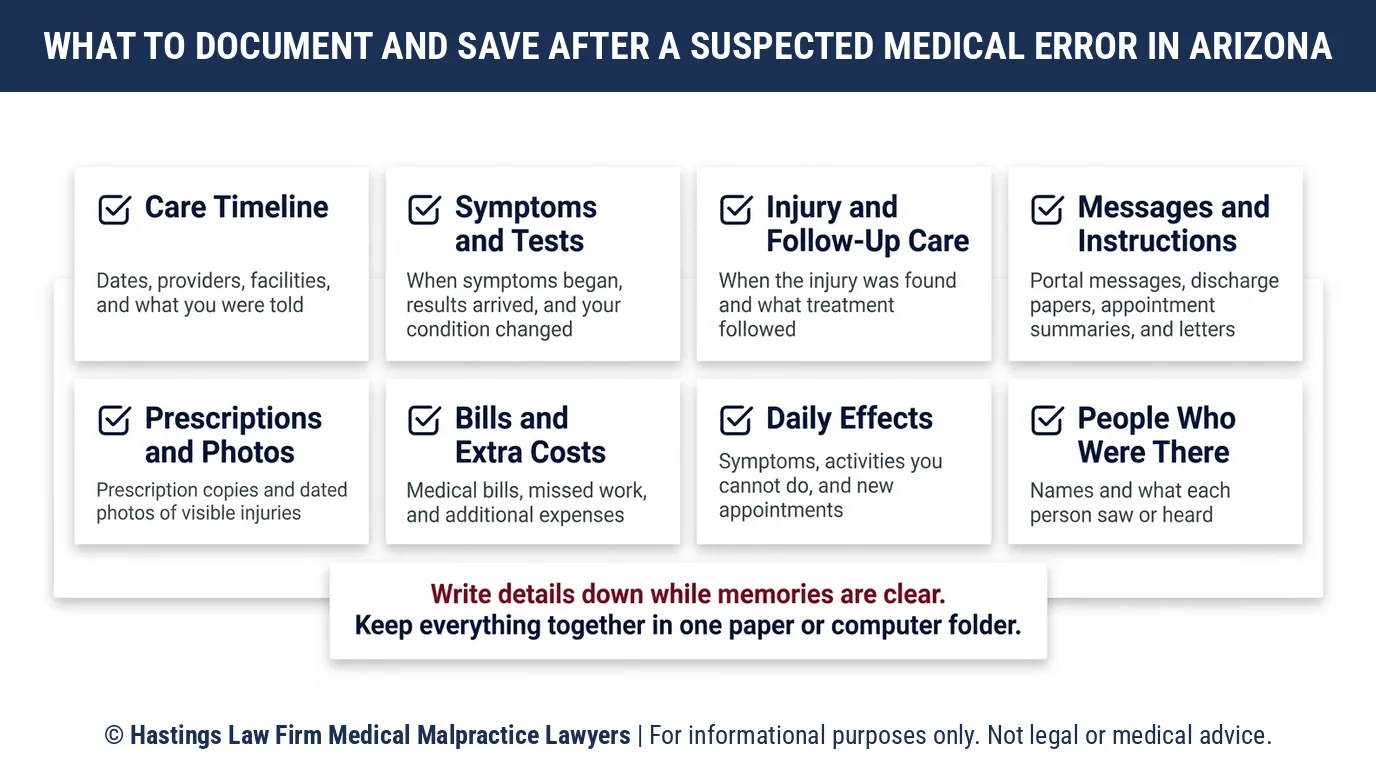
Write a dated timeline of the care after a suspected medical error in Arizona, covering when symptoms began, each provider and facility, what you were told, which tests were done, when the injury was found, and what treatment followed. Save every message and paper from that care with it, including the bills, which Arizona law treats as their own category of payment records under A.R.S. 12-2291.
Fill in the timeline with when test results came back and when your condition changed. Keep it in one folder, on paper or on a computer, with everything else the care put in writing, such as patient portal messages, discharge papers, medication instructions, appointment summaries, and letters. Copies of prescriptions and dated photos of any visible injury go with them.
That folder is also the place for a running record of how the injury affects daily life, added as things happen. Note your symptoms, the things you cannot do, missed work, extra costs, and each new appointment.
Those notes should name the people involved as well, from the providers to the family members or friends who were with you. Write down what each person saw or heard while memories are still clear.
How Do You Request Your Medical Records and Preserve Evidence in Arizona?
To get your medical records in Arizona, ask each provider and facility in writing for the complete medical record and the billing records, and keep any physical evidence and original papers just as they are. Under A.R.S. 12-2293, a patient or the patient’s health care decision maker can request copies, and the provider must respond within 30 calendar days to a request made for a lawsuit.
Ask for diagnostic images such as x-rays by name, since a chart copy may not include them. Request older records promptly too, because Arizona sets only minimum periods for keeping them.
Treat physical evidence with the same care, including medication bottles and labels, clothing, and any devices or equipment from your treatment. Store it all somewhere safe and unchanged, with copies of documents kept apart from the originals.
Should You Talk to Your Doctor or Hospital About a Suspected Medical Mistake in Arizona?
Talking to your doctor or hospital about a suspected medical mistake in Arizona can help you understand the care, and you can keep getting treatment there while you ask. Under A.R.S. 12-2605, a provider’s apology, expression of sympathy, or even acknowledgment of responsibility after an unexpected outcome cannot be used in court as an admission of fault. Proof of fault has to come from the records and other evidence instead.
Keep those conversations focused on your care and recovery. After each one, add who said what and when to your timeline.
A different kind of conversation starts when someone from the hospital’s risk management office or an insurer asks for a statement, offers to write off bills, or offers a payment. Take time before answering, and have a lawyer read any paperwork before you sign it.
If you want the hospital itself to look into what happened, you can file a complaint with it, known as a grievance. Under the federal patient rights rule, 42 CFR 482.13, a hospital that takes part in Medicare must have a process for grievances, and you or your patient representative can raise one in writing or verbally. The hospital must review it and send a written decision explaining the steps it took and what it found. Nothing in that rule pauses the lawsuit deadline while the review runs.
Should You File a Complaint With the Arizona Medical Board?
Filing a complaint with the Arizona Medical Board makes sense when you want a medical doctor’s conduct looked into, because the board can investigate and discipline that doctor. The board does not award malpractice compensation, though, and filing a complaint does not extend the lawsuit deadline.
To file, download the complaint form for doctors of medicine (MDs) from the board’s complaint forms page and mail or fax it. Arizona has separate complaint boards for osteopathic physicians, physician assistants, and nurses, so check the provider’s credentials first. Complaints about a hospital or other licensed facility go to the Arizona Department of Health Services.
How Do You Find Out If You Have a Medical Malpractice Case in Arizona?
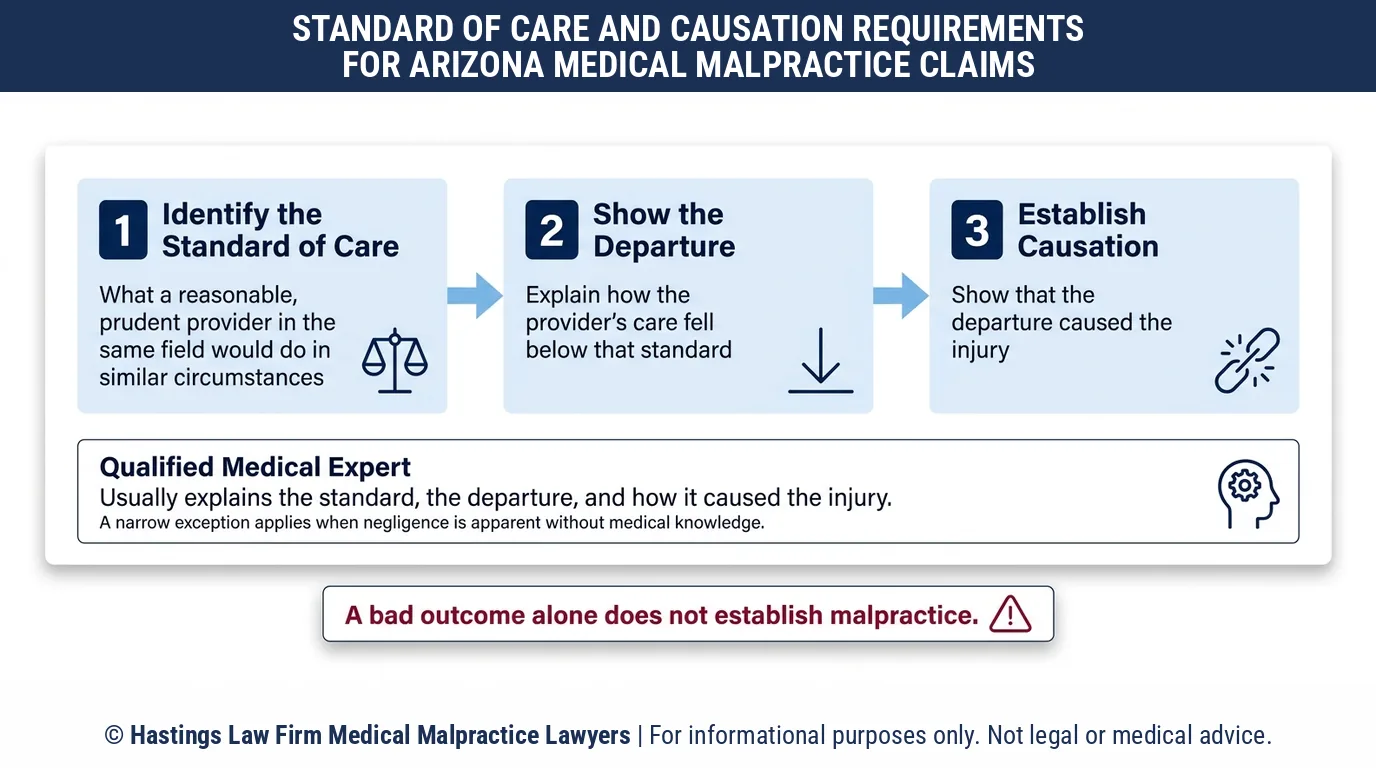
You find out whether you have a medical malpractice case in Arizona by having the care reviewed against what the law requires a claim to prove. Under A.R.S. 12-563, that means showing the provider fell below the accepted standard of care and that the failure caused the injury. A bad outcome alone does not establish malpractice.
The standard of care is the care, skill, and learning expected of a reasonable, prudent provider in the same field acting in similar circumstances. Causation, meaning the treatment caused the harm, is a separate part of the claim, covered in proving causation in an Arizona medical malpractice case.
Proof of both usually comes from a qualified medical expert, who explains what proper care required, how the provider departed from it, and how it caused the injury. A narrow exception applies when the negligence is apparent without medical knowledge. A patient suing a health care professional must certify whether expert testimony is needed and, if it is, serve the expert’s sworn opinion, called a preliminary expert opinion affidavit under A.R.S. 12-2603, early in the case.
How Long Do You Have to File a Claim for Medical Negligence in Arizona?
An Arizona medical negligence lawsuit generally must be filed within two years. Under the Arizona Supreme Court’s decision in Walk v. Ring, that clock starts when the patient knew or reasonably should have known enough to suspect the injury was caused by negligence, not necessarily on the date of treatment. The two-year period does not wait for an expert to confirm malpractice.
For a patient who was under 18 when the claim arose, the two-year period is paused until the patient turns 18, then runs from there. Claims against a public hospital or other public entity require a much earlier first step. Under A.R.S. 12-821.01, a written notice of claim must be filed within 180 days after the claim arises, stating the facts behind it and a specific dollar amount, and an estimate or a range does not meet that requirement.
What Mistakes Can Weaken a Medical Malpractice Claim in Arizona?
The mistakes that can weaken a medical malpractice claim in Arizona are missing the applicable filing deadline, throwing away relevant medical records or messages, posting statements online that contradict your claim, and signing a settlement release or accepting a payment that settles your claim before a lawyer has read the paperwork. The Arizona Supreme Court enforces valid settlements as contracts, so a signed release can end the claims it covers.
Social media posts raise a different risk, because they can be read out of context. Keep your notes private and avoid posting details, accusations, or timelines about what happened. Save those conversations for your treating providers, close family, and a lawyer.
Who Pays Your Medical Bills After Medical Negligence in Arizona?
Medical bills after medical negligence in Arizona can be paid back out of any recovery, because hospitals, other providers, and the Arizona Health Care Cost Containment System (AHCCCS) may hold liens, which are legal claims against that money. Hospitals and providers hold them under A.R.S. 33-931 and AHCCCS under A.R.S. 36-2915, so who is repaid depends on who covered your care.
While a claim is open, your own health insurance usually keeps paying for covered care, Medicare may make conditional payments, and AHCCCS can pay when no other payer is available.
Other benefit providers face a limit, because A.R.S. 12-565 restricts their repayment from the patient unless another statute allows it. Medicare and self-funded employer health plans follow federal repayment rules, so have each claim checked before any money is paid out.
The Hastings Law Firm Difference
Results matter, but what truly sets us apart is how we achieve them. Every verdict, every settlement, and every courtroom victory comes from one guiding promise: To treat each client’s fight for justice as if it were our own.
This balance of skill, experience, and empathy reflects our core philosophy that justice should not only compensate the injured, but also make health care safer nationwide.

When is the Right Time to Talk to a Lawyer About Your Medical Care in Arizona?
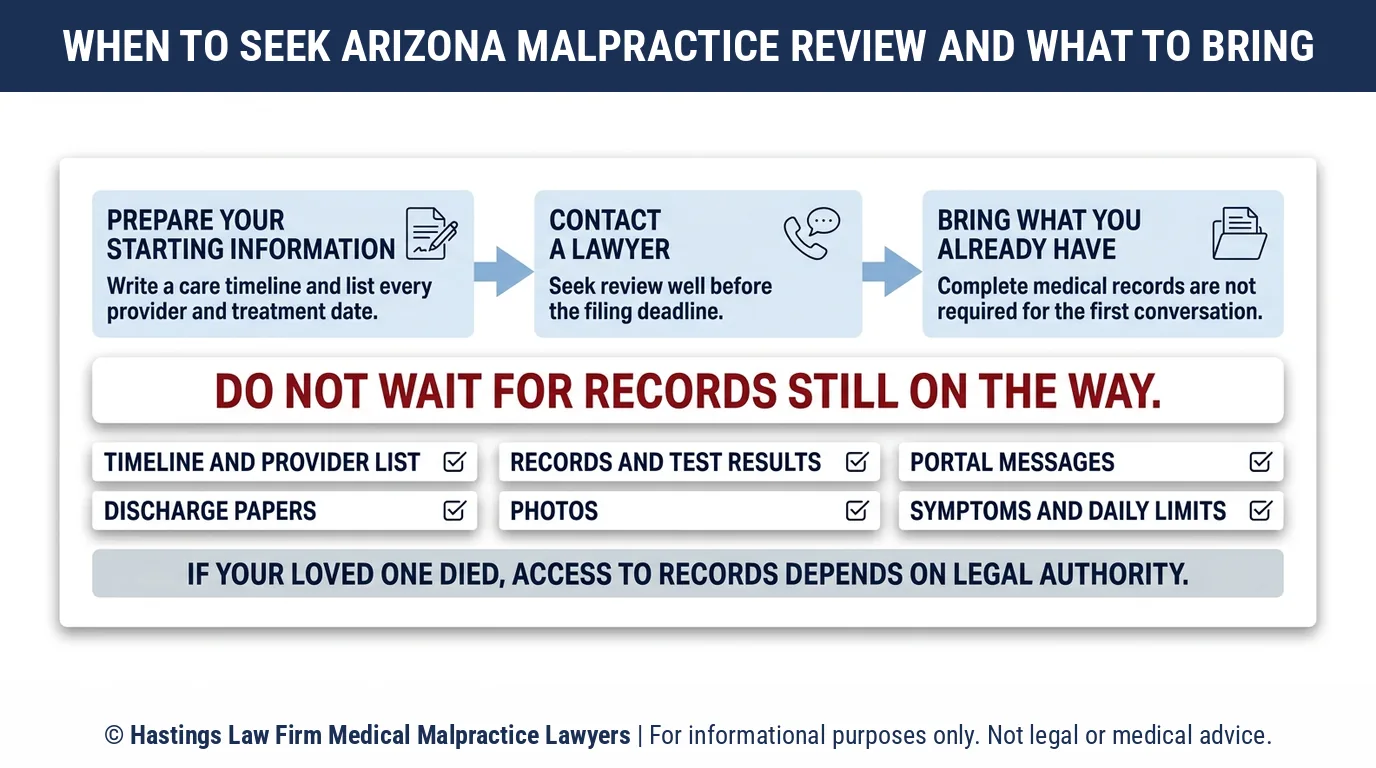
The right time to talk to a medical malpractice lawyer in Arizona is as soon as you have a written timeline of the care and a list of every provider and date of treatment, and well before the filing deadline. Medical records still on the way are no reason to wait.
A lawyer can request those records from each provider with your signed authorization under A.R.S. 12-2294, then arrange a medical review of the care. That review begins with what you bring to the first conversation. Gather the timeline, the names of the providers and facilities, any records and test results already in hand, portal messages, discharge papers, photos, and notes on current symptoms and daily limits. Together they show what happened and which records still need to be requested.
The legal work after that is demanding. Arizona malpractice claims carry strict deadlines, expert requirements, and an early sworn affidavit, and falling short on any of them can put the claim at risk of dismissal. Those requirements are a good reason to bring a claim with a lawyer, who handles each step while you focus on recovery.
For a family whose loved one died, the steps differ. A medical malpractice wrongful death claim generally must be filed within two years of the death, and A.R.S. 12-612 allows the spouse, a child, a parent or guardian, or the personal representative of the estate to bring it. Getting the records then depends on legal authority, such as appointment as personal representative through probate or a family member’s priority under Arizona’s records law.
Talk to an Arizona Medical Malpractice Attorney About What Happened
Hastings Law Firm performs a free, confidential case review for patients and families in Arizona who believe medical care went wrong. We listen to what happened, request and review the medical records, and give you an honest answer about whether there is a claim.
Our medical malpractice lawyers are experienced in helping people across the state take the first steps after a suspected medical error. We understand how hard it is to manage ongoing care, mounting bills, and unanswered questions all at once.
Hastings Law Firm has been dedicated exclusively to medical malpractice since 2005. If we take your case, we work on a contingency fee, so there is no fee unless we win, and we advance the costs of building the claim. Contact us now. Our team is here for you.
Sources
- A.R.S. 12-542, Arizona’s two-year limit for injury lawsuits | Arizona State Legislature
- A.R.S. 12-2291, definitions of medical records and payment records | Arizona State Legislature
- A.R.S. 12-2293, patient requests for medical and payment records | Arizona State Legislature
- A.R.S. 12-2605, provider apologies not admissible as admissions of fault | Arizona State Legislature
- 42 CFR 482.13, hospital patient rights and grievance process | Electronic Code of Federal Regulations
- MD complaint form and filing instructions for Arizona doctors | Arizona Medical Board
- A.R.S. 12-563, what a medical negligence claim must prove | Arizona State Legislature
- A.R.S. 12-2603, preliminary expert opinion affidavit in health care cases | Arizona State Legislature
- Walk v. Ring, when an Arizona malpractice claim’s clock starts | CourtListener
- A.R.S. 12-821.01, 180-day notice of claim against public entities | Arizona State Legislature
- Robertson v. Alling, Arizona Supreme Court on enforcing settlements and releases | Arizona Judicial Branch
- A.R.S. 33-931, health care provider liens on injury recoveries | Arizona State Legislature
- A.R.S. 12-2294, releasing medical records to a lawyer or third party | Arizona State Legislature
- A.R.S. 12-612, who may bring an Arizona wrongful death claim | Arizona State Legislature

This content was researched and written by the Hastings Law Firm editorial team, which includes attorneys, medical professionals, and experienced researchers. Our writing is informed by internal knowledge and practical experience, and we cross-check critical details against authoritative sources cited throughout. Every piece undergoes human-led fact-checking and legal review. Because legal and medical information can change, if you spot an error, please contact us. Learn more about our content standards and review process on our editorial policy page.

Tommy Hastings, founder of Hastings Law Firm, is a board-certified personal injury trial lawyer (by the Texas Board of Legal Specialization) dedicated exclusively to healthcare injury cases. Since 2001, he has represented injured patients and families in litigation against major hospital systems, pharmaceutical companies, and negligent healthcare providers nationwide. He has handled numerous high-profile cases that have drawn national media attention and resulted in multi-million dollar recoveries.
