


How Do You File a Complaint Against a Doctor in Arizona?
Reporting a doctor is seldom something a patient or family expects to do. It usually follows care that left someone hurt or worse, or a visit that ended with a lasting sense that something went wrong. A complaint asks someone with authority to look closely at that care, and it is one of the ways medicine checks its own work for the patients who come next. Knowing how to file a complaint against a doctor in Arizona, and what happens next, helps the concern reach the people who can act on it.

Last Updated: November 4, 2026
What You Should Know About Filing a Complaint Against a Doctor in Arizona:
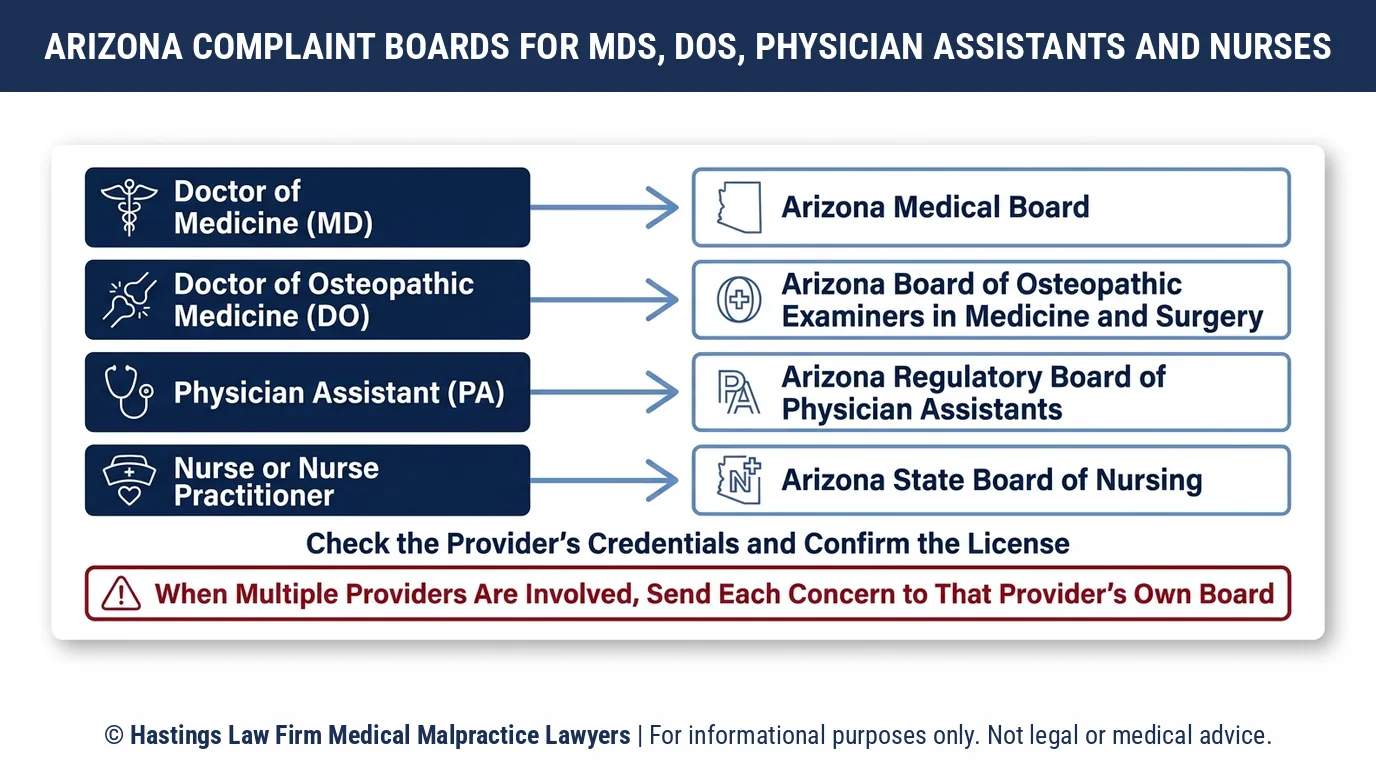
- A complaint about an Arizona provider goes to the board that licensed them, which is the Arizona Medical Board for an MD, the Arizona Board of Osteopathic Examiners in Medicine and Surgery for a DO, the Arizona Regulatory Board of Physician Assistants for a PA, and the Arizona State Board of Nursing for a nurse or nurse practitioner.
- Any person can report a concern about an MD to the Arizona Medical Board under A.R.S. § 32-1451, using the board’s MD complaint form sent by mail or fax, and no complaint-filing fee is listed.
- The Arizona Medical Board generally cannot act on conduct that happened more than four years before it receives the complaint, with exceptions that include malpractice settlements or judgments, sexual misconduct, and impairment while practicing.
- Under A.R.S. § 32-1401(27), unprofessional conduct by an Arizona MD includes gross negligence, repeated negligence, or negligence resulting in harm to a patient, but not every disappointing outcome is unprofessional conduct.
- After an Arizona Medical Board complaint is filed, the physician is notified of what it says, and a person whose complaint the Executive Director dismisses can ask the board in writing to review it, generally within 30 days of being told in person or 35 days from the date on a mailed notice.
- Outcomes of an Arizona Medical Board complaint range from dismissal and a nondisciplinary advisory letter to a letter of reprimand, probation, suspension, and revocation of the doctor’s license.
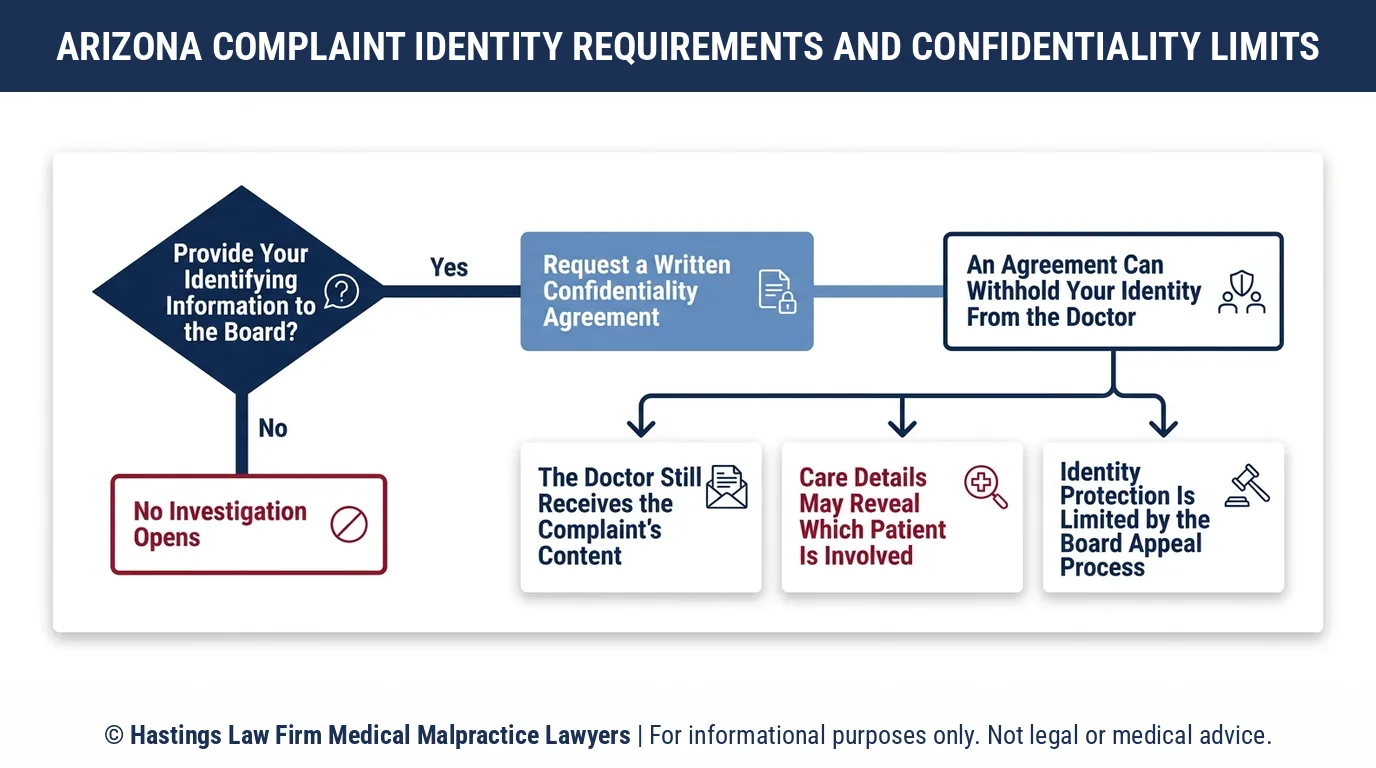
- The Arizona Medical Board will not open an investigation without identifying information about the person filing, but that person can ask for a written agreement to withhold it from the doctor.
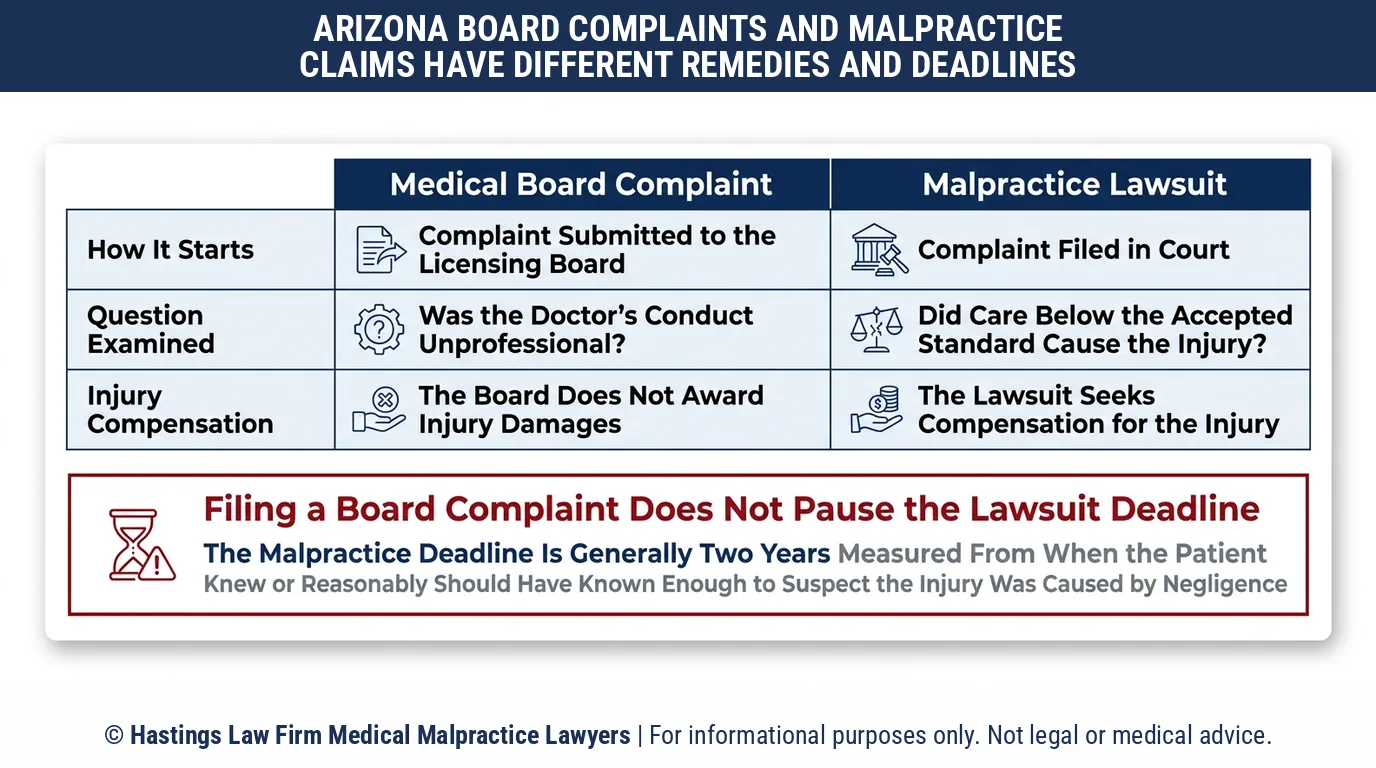
- A board complaint is not a malpractice lawsuit, because the board does not award damages and filing a complaint does not pause the Arizona deadline to sue, which is generally two years from when the patient knew or reasonably should have known enough to suspect the injury was caused by negligence.
- Complaints about a licensed hospital, outpatient surgical facility, or nursing home in Arizona go to the Arizona Department of Health Services (ADHS) through its Licensing Services online complaint forms.
What Are the Steps to Report a Doctor to the Arizona Medical Board?
To file a complaint against a doctor in Arizona, download the complaint form for doctors of medicine from the Arizona Medical Board’s Complaint Forms page and mail or fax it as the form directs. Section 32-1451 of the Arizona Revised Statutes allows any person to report a concern about a doctor of medicine (MD). A complaint about a doctor of osteopathic medicine (DO) goes to a separate board.
The patient, a family member, or anyone else who knows of the concern can file an Arizona Medical Board complaint. No complaint-filing fee is listed in the board’s complaint materials or in its fee statute.
Timing also matters. Under A.R.S. § 32-1451.03, the Medical Board generally cannot act on conduct that happened more than four years before it receives the complaint. The statute makes exceptions, including malpractice settlements or judgments, sexual misconduct, and incidents involving a felony, the diversion of controlled substances away from medical use, or impairment while practicing. Filing promptly keeps a complaint well inside that limit.
What is Considered Unprofessional Conduct by a Doctor in Arizona?
Unprofessional conduct by an Arizona doctor of medicine (MD) includes anything the Arizona Medical Board determines is gross negligence, repeated negligence, or negligence resulting in harm to a patient, under the definition in A.R.S. § 32-1401(27). The statute sets out the categories, and the board decides whether a doctor’s conduct fits one of them.
A doctor’s mistreatment of a patient can fall under that definition in ways that go well beyond the care itself. The statute’s categories cover improper prescribing, impairment from alcohol or other substances, sexual misconduct, inadequate medical records, and sharing a patient’s protected information improperly. The list extends to deceptive advertising or statements, certain improper fees and financial arrangements, and unlawful medical practice.
The definition has limits as well, because Arizona law does not make every disappointing outcome of care unprofessional conduct. Medicine carries risk, and a bad outcome is not always negligence. When a complaint alleges harm from patient care, a medical consultant reviews the treatment so the board can judge whether it was negligent.
Rudeness, dismissiveness, and disrespect are a separate matter from the care. Arizona’s MD statute does not specifically list poor bedside manner alone as unprofessional conduct. When dismissive behavior comes with potentially harmful care, it can raise a different issue, because the definition also covers conduct that is or might be harmful or dangerous to the patient’s health.
A doctor of osteopathic medicine (DO) is judged under a separate statute, A.R.S. § 32-1854, which the Arizona Board of Osteopathic Examiners in Medicine and Surgery applies. That statute’s definition of unprofessional conduct covers gross negligence, repeated negligence, or negligence that harms or kills a patient.
Which Arizona Licensing Board Handles a Complaint About Your Provider?
The Arizona Medical Board handles complaints against doctors of medicine (MDs), and the Arizona Board of Osteopathic Examiners in Medicine and Surgery handles those against osteopathic physicians (DOs). Other providers answer to their own licensing boards, so a complaint about a physician assistant (PA) goes to the Arizona Regulatory Board of Physician Assistants, and one about a nurse or nurse practitioner goes to the Arizona State Board of Nursing.
The Arizona Ombudsman-Citizens’ Aide gives the same advice, sending a complaint about a medical professional to the board that issued the professional’s license. Checking the provider’s credentials settles which board that is. The letters after a doctor’s name show MD or DO, and the Medical Board’s Find your MD search or the Osteopathic Board’s Find your DO search confirms the license.
When the search shows a DO, the complaint goes to the Osteopathic Board, through its online complaint system or on its form sent by email, fax, or mail. That board accepts complaints only in writing, never by phone.
A complaint about a nurse follows the same licensing rule. The Arizona State Board of Nursing has authority to investigate complaints about nurses and nurse practitioners, so a concern about nursing care goes there rather than to a physician board. When both a doctor and a nurse were involved, each concern goes to that provider’s own board.
What Should an Arizona Medical Board Complaint Include?
The Arizona Medical Board’s complaint form asks for your contact information, the patient’s information, your relationship to the patient, and details identifying the physician. It also asks for the dates of the care, a description of what happened, and copies of supporting documents, and you sign and date the completed form.
A clear description lets the reviewers follow the care. Set the events out in order, with dates, the other providers who treated the patient, and any witnesses, the same details the Osteopathic Board’s complaint page asks for. Describe what you saw and were told, and leave medical conclusions to the board.
Send copies of the supporting documents you already have with that description, and the boards gather what else they need. The Medical Board’s investigators collect the relevant evidence, and the Osteopathic Board’s complaint form says that board obtains the medical records itself.
What Happens After a Complaint is Filed Against an Arizona Physician?
After a complaint is filed, Arizona Medical Board staff check that the board has authority over it, notify the physician of what the complaint says, and gather the relevant evidence. A complaint that alleges harm from patient care goes to a medical consultant for review, as the board’s Complaint and Investigation Process Summary describes.
The physician receives a copy of the complaint and is asked to respond. Failing to give the board information it lawfully requests can itself be unprofessional conduct.
Board staff and members weigh the physician’s response alongside any medical consultant’s report, and the decision rests with them rather than the consultant. The Executive Director may dismiss a complaint that lacks merit when the board has delegated that power, but not one in which a court has entered a malpractice judgment against the physician. Other complaints go to the board, which can hold a formal interview, take disciplinary action, or send the case to a formal hearing.
When the Executive Director dismisses a complaint, the person who filed it is notified and can ask the board in writing to review the dismissal, according to the board’s process summary. Under A.R.S. § 32-1405, that request is generally due within 30 days after being told in person, or 35 days after the date on a mailed notice. That person can also ask to speak about the complaint when it is on the agenda of a public disciplinary meeting.
How Long Does an Arizona Medical Board Investigation Take?
An Arizona Medical Board investigation has no set length, and some complaints are resolved within six months while others take longer. A 2017 performance audit by the Arizona Auditor General found that of the complaints received in 2016, 52% were resolved within 180 days, 24% took longer, and 24% were still open when the audit counted them in March 2017.
Those figures describe complaints from one year, not today’s average, and the audit treated 180 days as a guideline. The board’s proceedings statute sets no deadline for resolving a complaint as a whole, and its time limits apply only at the hearing stage, where a formal hearing generally begins within 120 days after the hearing notice is mailed.
Can a Doctor Lose Their License After a Complaint in Arizona?
A doctor can lose their license after a complaint in Arizona, because revocation is one of the outcomes A.R.S. § 32-1451 allows. The Arizona Medical Board can also dismiss the complaint, issue an advisory letter, require continuing medical education, issue a letter of reprimand or a decree of censure, order probation or a practice restriction, impose a civil penalty, or suspend the license.
Which outcomes the public can see depends on the kind of action. Final disciplinary orders are public, and so is an advisory letter, even though it is not a form of discipline. Pending complaints and investigations are not disclosed, and under A.R.S. § 32-3214 the board’s website does not show every record that is open to the public.
Checking a doctor’s record starts with the Medical Board’s Find your MD search, which shows license status and board orders from the previous five years. Dismissals and advisory letters take a separate public-records request. The Federation of State Medical Boards’ DocInfo search adds state medical board actions from across the country. Even so, an empty online history does not prove that no complaint was ever filed.
Will an Arizona Doctor Find Out Who Filed the Complaint?
An Arizona doctor can be kept from learning who filed a complaint if the person filing asks the Arizona Medical Board for a written confidentiality agreement, but that person must still identify themselves to the board. Under A.R.S. § 32-1451.03, the board will not open an investigation without identifying information about the person filing, so a fully anonymous complaint does not start one.
That agreement has limits. Under A.R.S. § 32-1451, the physician is still notified of what the complaint says, and the agreement protects the filer’s identity only as far as the appeal process for board decisions allows. The details of one patient’s care can also tell the doctor which patient the complaint concerns.
Is a Medical Board Complaint the Same as a Malpractice Claim in Arizona?
A medical board complaint is not the same as a malpractice claim in Arizona. A board complaint starts a regulatory process that can discipline the doctor, while a malpractice lawsuit seeking compensation begins only when a complaint is filed in court under Rule 3 of the Arizona Rules of Civil Procedure. Filing with the board does not start that lawsuit or replace it.
The board does not award damages for an injury, although it can require a physician to return fees a patient paid as part of certain disciplinary actions. Compensation for the injury itself is what a malpractice claim seeks.
That claim runs on its own deadline, and filing a board complaint does not pause it. Someone who was harmed cannot count on the board’s process to protect that deadline, and waiting for the board’s outcome before deciding can use up the time to file.
The deadline is generally two years under A.R.S. § 12-542, counted from when the claim accrues, meaning the point when the patient knew, or reasonably should have known, enough to suspect the injury was caused by negligence. That point can come later than the date of the care.
The two processes also ask different questions. The board asks whether a doctor’s conduct was unprofessional. Under A.R.S. § 12-563, a malpractice claim must prove that the provider fell below the accepted standard of care and that this failure caused the injury. Both elements apply to doctor malpractice claims in Arizona.
A malpractice case can lead back to the board. Under A.R.S. § 12-570, a malpractice settlement or monetary judgment is reported to the doctor’s licensing board, which must then open an investigation. The board’s own investigative file on a physician stays confidential, even though its final orders are public.
How Do You Report a Hospital or Nursing Home in Arizona?
To report a licensed hospital, outpatient surgical facility, nursing home, or other licensed health care institution in Arizona, file a complaint with the Arizona Department of Health Services (ADHS). ADHS Licensing takes these complaints through its Licensing Services Online Complaint Forms.
ADHS can inspect a facility when it has reasonable cause to believe the facility is not meeting its licensing requirements. When the findings warrant it, ADHS can impose civil penalties, and under A.R.S. § 36-427 it can order intermediate sanctions or suspend or revoke the facility’s license. A complaint does not lead to a sanction automatically.
A facility complaint is not a complaint against each clinician who treated the patient, so a concern about a doctor or nurse goes to that person’s licensing board as well. For a nursing home resident, the Arizona Ombudsman-Citizens’ Aide’s guidance also points to Adult Protective Services for abuse or neglect and to the local Long-Term Care Ombudsman for help resolving problems with the facility.
Neither an ADHS complaint nor an Adult Protective Services report extends the deadline to sue, just as a board complaint does not. A claim over a hospital’s care is a separate legal matter, and our page on hospital negligence claims in Arizona covers it.
The Hastings Law Firm Difference
Results matter, but what truly sets us apart is how we achieve them. Every verdict, every settlement, and every courtroom victory comes from one guiding promise: To treat each client’s fight for justice as if it were our own.
This balance of skill, experience, and empathy reflects our core philosophy that justice should not only compensate the injured, but also make health care safer nationwide.

What Should You Do After Filing a Complaint Against an Arizona Health Care Professional?
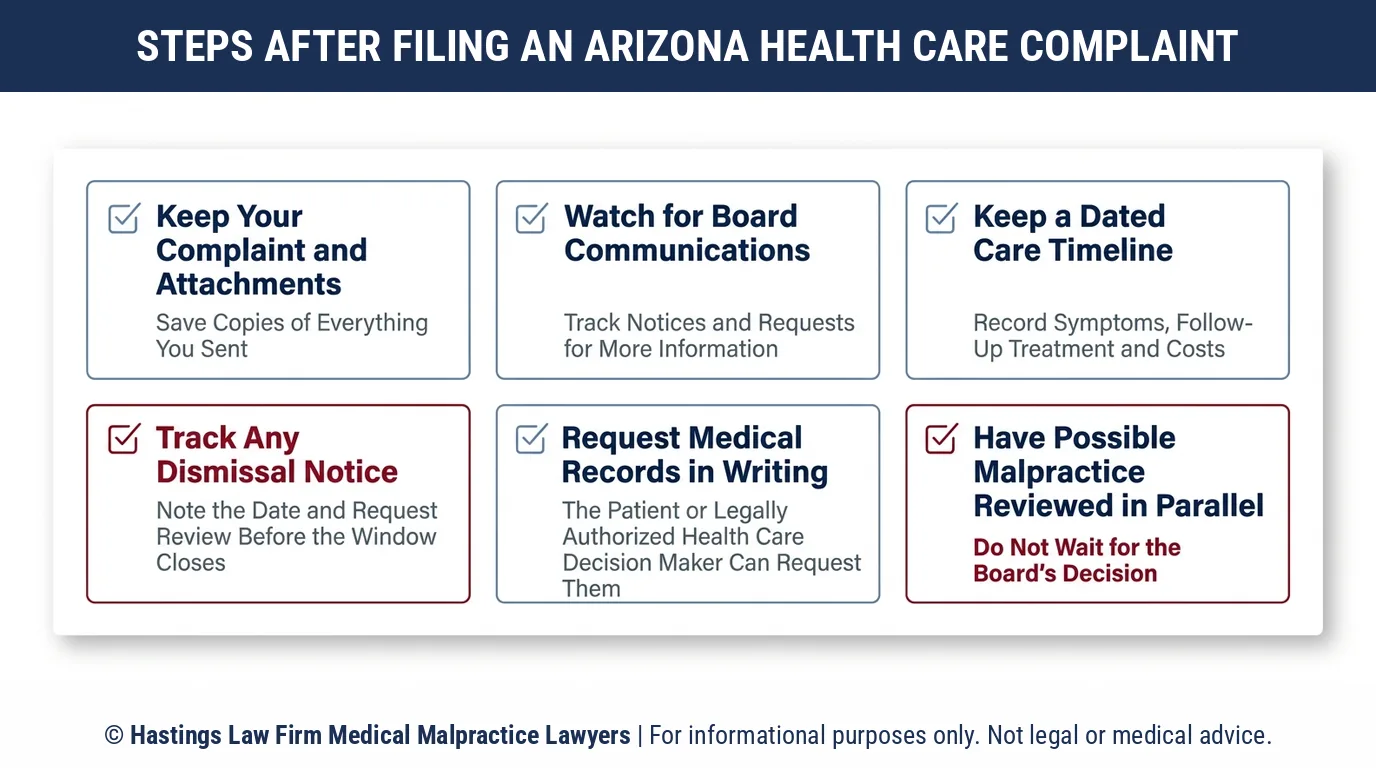
After filing a complaint against an Arizona doctor, keep a copy of the complaint and everything sent with it, and watch for notices and requests for more information from the doctor’s licensing board. If the doctor’s care caused harm, have that care reviewed for a possible malpractice claim at the same time, without waiting for the complaint to be resolved.
A record of your own helps with both. Write a dated timeline of the care, the symptoms, any follow-up treatment, and the costs, and add to it as things happen. Notes made at the time keep the details accurate as the months pass.
The board’s notices belong in that record too, and a dismissal notice matters most, because it starts the short window to ask the board to review the decision. Note the date on the notice and send the written request well before the window closes.
For the malpractice review, the medical records are the starting point. A patient, or the person legally authorized to make health care decisions for the patient, can request the records in writing under A.R.S. § 12-2293. Arizona sets response times for these requests, including 30 calendar days for a request made for a lawsuit, and providers may charge reasonable copying fees.
Talk to an Arizona Medical Malpractice Attorney About Your Case
When you contact Hastings Law Firm, a member of our intake team asks about the care, when it happened, and who provided it. We request the medical records at no cost to you, and our attorneys and medical professionals review them. Once that review is complete, we give you an honest answer about whether there is a malpractice claim to pursue alongside any complaint you have filed with a board.
That answer comes from our Arizona medical malpractice lawyers, who are experienced in handling medical negligence claims against doctors across the state. We understand that a family who reports a doctor wants accountability and answers, and that a malpractice claim is the path that can also address what the injury has cost them.
Pursuing that claim costs nothing up front, because every case is handled on a contingency fee. There is no fee unless we win, and we advance the cost of experts and everything else it takes to build the claim.
Hastings Law Firm has been dedicated exclusively to medical malpractice since 2005, and our team is here for you. Contact us now for a free, confidential case review.
Sources
- Arizona Medical Board page to download the MD complaint form | Arizona Medical Board
- A.R.S. § 32-1451.03 on the four-year limit and complainant confidentiality | Arizona State Legislature
- A.R.S. § 32-1401 definition of unprofessional conduct for Arizona MDs | Arizona State Legislature
- Find your MD license and board order search | Arizona Medical Board
- Find your DO search for osteopathic physician licenses | Arizona Board of Osteopathic Examiners in Medicine and Surgery
- How to file a complaint against an Arizona osteopathic physician | Arizona Board of Osteopathic Examiners in Medicine and Surgery
- Board of Nursing authority to investigate complaints about nurses | Arizona State Board of Nursing
- Osteopathic Board complaint form and its filing instructions | Arizona Board of Osteopathic Examiners in Medicine and Surgery
- Medical Board summary of how complaints are investigated and resolved | Arizona Medical Board
- A.R.S. § 32-1405 on Executive Director review and appeal to the board | Arizona State Legislature
- 2017 performance audit of the Arizona Medical Board, including complaint resolution times | Arizona Auditor General
- A.R.S. § 32-3214 on public access to board records and websites | Arizona State Legislature
- DocInfo search for state medical board actions against physicians | Federation of State Medical Boards
- A.R.S. § 32-1451 on board proceedings, notice and disciplinary action | Arizona State Legislature
- Arizona Rules of Civil Procedure, Rule 3 on how a civil action begins | Arizona Supreme Court
- A.R.S. § 12-542 two-year limit for medical malpractice lawsuits | Arizona State Legislature
- A.R.S. § 12-563 elements a medical malpractice claim must prove | Arizona State Legislature
- A.R.S. § 12-570 reporting malpractice settlements and judgments to licensing boards | Arizona State Legislature
- ADHS Licensing online complaint forms for health care facilities | Arizona Department of Health Services
- A.R.S. § 36-427 on suspending or revoking a health care institution’s license | Arizona State Legislature
- Ombudsman guidance on where to send health care complaints | Arizona Ombudsman-Citizens’ Aide
- A.R.S. § 12-2293 on patient access to medical records | Arizona State Legislature

This content was researched and written by the Hastings Law Firm editorial team, which includes attorneys, medical professionals, and experienced researchers. Our writing is informed by internal knowledge and practical experience, and we cross-check critical details against authoritative sources cited throughout. Every piece undergoes human-led fact-checking and legal review. Because legal and medical information can change, if you spot an error, please contact us. Learn more about our content standards and review process on our editorial policy page.

Tommy Hastings, founder of Hastings Law Firm, is a board-certified personal injury trial lawyer (by the Texas Board of Legal Specialization) dedicated exclusively to healthcare injury cases. Since 2001, he has represented injured patients and families in litigation against major hospital systems, pharmaceutical companies, and negligent healthcare providers nationwide. He has handled numerous high-profile cases that have drawn national media attention and resulted in multi-million dollar recoveries.
