


What is the Average Medical Malpractice Settlement in Texas?
A serious injury caused by medical negligence can change a family’s finances as much as its health, leaving patients and loved ones facing ongoing care, lost income, and lasting uncertainty. The question of what a claim could be worth often comes early, before a family knows what happened or who was responsible. Every injury and every set of losses is different, so an honest answer starts with understanding what shapes a claim’s value. Real payment data and a clear view of what drives value give Texas families a grounded starting point for understanding a medical malpractice claim.

Last Updated: October 22, 2026
What You Should Know About Medical Malpractice Settlements in Texas:
- Among National Practitioner Data Bank (NPDB) malpractice payment reports originally processed from 2016 through 2025 that listed Texas as the physician’s work state, the median reported payment was about $145,000 and the average about $229,000, without adjusting for inflation.
- The NPDB file holds 4,257 Texas-selected reports from those years across all professions, with a median of about $115,000 without adjusting for inflation. In 2025 dollars, the Texas medians were about $132,000 across all professions and $173,000 for physicians.
- Among NPDB reports from the same years listing a work state in the 50 states or DC, the median was about $195,000 across all professions and $245,000 for physicians. The Texas-selected reports had lower medians and means.
- About 47.8% of the Texas-selected NPDB reports recorded payments of $100,000 or less, and about 1.3% recorded payments over $1 million.
- The NPDB figures describe reported payments, not the likelihood of compensation or the value of an individual case, which depends on the injury’s severity and the financial losses it causes.
- Texas Civil Practice and Remedies Code §74.301 ordinarily limits non-economic damages to $250,000 combined for all physicians and other non-institution providers, plus $250,000 for each liable healthcare institution up to $500,000. It does not cap economic damages, and the court applies it when entering judgment.
- In a death case, §74.303 adds an inflation-adjusted limit on all damages, including exemplary damages, except necessary medical, hospital and custodial care.
- A patient’s own share of fault reduces the recovery and bars it above 50%, and each responsible provider’s insurance and collectible assets affect what is collected.
- Compensation for a physical injury is generally not federal taxable income, while punitive damages and interest generally are.
How Much Do Texas Medical Malpractice Claims Pay on Average?
The average medical malpractice payment reported for physicians whose listed work state was Texas was about $229,000, and the median was about $145,000, among National Practitioner Data Bank (NPDB) reports originally processed from 2016 through 2025, without adjusting for inflation. These figures describe payments reported on behalf of physicians, not the settlement in any one case or what an individual case is worth.
Our payment figures come from the National Practitioner Data Bank Public Use Data File, published by the Health Resources and Services Administration of the U.S. Department of Health and Human Services. The June 30, 2026 release contains payment reports received through June 30, 2026, and the figures cover reports originally processed from 2016 through 2025. We last updated these figures on October 21, 2026.
Malpractice payment reports originally processed 2016 through 2025, by the practitioner’s work state. Amounts are approximate.
| Work state and group | Payment reports | Median, without inflation adjustment | Mean, without inflation adjustment | Median, 2025 dollars | Mean, 2025 dollars |
|---|---|---|---|---|---|
| Texas, physicians | 3,123 | $145,000 | $229,000 | $173,000 | $270,000 |
| Texas, all professions | 4,257 | $115,000 | $203,000 | $132,000 | $240,000 |
| 50 states and DC, physicians | 55,525 | $245,000 | $434,000 | $296,000 | $515,000 |
| 50 states and DC, all professions | 75,323 | $195,000 | $375,000 | $235,000 | $444,000 |
Every row is a set of payments reported on behalf of practitioners, not settlements per case or a family’s recovery, so no row is the average medical malpractice settlement in Texas for one claim. Texas medical malpractice settlement amounts depend on each injury and the damage caps, and our Texas medical malpractice statistics draw on other sources.
How we measured. The table is Hastings Law Firm’s analysis of the NPDB Public Use Data File, June 30, 2026 release. Each report’s processing year approximates its payment year, and later reports or corrections can still change a completed year.
Texas means reports giving Texas as the practitioner’s work state, which is not necessarily where the care or injury happened, following NPDB’s approach to geography. Physicians include residents, and all professions adds dentists and other practitioners. The 2025-dollar columns apply each processing year’s CPI-U annual average to each report before pooling.
Each record is a payer’s malpractice payment report concerning a named practitioner, paid on behalf of, not to, that practitioner. One matter can produce several reports, and an amount is not always an exclusively allocated share, so reports cannot reliably be combined into unique cases or full recoveries.
Work state was missing from 35,505 of the 112,187 payment reports originally processed in 2016 through 2025, about 31.6%. The work-state analysis excludes those reports. We cannot determine how many belong to Texas or whether their inclusion would raise or lower the Texas payment statistics.
NPDB codes payment amounts into ranges, so the medians and means are approximations, and some payments, such as those made by an organization alone, can fall outside NPDB reporting. A payment report does not establish malpractice.
How Are Medical Malpractice Payment Amounts Spread in Texas?
Texas medical malpractice payments have no single typical size, and they run from $100,000 or less to more than $1 million. Among National Practitioner Data Bank (NPDB) reports processed from 2016 through 2025 that listed Texas as the practitioner’s work state, about 47.8% recorded $100,000 or less and 1.3% over $1 million, against 4.9% over $1 million in reports listing a work state in the 50 states or DC.
Across that spread, the mean reported payment, the average medical malpractice payout in Texas, runs above the median in every group of the table, and both figures approximate NPDB’s coded payment ranges.
How Many Texas Malpractice Payment Reports Are Coded as a Death?
About 26.4% of National Practitioner Data Bank (NPDB) malpractice payment reports originally processed from 2016 through 2025 that listed Texas as the practitioner’s work state were coded in the death category. The death category is the reporting payer’s coding of alleged injury severity, so the share does not count distinct deaths and is not a medical or legal finding.
How Do Texas Medical Malpractice Payments Compare With National Figures?
National Practitioner Data Bank (NPDB) malpractice payment reports originally processed from 2016 through 2025 that listed Texas as the practitioner’s work state had lower medians and means than reports listing a work state in the 50 states or DC. The median physician payment was about $145,000 in the Texas reports and about $245,000 in the wider group, without adjusting for inflation. The NPDB data describe that difference without explaining it.
The comparison leaves out the 31.6% of payment reports from those years that listed no work state, and whether including them would raise or lower the Texas figures cannot be determined. NPDB’s methods page explains how it assigns geography.
How Often is a Texas Malpractice Payment Report Coded as a Court Judgment?
Fewer than 1 in 100 Texas medical malpractice payment reports are coded as a court judgment, and the National Practitioner Data Bank (NPDB) groups the rest as settlements of some kind. About 0.54% of NPDB reports processed from 2016 through 2025 that listed Texas as the practitioner’s work state carried the judgment payment code, against 1.66% of reports listing a work state in the 50 states or DC.
The share covers paid reports only, so it is not a trial rate, a win rate or the share of lawsuits that settle.
How Many Years Pass Between the Alleged Malpractice and a Texas Payment Report?
At the median, four calendar years separated the year the alleged malpractice began and the year the payment report was processed, among National Practitioner Data Bank (NPDB) reports originally processed from 2016 through 2025 that listed Texas as the practitioner’s work state. About 31.9% of those reports showed a gap of five years or more.
That gap does not measure how long a case or lawsuit lasts.
What Determines the Value of a Medical Malpractice Case in Texas?
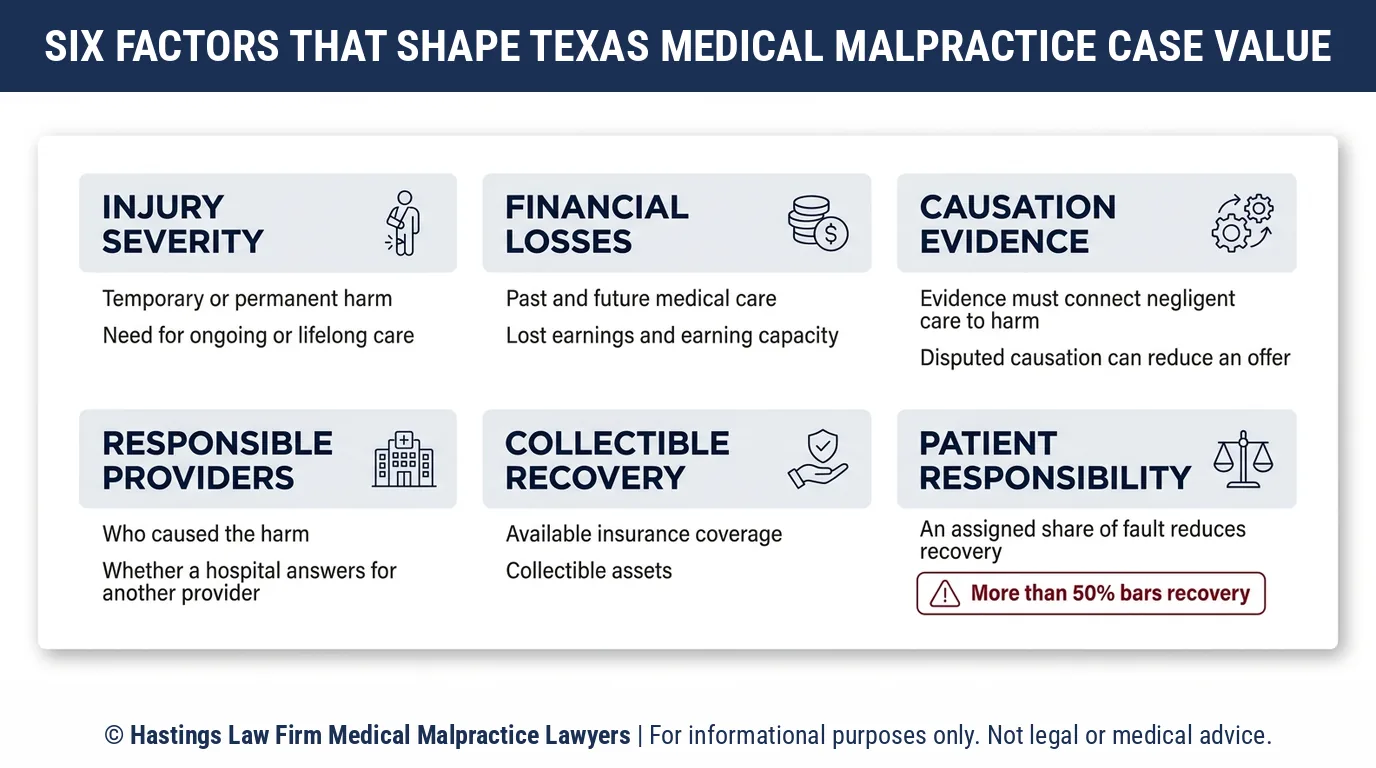
How much a medical malpractice case is worth in Texas depends mainly on how severe and lasting the injury is, the financial losses it causes, how strongly the evidence ties it to negligence, and who is responsible and how much insurance they carry. The Texas Civil Practice and Remedies Code also limits some damages.
How Do Injury Severity and Financial Losses Affect a Texas Malpractice Settlement?
How much you can get for suing for medical malpractice in Texas depends first on how severe and permanent the injury is and on the economic damages it causes, such as past and future medical care, lost earnings and lost earning capacity. Under Texas Civil Practice and Remedies Code §41.0105, recoverable medical expenses already incurred are limited to amounts actually paid or incurred, rather than automatically the original bills.
That section does not decide future-care damages, and the non-economic cap does not limit economic damages, though other limits can apply. Lost earning capacity can count even for a patient with no current wages, when evidence supports it. A temporary injury is valued differently from a permanent disability or an injury that needs lifelong care.
For those permanent injuries, including the ones behind birth injury claims, a life care plan and an economist’s projection can show future losses that span decades.
Why Do Evidence, Defendants, and Insurance Limits Matter in a Texas Medical Negligence Claim?
A Texas medical malpractice settlement amount is affected by the severity of the injury, how strongly the evidence proves causation, which providers are responsible, how much insurance and collectible assets they have, and the patient’s own share of fault. Under Texas Civil Practice and Remedies Code Chapter 33, a patient’s legally established share of responsibility reduces the recovery, and a share greater than 50% bars it.
On the evidence side, the patient must prove causation, that the care more likely than not caused the harm, and disputed causation can lower what the defense will pay. The Chapter 74 expert report starts that proof, ordinarily served within 120 days after each defendant’s original answer, subject to written extensions and the alternative deadlines in §74.353.
Which providers are responsible matters too, because a Texas hospital can answer for its own conduct, its employees, and a non-employee physician when actual or ostensible agency is proven. Available insurance and collectible assets can affect what is collected, since Texas statutes do not require physicians to carry malpractice insurance and a judgment can exceed the coverage and assets available.
How Do Texas Damage Caps Limit a Medical Malpractice Settlement?
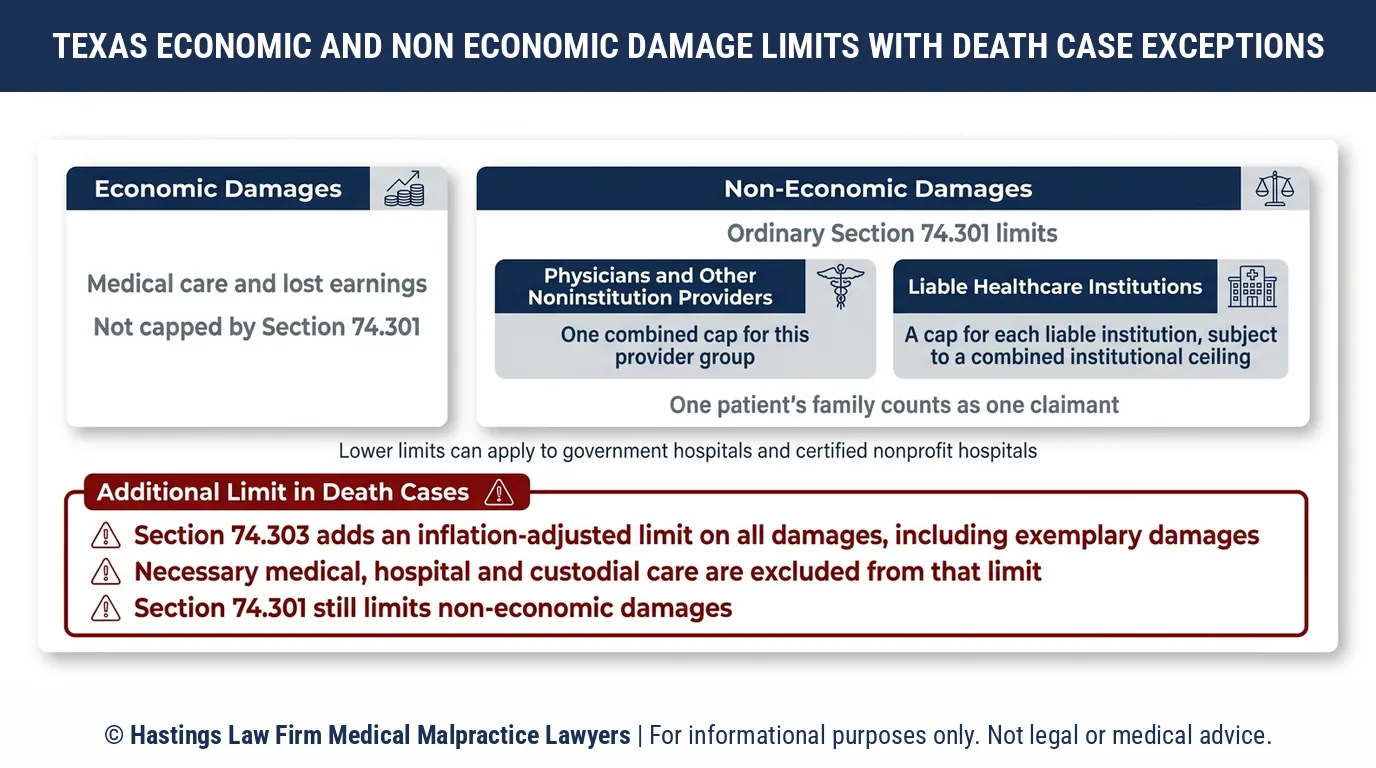
The medical malpractice cap in Texas, under Texas Civil Practice and Remedies Code §74.301, ordinarily limits non-economic damages to $250,000 combined for all physicians and other non-institution providers, plus $250,000 for each liable healthcare institution up to $500,000 for institutions. The $750,000 total is reached only when the needed defendants are liable and the damages support it, and §74.301 does not cap economic damages.
The caps include a hospital’s liability for its staff, one patient’s family counts as one claimant, and government hospitals and certified nonprofit hospitals during certification can face lower limits. Non-economic damages cover pain and suffering, emotional anguish, impairment, disfigurement and lost companionship, and no statute sets a multiplier for pain and suffering in a Texas malpractice case. The cap weighs most where economic losses are small next to the pain and limitation, and least where an injury ends a working life or needs lifelong care, losses §74.301 leaves uncapped.
Those losses are not always uncapped in a death case, because §74.303 adds an inflation-adjusted limit on all damages, including exemplary damages, while §74.301 still limits non-economic damages. The §74.303 limit leaves out only necessary medical, hospital and custodial care. Our wrongful death cap calculator runs the current figure for Texas wrongful death claims.
Texas enacted these medical-liability caps through House Bill 4 in 2003, and voters approved Proposition 12 that September, adding constitutional authority for non-economic limits. Because both sides know the ceiling before trial, Texas medical malpractice damage caps shape settlement, and they can make some cases hard for an attorney to accept.
Can a Medical Negligence Case in Texas Include Punitive Damages?
A Texas medical negligence case can include punitive damages, called exemplary damages, only when clear and convincing evidence shows the harm resulted from fraud, malice or gross negligence, under Texas Civil Practice and Remedies Code Chapter 41, §41.003. Ordinary negligence is not enough, and the jury must be unanimous on liability for exemplary damages and on their amount.
Under §41.008, the ordinary Texas cap on punitive damages is the greater of $200,000 or twice the economic damages plus the non-economic damages found, with that non-economic part limited to $750,000. That formula has statutory exceptions. Governmental units owe no exemplary damages, and in a death case exemplary damages fall inside the §74.303 limit. Exemplary damages need proof beyond ordinary malpractice and are generally taxable, so a family should not build its expectations around them.
How Do Texas Medical Malpractice Settlements Compare With Jury Verdicts?
A Texas medical malpractice settlement is certain and arrives sooner, while a jury verdict can be larger but carries the risk of losing, an appeal and more time. A verdict is also reduced to what the law allows, because the court applies the Texas Civil Practice and Remedies Code §74.301 cap when entering judgment, so a jury’s finding can exceed what the patient recovers.
That risk of losing shows in national studies. The Bureau of Justice Statistics estimated that plaintiffs won 22.7% of medical malpractice trials in state general-jurisdiction courts nationally in 2005, and RAND found a 34.8% plaintiff win rate in 2,553 medical malpractice verdict records from 2010 to 2019.
We did not find a reliable current statewide Texas trial-win rate, and neither study predicts one case. A settlement offer can come at any stage, including mediation, and each one is weighed against that risk.
Should You Accept the First Settlement Offer in a Texas Medical Malpractice Case?
Accepting a first settlement offer in a Texas medical malpractice case is a decision that depends on the situation, and every case is different. The offer is the other side’s number, not a measure of the patient’s losses, and Texas courts treat a valid release as generally ending the claims it covers, so accepting an offer generally closes the claim to any later recovery.
Because the release is final, an offer has to be measured against future care and lost earnings as well as the bills so far. Closing a child’s claim also takes more than a parent’s signature, because a settlement of a claim brought through a next friend needs court approval to bind the child under Texas Rule of Civil Procedure 44. What a patient keeps depends on the contingency fee and case costs, and health-plan, Medicare or Medicaid reimbursement obligations may reduce it further.
Is a Medical Malpractice Settlement Taxable in Texas?
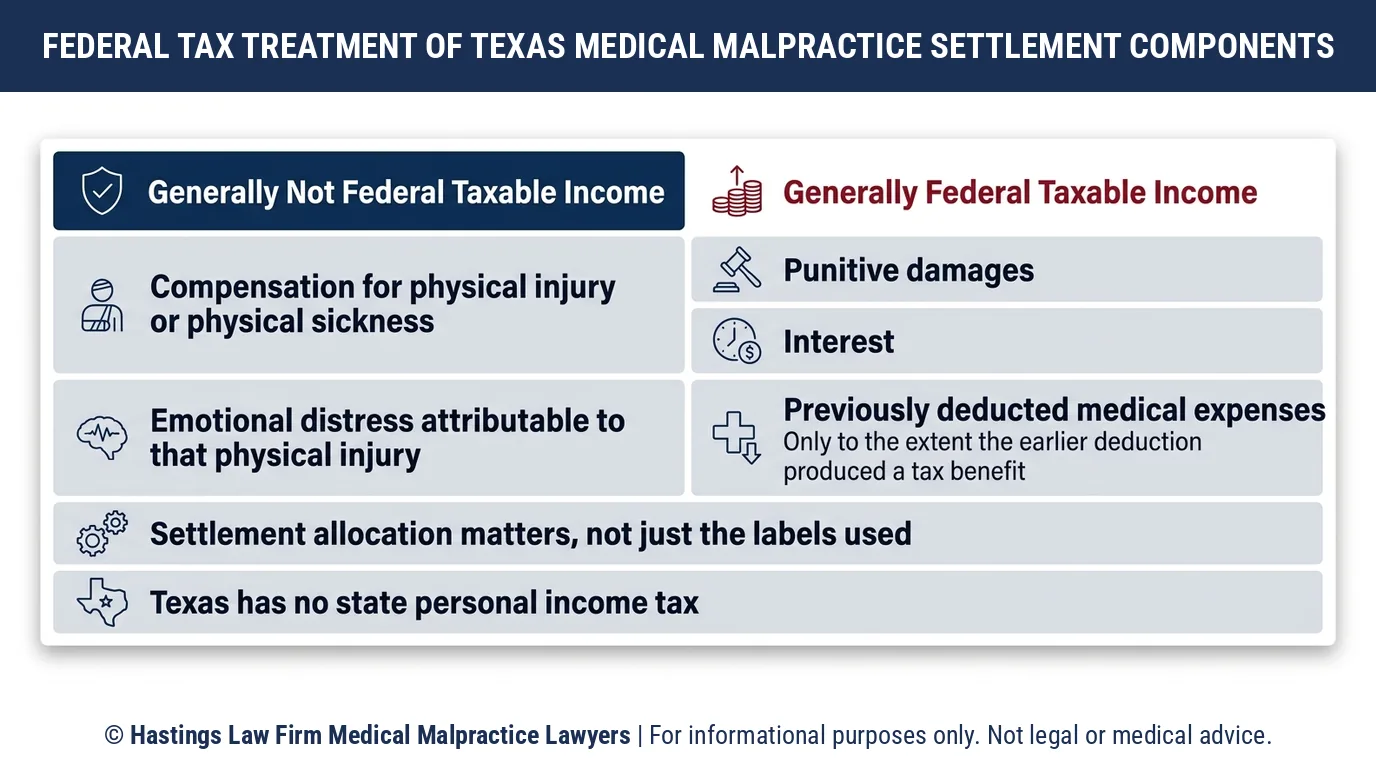
A medical malpractice settlement is generally not federal taxable income when it pays damages received on account of a personal physical injury or physical sickness, under Internal Revenue Code Section 104(a)(2). Emotional distress attributable to the physical injury is treated the same way, while punitive damages and interest are generally taxable under IRS guidance.
Recovery of medical expenses deducted in an earlier year can also be taxable to the extent the deduction gave a tax benefit, according to IRS Publication 4345. Under IRS settlement guidance, how the settlement allocates the recovery matters, not what an amount is called. Texas has no state personal income tax, so the question is federal.
The Hastings Law Firm Difference
Results matter, but what truly sets us apart is how we achieve them. Every verdict, every settlement, and every courtroom victory comes from one guiding promise: To treat each client’s fight for justice as if it were our own.
This balance of skill, experience, and empathy reflects our core philosophy that justice should not only compensate the injured, but also make health care safer nationwide.

What Steps Help Protect the Value of a Texas Medical Malpractice Claim?
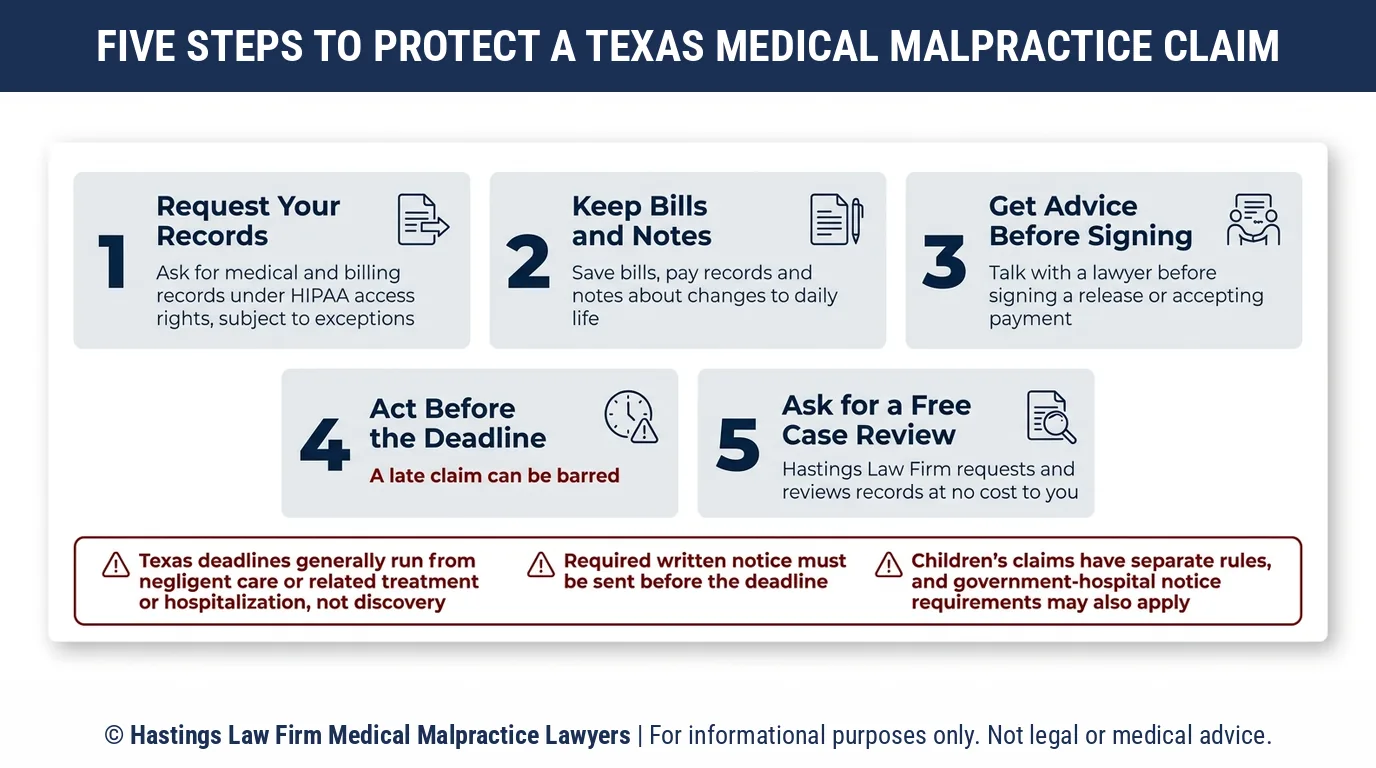
After medical malpractice in Texas, the first step that protects a claim’s value is requesting the medical and billing records, then keeping bills and notes on what happened. Acting before the filing deadline matters as much, because a late claim can be barred.
- Request your records. Ask for the medical and billing records you are entitled to obtain under the HIPAA right of access, which has exceptions.
- Keep bills and notes. Bills and pay records prove the economic losses §74.301 does not cap, and notes on daily life support non-economic losses.
- Talk with a lawyer before signing a release or accepting payment from a provider or insurer.
- Act before the deadline. Texas generally measures it from the negligent care or related treatment or hospitalization, not discovery, and requires written notice sent before it runs. Children’s claims follow separate rules, and Chapter 74 notice does not automatically satisfy government-hospital notice rules, as our Texas medical malpractice statute of limitations guide explains.
- Ask for a free case review. We request and review the records at no cost to you.
Talk to a Texas Medical Malpractice Attorney About What Your Case is Worth
If you are trying to understand what your case could be worth, the first answer you need is whether there is a claim. In a free, confidential case review, we listen to what happened, review the medical records, and give you an honest answer about whether you have a claim and what shapes its value.
Our medical malpractice lawyers are experienced in valuing and pursuing these claims across Texas. We understand what a serious injury can mean for a family, from years of medical care to lost income and a changed daily life.
Hastings Law Firm has been dedicated exclusively to medical malpractice since 2005. Whether you reach our Houston medical malpractice lawyers or another of our Texas offices, we work on a no-win, no-fee basis, so if we do not win the case, you pay nothing. Our team is here for you.
Sources
- NPDB Public Use Data File release through June 30, 2026, and its subset definitions | National Practitioner Data Bank, HRSA
- How NPDB assigns geography and how its public data products differ | National Practitioner Data Bank, HRSA
- What a medical malpractice payment report covers and whom it names | National Practitioner Data Bank, HRSA
- Public Use Data File format, including how payment amounts are coded into ranges | National Practitioner Data Bank, HRSA
- Public Use Data File variable definitions for injury severity, payment type and act year | National Practitioner Data Bank, HRSA
- CPI-U historical annual averages used to state payments in 2025 dollars | U.S. Bureau of Labor Statistics
- Texas damages rules, including §41.0105 medical expenses and §41.008 exemplary damages cap | Texas Legislature
- Texas proportionate responsibility rules, including the §33.001 bar above 50 percent | Texas Legislature
- Whether Texas law requires physicians to carry malpractice insurance | Texas Medical Board
- Texas medical liability law, including the §74.301 and §74.303 damages caps | Texas Legislature
- Plaintiff win rates in 2005 state court tort trials, including medical malpractice | Bureau of Justice Statistics
- Plaintiff win rates in medical malpractice verdict records from 2010 to 2019 | RAND Corporation
- Texas appeals court opinion on a release barring later claims it covers | Texas Fourteenth Court of Appeals
- Texas Rule of Civil Procedure 44 on court approval of a minor’s settlement | Supreme Court of Texas
- IRS Publication 4345 on taxes owed on settlement proceeds | Internal Revenue Service
- Federal tax treatment of physical injury settlements, punitive damages and interest | Internal Revenue Service
- Your HIPAA right to inspect and get copies of medical records | U.S. Department of Health and Human Services

This content was researched and written by the Hastings Law Firm editorial team, which includes attorneys, medical professionals, and experienced researchers. Our writing is informed by internal knowledge and practical experience, and we cross-check critical details against authoritative sources cited throughout. Every piece undergoes human-led fact-checking and legal review. Because legal and medical information can change, if you spot an error, please contact us. Learn more about our content standards and review process on our editorial policy page.

Tommy Hastings, founder of Hastings Law Firm, is a board-certified personal injury trial lawyer (by the Texas Board of Legal Specialization) dedicated exclusively to healthcare injury cases. Since 2001, he has represented injured patients and families in litigation against major hospital systems, pharmaceutical companies, and negligent healthcare providers nationwide. He has handled numerous high-profile cases that have drawn national media attention and resulted in multi-million dollar recoveries.
