


How Much Does a Medical Malpractice Lawyer Cost in Texas?
Worry about money can stop a family from asking questions after a medical injury, especially when bills are already arriving and work has been interrupted. The fear of paying a lawyer on top of everything else can keep people from learning whether what happened was preventable. Lawyers in these cases are paid in ways that differ from most professional services, and the details of each arrangement are set out in writing. Knowing how medical malpractice lawyers in Texas are paid, and what a family keeps at the end, makes it possible to ask what happened without guessing at the cost.

Last Updated: October 22, 2026
What You Should Know About the Cost of a Medical Malpractice Lawyer in Texas:
- A Texas medical malpractice lawyer can work on a contingency fee, so no attorney fee is paid up front and the fee is owed only from a recovery. Case expenses are handled separately by the written agreement.
- Texas Government Code §82.065 requires a contingent fee contract to be in writing and signed by the attorney and the client, and Rule 1.04 requires it to state the percentages for settlement, trial and appeal and how expenses are handled.
- The percentage is set in each written agreement and varies from firm to firm, so ask for it in writing before you sign.
- Texas law sets no general cap on attorney fees in an ordinary medical malpractice case, and Rule 1.04 bars illegal or unconscionable fees.
- Case costs include the medical experts Chapter 74 requires, and Texas ethics rules permit a lawyer to advance them with repayment tied to the outcome.
- A patient who loses owes a contingency-fee lawyer no fee, but case expenses depend on the agreement. If a required expert report is not served on time, the court must award the provider its attorney fees and court costs on its motion.
- The fee, the advanced case costs and any liens come out of a recovery before the client is paid, and whether costs come out before or after the fee changes the client’s share.
- Legal aid programs funded by the Legal Services Corporation face restrictions on fee-generating cases, with exceptions.
What Does It Cost to Hire a Medical Malpractice Lawyer in Texas?
A Texas patient can hire a medical malpractice lawyer on a contingency fee, which means no attorney fee is paid up front and the fee is owed only from money the case recovers. Texas Government Code §82.065 requires a contingent fee contract to be in writing and signed by the attorney and the client. Case expenses are a separate question that the written agreement answers.
For a family facing medical bills and time away from work, the price of a lawyer can feel like a reason not to ask what happened. How much a medical malpractice lawyer costs in Texas comes down to three amounts, the attorney fee, the case costs spent building the claim, and what the client keeps once the fee, the costs and any liens are paid.
Medical malpractice lawyer fees in Texas are set by each written agreement, and the first conversation is the place to ask about them, including whether the first review of your case is free and what it includes.
How Do Contingency Fees Work in Texas Medical Malpractice Cases?
A contingency fee is a lawyer’s fee figured as a share of the money recovered for the client, by settlement or verdict, and owed only if there is a recovery. Rule 1.04 of the Texas Disciplinary Rules of Professional Conduct requires a written contingency fee agreement to explain how the fee is calculated and how case expenses are handled.
Under Rule 1.04(d), the agreement must also state the percentages for settlement, trial and appeal, and whether expenses are deducted before or after the fee. A case that recovers money ends with a written statement showing the outcome and the calculation.
A contingency fee puts the lawyer’s own time at risk, because a case that recovers nothing earns no fee, while any expenses owed after a loss depend on the agreement. Hourly fees and retainers also exist, so ask a lawyer how they charge.
What Percentage Do Medical Malpractice Lawyers Charge in Texas?
Texas sets no contingency fee percentage for an ordinary medical malpractice case, so the lawyer’s share of a recovery is set in each client’s written fee agreement and varies from firm to firm. Texas Government Code §82.065 requires that agreement to be signed by attorney and client, and Rule 1.04(d) of the Texas Disciplinary Rules of Professional Conduct requires it to state the percentages for settlement, trial, and appeal.
Ask for the percentage in writing before you sign, and read what amount it applies to and whether a different figure applies at trial or on appeal. A clear answer on paper shows exactly how a recovery would be divided.
Does Texas Law Cap Attorney Fees in Medical Malpractice Cases?
Texas sets no general cap on attorney fees in medical malpractice cases, because Chapter 74 of the Texas Civil Practice and Remedies Code prescribes no contingency percentage or sliding scale for an ordinary claim. The percentage is left to a signed written agreement that complies with Rule 1.04 of the Texas Disciplinary Rules of Professional Conduct, which bars illegal or unconscionable fees.
Special proceedings and federal claims can carry different fee rules. Chapter 74 does limit some damages, but those Texas damage caps restrict what a case can recover, not what a lawyer can charge.
What Case Costs Come With a Medical Malpractice Lawsuit in Texas?
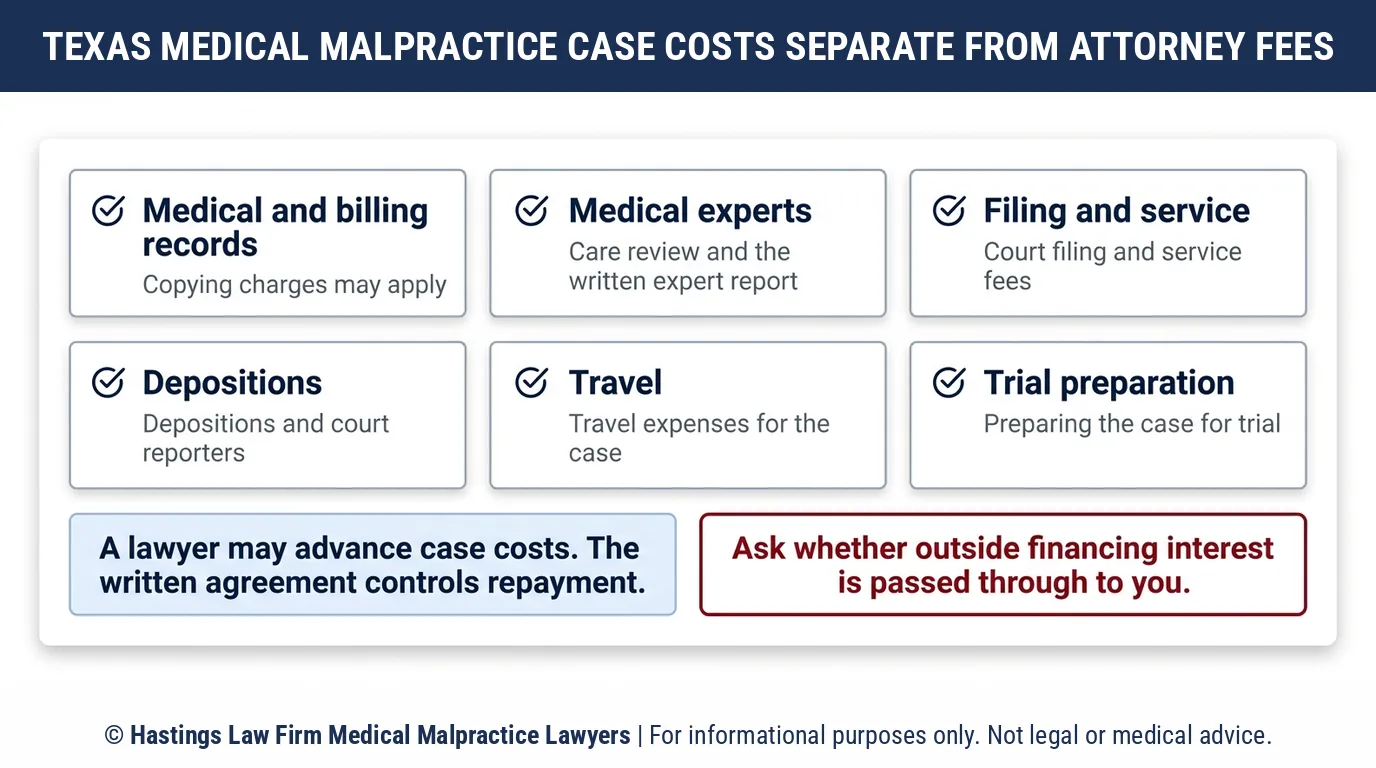
The cost of a medical malpractice lawsuit in Texas includes case costs separate from the attorney fee, such as the medical experts that Texas Civil Practice and Remedies Code §74.351 requires, medical records, filing fees and depositions. Rule 1.08 of the Texas Disciplinary Rules of Professional Conduct permits a lawyer to advance those costs, with repayment contingent on the outcome of the case.
Case costs can include:
- Medical and billing records, which can carry copying charges the law allows
- Review of the care by medical experts and the written expert report
- Court filing and service fees
- Depositions and court reporters
- Travel
- Trial preparation
Fees and litigation costs are separate charges, as the Texas State Law Library’s guide to attorneys’ fees explains. Some agreements may pass through interest from an outside lender that funds the costs, under Texas Professional Ethics Opinion 465, so ask what yours provides. Because these costs come before any recovery, they also help explain why a lawyer may not take a case.
Why Do Texas Medical Malpractice Cases Require Paid Medical Experts?
Texas medical malpractice cases require paid medical experts because Texas Civil Practice and Remedies Code §74.351 requires the claimant to serve an expert report, with each expert’s curriculum vitae, a summary of training and experience, by the ordinary deadline of 120 days after each defendant’s original answer. Written agreements between the parties and the alternative deadlines in Section 74.353 can change that date.
The report gives a fair summary of the standard of care, how the care fell short, and how that failure caused the harm. It is an early requirement, not the proof needed at trial. Experts may also review records and testify later, which makes their work one of the case costs and central to proving causation.
Who Pays if You Lose a Medical Malpractice Case in Texas?
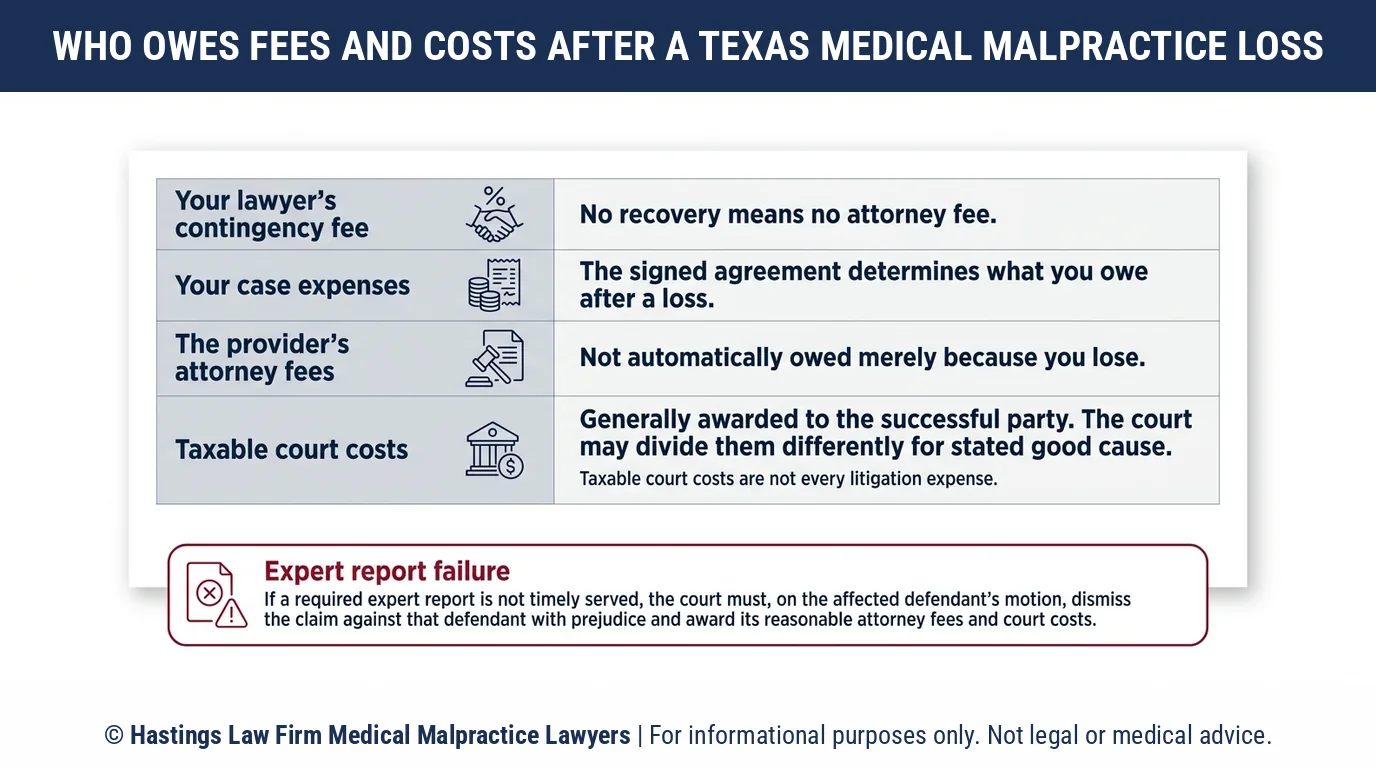
A patient who loses a Texas medical malpractice case owes a contingency-fee lawyer no fee, because Rule 1.04(d) of the Texas Disciplinary Rules of Professional Conduct ties a contingent fee to a recovery. Case expenses depend on the client’s written fee agreement, and Texas Civil Practice and Remedies Code §74.351(b) requires a fee award against the patient if an expert report is not timely served and the claim is dismissed.
Who pays if you lose starts with your own agreement, because agreements differ on who bears case costs when nothing is recovered. The Texas State Law Library warns that a contingency client may still owe court costs, so ask how yours handles a loss.
The provider’s own attorney fees are a separate question. Texas generally leaves each side to pay its own lawyer unless a statute or contract shifts fees, as the Texas Supreme Court explained in Rohrmoos Venture v. UTSW DVA Healthcare, so an ordinary malpractice claim does not automatically shift fees either way.
Chapter 74 creates an exception that matters here. If a required expert report is not served by the ordinary 120-day deadline, the court must, on the affected defendant’s motion, dismiss the claim against that defendant with prejudice and award its reasonable attorney fees and court costs. A court may grant one 30-day extension to cure a report that was served but falls short. That extension is not automatic when no report was served at all, so the deadline is one your lawyer tracks.
Court costs follow their own rule. Texas Rule of Civil Procedure 131 generally awards allowable court costs to the successful party, and Rule 141 lets the court divide them differently for good cause stated on the record. Taxable court costs are not every expense a lawyer spends on a case.
How Much of a Texas Medical Malpractice Settlement Do You Keep After Fees and Costs?
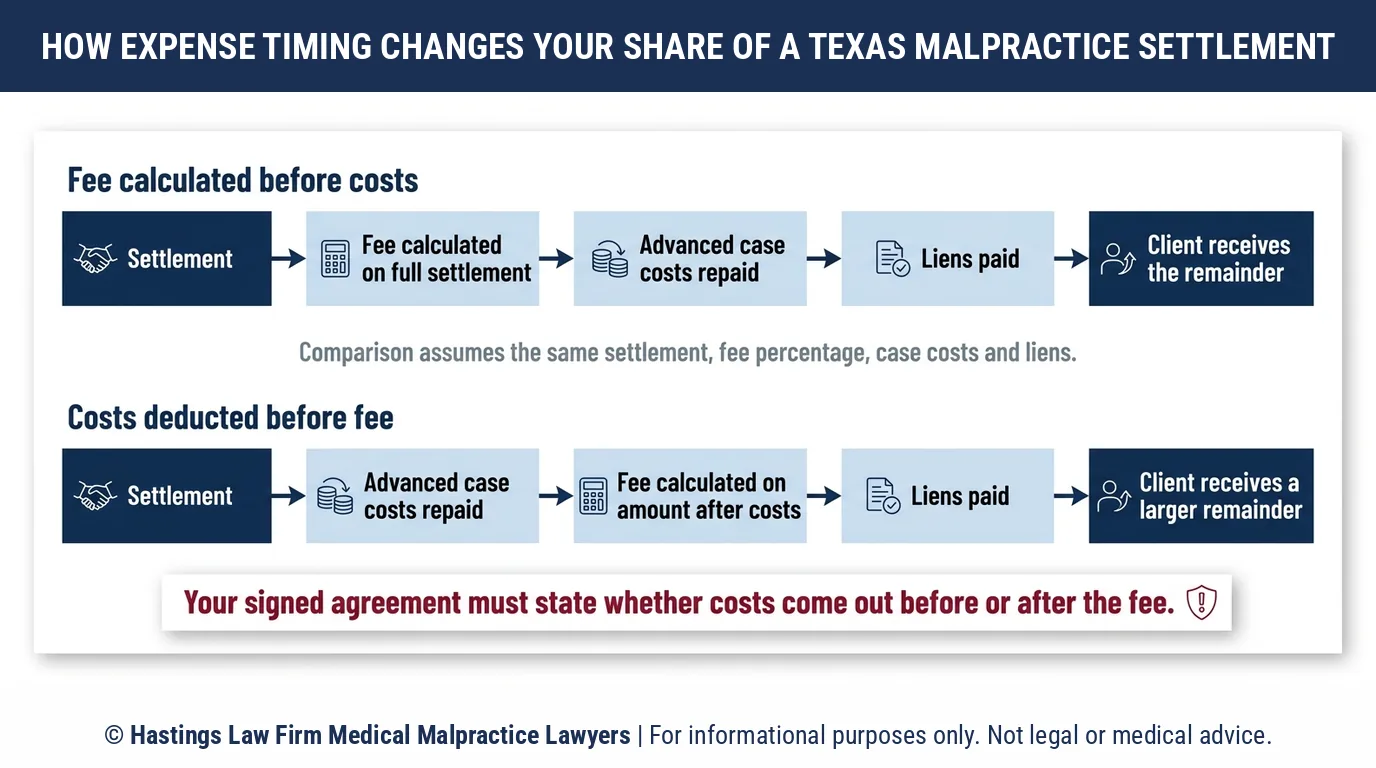
A client keeps what remains of a Texas medical malpractice settlement after the attorney fee, the advanced case costs and any liens are paid. Rule 1.04(d) of the Texas Disciplinary Rules of Professional Conduct requires the client’s written fee agreement to say whether case expenses are deducted before or after the fee is calculated, and that choice changes the client’s share.
How much of a settlement you keep depends on that order. The figures here are an example only, not how every case works and not how Hastings Law Firm’s fees work, because many variables apply to any real case.
Take a hypothetical $250,000 settlement and a 40 percent fee figured on the full amount:
- The fee at 40 percent is $100,000.
- The case costs the lawyer advanced are repaid.
- Any liens are paid.
- The client receives what remains.
If the case costs come out first and the fee is figured on what is left, the fee is smaller and the client’s share is larger, so ask which order your agreement uses.
The 40 percent comes from published research, not from Texas law or any one firm. In a 2010 Health Affairs article on the national costs of the medical liability system, Mello and colleagues described contingency fee levels reported in the literature as converging in the range of 35 to 40 percent of awards to plaintiffs. That is national, historical data, not a current Texas figure.
Damage caps can limit the recovery a fee is figured on, and taxes can matter too. Compensation for physical injury is generally excluded from federal income, while interest and punitive damages are generally taxable, as IRS Publication 4345 explains.
Do Medical Liens Reduce What You Recover in a Texas Malpractice Claim?
Medical liens and reimbursement claims can reduce what a patient recovers from a Texas malpractice claim, and each one depends on its own law. A qualifying, properly secured hospital lien under Chapter 55 of the Texas Property Code can attach to settlement proceeds, and Medicare, Texas Medicaid and some health plans may seek repayment for related care they paid for.
A hospital lien requires qualifying services and admission within 72 hours after the injury, and its amount is the lesser of limits the statute sets, so its validity and amount must be checked. Medicare reduces its recovery of related payments for procurement costs, the costs of obtaining the recovery, and Texas Medicaid’s recovery is limited to what it paid and may be waived.
Chapter 140 of the Texas Civil Practice and Remedies Code limits some health-plan reimbursement claims and governs how fees are shared, but it excludes self-funded ERISA plans, Medicare and Medicaid. Ask how liens will be handled before any money reaches you.
Can You Get a Medical Malpractice Attorney in Texas if You Cannot Afford One?
A Texas patient can get a medical malpractice attorney without money for a fee, because a contingency fee is paid only from a recovery, while case expenses are handled by the client’s written fee agreement. Legal aid programs funded by the Legal Services Corporation face restrictions on fee-generating cases under 45 CFR Part 1609, with exceptions.
Legal aid is one way to hire a lawyer if you cannot afford one, but its exceptions are narrow, such as cases private lawyers declined after a referral or places where private representation is not available. Whether a program can help depends on the program, the circumstances and the client’s eligibility. Whatever route you take, keeping your medical records and the filing deadline in view costs nothing.
The Hastings Law Firm Difference
Results matter, but what truly sets us apart is how we achieve them. Every verdict, every settlement, and every courtroom victory comes from one guiding promise: To treat each client’s fight for justice as if it were our own.
This balance of skill, experience, and empathy reflects our core philosophy that justice should not only compensate the injured, but also make health care safer nationwide.

What Should You Ask a Texas Medical Malpractice Lawyer About Fees Before You Sign?
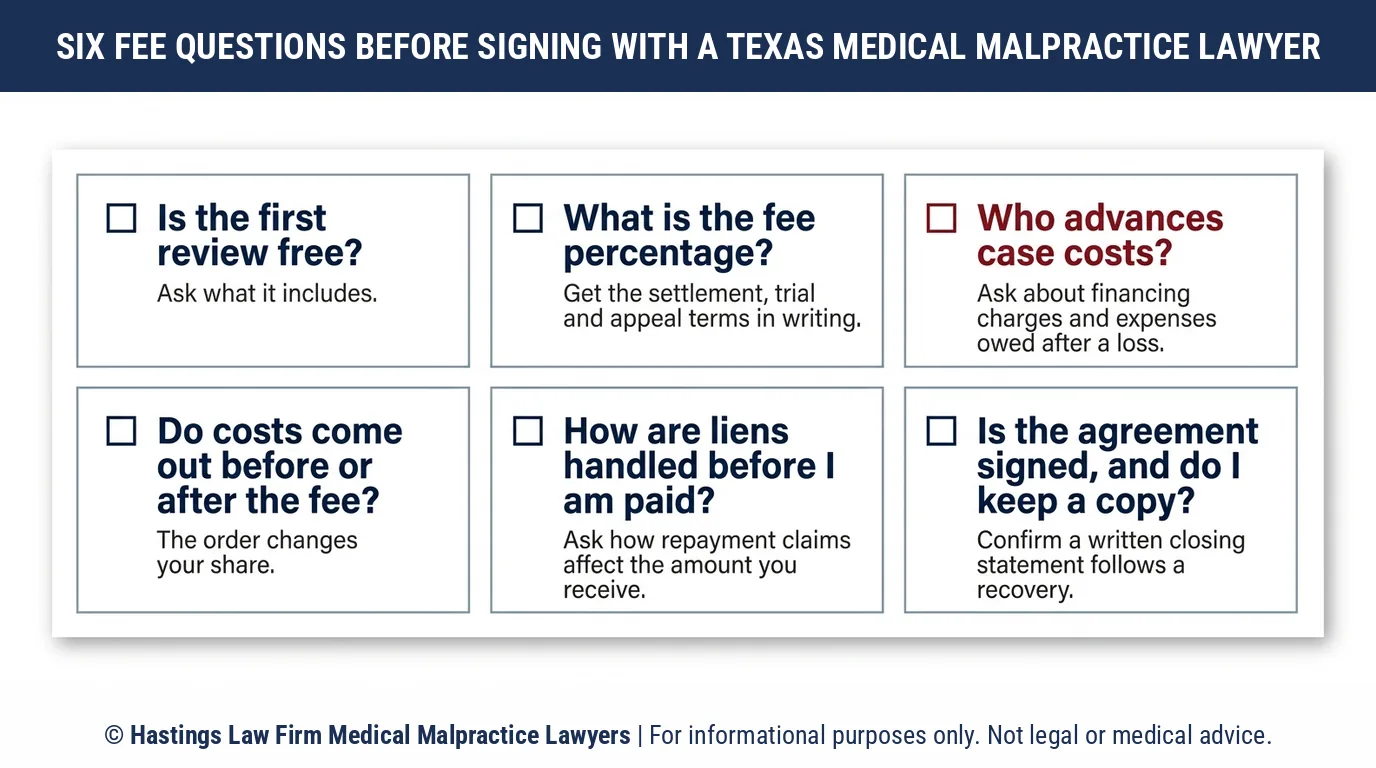
Before signing with a Texas medical malpractice lawyer, a patient should ask for the fee percentage in writing, how case costs are handled, and what the patient would owe if the case recovers nothing. Each of those answers belongs in the signed fee agreement, where the patient can read it and keep a copy.
- Is the first review free, and what does it involve?
- What is the fee percentage? Get it in writing, with what it applies to at settlement, trial and appeal.
- Who advances the case costs? Ask whether outside financing charges are passed through and whether costs are owed after a loss.
- Do costs come out before or after the fee? The order changes how much of a recovery reaches you.
- How are liens handled before you are paid?
- Is the agreement signed, and do you keep a copy? Confirm that a case that recovers money ends with a written closing statement.
These questions help you understand exactly what you are signing. The filing deadline keeps running while you weigh them, and Texas generally measures it from the care at issue rather than from when a problem was discovered. Learn how the Texas filing deadline works before time passes.
Talk to a Texas Medical Malpractice Attorney About Your Case at No Cost
When you contact Hastings Law Firm, a member of our intake team listens to what happened, and we request and review the medical records to give you an honest answer about whether you have a claim.
Our medical malpractice lawyers are experienced in answering the fee and cost questions families bring to Texas medical malpractice cases. We understand that worry about money can sit alongside medical bills, lost work and uncertainty about what happened, and we explain how our fee works in plain terms.
Hastings Law Firm has been dedicated exclusively to medical malpractice since 2005. The firm advances the cost of medical experts and of everything else it takes to build a medical malpractice claim, and it works on a no-win, no-fee basis, so if we do not win the case, you pay nothing, neither fees nor costs. Our medical malpractice attorneys perform a free, confidential case review for families across Texas, and our team is here for you.
Sources
- Government Code §82.065, the written and signed contingent fee contract rule | Texas Legislature
- Disciplinary Rules 1.04 and 1.08 on contingent fee terms and advanced expenses | Texas Courts
- Chapter 74 medical liability law, including the §74.351 expert report rules | Texas Legislature
- How attorney fees and court costs work for Texas clients | Texas State Law Library
- Ethics Opinion 465 on passing outside lender interest charges to clients | Texas Center for Legal Ethics
- Texas Supreme Court opinion stating that each side generally pays its own attorney fees | Texas Courts
- Texas Rules of Civil Procedure 131 and 141 on awarding court costs | Texas Courts
- 2010 national study of medical liability costs, including plaintiff attorney fee levels | Health Affairs, via PubMed Central
- Federal tax treatment of settlements, including interest on a settlement | Internal Revenue Service
- Property Code Chapter 55 hospital lien requirements and amount limits | Texas Legislature
- Chapter 140 limits on health plan reimbursement and fee sharing | Texas Legislature
- 45 CFR Part 1609 restrictions on legal aid in fee-generating cases | Electronic Code of Federal Regulations

This content was researched and written by the Hastings Law Firm editorial team, which includes attorneys, medical professionals, and experienced researchers. Our writing is informed by internal knowledge and practical experience, and we cross-check critical details against authoritative sources cited throughout. Every piece undergoes human-led fact-checking and legal review. Because legal and medical information can change, if you spot an error, please contact us. Learn more about our content standards and review process on our editorial policy page.

Tommy Hastings, founder of Hastings Law Firm, is a board-certified personal injury trial lawyer (by the Texas Board of Legal Specialization) dedicated exclusively to healthcare injury cases. Since 2001, he has represented injured patients and families in litigation against major hospital systems, pharmaceutical companies, and negligent healthcare providers nationwide. He has handled numerous high-profile cases that have drawn national media attention and resulted in multi-million dollar recoveries.
