


What Are the Odds of Winning a Medical Malpractice Case in Texas?
Harm from medical care can leave patients and families with lasting injuries, mounting bills, and a difficult question about whether anything can be done. Hearing that malpractice cases are hard to win can make that question feel settled before anyone has looked at what happened. The facts of one family’s care, not a general impression, are what decide whether a claim can succeed. Knowing how medical malpractice cases in Texas are won, and what the published figures do and do not show, gives that question a grounded answer.

Last Updated: October 22, 2026
What You Should Know About Winning a Medical Malpractice Case in Texas:
- We did not find a reliable current statewide Texas success rate for medical malpractice cases. The best guides are dated studies, named with their years.
- In a 2011 New England Journal of Medicine study of claims against physicians from 1991 to 2005, 78% of claims closed without a payment and about 22% were paid.
- Plaintiffs won 22.7% of medical malpractice trials in state general-jurisdiction courts in 2005, according to the Bureau of Justice Statistics, and RAND found a 34.8% plaintiff win rate in 2010 to 2019 verdict records, a different dataset.
- About 0.54% of National Practitioner Data Bank (NPDB) malpractice payment reports originally processed from 2016 through 2025 that listed Texas as the practitioner’s work state were coded as resulting from a judgment, against 1.66% of reports listing a work state in the 50 states or DC. The figures cover paid reports only, not a win or trial rate.
- A patient must prove duty, breach, causation and damages by a preponderance of the evidence, with causation shown in reasonable medical probability.
- The expert report is ordinarily due 120 days after each defendant’s original answer, unless extended by written agreement or under Section 74.353. A missing or deficient report can end the claim against that defendant on its motion, though a court may allow one 30-day cure for a deficient report.
- The two-year filing deadline runs from the negligent act or the completion of the treatment or hospitalization, not from discovery, and qualifying notice with the medical authorization tolls it for 75 days.
- Section 74.301 limits non-economic damages to $250,000 combined for physicians and other noninstitutional providers, with separate limits for healthcare institutions. It does not cap economic damages, and death cases face an additional Section 74.303 limit.
What Are the Chances of Winning a Medical Malpractice Lawsuit in Texas?
A medical malpractice claim has historically had about a one-in-five chance of ending in a payment, based on a national study of claims against physicians from 1991 to 2005. That 2011 study by Jena and colleagues in the New England Journal of Medicine found 78% of claims closed without a payment and about 22% were paid, a national figure rather than a current Texas rate.
The Jena study covered one large insurer with a nationwide client base and 40,916 physicians, so it describes claims against those physicians, not injured patients as a whole.
Texas research is narrower still. In a 2016 study in Health Services Research, Sage, Harding, and Thomas reported that 60 of 244 claims closed in 2001 to 2002 in the University of Texas System’s self-insurance program were paid, a group that does not include all Texas providers.
We did not find a reliable current statewide Texas success rate. These studies are the closest published guide to the odds of winning a medical malpractice case in Texas, but they cannot be combined into one figure or read as the odds for one case, which is decided by its own records. A case is won by settlement or by verdict. Our Texas medical malpractice statistics give wider figures.
What is the Success Rate of Medical Malpractice Lawsuits That Go to Trial in Texas?
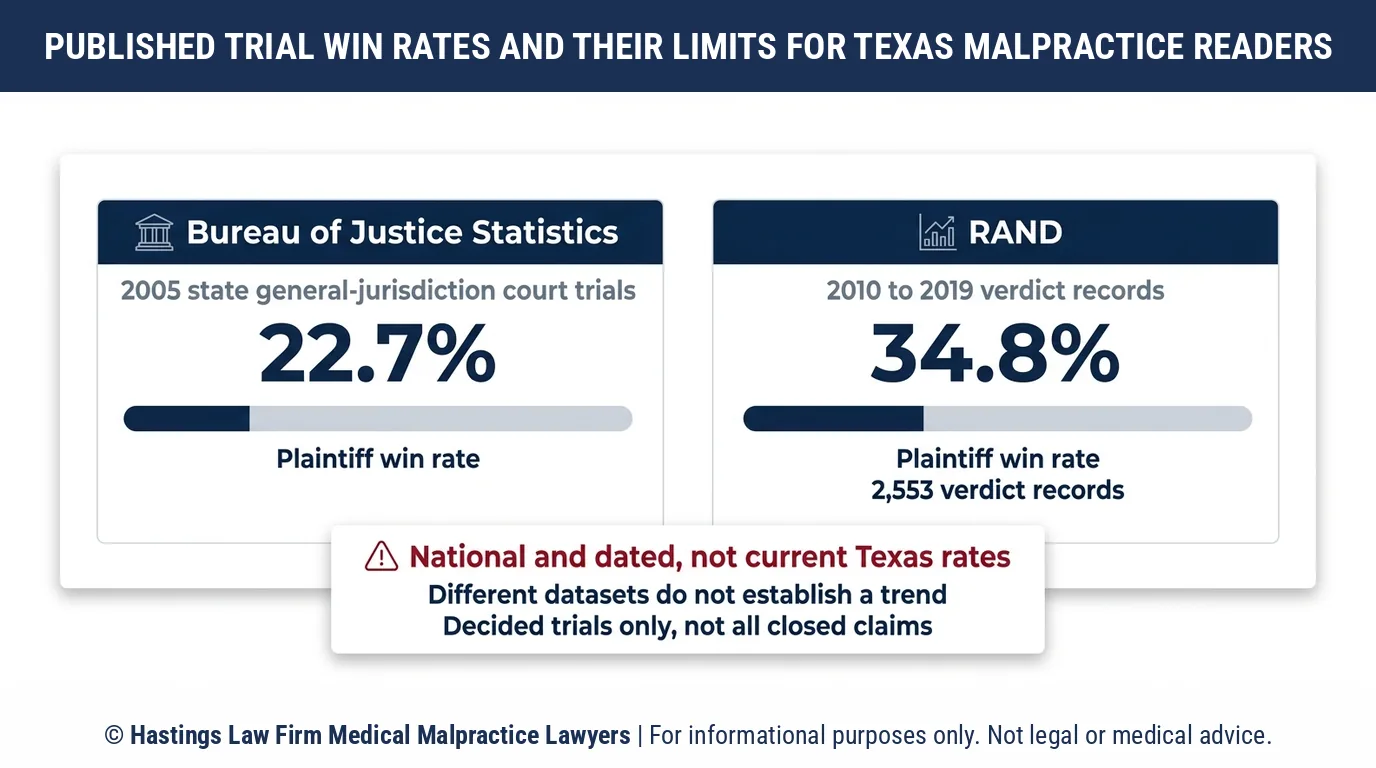
Plaintiffs won 22.7% of medical malpractice trials in state general-jurisdiction courts in 2005, according to the Bureau of Justice Statistics, and RAND found a 34.8% plaintiff win rate among 2,553 verdict records from 2010 to 2019. Both figures are national and dated, not current Texas rates.
The two figures come from different datasets, so they show no trend. As for how often doctors win medical malpractice cases, plaintiffs won fewer than half of the trials in both.
Trial figures count decided trials and payment figures count closed claims, so the two are never combined. For a family, a trial is one of several paths, decided with counsel when an offer is on the table.
How Often Do Paid Texas Medical Malpractice Claims End in a Court Judgment?
About 0.54% of National Practitioner Data Bank malpractice payment reports originally processed from 2016 through 2025 that listed Texas as the practitioner’s work state were coded as resulting from a judgment, against 1.66% of reports listing a work state in the 50 states or DC. NPDB recommends grouping the other codes as settlements of some kind. The figures cover paid reports only, not every lawsuit filed or tried.
A settlement is still a win, reached without a verdict. The figure comes from Hastings Law Firm’s analysis of the National Practitioner Data Bank Public Use Data File, published by the Health Resources and Services Administration of the U.S. Department of Health and Human Services. The June 30, 2026 release contains payment reports received through June 30, 2026, and we last updated the figure on October 21, 2026. Our guide to average Texas medical malpractice settlements covers the full data and method.
Each record is a payer’s payment report concerning a named practitioner, so one matter can produce several reports. Claims closed without payment are absent, and the figures describe reported payments, not the likelihood of compensation. Medical malpractice cases that settle out of court can do so at any stage, and a case prepared as if it will go to trial gives the other side more to weigh.
Why is Medical Malpractice Hard to Prove in Texas?
Medical malpractice is hard to prove in Texas because Texas Civil Practice and Remedies Code Chapter 74 sets strict deadline, expert report, and damages rules for health care liability claims against physicians, hospitals, nurses, and other covered providers. On top of those rules, a patient must prove that the care fell below the accepted standard and caused the harm.
Each of those rules adds to how difficult it is to win a malpractice suit, which is why investigating a claim early matters.
What Does a Patient Have to Prove to Win a Medical Malpractice Case in Texas?
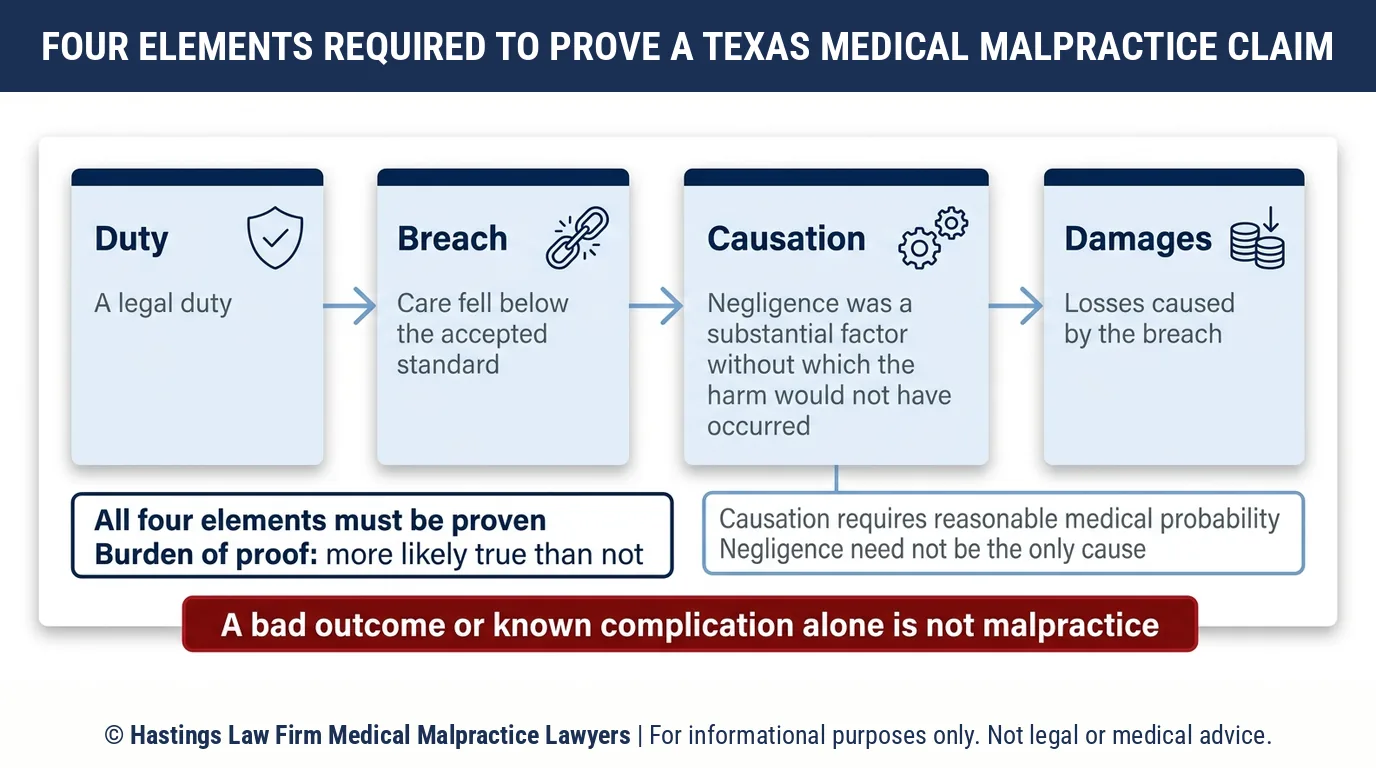
To win a medical malpractice case in Texas, a patient must prove a legal duty, a breach of that duty, and damages proximately caused by the breach, as the Texas Supreme Court described in Windrum v. Kareh. The patient carries the burden of proof by a preponderance of the evidence, which means the facts are more likely true than not.
A bad outcome or a known complication is not malpractice by itself. Under Bustamante v. Ponte, causation must be shown in reasonable medical probability, with the negligence a substantial factor without which the harm would not have occurred, though not necessarily the only cause. Medical experts carry that proof, as our page on proving causation in a Texas malpractice case explains.
Emergency care raises the bar. Qualifying emergency care in a hospital emergency department, an obstetrical unit, or a surgical suite right after emergency department care requires proof of willful and wanton negligence under Section 74.153, still by a preponderance of the evidence.
Which Texas Rules Can End a Malpractice Claim Before Trial?
Three Chapter 74 rules can end a Texas malpractice claim before trial: the filing deadline in Section 74.251, which is generally two years, the written notice Section 74.051 requires at least 60 days before suit, and the expert report Section 74.351 requires, ordinarily served within 120 days after each defendant’s original answer. Each rule has its own conditions and its own clock.
The deadline runs from the negligent act or the completion of the treatment or hospitalization at issue, not from discovery, and a known act date controls. A ten-year repose period sets an outer limit, and children’s claims need separate analysis, as our page on Texas medical malpractice filing deadlines explains.
Notice sent by certified mail with the required medical authorization tolls the deadline for 75 days, a rule the Texas Supreme Court applied in Hampton v. Thome, but it cannot revive an expired claim. The expert report must be served, and written agreement or the alternative deadlines in Section 74.353 can change when it is due. On the affected defendant’s motion, a statutory failure requires dismissal with prejudice and fees, though a court may allow one 30-day cure for a deficient report. Separate clocks are why acting early helps.
How Do Texas Damage Caps Affect a Medical Negligence Claim?
Texas damage caps limit how much of some losses a medical negligence claim can recover, not whether the care was negligent. Section 74.301 limits non-economic damages to $250,000 combined against all physicians and other noninstitutional providers, with separate limits for hospitals and other healthcare institutions that can bring the ordinary combined ceiling to $750,000 when the necessary defendants are liable.
Family members count as one claimant, and economic damages are not capped by Section 74.301, so a full record of medical costs and lost income carries weight. In a death case, Section 74.303 adds an inflation-adjusted limit on top of Section 74.301, as our pages on Texas medical malpractice damage caps and wrongful death claims explain.
How Do Doctors and Hospitals Defend Malpractice Lawsuits in Texas?
Doctors and hospitals defend malpractice lawsuits in Texas by arguing that the care met the standard, that the harm was a known risk, that something other than the care caused it, or that the patient shares responsibility under Texas Civil Practice and Remedies Code Chapter 33. A patient’s legally established share of responsibility reduces recovery, and a share greater than 50% bars it.
A share of exactly 50% does not bar recovery, and an underlying condition is not a complete defense when the care was also a cause. The defense brings its own medical experts, so the records matter to both sides, and knowing these arguments in advance is part of preparing a claim.
What Improves the Odds of Winning a Medical Malpractice Case in Texas?
A Texas medical malpractice case is stronger when the records show a clear departure from the standard of care, evidence links that departure to the harm, and a qualified medical expert explains both, since Section 74.401 requires expert qualifications relevant to the care and issue addressed. Complete medical records, well-documented losses, and action before the Texas filing deadlines run also improve the odds.
Some of these factors were set by what already happened, but a family controls the records, the timing, and who reviews the case.
Records show how this works. Consider a patient whose nurse recorded a dangerous change in vital signs that no one acted on for hours. That chart entry can show what the care team knew and when, and an expert can explain what the standard required. Counsel who handles medical malpractice and prepares each case for trial matters too, and our lawyers know how the defense builds its case.
The Hastings Law Firm Difference
Results matter, but what truly sets us apart is how we achieve them. Every verdict, every settlement, and every courtroom victory comes from one guiding promise: To treat each client’s fight for justice as if it were our own.
This balance of skill, experience, and empathy reflects our core philosophy that justice should not only compensate the injured, but also make health care safer nationwide.

What Should You Do Next If Medical Negligence Harmed You or a Loved One in Texas?
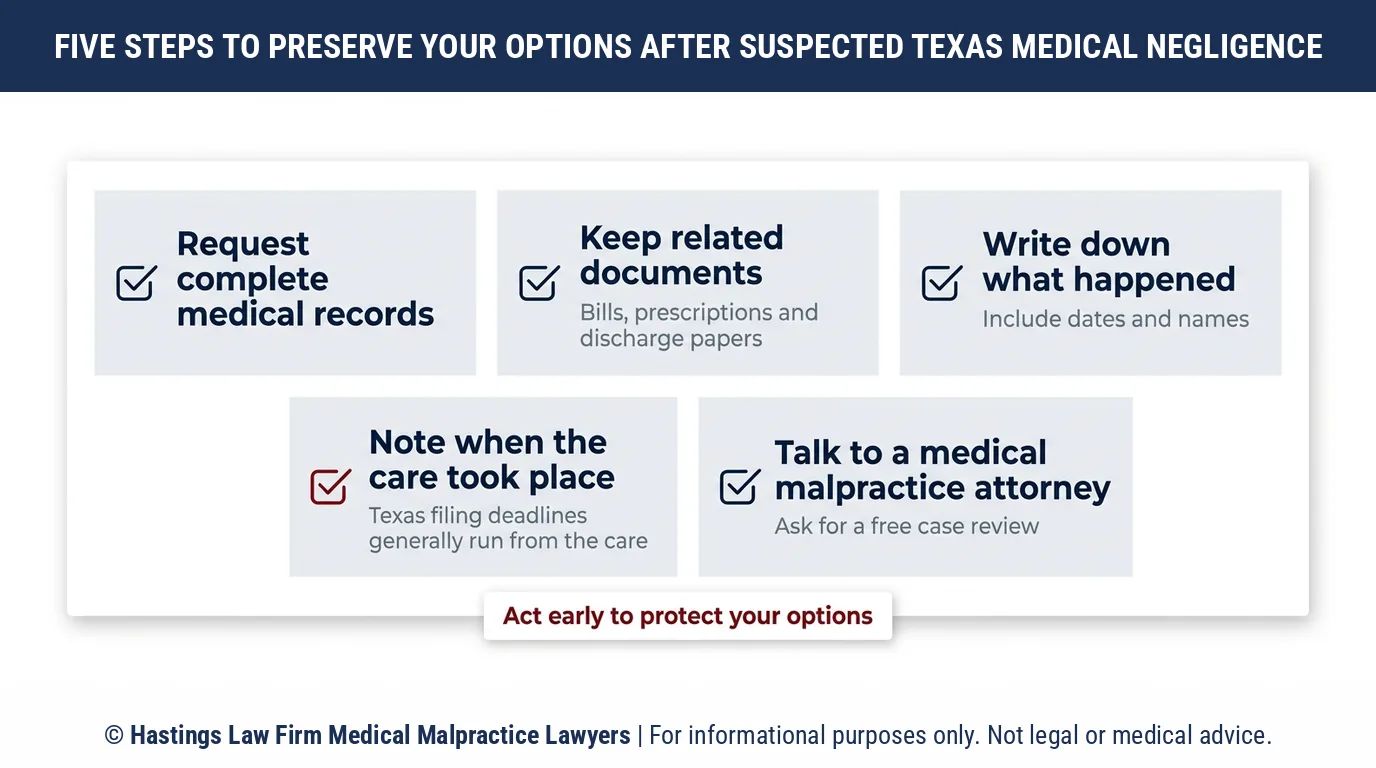
If you think you have a medical malpractice case in Texas, start by requesting a complete copy of the medical records, then keep every related document and write down what happened. Note when the care took place, because the Texas filing deadline is generally measured from it, and talk to a medical malpractice attorney for a free case review.
These first steps cost nothing and protect your options.
- Request the medical records. Patients generally can request their records, with response deadlines and limited exceptions, as the U.S. Department of Health and Human Services explains.
- Keep every document, including bills, prescriptions, and discharge papers.
- Write down what happened, with dates and names.
- Talk to a medical malpractice attorney. Reach our intake team by phone or our online contact form. We request the records at no cost and always give an honest answer.
A case another firm turned down is not always a weak case, as our page on why attorneys decline some cases explains. Whether a case is worth pursuing is answered by the records, not a dollar figure.
Talk to a Texas Medical Malpractice Attorney About Your Case
You came here to learn the odds, and the honest answer for one case comes from its own records. When you contact us, we perform a free, confidential case review. We listen to what happened, review the medical records, and give you an honest answer about whether there is a claim.
Our medical malpractice lawyers are experienced in handling these claims for patients and families across Texas. We understand what a serious medical injury can mean for a family, from added medical bills and lost income to the care a patient may need for years, and why knowing whether a case can be won matters so much.
Hastings Law Firm has been dedicated exclusively to medical malpractice since 2005. If you are ready to take the next step, talk to our Texas medical malpractice lawyers. We work on a no-win, no-fee basis, so if we do not win the case, you pay nothing. Our team is here for you.
Sources
- Texas Civil Practice and Remedies Code Chapter 74, rules for health care liability claims | Texas Legislature
- Section 74.401 qualifications for medical experts in malpractice cases | Texas Legislature
- Texas Civil Practice and Remedies Code Chapter 33, proportionate responsibility rules | Texas Legislature
- Windrum v. Kareh, Texas Supreme Court opinion on the elements of malpractice | Supreme Court of Texas
- Bustamante v. Ponte, Texas Supreme Court opinion on proving causation | Justia
- Hampton v. Thome, Texas Supreme Court opinion on pre-suit notice tolling | Supreme Court of Texas
- National survey of 2005 state court tort trials, including medical malpractice win rates | Bureau of Justice Statistics
- Analysis of 2010 to 2019 verdict records, including medical malpractice win rates | RAND Corporation
- Study of malpractice claims and payments against physicians, 1991 to 2005 | PubMed, National Library of Medicine
- Study of paid malpractice claims in the University of Texas System | Texas A&M University School of Law
- Public use data file of National Practitioner Data Bank payment reports | Health Resources and Services Administration
- NPDB file specification for coding payments as judgments or settlements | Health Resources and Services Administration
- Federal guidance on a patient’s right to access medical records | U.S. Department of Health and Human Services

This content was researched and written by the Hastings Law Firm editorial team, which includes attorneys, medical professionals, and experienced researchers. Our writing is informed by internal knowledge and practical experience, and we cross-check critical details against authoritative sources cited throughout. Every piece undergoes human-led fact-checking and legal review. Because legal and medical information can change, if you spot an error, please contact us. Learn more about our content standards and review process on our editorial policy page.

Tommy Hastings, founder of Hastings Law Firm, is a board-certified personal injury trial lawyer (by the Texas Board of Legal Specialization) dedicated exclusively to healthcare injury cases. Since 2001, he has represented injured patients and families in litigation against major hospital systems, pharmaceutical companies, and negligent healthcare providers nationwide. He has handled numerous high-profile cases that have drawn national media attention and resulted in multi-million dollar recoveries.
