


What is the Statute of Limitations for Nursing Home Abuse in Arizona?
Discovering that a parent may have been hurt or neglected in a nursing home can leave a family shaken and unsure what to do first. Some harm builds quietly over time and some comes to light all at once, but both raise hard questions about what happened. Many families in that position also wonder how much time they have to act, often before they have decided whether to take the matter further. A clear picture of how the law protects a nursing home resident in Arizona can help a family make that decision with confidence.

Last Updated: November 4, 2026
What You Should Know About the Arizona Nursing Home Abuse Statute of Limitations:
- A lawsuit against an Arizona nursing home for an injury caused by abuse or neglect generally must be filed within two years under A.R.S. § 12-542, counted from the date the claim accrues.
- Negligence in the nursing or health-related care of a licensed Arizona nursing home or assisted living facility can be a medical malpractice action under A.R.S. § 12-561, which carries the same two-year deadline.
- A vulnerable adult’s claim under Arizona’s Adult Protective Services Act must be filed within two years after actual discovery of the cause of action under A.R.S. § 46-455, and it can be brought against a nursing home operator.
- The clock on an Arizona nursing home claim generally starts when the injured person knew, or reasonably should have known, that a wrong caused the injury, so a date that looks too late may not be.
- Dementia can pause an Arizona filing deadline under A.R.S. § 12-502 when it leaves the resident of unsound mind at the time the claim accrues, and appointing a guardian does not end that pause.
- When an Arizona nursing home resident is incapacitated, the conservator brings the case, or the guardian if no conservator has been appointed, under Rule 17 of the Arizona Rules of Civil Procedure.
- A wrongful death claim against an Arizona nursing home generally must be filed within two years of the resident’s death, even when the neglect happened months earlier.
- A claim against a government-run nursing home in Arizona needs a written notice of claim within 180 days and a lawsuit within one year.
- A report to Adult Protective Services or the Arizona Department of Health Services does not pause the deadline to sue an Arizona nursing home.
How Long Do You Have to Sue a Nursing Home in Arizona?
You generally have two years to sue a nursing home in Arizona for an injury caused by abuse or neglect, counted from the date the claim accrues under Section 12-542 of the Arizona Revised Statutes. Accrual is the legal term for the day the two-year clock starts. Section 12-542 is Arizona’s general deadline for injury and medical malpractice claims, though some nursing home claims run on a different clock.
A licensed nursing home or assisted living facility is a health care institution, so the statute of limitations for nursing home abuse in Arizona can be the medical malpractice deadline. Negligence in the facility’s nursing or health-related care can be a medical malpractice action under A.R.S. § 12-561, and that action carries the same two years. Not every incident on the premises is malpractice, so the conduct involved decides what kind of claim it is.
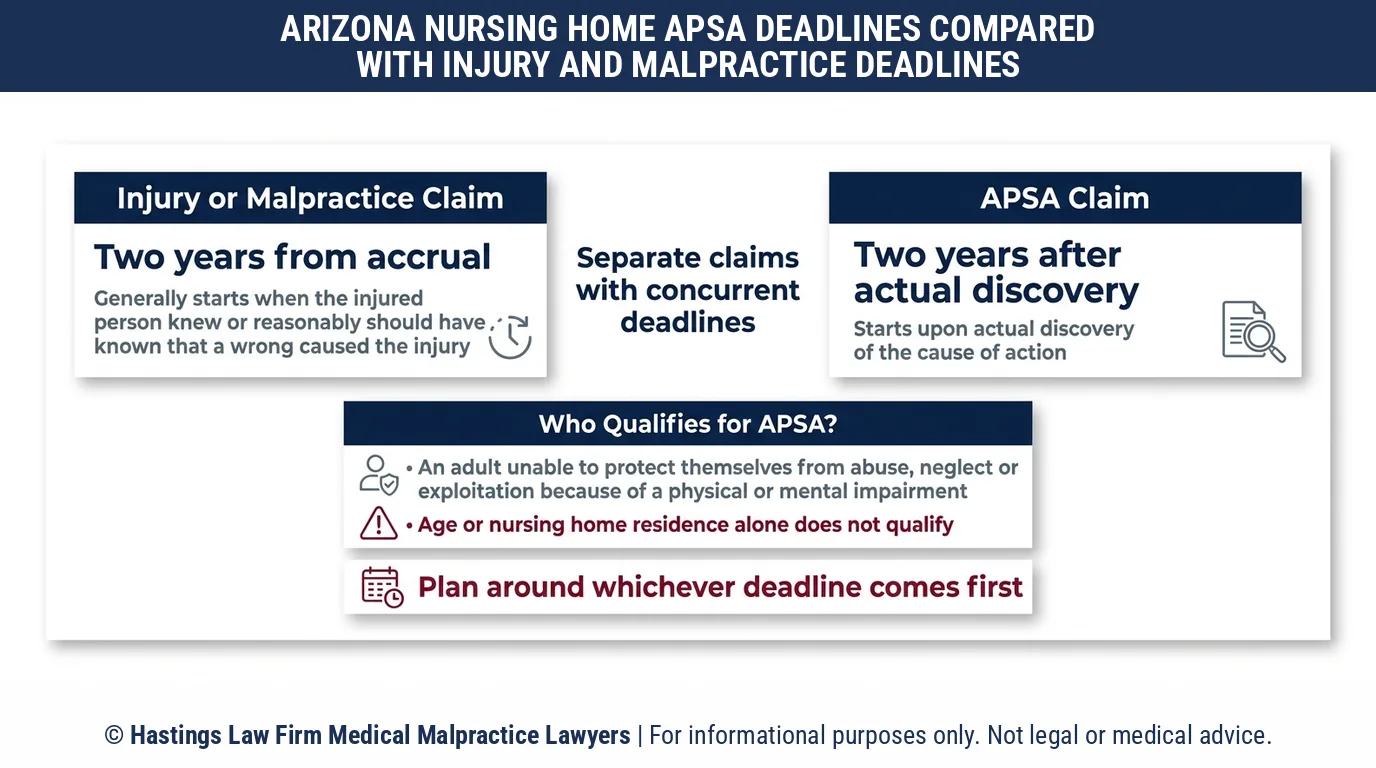
The kind of claim then decides which clock applies, and one family may face more than one. An injury or malpractice claim runs two years from accrual, and a claim under the Adult Protective Services Act runs two years after actual discovery of the cause of action. A government-run facility requires a notice of claim within 180 days and a lawsuit within one year, and a wrongful death claim generally runs two years from the death.
A criminal prosecution of a caregiver for abusing a vulnerable adult runs on its own time limits under A.R.S. § 13-107. Those limits are separate from the civil deadlines and do not change the family’s time to file a lawsuit.
For a malpractice claim, the time to sue works the same way for a nursing home resident as for any other Arizona patient. Arizona has no separate outer cutoff measured only from the date of treatment, so whether an older claim is still timely depends on when it accrued and whether any pause applies.
These deadlines apply whatever form the harm took, whether a fall, bedsores, a medication error, an infection, or abuse by staff. What matters in every one of them is the kind of claim and the date it accrued.
Does Arizona’s Adult Protective Services Act Give Nursing Home Residents a Separate Deadline?
Arizona’s Adult Protective Services Act, or APSA, gives a vulnerable adult a separate civil claim against a person or enterprise employed to provide care, and A.R.S. § 46-455(K) requires that claim to be filed within two years after actual discovery of the cause of action. That deadline runs alongside Arizona’s two-year deadline for injury and malpractice claims rather than replacing it.
The claim depends on the resident qualifying as a vulnerable adult. Under A.R.S. § 46-451, that is an adult who cannot protect themselves from abuse, neglect, or exploitation because of a physical or mental impairment. Living in a nursing home or reaching an advanced age does not qualify a resident on its own.
For a resident who does qualify, the claim can reach the facility itself. An enterprise under the statute includes a corporation or other entity involved in providing care, and the Arizona Supreme Court recognized in Delgado v. Manor Care of Tucson AZ, LLC that a nursing home operator can qualify.
The court also held that negligent care can be APSA abuse when the statute’s requirements are met, even when the same conduct is medical malpractice. It did away with an older four-part test courts had used to decide whether these claims could go forward. The statute limits APSA liability for certain individual clinicians, not for nursing homes as a whole. Because the APSA deadline and the injury and malpractice deadline are worded differently, the careful course is to work from whichever date comes first.
When Does the Clock Start on a Nursing Home Abuse or Neglect Claim in Arizona?
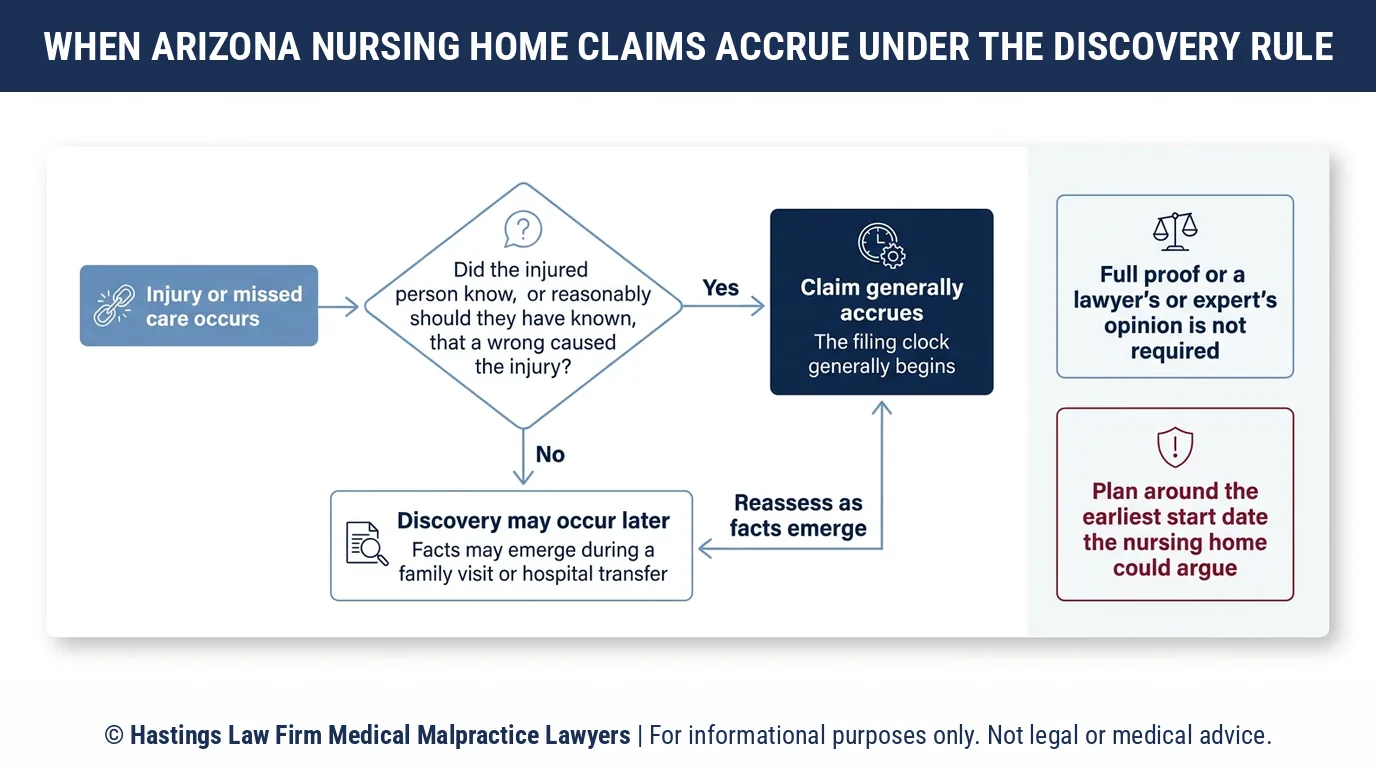
The clock on an Arizona nursing home abuse or neglect claim generally starts when the injured person knew, or with reasonable diligence should have known, the facts showing that a wrong caused the injury. A decision of the Arizona Supreme Court, Doe v. Roe, applied that discovery rule beyond professional malpractice, so it can apply to claims against a nursing home and its staff.
Under the discovery rule, the start date is not always the day of the fall or the missed care. Knowing does not mean having every fact, full proof, or a lawyer’s or expert’s opinion. It means knowing enough to put a reasonable person on notice to look into whether the injury was wrongfully caused.
In a nursing home, the facts that give that notice can come to light later, during a family visit or a transfer to a hospital. The facility can dispute when the clock started, and a jury ordinarily decides that question. The safest date to plan around is the earliest one the nursing home could argue.
Does Dementia Pause the Deadline for an Arizona Nursing Home Claim?
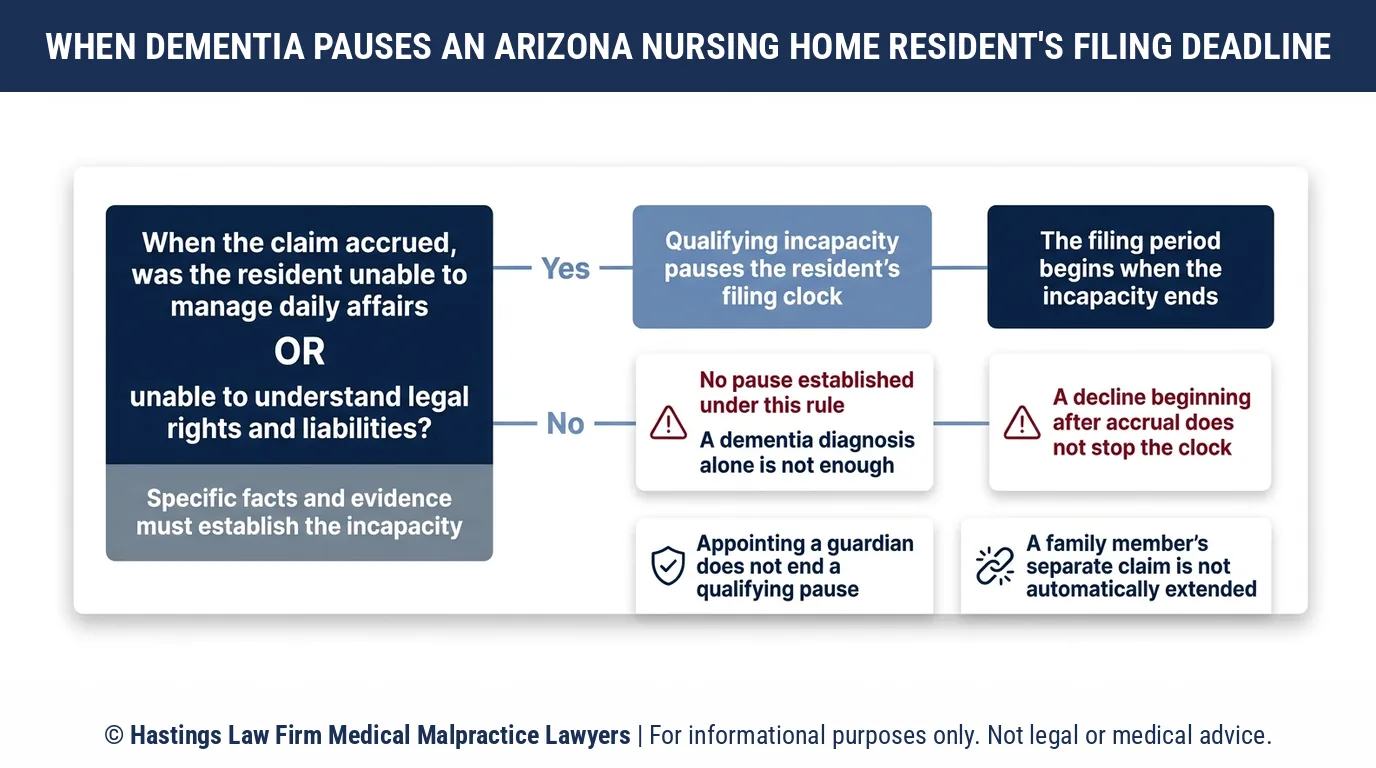
Dementia can pause the Arizona filing deadline when it leaves a nursing home resident of unsound mind at the time the claim accrues. Under A.R.S. § 12-502, the period of that disability does not count against the clock, and the filing period begins to run once the disability ends.
Unsound mind means the resident was unable to manage daily affairs or unable to understand legal rights and liabilities, and specific facts and evidence must show it. A dementia diagnosis, a serious illness, or a hospital stay does not pause the deadline on its own.
A decline that begins only after the clock has started does not stop it, because the incapacity must exist when the claim accrues. Records of the resident’s condition at that point carry real weight.
Once the pause applies, a guardianship does not end it. In Sahf v. Lake Havasu City Association, the Arizona Court of Appeals held that appointing a guardian does not itself start the clock for a person whose unsound mind meets these requirements. That protection covers the resident’s own claim but does not automatically extend a family member’s separate claim, so acting early is still the safer course.
Who Can Sue on Behalf of an Arizona Nursing Home Resident?
The resident’s conservator can sue on behalf of an incapacitated Arizona nursing home resident, or the guardian if no conservator has been appointed, under Rule 17 of the Arizona Rules of Civil Procedure. When neither has been appointed, an agent under a valid durable power of attorney that authorizes litigation can bring the case.
Because the claim belongs to the resident, a relative cannot sue for the resident on the family relationship alone. The court’s appointment order or the power of attorney sets the limits of the representative’s authority, and a guardian cannot bypass a conservator the court has already appointed. A conservator who brings the case needs court approval to settle an injury claim for the resident.
An APSA claim also belongs to the vulnerable adult, and the state can bring its own action on the adult’s behalf. If the resident dies, the APSA claim survives, and the personal representative appointed by the probate court for the resident’s estate can pursue it.
How Long Does a Family Have to File a Wrongful Death Claim Against an Arizona Nursing Home?
A wrongful death claim against an Arizona nursing home generally must be filed within two years of the resident’s death. Under A.R.S. § 12-542 and § 12-612, the surviving spouse, child, parent, or guardian, or the personal representative of the estate, can bring the claim within that time.
For each of them, the clock starts at the death, even when the fall, the bedsore, or the missed care came months earlier. A minor child’s own wrongful death claim can be paused while the child is a minor, but that pause does not extend the adult survivors’ time. Whether any later start date could apply is a question for an attorney.
The resident’s own claim also survives the death as a separate claim, brought by the estate’s personal representative. That claim keeps the resident’s original deadline, with a short pause until the representative is appointed or 12 months pass after the death, whichever comes first, and it cannot run out sooner than four months after the death. The death does not start a new two years or revive a claim that had already expired.
That surviving claim can recover medical bills, income lost before death, and other proven economic losses, but not the resident’s pain and suffering. Becoming a personal representative takes a probate appointment and letters, the court papers that authorize the role, so that step is worth starting early.
If the resident settled and released the claim before the death, that release can prevent a later wrongful death lawsuit against the parties it covered. A missed deadline on the resident’s own claim does not, by itself, bar the family’s case.
When the family’s claim goes forward, one nursing home wrongful death lawsuit serves every eligible survivor, and one eligible family member or the personal representative can file it without everyone’s permission. Settling the other survivors’ claims requires their consent.
Is the Deadline Shorter for a Government-Run Nursing Home in Arizona?
A claim against a government-run nursing home in Arizona requires a notice of claim stating a specific settlement amount within 180 days after the claim accrues, under A.R.S. § 12-821.01. The lawsuit must be filed within one year after the claim accrues under A.R.S. § 12-821. These rules apply only to public entities, so the first step is finding out who owns and operates the facility.
Is It Too Late to Sue a Nursing Home in Arizona After Two Years?
Suing an Arizona nursing home more than two years after the claim accrued can be too late, because the facility can raise the statute of limitations as a defense, and an expired period can then end the claim. A.R.S. § 12-542 requires filing within its period “and not afterward.” Two years is the usual deadline, though a claim against a government-run facility must be filed within one year.
A date that looks too late may not be, because the clock may have started later under the discovery rule or been paused while the resident was of unsound mind. An attorney can check those dates before a family decides a claim is lost.
The Hastings Law Firm Difference
Results matter, but what truly sets us apart is how we achieve them. Every verdict, every settlement, and every courtroom victory comes from one guiding promise: To treat each client’s fight for justice as if it were our own.
This balance of skill, experience, and empathy reflects our core philosophy that justice should not only compensate the injured, but also make health care safer nationwide.

What Should Families Do Now to Protect an Arizona Nursing Home Claim?
Families who suspect nursing home abuse in Arizona should first write down when the harm was noticed and by whom, request the resident’s records, and speak with an attorney promptly to identify the filing deadlines that apply. Those three steps protect both the evidence and the filing deadline, which comes much sooner for a government-run facility.
The harm can also be reported to Adult Protective Services, which investigates abuse, neglect, and exploitation of vulnerable adults, or to the Arizona Department of Health Services, which handles licensing and complaints for long-term care facilities. A report is worth making, but it does not pause the time to sue.
If the resident cannot act personally, find out early whether a conservator, guardian, or agent under a durable power of attorney is already in place. That person brings the case, so who holds the authority is worth settling long before the deadline draws close.
Keep the admission papers too, including any arbitration agreement, which is a contract to resolve disputes before an arbitrator rather than in court. At a nursing facility covered by the Medicare and Medicaid participation rules, 42 C.F.R. § 483.70 provides that signing an arbitration agreement cannot be a condition of admission or continued care, and the agreement must allow the resident or a representative to cancel it within 30 calendar days of signing. These protections do not automatically reach every assisted living facility, which is one more reason to keep a copy of what was signed.
Photographs, notes from each visit, and the names of staff on duty are easier to gather while the events are recent. Copies of anything the facility provides and the dates of any hospital transfers give an attorney more to work with when checking the claim and its deadline.
Talk to an Arizona Nursing Home Abuse Attorney About Your Family’s Case
When your family contacts Hastings Law Firm, a member of our intake team listens to what you saw and asks about the care, when it happened, and who provided it. We request the resident’s records at no cost, our attorneys and medical professionals review them, and once that review is complete we give you an honest answer about whether there is a claim and which deadline applies.
Our lawyers are experienced in handling nursing home abuse and neglect claims in Arizona. We understand what harm in a nursing home can mean for a resident’s health and dignity, and for the family members now making decisions about a parent’s care.
Our Arizona nursing home abuse lawyers work on a contingency fee, which means you pay no attorney fees or costs unless we win, and we advance the cost of experts and the other expenses of building the case. Hastings Law Firm has been dedicated exclusively to medical malpractice since 2005. Contact us now for a free, confidential case review. Our team is here for you.
Sources
- A.R.S. § 12-542, Arizona’s two-year deadline for injury and malpractice actions | Arizona State Legislature
- A.R.S. § 12-561, Arizona’s definition of a medical malpractice action | Arizona State Legislature
- A.R.S. § 46-455, the vulnerable adult civil claim and its two-year deadline | Arizona State Legislature
- Delgado opinion on nursing home operators and abuse claims under APSA | Arizona Supreme Court
- Doe v. Roe opinion on when an Arizona claim accrues under the discovery rule | CourtListener
- A.R.S. § 12-502, the pause for minors and persons of unsound mind | Arizona State Legislature
- Sahf opinion holding a guardianship does not end the unsound-mind pause | Justia
- Order adopting Rule 17 on who sues for an incapacitated person | Arizona Supreme Court
- A.R.S. § 12-612, who may bring an Arizona wrongful death action | Arizona State Legislature
- A.R.S. § 12-821.01, the 180-day notice of claim against a public entity | Arizona State Legislature
- Civil answer form listing the statute of limitations among the defenses | Superior Court of Arizona in Maricopa County
- Adult Protective Services and its investigation of vulnerable adult abuse and neglect | Arizona Department of Economic Security
- 42 C.F.R. § 483.70, nursing facility rules on binding arbitration agreements | eCFR

This content was researched and written by the Hastings Law Firm editorial team, which includes attorneys, medical professionals, and experienced researchers. Our writing is informed by internal knowledge and practical experience, and we cross-check critical details against authoritative sources cited throughout. Every piece undergoes human-led fact-checking and legal review. Because legal and medical information can change, if you spot an error, please contact us. Learn more about our content standards and review process on our editorial policy page.

Tommy Hastings, founder of Hastings Law Firm, is a board-certified personal injury trial lawyer (by the Texas Board of Legal Specialization) dedicated exclusively to healthcare injury cases. Since 2001, he has represented injured patients and families in litigation against major hospital systems, pharmaceutical companies, and negligent healthcare providers nationwide. He has handled numerous high-profile cases that have drawn national media attention and resulted in multi-million dollar recoveries.
