


Arizona Nursing Home Medication Error Lawyer
Medication errors in nursing homes can cause serious harm when a resident receives the wrong drug, the wrong dose, the wrong route, or no medication at all. These mistakes are often tied to preventable breakdowns such as skipped verification steps, documentation gaps, communication failures during shift changes, and systemic issues like understaffing or inadequate training. Families may also face uncertainty when records are incomplete or when a facility blames a resident’s decline on other health problems. If your loved one was harmed or worse due to nursing home medication errors in Arizona, contact Hastings Law Firm for a free, confidential case review.

Last Updated: July 27, 2026
Trusted Arizona Medical Attorneys for Nursing Home Drug Error Claims
When you entrust a nursing home with the care of someone you love, you expect that basic medical tasks, like administering the right medication at the right time, will be handled safely. Discovering that a medication error caused your family member harm can leave you feeling angry, confused, and unsure of what to do next.
You deserve answers, and you deserve to know whether what happened was preventable. Founded by Tommy Hastings, a board-certified trial lawyer, Hastings Law Firm focuses exclusively on medical malpractice litigation. Our team includes in-house nurses and former defense attorneys who know how to manage facility failures and identify where the standard of care broke down.
If your loved one was harmed by a drug error in an Arizona care facility, we can review what happened and explain your legal options in a free, confidential consultation.

Common Types of Medication Errors in Arizona Care Facilities
Medication errors in nursing homes occur when residents receive the wrong drug, an incorrect dosage, or no medication at all, often resulting in severe physiological harm. These errors take many forms, including improper medication administration or a failure to administer medication, and understanding the specific type of mistake is the first step in determining whether negligence was involved. A qualified attorney for medication mistakes can help families identify these failures.
Healthcare providers are trained to follow the 5 Rights of Medication Administration: the right patient, right drug, right dose, right route, and right time. When any of these safeguards is skipped or ignored in a nursing home setting, the consequences for a vulnerable resident can be serious or even fatal.
Wrong Drug or Wrong Patient. In Arizona care facilities, one of the most common errors involves administering medication intended for a different resident. This can happen when staff fail to verify identity through wristbands or photo identification. A resident who receives the wrong medication may suffer an allergic reaction, dangerous drug interactions, or a medical crisis unrelated to any condition they actually have.
Dosage Errors. Dosage mistakes often involve high-alert medications where the difference between a therapeutic dose and a harmful one can be razor-thin. High-alert medications carry a heightened risk of significant harm when used incorrectly, such as blood thinners, insulin, or opioids. An overdose can cause organ damage, breathing trouble, or death, while an underdose can leave a condition untreated.
Improper Administration Routes. Choosing the correct delivery method is essential for resident safety because how a drug is delivered matters as much as which drug is given. Crushing a time-release tablet, for example, can cause a resident to absorb a full day’s dose within minutes. Giving an injection meant for intramuscular delivery through an IV line can trigger a life-threatening reaction.
Omissions. Skipping a scheduled dose is a common form of medication error. A missed dose of a seizure medication, blood pressure drug, or antibiotic can set off a chain of medical complications. These gaps are often documented, or noticeably absent, in the Medication Administration Record (MAR), which is the facility’s official log of every drug given to each resident.
| Error Type | What Happens | Potential Harm |
|---|---|---|
| Wrong Drug/Patient | Medication given to the wrong resident or wrong drug selected | Allergic reactions, drug interactions, damage |
| Overdose | Dose exceeds prescribed amount | Organ damage, breathing failure, death |
| Underdose | Dose is below therapeutic level | Disease progression, uncontrolled symptoms |
| Wrong Route | Drug delivered by incorrect method | Rapid absorption, overdose effect, tissue injury |
| Omission | Scheduled dose is skipped entirely | Seizures, blood pressure crisis, infection spread |
Under Arizona Revised Statutes § 12-2603, pursuing a claim against a healthcare professional requires a preliminary expert opinion confirming that the standard of care was violated. An Arizona nursing home medication error lawyer can manage this review and determine which type of error occurred.
Look-Alike and Sound-Alike Drug Confusion
Drug name confusion occurs when two different medications have similar names or packaging. A lesser-known but dangerous category of errors involves Look-Alike/Sound-Alike medications, commonly called LASA drugs. For example, hydroxyzine and hydralazine sound nearly identical when spoken aloud but treat entirely different conditions.
Nursing facilities have a duty of care to implement safeguards against LASA mix-ups, including tall-man lettering on labels and barcode scanning systems. When a facility fails to adopt or enforce these standard protections, and a resident receives the wrong medication, that failure may constitute a breach of the standard of care.

Why Do Drug Errors Happen? Systemic Causes and Negligence
While individual staff members may make mistakes, medication errors are frequently caused by systemic facility negligence, such as chronic understaffing, inadequate training, or faulty electronic health record (EHR) systems. Identifying these root causes is important because they often point to institutional liability rather than a single nurse’s lapse.
Staff Fatigue and Understaffing. Workforce shortages in nursing homes often lead to mistakes when one nurse is responsible for dozens of residents. Research published by PubMed Central on the impact of rationing nursing care confirms that understaffing levels directly compromise patient safety. Fatigued staff are more likely to skip verification steps, misread labels, or forget scheduled doses altogether.
Inadequate Training. Proper staff training is a requirement for safe medication management. Some errors result from staff who were never properly trained on a resident’s specific needs or the facility’s Electronic Medication Administration Record (eMAR). Without proper training on these digital systems, errors in documentation and monitoring compound quickly.
Diversion of Medication. Drug theft by staff can leave residents without their needed medicine. Diversion of medication is an uncomfortable reality where caregivers steal controlled substances like opioids. When this happens, the resident may receive a diluted dose or nothing at all, leaving them in unmanaged pain while records falsely show the medication was given.
Communication Failures. Clear communication during nursing shift changes prevents errors. Shift changes are high-risk windows because if an outgoing nurse fails to communicate a prescription change or a new allergy, the incoming team may not have the necessary information.
A lawyer for nursing home drug errors will look for patterns across these categories. The following red flags often indicate systemic negligence:
- Repeated medication errors involving the same resident or the same staff member
- Gaps, overwritten entries, or late additions in the eMAR or electronic medication record
- High staff turnover rates or frequent use of temporary agency nurses
- Residents showing unexplained changes in alertness, behavior, or pain levels
- Missing or incomplete drug interaction and allergy screening documentation
- No evidence of pharmacist review for new prescriptions
Under Arizona Revised Statutes § 12-563, a patient or family must demonstrate the specific elements of proof for a negligence claim. An Arizona medication negligence attorney can trace these systemic failures back to the decisions, or the inaction, of the facility itself.
Storage and Refrigeration Failures
Correct storage is important to keeping medications effective. Certain medications, including insulin and some antibiotics, must be stored within strict temperature ranges. This is sometimes called maintaining the cold chain, which is the series of temperature-controlled handling conditions required to keep drugs effective.
The standard of care typically requires proper refrigeration of sensitive drugs to keep them effective. When a facility fails to properly store these drugs, they breach the standard of care, and a resident may receive medication that has lost its potency. This type of negligence can be difficult to detect without a careful investigation into the facility’s storage logs and pharmacy records.

The Hastings Law Firm Difference
Results matter, but what truly sets us apart is how we achieve them. Every verdict, every settlement, and every Arizona courtroom victory comes from one guiding promise: To treat each client’s fight for justice as if it were our own.
This balance of skill, experience, and empathy reflects our core philosophy that justice should not only compensate the injured, but also make health care safer nationwide.

Liability for Pharmaceutical Negligence in Nursing Homes
Liability for a medication error may extend beyond the nurse administering the drug to include the nursing home facility, the pharmacy that dispensed the medication, or the prescribing physician. Determining legal responsibility is the first step in building a case.
Vicarious Liability. Vicarious liability allows facilities to be held responsible for staff errors. Under this legal doctrine, the nursing home can be held accountable for the negligent actions of its employees. This means the facility is responsible for errors made by staff on their payroll, even if management was not directly involved.
Corporate Negligence. Corporate negligence involves institutional failures by the facility management. Separate from the actions of any single employee, a facility can face direct liability for its own failures, such as hiring unqualified staff or failing to enforce safety protocols. These decisions reflect the facility’s own breach of the duty of care owed to its residents.
Third-Party Liability. Sometimes parties outside the nursing home, like pharmacies, share liability. A pharmacy may dispense the wrong drug or dosage, creating potential pharmacist liability. A visiting physician may also be responsible if they prescribe medication without checking the resident’s full medical history for drug interactions.
An Arizona nursing home medication error lawyer will evaluate every link in the chain to identify each party whose negligence contributed to the harm. We also analyze causation to ensure the injury is legally linked to the error. Experienced legal counsel for drug injury is important in these multi-party claims.
Proving Malpractice and The Arizona Legal Standard
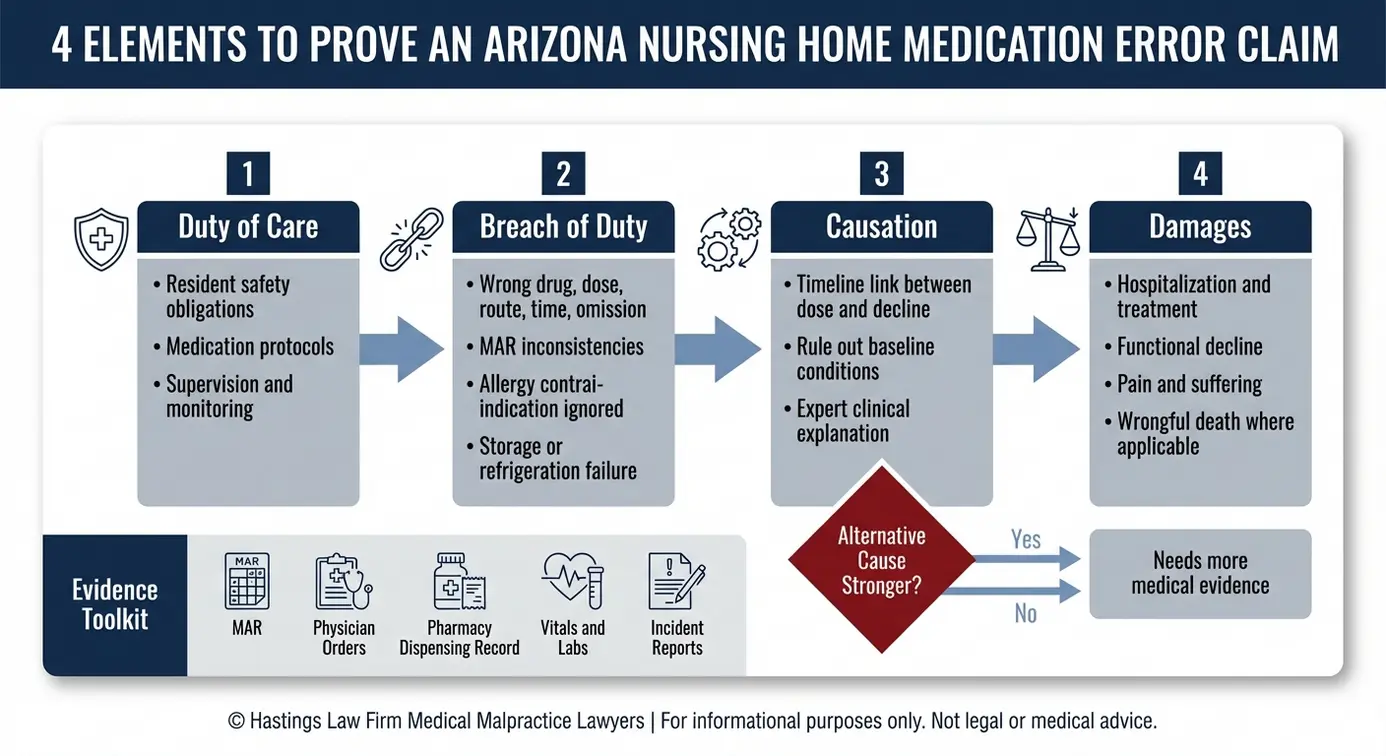
To win a claim, a plaintiff must prove four elements: the facility owed a duty of care, they breached that duty through a specific error, the error caused actual injury, and damages resulted from that injury. Legal claims in Arizona require specific proof that the care provided was substandard.
Establishing Duty. The duty of care is the legal obligation facilities have to residents. Every licensed nursing home in Arizona is obligated to provide treatment that meets the accepted standard for skilled nursing care, including safe and accurate medication administration.
Identifying the Breach. A breach occurs when the facility fails to meet the standard of care. We identify this breach of duty by analyzing the Medication Administration Record for gaps, inconsistencies, or alterations. We also examine medication reconciliation, which is the process of comparing current orders against what is actually being administered.
Proving Causation. Causation proves the error directly caused the resident’s harm. The defense often argues that a resident’s decline was caused by pre-existing conditions rather than a medication error. To counter this, our team reconstructs the clinical timeline to establish a clear link between the error and the adverse drug reaction (ADR), using the resident’s medical history as a baseline.
Documenting Damages. Damages are the specific losses a family suffers after an error. The final element requires proof of actual harm, whether physical, financial, or emotional. An experienced attorney for medical negligence knows how to compile medical records and testimony to support this portion of the case.
An Arizona nursing home medication error lawyer at Hastings Law Firm prepares every case with trial-level rigor from the outset. We scrutinize the facility’s adherence to the standard of care to build a strong foundation for settlement or litigation.
Recoverable Damages for Medication Injuries
Victims of medication errors in Arizona may recover compensation for medical expenses, pain and suffering, and in tragic cases, wrongful death damages for the loss of a loved one. Recovering compensation helps families cover the costs of unexpected medical care.
Economic damages cover the measurable financial losses tied to the injury. This includes reimbursement for all medical expenses incurred, such as:
- Emergency hospitalization and corrective medical treatment
- Ongoing care, rehabilitation, or transfer to a higher-level facility
- Prescription costs for medications needed to treat complications
- Future medical expenses if the injury requires long-term management
Non-Economic Damages address the human cost of the error. These damages provide compensation for the intangible losses that accompany a serious injury, including physical pain and suffering and emotional distress experienced by the resident or family.
Arizona courts may award punitive damages when evidence shows the defendant acted with an “evil mind,” meaning conscious disregard for the safety of others. Examples in the nursing home context could include intentional over-sedation of residents or knowingly operating with dangerously inadequate staffing levels.
A lawyer for nursing home medication error cases will document every category of harm to pursue full compensation under Arizona law. Insurance companies often attempt to minimize payouts, but a detailed damages assessment forces them to account for the true long-term impact of the injury.
Contact the Arizona Nursing Home Attorneys at Hastings Law Firm Today for Help
If a loved one has suffered because of a medication error in an Arizona nursing facility, acting quickly matters. Medical records can be altered and evidence of systemic failures can disappear, so early legal involvement helps preserve important documentation.
Hastings Law Firm offers a free, confidential consultation to evaluate the details of what happened. Our in-house medical staff, including nurse practitioners and board-certified patient advocates, review the clinical records alongside our legal team to determine whether the standard of care was violated.
We handle these cases on a contingency fee basis, meaning you pay no legal fees unless we recover compensation on your behalf. If your family needs an Arizona nursing home medication error attorney, contact us today and let us help you find the answers you deserve.
Frequently Asked Questions About Nursing Home Medication Error in Arizona


This content was researched and written by the Hastings Law Firm editorial team, which includes attorneys, medical professionals, and experienced researchers. Our writing is informed by internal knowledge and practical experience, and we cross-check critical details against authoritative sources cited throughout. Every piece undergoes human-led fact-checking and legal review. Because legal and medical information can change, if you spot an error, please contact us. Learn more about our content standards and review process on our editorial policy page.

Tommy Hastings, founder of Hastings Law Firm, is a board-certified personal injury trial lawyer dedicated exclusively to healthcare injury cases. Since 2001, he has represented injured patients and families in litigation against major hospital systems, pharmaceutical companies, and negligent healthcare providers nationwide. He has handled numerous high-profile cases that have drawn national media attention and resulted in multi-million dollar recoveries. He draws on that experience in his writing, helping readers understand how these cases work and what options may be available to them.
