


Arizona Nursing Home Bedsores Lawyers
Written by: Hastings Law Firm | Reviewed by: Tommy Hastings | Updated: July 27, 2026
Bedsores in a nursing home can signal a serious breakdown in basic care and can leave families feeling betrayed and overwhelmed. Pressure injuries are described as largely preventable when facilities assess risk, follow individualized care plans, and provide consistent repositioning, skin checks, nutrition support, and moisture management. When prevention fails, wounds can worsen quickly and lead to infection, lasting harm, or worse. Clear documentation and timely preservation of records can matter when neglect is suspected. If you or a loved one were harmed or worse due to nursing home bedsores in Arizona, contact Hastings Law Firm for a free, confidential case review.

Trusted Legal Representation for Elderly Victims of Bedsores in Arizona
What You Should Know About Elderly Pressure Sore Negligence Claims in Arizona:
- Severe bedsores can lead to systemic infection, sepsis, amputation, or death, especially when advanced stage wounds develop during a facility stay.
- A bedsore that develops after admission can raise concerns about neglect, particularly when records show missed prevention measures.
- Options for accountability can narrow when evidence is lost or altered, since staffing logs and wound documentation may become harder to obtain over time.
- Recovery can include economic damages for medical bills and ongoing treatment, along with non economic damages for pain, emotional distress, and loss of dignity.
- Additional claims may be available when a fatal infection occurs, since Arizona law recognizes wrongful death claims in that circumstance.
- Punitive damages may be available when conduct reflects gross negligence or reckless disregard for resident safety.
- Criminal exposure can arise for individuals who fail to report neglect, since Arizona law imposes reporting duties and penalties.
- Disputes often turn on documentation quality, since inconsistent or falsified wound care records and ghost charting may indicate care was not provided.
- Facility compliance issues can matter in Arizona, since operational standards address staffing, resident assessments, and care planning.
- Key records can be central to evaluating neglect, including wound care notes and staffing schedules.

A Healthcare Focused Law Firm
Discovering that a loved one has developed bedsores in a nursing home can feel like a profound betrayal. You trusted a facility to provide safe, attentive care, and now you are facing painful evidence that something went wrong. Bedsores, also known as pressure ulcers, are almost always preventable with proper attention. When they appear, it often points to a breakdown in the care your family member was promised.
At Hastings Law Firm, we focus exclusively on medical negligence. Led by founder Tommy Hastings, a board-certified trial attorney, our team understands the frustration of feeling like the system meant to protect your loved one has let them down. If you or a loved one is dealing with this, we can review what happened and explain your options in a free, confidential consultation.
How an Arizona Nursing Home Bedsores Lawyer Can Help
Arizona nursing home bedsores attorneys investigate claims of neglect by securing medical records, staffing logs, and expert testimony to determine whether a facility failed to follow prevention protocols. Our team focuses on uncovering the evidence needed to hold negligent facilities accountable.
Time is an important factor in these investigations. Facilities may alter records, and evidence of elder neglect, such as staffing agency invoices or shift logs, can become harder to obtain each week. An experienced lawyer acts quickly to preserve evidence immediately, filing motions to prevent the destruction of key documents before they disappear.
Our team includes in-house medical professionals, including nurse practitioners and patient advocates, who know exactly what to look for in clinical documentation. We also maintain a national network of expert witnesses who can validate the injury and explain how nursing home standards apply to your situation. Experts help us determine if low staffing levels contributed to the injury.
Here is what lawyers for nursing home bedsores in Arizona typically do on your behalf:
- Secure and preserve evidence immediately, including wound care records, staffing schedules, and incident reports, before anything can be lost or altered.
- Engage qualified medical experts who review the clinical timeline and assess whether the standard of care was met.
- Handle communications with facility insurers, who often deploy defense tactics designed to minimize or deny liability.
You should not have to manage this process alone while also caring for an injured family member. That is what our legal and medical team is here to do.
Understanding Pressure Injuries: Stages and Severity
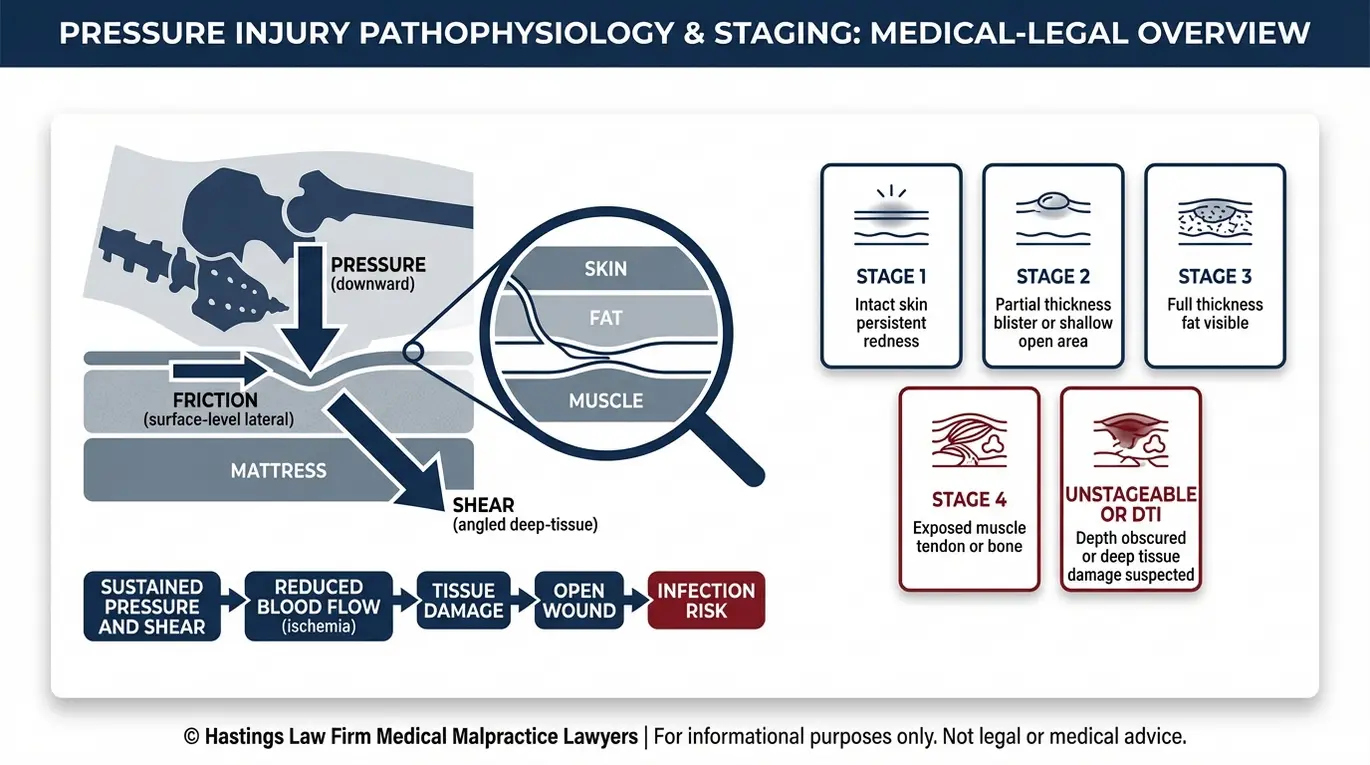
Bedsores, or decubitus ulcers, are injuries to the skin and underlying tissue caused by prolonged pressure, typically developing over bony prominences like the heels, ankles, hips, sacrum (tailbone), and trochanters (hip bones). Knowing how these wounds develop helps identify where a facility failed to provide necessary care.
The mechanism involves three forces working together. Direct pressure compresses the tissue against bone, cutting off oxygen. Friction damages the outer skin when it drags against bedding or clothing. Shear forces, which occur when the skin stays in place while deeper tissue shifts, tear the blood vessels feeding the skin from beneath the surface. Without relief, these forces cause cell death within hours.
The staging system classifies pressure ulcer severity, and the progression from early warning signs to serious wounds can happen quickly without proper intervention. Detecting Stage 1 or 2 injuries early is essential; if ignored, they can rapidly deteriorate into Stage 3 or 4 wounds that expose bone and invite infection. The Revised National Pressure Ulcer Advisory Panel Pressure Injury Staging System outlines the following classifications:
| Stage | Description | Key Indicators |
|---|---|---|
| Stage 1 | Skin is intact but shows persistent redness that does not blanch when pressed | Warmth, firmness, or pain at the site |
| Stage 2 | Partial-thickness skin loss with a shallow open wound or blister | Exposed dermis; pink or red wound bed |
| Stage 3 | Full-thickness tissue loss; fat may be visible | Deep crater-like wound; possible tunneling |
| Stage 4 | Full-thickness tissue and muscle/bone loss | Exposed bone, tendon, or muscle; high risk of sepsis |
| Unstageable | Wound bed obscured by dead tissue (slough or eschar) | True depth unknown until debrided; often a Stage 3 or 4 |
| Deep Tissue Injury (DTI) | Damage originates beneath intact skin | Dark purple discoloration; can deteriorate rapidly |
Stage 3 and Stage 4 wounds carry severe risks, including gangrene, systemic infection leading to sepsis, and in the worst cases, amputation or death. A bedsores lawyer evaluates the full clinical picture to determine whether the facility should have intervened and how the injury progressed.
The Hastings Law Firm Difference
Results matter, but what truly sets us apart is how we achieve them. Every verdict, every settlement, and every Arizona courtroom victory comes from one guiding promise: To treat each client’s fight for justice as if it were our own.
This balance of skill, experience, and empathy reflects our core philosophy that justice should not only compensate the injured, but also make healthcare safer nationwide.

The Standard of Care: Prevention Protocols in Arizona Facilities
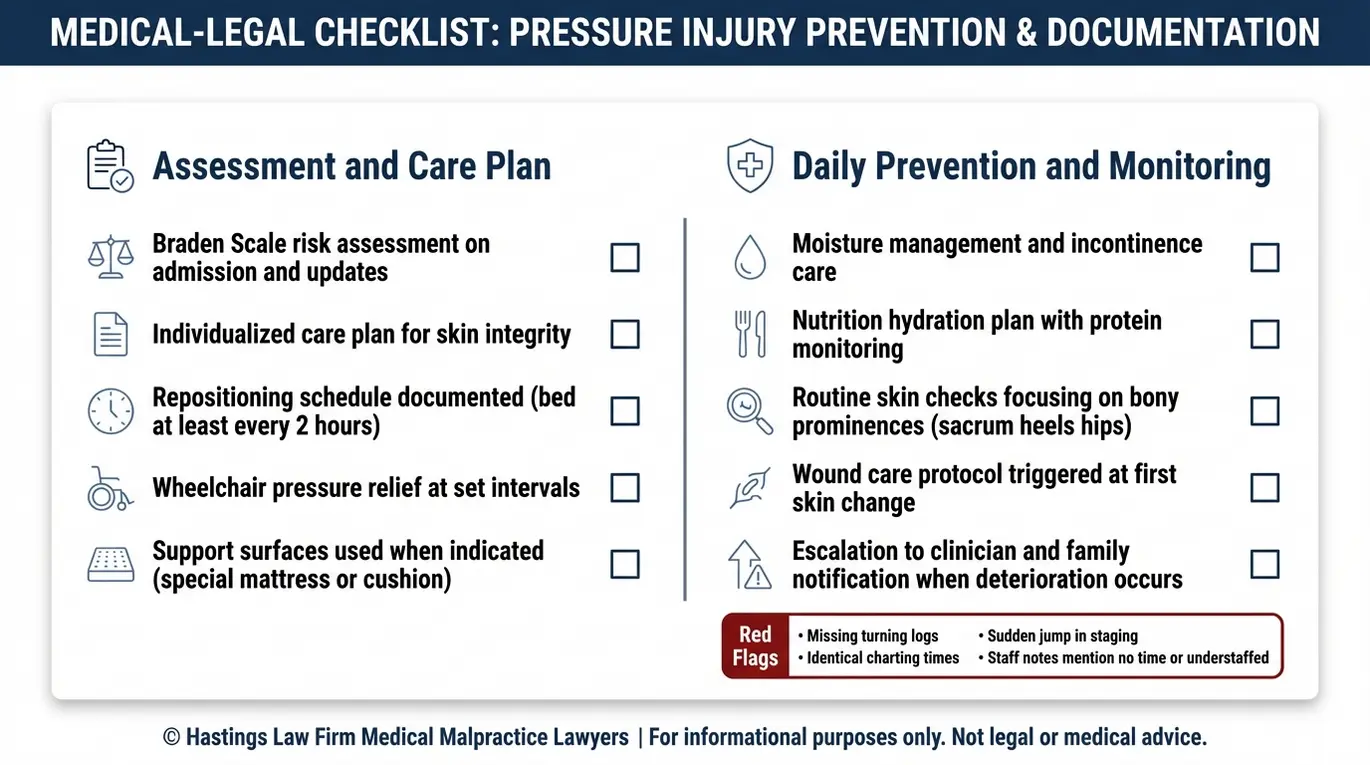
Nursing homes are legally required to assess each resident for pressure injury risk and implement an individualized care plan that includes frequent repositioning, specialized support surfaces, and nutritional support to prevent skin breakdown. These regulations provide a benchmark for the level of care every resident should receive.
Risk Assessment
Every resident should be evaluated upon admission using a validated tool like the Braden Scale for Predicting Pressure Sore Risk. Healthcare providers use these scores to determine which patients need the most intensive skin monitoring. If this assessment is skipped or its results are ignored, the patient often suffers from avoidable skin breakdown.
Prevention Standards
The standard of care generally requires the following for at-risk residents to maintain skin health. These medical protocols help prevent tissue death in immobile patients:
- A turning protocol requiring the patient to be turned at least every two hours while in bed and every 15 minutes when seated in a wheelchair
- Pressure-redistribution mattresses and seat cushions appropriate to the resident’s risk level
- Daily skin inspections with documented findings
- Adequate nutrition and hydration, particularly protein intake, to support skin integrity
- Moisture management to protect skin from incontinence-related breakdown
- Staff training on proper lifting and transfer techniques to reduce friction and shear
Research published in a systematic review on turning and repositioning frequency confirms that consistent repositioning is an effective intervention for preventing facility-acquired pressure injuries. If facilities lack sufficient resources or training, immobile residents often bear the physical cost.
CMS “Never Events” and Clinical Negligence
The Centers for Medicare & Medicaid Services (CMS) classifies certain outcomes as Never Events, meaning conditions that should not occur if proper care is provided. Experts widely recognize Stage 3 and Stage 4 pressure injuries acquired during a facility stay in this category. The designation reflects a clinical consensus that these wounds represent a failure of prevention.
When medical records show that a severe pressure ulcer developed after admission, it raises a strong question of negligence and liability. Our Arizona bedsores legal team examines the facility’s charting, care plans, and staffing documentation to determine whether the standard of care was met. Nursing home bedsores lawyers understand that these injuries often result from gaps in basic wound care rather than unavoidable medical complications.
Arizona Laws Protecting Nursing Home Residents
Arizona protects elderly and vulnerable adults under the Adult Protective Services Act (APSA), A.R.S. § 46-451, which mandates reporting of abuse and neglect and provides civil remedies for individuals who receive substandard care in licensed facilities. These statutes provide a legal pathway for families to seek justice when care falls below legal requirements.
This statute defines neglect broadly, covering situations where a caregiver fails to provide the supervision, food, shelter, or medical treatment necessary to maintain a resident’s health and safety. Under APSA, nursing home staff have a legal duty to report signs of developing wounds and other indicators of neglect.
Failure to report can be a violation, potentially subjecting the individual to criminal penalties, including misdemeanor charges. Arizona nursing home negligence lawyers use these statutory protections as a framework for holding facilities accountable. The Arizona Administrative Code also sets specific operational standards for licensed long-term care facilities, including requirements around staffing, resident assessments, and care planning.
Violations of these regulations can serve as evidence of negligence in civil litigation. If a bedsore progresses to a fatal infection or sepsis, families may have a wrongful death claim under Arizona law. Attorneys for pressure sores evaluate whether the facility’s conduct supports punitive damages, which Arizona courts may award in cases involving reckless disregard for a resident’s safety.
Proving Neglect: Evidence and Investigation
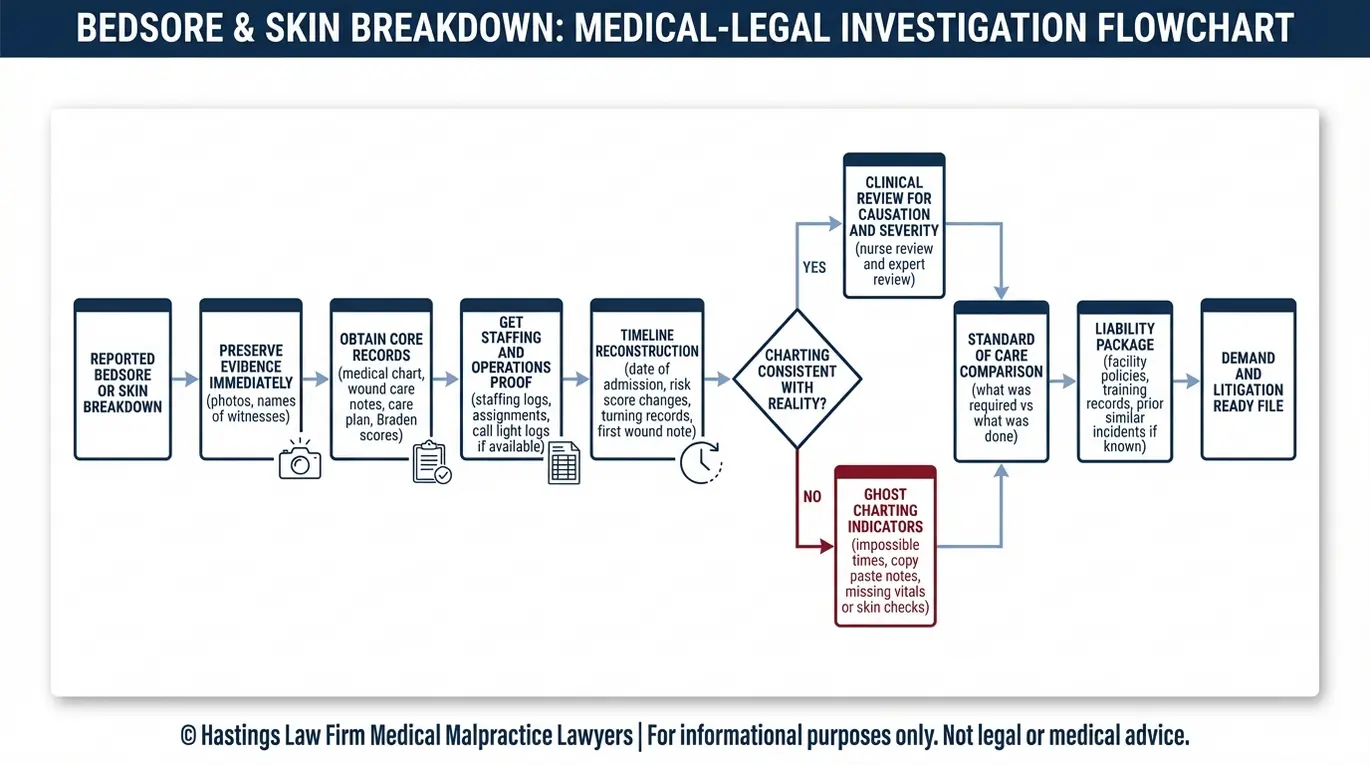
Proving neglect requires demonstrating a breach of the standard of care through evidence such as gaps in staffing logs, inconsistent or falsified wound care records, and witness statements from former employees or family members. Our investigators look for specific patterns in nursing logs that indicate a patient was ignored.
Our team, which includes former defense attorneys and in-house medical professionals, knows how facilities document care and where the record often breaks down. One of the most telling signs of neglect is what we call ghost charting, where records claim that repositioning or wound assessments were performed when the physical evidence suggests otherwise.
Here are the key types of evidence Arizona nursing home bedsores lawyers typically pursue:
- Wound care and nursing notes to track when the injury was first documented and how it progressed
- Staffing logs and schedules to determine whether adequate staff were present during the period the pressure ulcer developed
- Photographs taken by family members or facility staff showing the wound’s condition over time
- Witness statements from roommates, visitors, or former employees who observed care deficiencies
- Facility inspection reports such as those available through Medicare’s Care Compare tool for Arizona facilities
- The resident’s individualized care plan to assess whether it addressed pressure injury risk
Pressure ulcer attorneys correlate staffing ratios with the timeline of injury development. To track when the injury was first documented, we review every entry in the clinical record. When a facility was short-staffed or when care plans failed to account for risks like friction and shear, that connection becomes powerful evidence of a systemic failure.
Compensation and Damages in Bedsore Litigation
Families affected by nursing home neglect may recover economic damages for medical bills and the cost of ongoing medical treatment, including hospitalization, debridement (the surgical removal of dead or infected tissue from a wound), and negative pressure wound therapy, commonly known as a wound VAC, which uses suction to promote healing in deep wounds. Securing financial support allows families to provide the advanced medical care needed for recovery.
Non-economic damages compensate for the suffering that is harder to quantify but no less real: physical pain, emotional distress, and the loss of dignity. For elderly patients, the decline in quality of life caused by a severe bedsore can be devastating, robbing them of their remaining years of comfort.
Research from Johns Hopkins University on the national cost of hospital-acquired pressure injuries shows these wounds impose a significant financial burden on patients and the healthcare system. Arizona nursing home bedsores legal counsel works to ensure that burden does not fall on the family.
In cases where a facility’s conduct reflects gross negligence or reckless disregard for safety, punitive damages may be available. If a bedsore leads to fatal sepsis or infection, a wrongful death claim may provide additional recourse for surviving family members.
Contact the Arizona Nursing Home Attorneys at Hastings Law Firm Today for Help
Bedsores are not a natural consequence of aging. They are a preventable injury, and their presence in a care facility often signals a deeper failure. You do not have to face the legal system alone after a nursing home betrayal.
Hastings Law Firm focuses exclusively on medical negligence litigation to restore trust for families who feel the healthcare system let them down. Our legal and medical team will review the records, identify where care broke down, and help you and your family understand every available option.
Contact our Phoenix medical malpractice team today for a free, confidential evaluation. There are no fees unless we secure a recovery. Let our Arizona nursing home bedsores lawyers help you find the truth and hold the responsible parties accountable.
Frequently Asked Questions About Nursing Home Bedsores in Arizona


This content was researched and written by the Hastings Law Firm editorial team, which includes attorneys, medical professionals, and experienced researchers. Our writing is informed by internal knowledge and practical experience, and we cross-check critical details against authoritative sources cited throughout. Every piece undergoes human-led fact-checking and legal review. Because legal and medical information can change, if you spot an error, please contact us. Learn more about our content standards and review process on our editorial policy page.

Tommy Hastings, founder of Hastings Law Firm, is a board-certified personal injury trial lawyer dedicated exclusively to healthcare injury cases. Since 2001, he has represented injured patients and families in litigation against major hospital systems, pharmaceutical companies, and negligent healthcare providers nationwide. He has handled numerous high-profile cases that have drawn national media attention and resulted in multi-million dollar recoveries. He draws on that experience in his writing, helping readers understand how these cases work and what options may be available to them.
