


Fort Worth Surgical Error Lawyer
Written by: Hastings Law Firm | Reviewed by: Brady D. Williams | Updated: July 27, 2026
Surgical negligence can leave patients facing unexpected pain, complications, and lasting emotional distress, especially when the cause is unclear or communication feels incomplete. Preventable operating room mistakes can involve breakdowns in safety protocols, staffing, planning, or provider judgment, and the harm can be severe and sometimes fatal. Understanding how these errors happen and what records may show can help clarify whether care fell below accepted standards. If you or a loved one were harmed or worse due to surgical negligence in Fort Worth, Texas, contact Hastings Law Firm for a free, confidential case review.

Trusted Medical Attorneys for Surgical Negligence in Fort Worth
What You Should Know About Negligent Surgery Claims in Fort Worth:
- Long term harm can follow preventable surgical mistakes when operating room safety protocols are not followed.
- Liability can turn on whether the failure came from facility level breakdowns or provider level errors.
- Life altering outcomes can result when wrong site wrong patient or wrong procedure events occur after verification steps are skipped or performed carelessly.
- Recovery options can be lost permanently when Texas procedural requirements are missed.
- Additional surgery and serious complications can follow when foreign objects are left inside the body after closure.
- Severe injury or death can result from anesthesia and medication mistakes when monitoring or airway management fails.
- Life threatening infection can occur when bowel or organ damage is not recognized and repaired before the incision is closed.
- Responsibility can be disputed in robotic surgery cases when harm may involve surgeon training issues or device malfunction.
- Total compensation can be limited for non economic losses in Texas even when economic losses are not capped.
- Case outcomes can depend on what operative reports nursing notes monitoring logs and equipment records show about protocol compliance.

A Healthcare Focused Law Firm
When surgery goes wrong, the physical pain is only part of what you carry. There is also confusion, a loss of trust, and a sense that the medical team is not telling you everything. Those feelings are valid, and you deserve answers about what happened and your legal options.
At Hastings Law Firm, we focus exclusively on medical malpractice litigation. Our medical-legal team includes former hospital defense attorneys and in-house nurse consultants who understand hospital protocols from the inside. Founded by board-certified trial lawyer Tommy Hastings, we prepare every case for trial to drive fair outcomes.
If you believe a surgical mistake caused you or a loved one serious harm, we offer a free case evaluation. Let us review what happened and explain your options.
Common Types of Surgical Errors in Fort Worth Hospitals
Surgical errors in Fort Worth typically involve preventable mistakes such as operating on the wrong body part, leaving instruments inside a patient, administering improper anesthesia, or accidentally damaging nearby organs during the procedure. These are not acceptable risks of surgery. They are failures that fall below the standard of care, the level of treatment a reasonably competent surgeon would provide under the same circumstances.
Surgical errors can stem from failures at the facility level, the provider level, or both. Understanding where the breakdown occurred helps determine who is liable.
Facility-based failures often include:
- Inadequate surgical staffing or overworked operating room teams, which prevents proper monitoring of patient vitals.
- Improperly sterilized or defective instruments that increase infection risks.
- Lack of safety protocols or failure to enforce them consistently across departments.
- Poor pre-operative assessment and planning procedures that fail to identify patient-specific risks.
Provider-based failures may involve:
- Surgeon fatigue from back-to-back procedures, impairing judgment and precision.
- Insufficient training or experience for the specific operation being performed.
- Failure to review the patient’s medical history before surgery to check for allergies or conditions.
- Lack of preparation for known complications that arise during the procedure.
In any medical malpractice case, we look at whether the surgeon or the surgical team breached their duty to the patient. That breach of duty is often where the case begins. Proving it requires a detailed review of medical records, hospital policies, and the timeline of care.
Our surgical error lawyers in Fort Worth work alongside in-house medical professionals to reconstruct what happened in the operating room and identify exactly where the standard of care was violated.
Surgical Fires and Operating Room Burns
Though rare, surgical fires remain one of the most devastating operating room injuries. A surgical fire, a fire that ignites during a procedure, typically results from the dangerous interaction between an electrosurgical unit (ESU), a tool that uses electrical current to cut tissue or stop bleeding, and the oxygen-rich environment near the patient’s airway.
A severe burn injury can cause disfiguring injuries, permanent scarring, and severe psychological trauma. Surgical negligence in these cases often involves a failure to follow established operating room safety protocols. When a surgical team does not properly manage oxygen flow or ignition sources, the consequences can be catastrophic. We examine equipment logs, team communication records, and hospital safety policies to evaluate whether proper precautions were taken.
Wrong Site, Wrong Patient, and Wrong Procedure Surgery
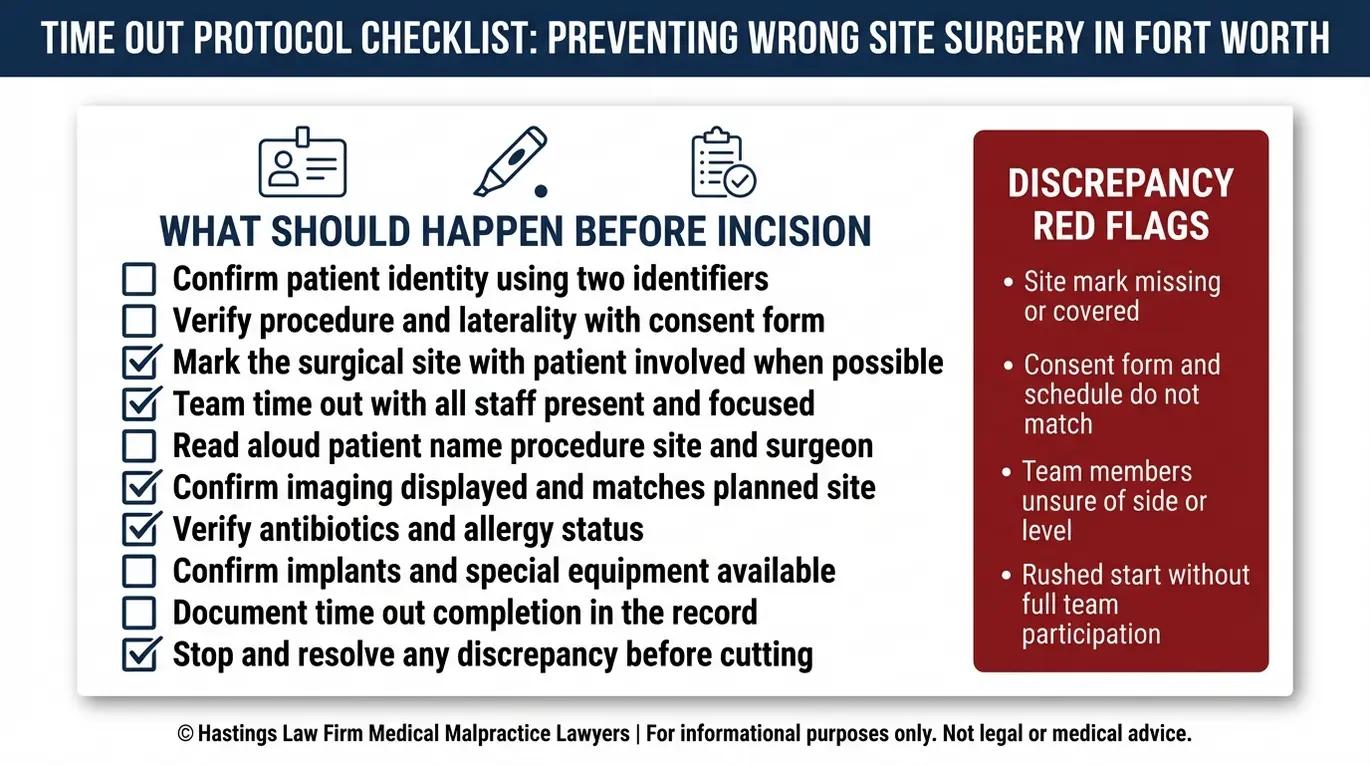
These “never events” occur when a surgical team fails to follow safety protocols, such as the pre-surgical “time-out,” resulting in wrong site surgery, an operation on the wrong body part, the wrong patient, or the wrong procedure entirely.
The primary safeguard against these errors is the surgical “time-out” protocol, a mandatory pause before the first incision where the entire operating room team verbally confirms the patient’s identity, the procedure being performed, and the correct surgical site. The World Health Organization Surgical Safety Checklist was developed specifically to standardize these verification steps and reduce preventable errors worldwide.
When a time-out is skipped or performed carelessly, the results can be life-altering. Beyond the physical harm of an unnecessary surgery, patients often experience significant psychological trauma, including anxiety, loss of trust in medical providers, and lasting emotional distress. Liability for this type of medical negligence is often clear because the hospital’s own records reveal whether the protocols were followed.
A proper pre-surgical safety process should include:
- Verification of the patient’s identity using at least two identifiers
- Confirmation of the correct surgical site, marked by the operating surgeon
- A verbal review of the planned procedure with all team members present
- Documentation that the time-out was completed before incision
- Confirmation of correct patient positioning and informed consent
These cases are often indefensible. As a Fort Worth surgical malpractice attorney team, we obtain the operative report, nursing notes, and time-out documentation to determine liability.
The Hastings Law Firm Difference
Results matter, but what truly sets us apart is how we achieve them. Every verdict, every settlement, and every Fort Worth courtroom victory comes from one guiding promise: To treat each client’s fight for justice as if it were our own.
This balance of skill, experience, and empathy reflects our core philosophy that justice should not only compensate the injured, but also make healthcare safer nationwide.

Retained Surgical Instruments and Foreign Objects
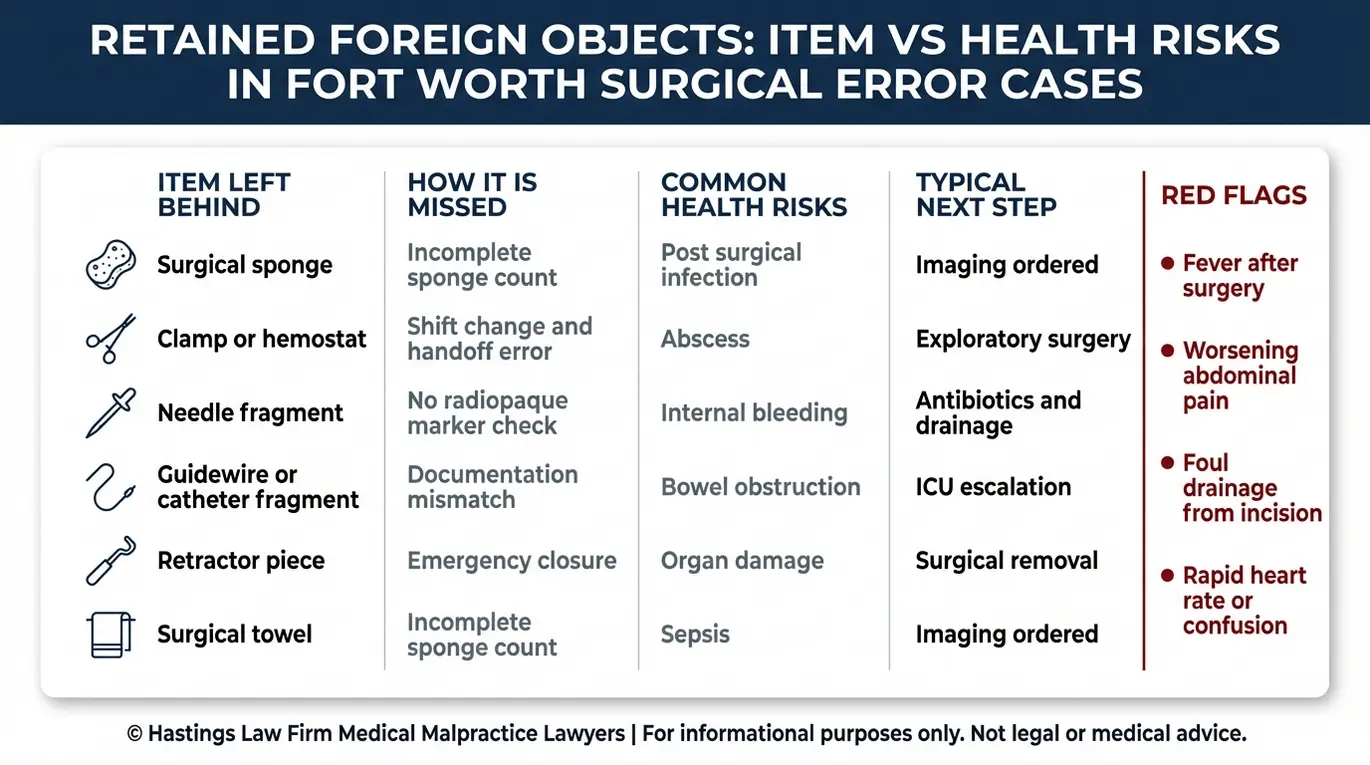
A retained foreign object case arises when items like sponges, clamps, needles, or surgical towels are accidentally left inside a patient’s body after the incision is closed. These retained surgical items (RSIs) can cause post-surgical infection, chronic pain, internal bleeding, and the need for additional corrective surgery.
Hospitals are required to follow a sponge count protocol, a standardized procedure where the surgical team counts all instruments, sponges, and needles before and after the procedure to confirm nothing is missing. According to the Agency for Healthcare Research and Quality (AHRQ) Patient Safety Network, retained surgical items remain a persistent patient safety problem, even in hospitals with count protocols in place.
When the count is inaccurate or skipped entirely, a patient may not discover the problem for weeks or months, until symptoms like fever, swelling, or unexplained pain prompt imaging studies.
| Retained Item | Potential Health Risks |
|---|---|
| Surgical sponge or gauze | Abscess, sepsis, bowel obstruction |
| Metal clamp or retractor | Internal damage, chronic pain |
| Needle or needle fragment | Nerve damage, tissue perforation, infection |
| Surgical towel | Adhesions, bowel obstruction, sepsis |
| Drain or catheter tip | Infection, internal scarring, secondary surgery |
Leaving a foreign object inside a patient is a clear violation of the standard of care and may constitute a specific breach under the Texas Civil Practice and Remedies Code. If you suspect a retained object caused your post-surgical complications, a surgical error attorney in Fort Worth can help you gather the imaging, surgical records, and count documentation needed to build your case.
Anesthesia Errors and Medication Mistakes
Anesthesia malpractice involves errors in dosage administration, failure to properly monitor vital signs, or missed allergic reactions that can result in hypoxic brain injury, stroke, or death during surgery. Because anesthesia controls a patient’s consciousness, breathing, and pain response, even a small mistake can lead to irreversible harm, including nerve damage or wrongful death.
There is an important distinction between the providers involved. An anesthesiologist is a physician with specialized medical training, while a Certified Registered Nurse Anesthetist (CRNA) is an advanced practice nurse who may administer anesthesia under varying levels of supervision. Errors can occur with either provider, but the standard of care and supervision requirements may differ depending on the clinical setting.
One of the most critical steps in anesthesia care is endotracheal intubation, the placement of a breathing tube into the patient’s airway to maintain oxygen flow during surgery. A failed or improper intubation can cut off oxygen to the brain within minutes. Continuous pulse oximetry (SpO2 monitoring), which tracks blood oxygen levels in real time, is the standard safeguard against this. The Anesthesia Patient Safety Foundation (APSF) has issued formal recommendations on minimum monitoring standards during all procedures involving anesthesia.
When we investigate these cases as a Fort Worth surgical injury lawyer team, we examine the anesthesia record, monitoring logs, and medication administration timeline to determine whether the provider met the expected standard of care.
Risks of Propofol in Interventional Pain Procedures
Propofol is a powerful sedative commonly used in minor surgical and interventional pain procedures. While effective, it carries a significant risk of respiratory depression, meaning the patient may stop breathing adequately if not closely monitored. In outpatient surgical centers where staffing and monitoring equipment may be limited, the risk of an anesthesia error involving Propofol increases. We evaluate whether the facility had proper monitoring protocols and trained personnel capable of managing sedation-related emergencies.
Bowel Perforation and Organ Damage During Surgery
Accidental nicks or perforations of the bowel during abdominal surgery can allow waste to leak into the abdominal cavity, causing peritonitis and life-threatening sepsis if not detected and repaired quickly. These injuries occur most often during laparoscopic surgery, a minimally invasive technique where surgeons operate through small incisions using a camera and specialized instruments.
Here is what many patients do not realize: in some cases, the perforation itself may not be the basis of the malpractice claim. The legal issue often centers on the failure to diagnose and repair the damage before closing the incision. It can also involve the failure to recognize post-operative warning signs like fever, increasing abdominal pain, or elevated white blood cell counts.
As a surgical malpractice lawyer team, we review the operative report, post-surgical notes, and lab results to evaluate whether the medical team identified the complication in time, which is critical for proving causation and recovering medical expenses for corrective treatment.
Robotic Surgical Malpractice and Device Failures
Robotic surgery claims involve injuries caused by the Da Vinci Surgical System, a robotic-assisted platform that allows surgeons to perform minimally invasive procedures using mechanical arms controlled from a console, or similar devices. These cases often raise questions about whether the injury resulted from surgeon error, a mechanical malfunction, or both.
One of the key issues in robotic surgery cases is surgeon training. Some surgeons may lack sufficient hours or formal certification on the robotic system before performing procedures on patients. Without adequate training, the absence of tactile feedback, the physical sensation a surgeon normally feels when handling tissue directly, can lead to serious injuries like burned arteries or severed nerves.
When a mechanical failure is involved, the case may also include a medical product liability claim against the device manufacturer. According to a study published in PubMed Central analyzing adverse events reported to the FDA’s MAUDE database, robotic surgical systems have been associated with a range of device-related complications.
Our Fort Worth surgical error law firm evaluates these cases from both angles, working with qualified surgical experts and engineering consultants to determine if the provider met the standard of care and if the technology failed.
Texas Medical Malpractice Laws and Chapter 74 Requirements
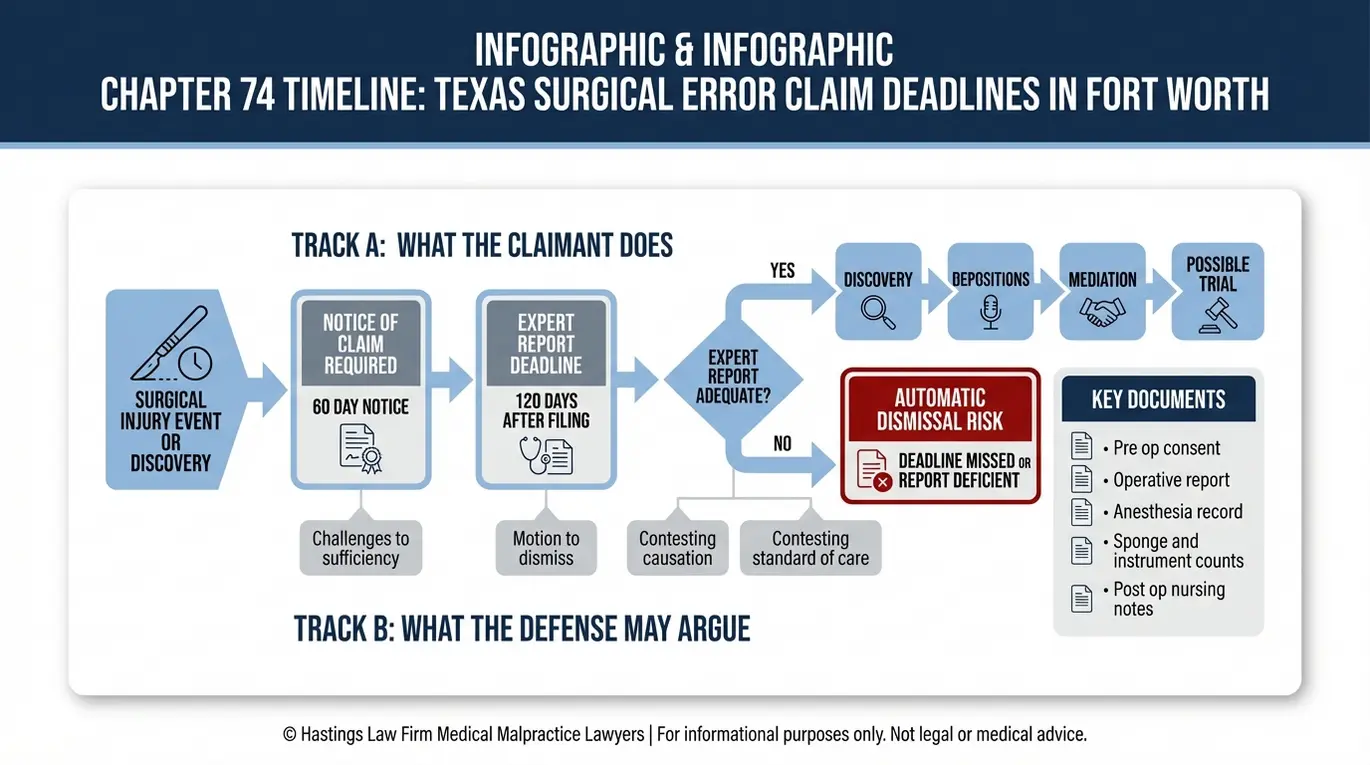
Texas law, specifically Chapter 74 of the Texas Civil Practice and Remedies Code, governs all healthcare liability claims, including surgical error lawsuits. Chapter 74 imposes strict procedural requirements that must be met before a case can move forward. Missing even one deadline can result in your case being dismissed permanently.
Here are the critical Chapter 74 requirements every patient should understand:
- 60-Day Notice of Claim: Before filing a lawsuit, you must provide written notice to each healthcare provider you intend to sue. After this notice is sent, there is a mandatory 60-day waiting period before the case can be filed.
- 120-Day Expert Report Deadline: Within 120 days of the defendant filing an original answer, you must serve a written expert report from a qualified medical professional. This report must identify the standard of care, how it was breached, and how that breach caused the injury.
- Automatic Dismissal: If the expert report is not served within the 120-day window, the court is required to dismiss the case with prejudice, meaning it cannot be refiled.
These deadlines are one of the main reasons why working with a Fort Worth surgical error lawyer who handles medical malpractice exclusively matters. At Hastings Law Firm, we maintain a national network of qualified medical experts who can evaluate your records and provide the expert report required under Chapter 74.
Recoverable Damages for Surgical Negligence in Texas
Patients who prove surgical negligence in Texas can recover both economic and non-economic damages, though state law places limits, known as damage caps, on certain categories.
Economic damages cover measurable financial losses, including past and future medical expenses, lost wages, loss of earning capacity, and the cost of ongoing rehabilitation or in-home care. These damages are not subject to a cap under Texas law.
Non-economic damages compensate for pain and suffering, mental anguish, disfigurement, and loss of quality of life. Under Texas Civil Practice and Remedies Code § 74.301, non-economic damages are capped at $250,000 per claimant for all physicians and individual providers combined, and $250,000 per health care institution (up to $500,000 across all institutions), with a maximum total of $750,000 when both types of defendants are involved.
| Damage Category | Examples | Cap Under Texas Law |
|---|---|---|
| Economic Damages | Medical bills, lost income, future care costs | No cap |
| Non-Economic Damages | Pain and suffering, mental anguish, disfigurement | $250,000 for all physicians combined; up to $500,000 for institutions; $750,000 max |
As a Fort Worth surgical negligence attorney team, we work to document the full scope of your losses so that every recoverable dollar is accounted for in your claim.
Statute of Limitations for Surgical Error Claims
In Texas, the statute of limitations for filing a surgical error lawsuit is generally two years from the date of the alleged negligence or the last date of treatment. This “discovery rule” can extend the filing window when an injury, like a retained foreign object, was not immediately apparent.
For minor children under the age of 12 at the time of the negligence, the deadline is extended. A child injured during surgery generally has until their 14th birthday to file a claim. Texas also imposes a hard outer boundary called the statute of repose, which bars claims filed more than ten years after the date of the alleged negligence in most circumstances.
Because these deadlines are strict and missing them means losing your right to file, speaking with a surgical error lawyer in Fort Worth as soon as possible is the best way to protect your claim.
Contact the Fort Worth Surgical Error Attorneys at Hastings Law Firm Today for Help
Surgical errors change lives in an instant, and the healthcare system rarely volunteers the full truth about what went wrong. You deserve answers, and you deserve a legal team that knows how to find them.
Hastings Law Firm focuses exclusively on medical malpractice litigation. Our team includes former hospital defense attorneys and in-house nurse consultants who know how these systems work from the inside. Founded by Tommy Hastings, a board-certified trial lawyer in Personal Injury Trial Law, we prepare every case for trial to drive fair outcomes.
As your Fort Worth surgical error lawyer, we handle the investigation and litigation so you can focus on recovery. Contact us today for a free, confidential case evaluation. You pay no fees unless we recover compensation on your behalf. Let us help you understand what happened and what comes next.
Frequently Asked Questions About Surgical Error in Fort Worth


This content was researched and written by the Hastings Law Firm editorial team, which includes attorneys, medical professionals, and experienced researchers. Our writing is informed by internal knowledge and practical experience, and we cross-check critical details against authoritative sources cited throughout. Every piece undergoes human-led fact-checking and legal review. Because legal and medical information can change, if you spot an error, please contact us. Learn more about our content standards and review process on our editorial policy page.

Brady D. Williams is a nationally recognized medical malpractice attorney who has spent his career handling high-stakes litigation for injured patients and families across the country. Licensed in both Texas and California, Brady draws on experience from hundreds of resolved medical cases to break down complex legal and medical topics for the people who need that information most. His writing reflects the same attention to detail and commitment to clarity that he brings to every case he handles.
