


Fort Worth Unnecessary Surgery Lawyer
Written by: Hastings Law Firm | Reviewed by: Gabe Sassin | Updated: July 27, 2026
Unnecessary surgery can leave patients with avoidable pain, complications, and financial strain even when the operation itself was performed correctly. These cases often turn on whether there was true medical necessity, whether conservative options were reasonably explored, and whether informed consent was based on accurate information about risks, benefits, and alternatives. Financial incentives and overuse of testing can also influence recommendations and lead to procedures that provide no legitimate benefit. If you or a loved one were harmed or worse due to unnecessary surgery in Fort Worth, Texas, contact Hastings Law Firm for a free, confidential case review.

Trusted Fort Worth Malpractice Attorneys for Unneeded Medical Procedures
What You Should Know About Non-Indicated Procedure or Intervention Claims in Fort Worth:
- Long term physical, emotional, and financial harm can result when an invasive procedure is performed without medical necessity.
- Accountability can hinge on whether a reasonable physician in the same specialty would have recommended conservative care instead of surgery.
- Recovery can be affected when consent was based on misrepresented diagnoses or withheld non surgical alternatives.
- Disputes often focus on whether financial incentives under fee for service payment structures influenced the recommendation for surgery.
- Harm can be driven by false positive testing that funnels patients toward procedures that provide no legitimate benefit.
- Case outcomes can depend on showing that the unnecessary procedure directly caused measurable losses such as physical injury or financial costs.
- Options can be lost if required expert support is not provided in time, since Texas courts can dismiss claims without it.
- Compensation can include economic losses and non economic harms such as pain, mental anguish, scarring, and loss of quality of life.
- Non economic recovery can be limited in Texas medical malpractice cases due to statutory caps.
- Proof can depend on what pre operative imaging and pathology findings show about whether the operation was clinically justified.

A Healthcare Focused Law Firm
If you suspect that a surgery you or a loved one underwent was not medically necessary, you are not alone in questioning what happened. The fee-for-service (FFS) reimbursement model, a system where doctors and hospitals are paid per procedure rather than per outcome, can create financial incentives that do not always align with the best interests of the patient. When that dynamic leads to an operation that should never have been performed, you deserve answers and accountability.
At Hastings Law Firm, our team focuses exclusively on medical malpractice. Led by Tommy R. Hastings, a Board Certified Personal Injury Trial Lawyer and 2025 inductee into the American Board of Trial Advocates (ABOTA), we bring the medical knowledge and litigation experience needed to evaluate whether a surgery was truly warranted. If you believe you were harmed by an unneeded procedure, a Fort Worth unnecessary surgery lawyer at our firm can review your records and explain your options in a free, confidential consultation.
Defining Medical Malpractice in Unnecessary Surgery Cases
Unnecessary surgery constitutes medical malpractice when a physician recommends an invasive procedure that no reasonable doctor would have performed under similar circumstances. A clinical indication is the medical reason for performing a specific test or treatment. This is not simply a matter of a bad result. A surgery can go exactly as planned and still be an act of negligence if the operation itself was never medically indicated, meaning there was no clinical justification or medical necessity for it.
The legal standard centers on what is known as the standard of care, the level of treatment a reasonably competent physician in the same specialty would have provided under similar conditions. For surgical recommendations, this often means that conservative treatment options should have been explored before resorting to an operation. If a surgeon skipped those steps or exaggerated the severity of a condition, that may represent a breach of the duty of care under Texas Civil Practice and Remedies Code, Chapter 74.
Informed consent, the process where your doctor fully explains the risks, benefits, and alternatives before you agree to a procedure, is another critical piece. If a doctor misrepresented your diagnosis or concealed non-surgical alternatives to persuade you to agree to an operation, the consent you provided may not hold up legally.
There is a distinction here: a bad surgical outcome does not automatically mean malpractice. But a surgery that was never clinically justified, one that exposed you to risk without legitimate medical benefit, is a different matter entirely. That is what our unnecessary surgery attorneys investigate.
Common Types of Unnecessary Procedures and Profit Motives
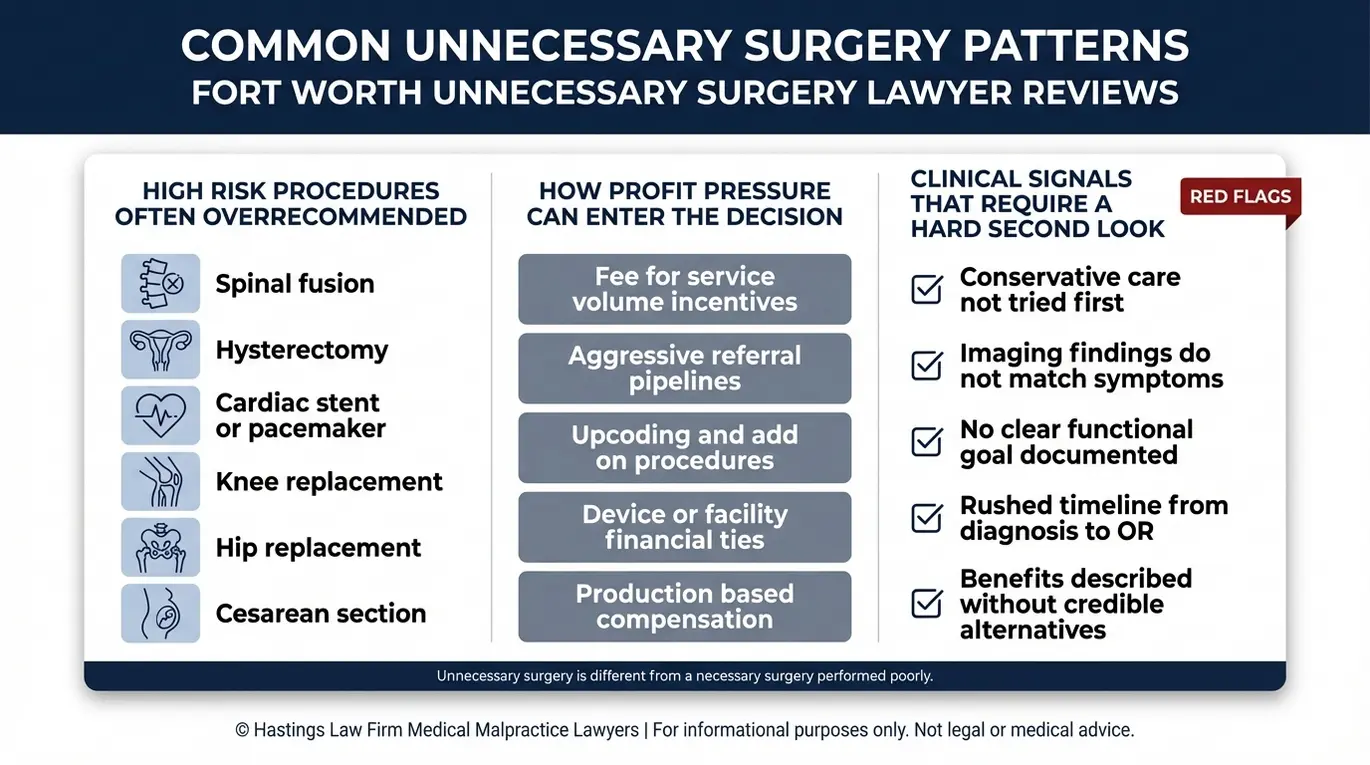
Certain high-cost procedures are statistically more likely to be performed without sufficient medical justification, in part because of the profit motives tied to them. Profit motives occur when financial incentives influence the volume of procedures recommended. Under fee-for-service payment structures, providers are compensated based on the volume and complexity of services delivered. As MedPAC (Medicare Payment Advisory Commission) has documented, this model can incentivize more unnecessary surgical procedures rather than better outcomes.
Overuse of diagnostic testing can compound the problem. When screenings produce a false positive, a test result that incorrectly suggests disease or damage, patients may be funneled toward surgical intervention they did not need. Without a second opinion, a patient may never learn that conservative treatment, non-surgical management such as physical therapy, medication management, or watchful waiting, could have resolved the issue without an operation.
Some procedures carry a higher risk of being performed unnecessarily. While some cases involve clear-cut “never events” like wrong-site surgery, others are more subtle. A lawyer for unnecessary operations can help determine whether your surgery falls into one of these categories:
- Spinal fusions, where significant cost variation across hospitals may reflect inconsistent clinical decision-making
- Hysterectomies, particularly when less invasive treatments were not attempted
- Cardiac stents and pacemaker implants, sometimes placed based on overstated cardiac risk
- Knee and hip joint replacement surgeries, occasionally recommended before conservative options are exhausted
- Cesarean sections, which may be performed for scheduling convenience rather than maternal or fetal need
These cases require careful medical and legal analysis. A surgical fraud attorney can work with independent specialists to determine whether the procedure was justified by your actual clinical condition, or whether the recommendation lacked a sound medical basis.
The Hastings Law Firm Difference
Results matter, but what truly sets us apart is how we achieve them. Every verdict, every settlement, and every Fort Worth courtroom victory comes from one guiding promise: To treat each client’s fight for justice as if it were our own.
This balance of skill, experience, and empathy reflects our core philosophy that justice should not only compensate the injured, but also make healthcare safer nationwide.

Proving Negligence and Surgical Errors in Texas Courts
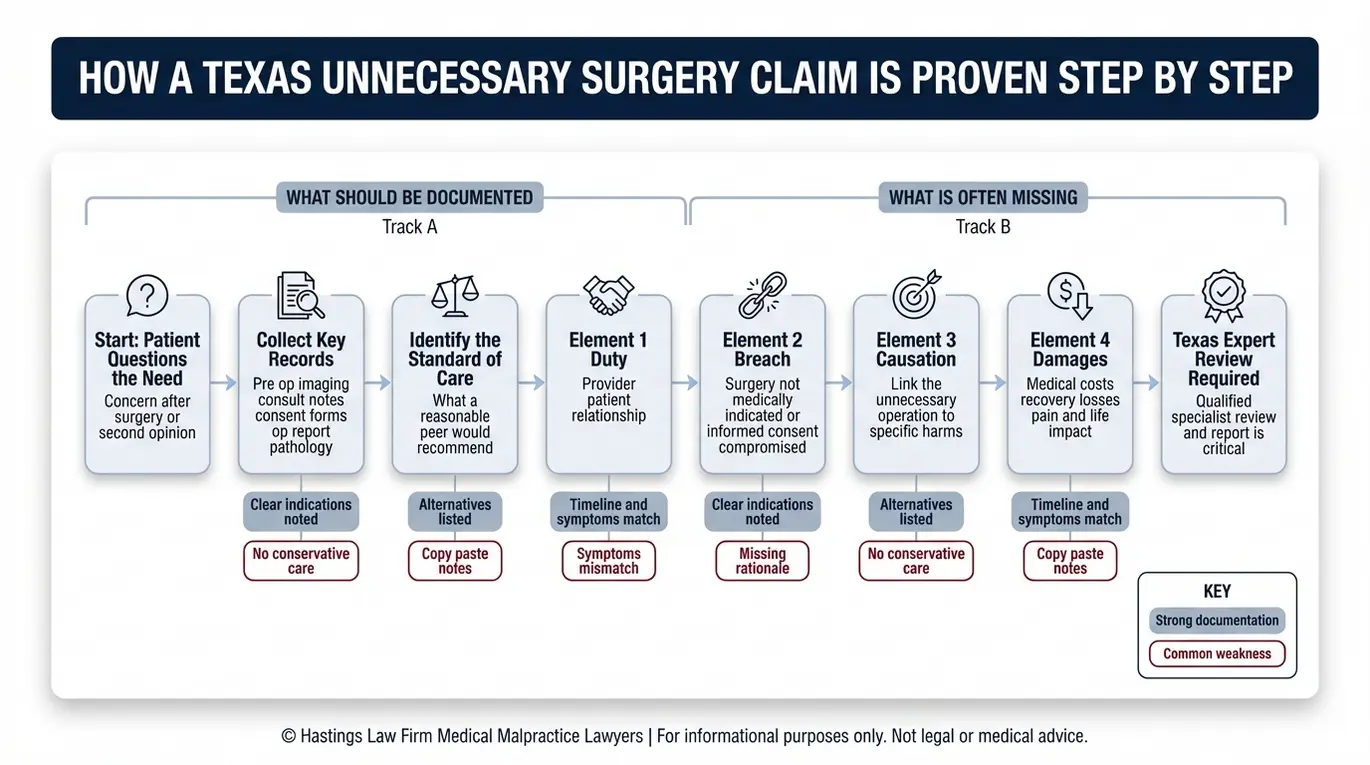
Proving negligence requires demonstrating that the surgeon breached the duty of care by performing an operation that a competent peer in the same specialty would have deemed medically unjustified, and that this decision directly caused the patient harm. A standard of care is the benchmark for competent medical treatment in a specific field. In Texas medical malpractice litigation, this analysis follows four essential elements:
- Duty: The surgeon owed you a professional obligation to recommend only medically appropriate treatment.
- Breach: The surgeon’s recommendation or decision fell below the accepted standard of care.
- Causation: The unnecessary procedure directly caused your injury, whether physical, financial, or both.
- Damages: You suffered measurable harm as a result.
Under Texas Civil Practice and Remedies Code, Chapter 74.351, a qualified expert witness must provide a written report supporting the claim within 120 days after the date each defendant’s original answer is filed. This expert must be qualified to render opinions on the applicable standard of care and can testify about whether the surgery met that standard. Without this report, the case can be dismissed.
Our investigation uses nurse consultants and former hospital defense lawyers who understand the internal protocols and charting methods used by medical facilities. We gather pre-operative imaging, MRI or CT scans taken before the procedure, to determine what the surgeon knew at the time. We also review pathology reports, the lab analysis of tissue removed during surgery, to see whether the findings justified the operation.
Medical “Never Events” and Surgical Errors
There is also a distinction between a surgery that was unnecessary and “never events,” surgical mistakes so egregious they should never occur, such as wrong-site surgery (operating on the wrong body part), wrong-patient surgery, or retained surgical instruments, also known as a retained surgical item (RSI), which is a sponge, tool, or other instrument left inside the body. Anesthesia errors and hospital-acquired infections also fall under surgical malpractice. A Fort Worth surgical error lawyer can evaluate whether your case involves one or both types of negligence.
Compensation Available for Victims of Surgical Malpractice
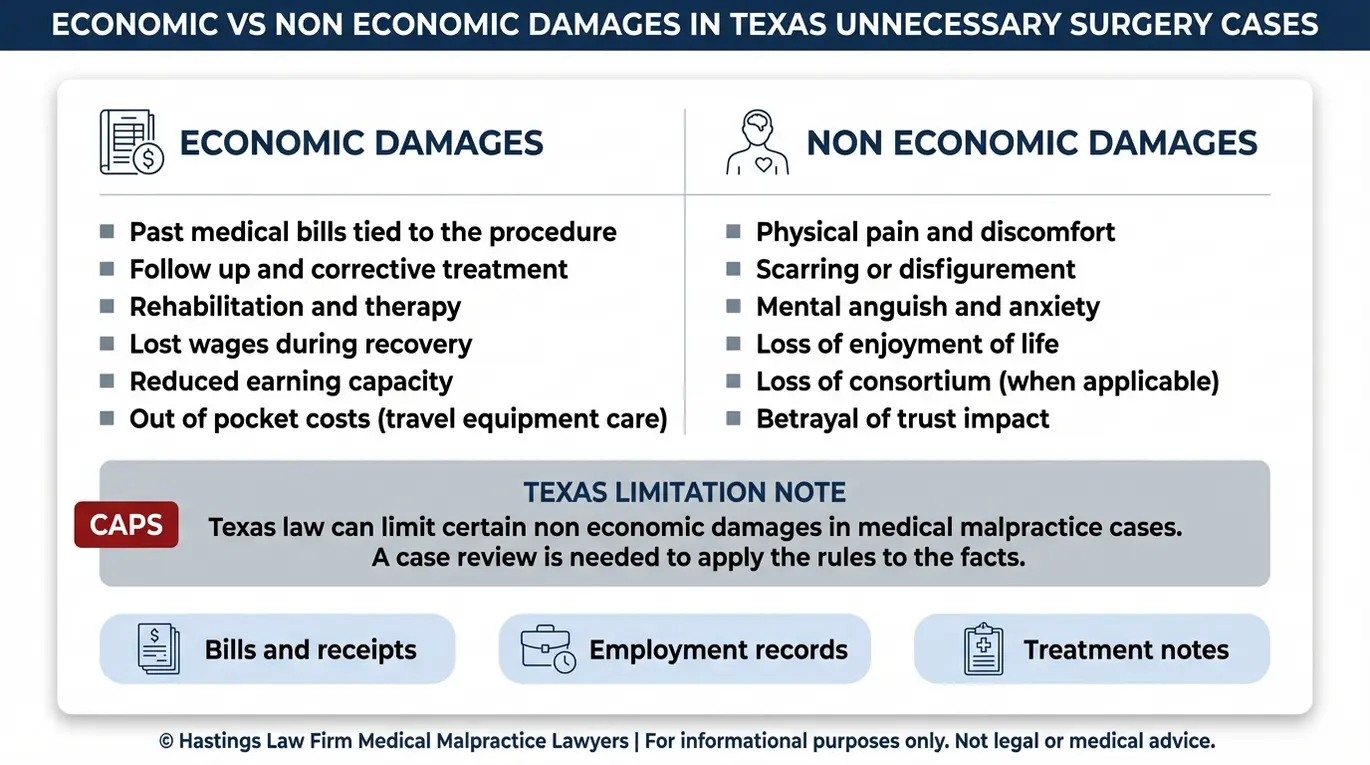
Patients harmed by unnecessary surgery may recover compensation for the full scope of losses caused by a procedure that provided no medical benefit. Damages refer to the financial and personal losses resulting from an injury. These damages generally fall into two categories:
| Economic Damages | Non-Economic Damages |
|---|---|
| Cost of the unnecessary surgery itself | Physical pain and suffering |
| Future corrective or revision surgery (procedures needed to repair harm from the original operation) | Mental anguish and emotional distress |
| Lost wages during recovery | Scarring or disfigurement |
| Lost earning capacity for long-term impairment | Loss of quality of life |
| Ongoing medical care and rehabilitation | Loss of consortium (for spouses) |
Economic damages cover the measurable financial losses you can document. Non-economic damages address the personal toll, including the betrayal of trust that comes with learning a procedure was never needed. In the most tragic cases, families may pursue a wrongful death claim.
Texas does place caps on non-economic damages in medical malpractice cases. Under Texas Civil Practice and Remedies Code Section 74.301, non-economic damages are capped at $250,000 per claimant against all individual physicians or health care providers, and $250,000 per claimant against each health care institution, with a maximum of $500,000 across multiple institutions. An unnecessary surgery settlement or verdict will depend on the specific facts of each case, and we can help you understand what recovery may be realistic.
Contact the Fort Worth Surgical Error Attorneys at Hastings Law Firm Today for Help
You should not have to bear the physical, emotional, and financial consequences of a surgery that was never medically warranted. If you or a loved one underwent a procedure that you believe was unnecessary, Hastings Law Firm is here to help you find clarity and hold the responsible parties accountable.
Our firm handles these cases on a contingency fee basis, which means you pay no attorney fees or costs unless we secure a recovery on your behalf. Your consultation is free and confidential.
A Fort Worth unnecessary surgery lawyer on our team can have your medical records reviewed by qualified professionals and give you an honest assessment of your legal options. Contact Hastings Law Firm today to schedule your risk-free case evaluation.
Frequently Asked Questions About Unnecessary Surgery in Fort Worth


This content was researched and written by the Hastings Law Firm editorial team, which includes attorneys, medical professionals, and experienced researchers. Our writing is informed by internal knowledge and practical experience, and we cross-check critical details against authoritative sources cited throughout. Every piece undergoes human-led fact-checking and legal review. Because legal and medical information can change, if you spot an error, please contact us. Learn more about our content standards and review process on our editorial policy page.

Gabe Sassin has focused exclusively on medical malpractice law since 2007. After spending more than a decade as a malpractice defense attorney, he knows exactly how the other side works. He has seen firsthand how healthcare providers, insurers, corporate defendants, and their legal teams think, prepare, and build their defense against claims. That knowledge works for the people who need it most today, injured patients and their families. His unique experience shapes everything he writes, giving readers a look at how these cases actually work from someone who has handled them from both sides.
