


Fort Worth Retained Medical Objects Lawyer
Written by: Hastings Law Firm | Reviewed by: Brady D. Williams | Updated: July 27, 2026
A retained surgical item can leave a patient facing ongoing pain, infection risk, and fear after what should have been a completed procedure. These errors often reflect breakdowns in operating room counts, communication, and safety checks that are meant to prevent foreign objects from being left behind. Symptoms may appear quickly or develop over time, and missed findings on imaging can delay proper treatment and worsen outcomes. If you or a loved one were harmed or worse due to retained surgical objects in Fort Worth, Texas, contact Hastings Law Firm for a free, confidential case review.
Trusted Fort Worth Medical Lawyers for Claims Involving Surgical Items Left Inside the Body
What You Should Know About Surgical Instrument Left in Body Claims in Fort Worth:
- Serious complications can follow when a surgical item is left inside the body, including internal infection, organ damage, internal bleeding, chronic pain, and life threatening sepsis.
- Recovery can be delayed when symptoms are misdiagnosed and treatment addresses infection without identifying the retained object as the source.
- Liability can extend beyond the lead surgeon because nurses, surgical technicians, anesthesiologists, and the hospital may share responsibility for operating room counts and safety enforcement.
- Options for compensation can include economic losses and non economic harms such as pain, suffering, and mental anguish tied to the discovery of a foreign object.
- Total recovery can be limited because Texas places caps on non economic damages in medical malpractice cases.
- Disputes often focus on whether required counts and imaging verification were followed when counts were inconclusive.
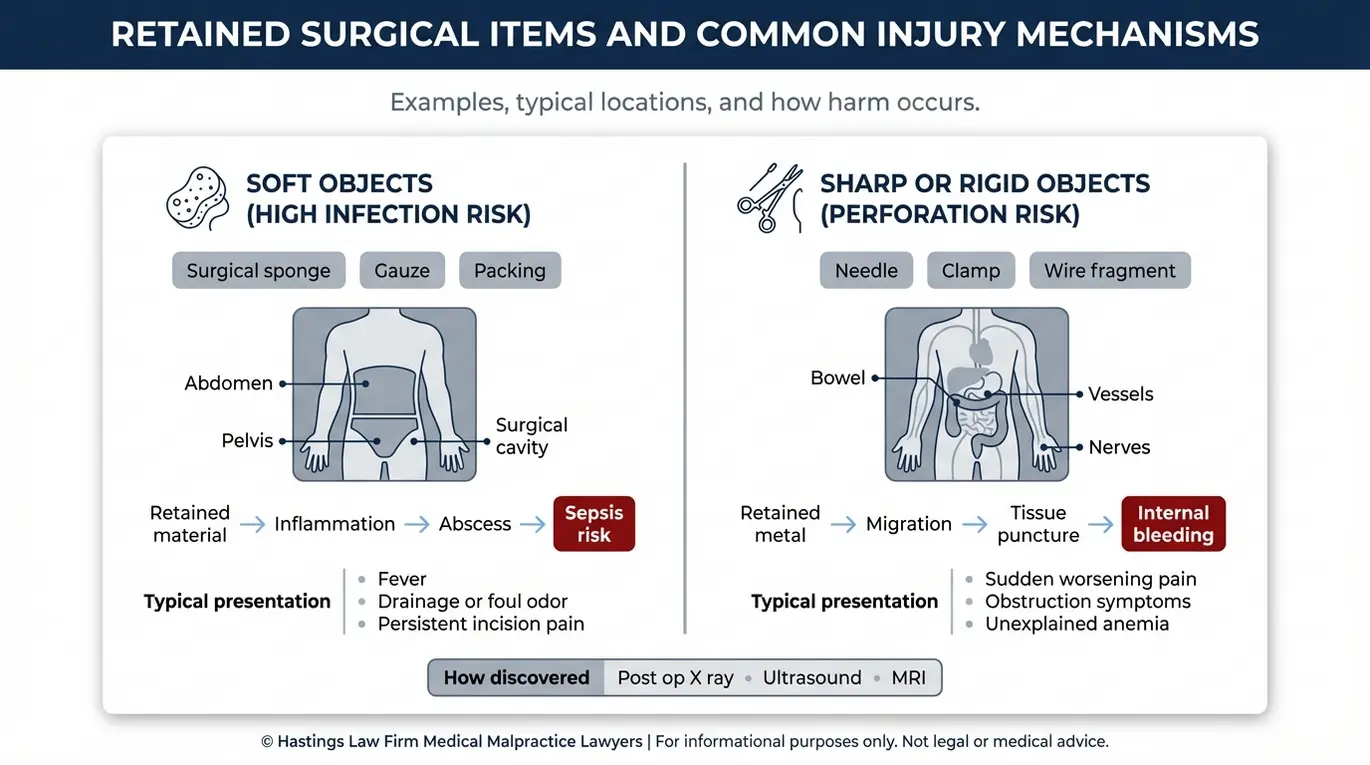
- Harm can worsen over time because soft items can trigger severe infection and sharp or rigid items can migrate and puncture tissue.
- Case outcomes can depend on what operative records and imaging show about counts, protocol compliance, and the presence of the object.

A Healthcare Focused Law Firm
Learning that a surgical item was left inside your body is a deeply unsettling experience. Beyond the physical pain, there is often a profound sense of betrayal. You trusted your surgical team to follow basic safety protocols, and that trust was broken.
At Hastings Law Firm, we focus exclusively on medical malpractice cases. Our legal team includes former defense attorneys who once represented hospitals, along with in-house nurse consultants who understand surgical procedures and the protocols designed to prevent exactly this kind of error. We know how operating rooms work, and we know what to look for when those systems fail.
If you or a loved one has been harmed by a retained surgical object, we are here to listen and to help. Contact our Fort Worth retained medical objects lawyer team for a free, confidential case evaluation. You pay no fees unless we recover compensation on your behalf.
Common Types of Retained Surgical Items and Medical Objects
A retained surgical item is any foreign object, such as a sponge, instrument, or needle, unintentionally left inside a patient’s body after a medical procedure concludes. This can include sponges, instruments, needles, or other materials used during surgery. Some retained objects are discovered within days. Others go undetected for months or even years before showing up on imaging studies.
A Fort Worth retained medical objects attorney can help you understand your legal options regardless of when the object was found. These cases generally fall into two broad categories based on the type of object involved.
Soft Objects:
- Surgical sponges
- Gauze pads and packing materials
- Laparotomy pads
Sharp or Rigid Objects:
- Needles and needle fragments
- Surgical clamps
- Wires, retractors, and guidewires
- Broken surgical instruments
Soft items like sponges and gauze carry a high risk of infection because the body may attempt to wall off the foreign material. This process can form a gossypiboma, which is a mass of inflamed tissue that develops around the retained textile. These masses can cause abscesses, fistulas, and severe internal infection.
Sharp retained objects pose a different danger. Needles, clamps, and wires can migrate through tissue over time, puncturing organs and causing internal bleeding or organ damage. Many of these items contain a radiopaque marker, a small strip woven into surgical sponges specifically so they appear on X-rays. When post-operative imaging is skipped or misread, that safety feature is rendered useless.
Consulting a retained object lawyer in Fort Worth is an important first step toward holding the responsible parties accountable regardless of the object type.
Why Retained Foreign Objects Are Classified as Never Events
In medical safety terms, a “Never Event” refers to a shocking medical error, such as leaving an object in a patient, that is unambiguous, serious, and should never occur if standard safety protocols are followed. Leaving a foreign object inside a patient falls squarely within this category.
The Agency for Healthcare Research and Quality (AHRQ) Patient Safety Network identifies retained surgical items as one of the most well-documented Never Events in healthcare. The National Quality Forum originally defined this classification to highlight errors so clearly preventable that their occurrence signals a systemic breakdown.
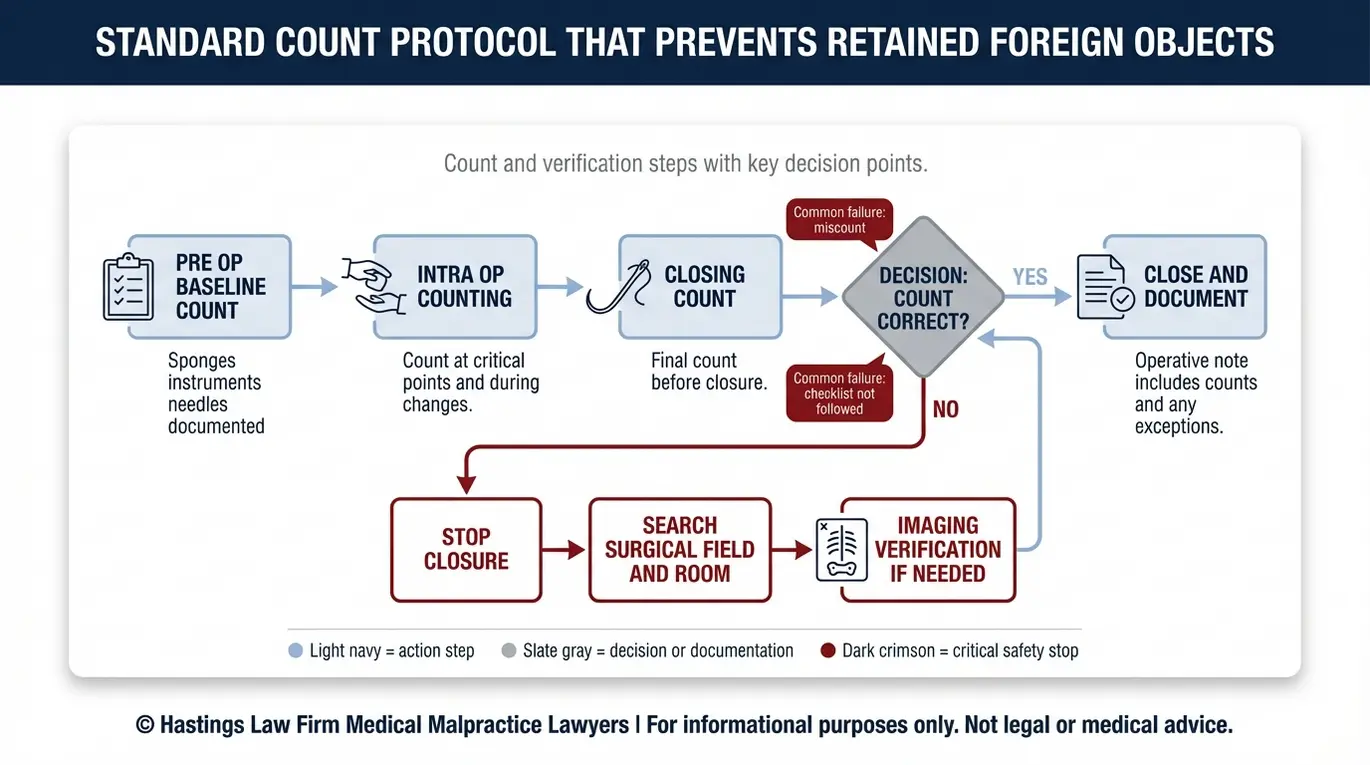
The standard of care requires the surgical team to perform multiple instrument and sponge counts at specific points during every procedure:
- Pre-operative count: All sponges, needles, and instruments are counted before the first incision.
- Intra-operative count: The team repeats counts before closing any body cavity.
- Post-operative count: A final reconciliation confirms that the team accounted for every item.
- Imaging verification: The team should take X-rays when counts are inconclusive before the patient leaves the OR.
Modern technology has made these errors even less excusable. Radiofrequency identification (RFID) sponge tracking, a system that uses embedded chips to electronically detect sponges inside the body, is now available in many hospitals. When a miscount occurs and these checklists and technologies are bypassed, the failure typically involves the entire OR staff, not just one person.
A Fort Worth medical malpractice lawyer experienced in retained object cases can evaluate whether the surgical team followed these required protocols.
The Hastings Law Firm Difference
Results matter, but what truly sets us apart is how we achieve them. Every verdict, every settlement, and every Fort Worth courtroom victory comes from one guiding promise: To treat each client’s fight for justice as if it were our own.
This balance of skill, experience, and empathy reflects our core philosophy that justice should not only compensate the injured, but also make healthcare safer nationwide.

Identifying Symptoms of a Foreign Object Left After Surgery
Symptoms of a retained foreign object may include unexplained pain near the incision site, fever indicating infection, digestive issues, or a palpable lump, though some objects remain asymptomatic for years. Recognizing these complications early helps your recovery. These signs often indicate that the body is reacting to an object it cannot break down. If you experience these signs, a retained medical objects attorney in Fort Worth can help determine if legal action is appropriate.
Symptoms to watch for:
- Persistent or worsening pain at or near the surgical site
- Fever, chills, or red streaks near the incision
- Swelling or a hard lump beneath the skin
- Nausea, vomiting, or unexplained digestive problems
- Chronic fatigue or unexplained weight loss
- Bowel obstruction symptoms (bloating, inability to pass gas)
Some of these symptoms appear within days. Others develop gradually as the body reacts to the foreign material. One of the most dangerous scenarios involves misdiagnosis, where a physician treats the resulting infection with antibiotics without identifying the underlying source. Left unaddressed, complications can escalate to sepsis, a life-threatening immune response, or chronic pain that persists for years.
If imaging reveals a retained surgical object, speaking with retained surgical object counsel promptly helps protect both your health and your legal rights.

Establishing Liability for Retained Instruments in Texas Courts
Liability for a retained object can extend beyond the lead surgeon. While the “Captain of the ship” doctrine historically placed all blame on the surgeon, modern medical negligence cases often implicate assisting nurses, surgical technicians, anesthesiologists, and the hospital itself. As a Fort Worth retained medical objects lawyer, we investigate each role in the chain of responsibility.
The circulating nurse responsible for coordinating supplies and counts in the operating room typically tracks every item that enters and leaves the surgical field. The scrub technologist, the surgical technician who hands instruments directly to the surgeon, shares responsibility for accurate counts. The surgeon bears ultimate responsibility for ensuring all items are accounted for before closing.
| Role | Primary Responsibility |
|---|---|
| Lead Surgeon | Final verification before wound closure |
| Circulating Nurse | Initiating and recording all counts |
| Scrub Technologist | Tracking instruments on the sterile field |
| Hospital/Facility | Enforcing count policies, staffing, and training |
Hospitals can also face direct liability for hospital negligence, such as inadequate staffing ratios, outdated counting protocols, or lack of required equipment. Texas courts recognize vicarious liability claims, meaning a hospital may be held responsible for the negligence of its employees. Vicarious liability means an employer is responsible for the actions of its staff while they are working. The Texas Pattern Jury Charges provide the framework juries use to evaluate these responsibilities.
Suing for retained objects in Fort Worth requires a thorough investigation into who was in the room and what protocols were followed.
Calculating Damages in a Fort Worth Retained Object Lawsuit
Victims of retained objects may recover economic damages for corrective surgeries and lost wages, as well as non-economic damages for pain, suffering, and the mental anguish of carrying a foreign body. Legal damages represent the financial and personal losses caused by medical errors.
Recoverable damages in these cases typically include:
- Cost of the removal surgery and related hospitalization
- Treatment for complications such as sepsis, infection, or organ damage
- Lost wages and diminished earning capacity during recovery
- Physical pain and suffering
- Mental anguish, including fear and anxiety tied to the discovery
- Loss of enjoyment of life
In cases of gross negligence, punitive damages may also be sought. However, Texas does impose statutory caps on non-economic damages in medical malpractice cases. Under Texas Civil Practice and Remedies Code Chapter 74, non-economic damages against individual physicians are capped at $250,000 per claimant, with a separate cap of $250,000 per healthcare institution. A medical injury lawyer familiar with these limits can help you understand how they may apply to your claim and work to maximize your total recovery within the law.
How Our Board Certified Malpractice Attorneys Prove Negligence
We utilize forensic record analysis to identify count discrepancies and secure testimony from surgical experts to prove that the retention of the object directly violated the standard of care. As a Fort Worth retained medical objects lawyer team, our approach is built on precision and preparation.
Our founder, Tommy Hastings, is Board Certified in Personal Injury Trial Law, a credential held by fewer than 2% of attorneys in Texas. The first step of our investigation involves securing medical records like the operative report and the surgical count protocol documentation. Our in-house nursing staff reviews every entry, comparing the documented counts against what imaging later revealed.
In many retained object cases, we invoke the legal doctrine of res ipsa loquitur, a Latin phrase meaning “the thing speaks for itself.” The principle is simple: foreign objects do not end up inside a patient’s body without someone’s negligence. This doctrine can shift the burden to the defense to explain how the error occurred.
We also collect evidence through depositions and work with our national network of surgical experts to provide testimony that ties the specific protocol failure to the patient’s injury. Research published in PubMed Central on retained surgical objects as preventable Never Events reinforces the medical consensus that these errors are entirely avoidable with proper technology and protocol compliance.
Every case we accept is prepared from the outset as if it will go before a jury. This trial-ready approach signals to defense teams and insurance carriers that we will not accept less than fair value for our clients.
Contact the Fort Worth Surgical Error Attorneys at Hastings Law Firm Today for Help
A retained surgical object is not just a medical complication. It is a violation of the trust you placed in your surgical team and the safety systems designed to protect you.
Since 2005, Hastings Law Firm has focused solely on medical malpractice litigation to secure compensation for our clients. Our team of board-certified attorneys, former defense counsel, and in-house medical professionals is ready to investigate what happened and explain your legal options. We handle these cases on a contingency fee basis, which means you pay nothing unless we secure a recovery for you.
If you or a loved one has been harmed by a retained foreign object, contact our Fort Worth retained medical objects lawyer team today for a free, confidential case evaluation. Call us to start the investigation.
Frequently Asked Questions About Retained Medical Objects in Fort Worth


This content was researched and written by the Hastings Law Firm editorial team, which includes attorneys, medical professionals, and experienced researchers. Our writing is informed by internal knowledge and practical experience, and we cross-check critical details against authoritative sources cited throughout. Every piece undergoes human-led fact-checking and legal review. Because legal and medical information can change, if you spot an error, please contact us. Learn more about our content standards and review process on our editorial policy page.

Brady D. Williams is a nationally recognized medical malpractice attorney who has spent his career handling high-stakes litigation for injured patients and families across the country. Licensed in both Texas and California, Brady draws on experience from hundreds of resolved medical cases to break down complex legal and medical topics for the people who need that information most. His writing reflects the same attention to detail and commitment to clarity that he brings to every case he handles.
