


Fort Worth Postoperative Malpractice Lawyer
Written by: Hastings Law Firm | Reviewed by: Gabe Sassin | Updated: July 27, 2026
Postoperative negligence can turn a routine recovery into a serious medical crisis when infections are missed, vital signs are not monitored, or discharge happens before it is medically safe. Recovery care often begins in the PACU and continues through the hospital stay and after discharge, so breakdowns at any point can lead to worsening injury, emergency readmission, or fatal outcomes. Understanding how monitoring, hygiene, and response to warning signs should work can help clarify what went wrong. If you or a loved one were harmed or worse due to postoperative malpractice in Fort Worth, Texas, contact Hastings Law Firm for a free, confidential case review.

Trusted Fort Worth Medical Attorneys for Surgical Recovery Negligence Claims
What You Should Know About Post-Surgical Monitoring Negligence Claims in Fort Worth:
- Harm can escalate quickly after surgery when infections are not identified and treated early.
- Life threatening outcomes can follow when vital sign checks are delayed or skipped and warning signs of internal bleeding or anesthesia reactions are missed.
- Recovery can worsen at home after premature discharge when a patient is sent home before meeting appropriate recovery benchmarks.
- Options can be lost if timing limits are missed because Texas medical malpractice claims are subject to strict filing deadlines.
- A claim can be dismissed if a required written expert report does not meet statutory requirements.
- Recovery can include economic damages for medical bills and lost income and non economic damages for pain suffering and physical impairment.
- Non economic recovery can be limited in Texas because state law caps pain and suffering damages in medical malpractice cases.
- Wrongful death damages may be available to surviving family members when a postoperative error is fatal.
- Disputes often focus on whether a complication was an unavoidable risk or a preventable deviation from the standard of care.
- Outcomes can depend on what the medical record shows because nursing notes medication logs lab results and discharge documentation can be central to what happened during recovery.

A Healthcare Focused Law Firm
When something goes wrong after surgery, it can feel like the system that was supposed to help you has let you down. Post-operative care, the monitoring and treatment a patient receives during the recovery period, is just as important as the surgery itself. That care begins in the Post-Anesthesia Care Unit (PACU), a specialized recovery area where nurses track vital signs as anesthesia wears off, and it continues through discharge and beyond.
If you or a loved one suffered a preventable injury during surgical recovery, you may have questions about what went wrong and what you can do about it. As Fort Worth postoperative malpractice lawyers, we focus exclusively on medical malpractice and have the medical and legal resources to investigate what happened. Contact us for a free, confidential case evaluation to understand your options.
Common Types of Postoperative Complications Caused by Negligence
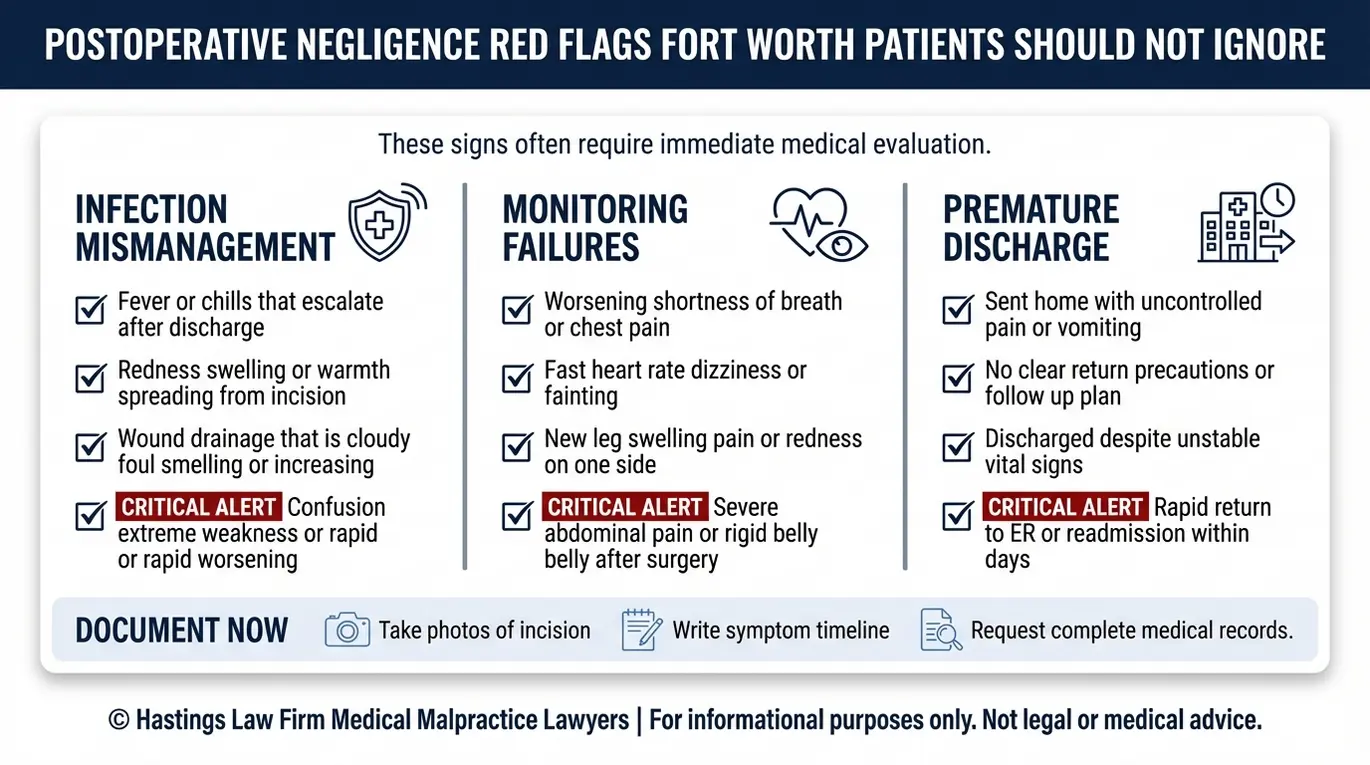
Postoperative malpractice occurs when medical staff fail to monitor a patient’s recovery, leading to preventable harm such as untreated infections, internal bleeding, or blood clots. These are not simply “bad outcomes.” They are the result of specific failures in post-operative care that a qualified medical team should have caught and addressed.
Our Fort Worth postoperative malpractice lawyers see several recurring patterns in these cases:
Infection Mismanagement
Surgical site infections and hospital-acquired infections can escalate quickly if they are not identified and treated early. Sometimes these issues stem from fundamental surgical errors during the procedure itself, but often they are the result of poor hygiene or monitoring on the ward. A condition like sepsis, the body’s life-threatening response to infection, can develop within hours.
Research published by Vanderbilt University Medical Center shows that recognizing intra-abdominal sepsis after surgery requires close attention to clinical signs that are often subtle in the early stages. An anastomotic leak, a breakdown at the connection point where two sections of tissue were surgically joined, is one common source of these dangerous infections. Wound dehiscence, the reopening of a surgical incision, can also introduce bacteria and lead to serious complications if not promptly treated.
Monitoring Failures
Effective monitoring involves checking vital signs to detect complications before they become severe. After surgery, nursing staff are responsible for tracking vital signs at regular intervals. When those checks are delayed or skipped, warning signs of internal bleeding, adverse reactions to anesthesia, or pulmonary embolism can go unnoticed. A pulmonary embolism is a blood clot that travels to the lungs and can be life-threatening if not detected.
A narrative review published by PubMed Central highlights how post-surgical blood clots that travel to the lungs remain a leading cause of preventable hospital death, particularly when risk-reduction protocols are not followed.
Premature Discharge
Premature discharge happens when a hospital sends a patient home before it is medically safe. Sending a patient home before they are medically stable is a form of negligence. If a patient is discharged without meeting appropriate recovery benchmarks, they may experience a rapid decline at home, leading to emergency readmission or death.
As postoperative malpractice lawyers, our role is to examine the medical records and determine whether the care team’s failure to diagnose or respond to these complications fell below the accepted standard. The symptoms may vary from case to case, but the core question is always the same: did the medical team do what was reasonably expected, and if not, did that failure cause harm?
Proving Negligence in Post-Surgical Care Cases
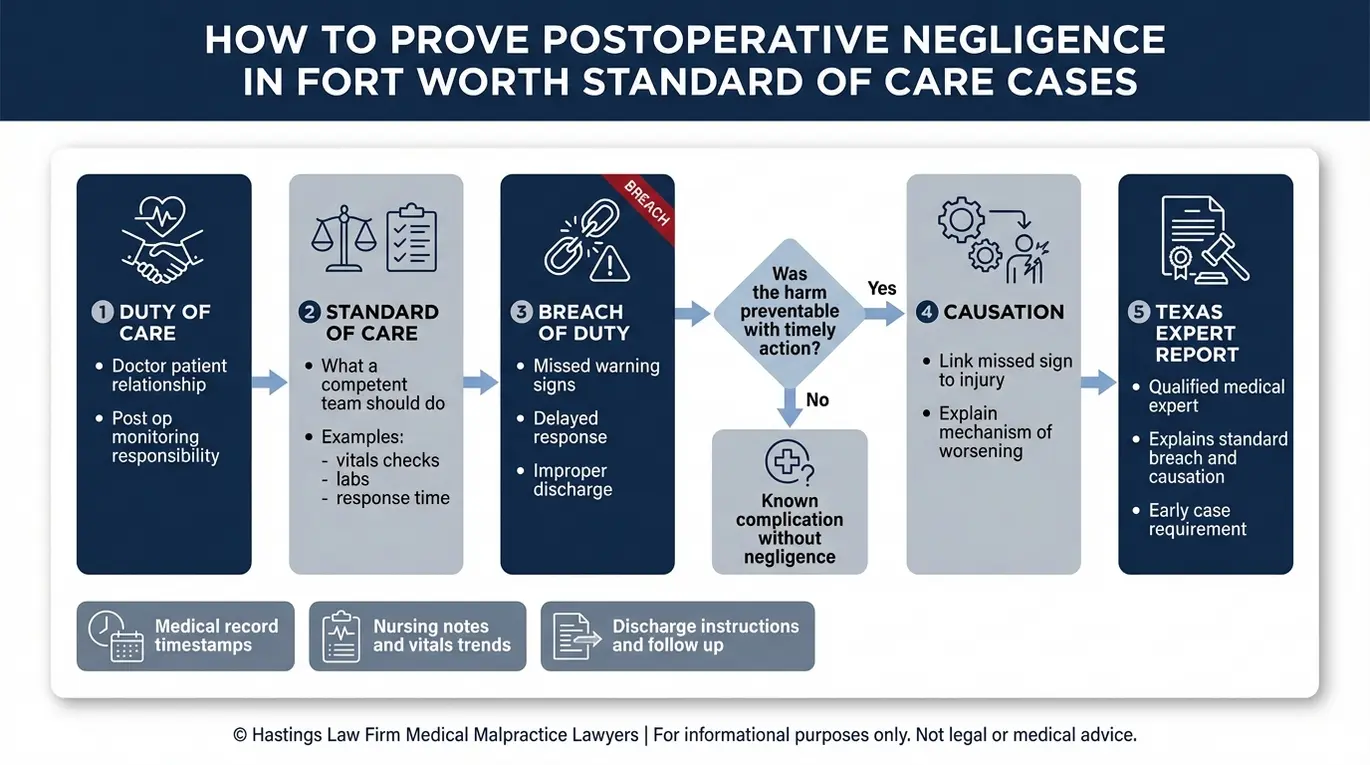
To prove negligence, a plaintiff must demonstrate that the doctor or nurse breached the accepted standard of care during the recovery period, directly causing new injury or worsening the patient’s condition. Establishing negligence requires showing that a health care provider failed to meet the standard of care. Proving medical negligence in these cases involves establishing a clear chain of responsibility and adhering to strict legal procedural requirements.
Duty and Breach
Every health care provider involved in a patient’s recovery owes a duty of care. That duty includes specific obligations, such as how frequently vital signs should be checked and what protocols to follow for pain management.
Venous thromboembolism (VTE) prophylaxis, which refers to preventive measures like blood thinners or compression devices to reduce clot risk, is one example of a standard post-surgical protocol. An early warning score (EWS), a bedside scoring system that tracks changes in heart rate, blood pressure, and other indicators, can flag a patient whose condition is deteriorating. When a provider ignores or fails to act on these tools, that can constitute a breach of duty.
Causation
In medical malpractice, causation is the link between a provider’s error and the patient’s specific injury. Identifying a breach is only part of the equation. Our Fort Worth postoperative malpractice lawyers must also establish causation, meaning the breach directly led to the patient’s injury.
This requires connecting the missed symptom or delayed response to the specific harm that followed, often through detailed medical timeline analysis. It is not enough to show that an error occurred; we must prove that the outcome would have been different had the error not happened.
The Expert Report Requirement
Texas law adds an additional layer. Under Texas Civil Practice and Remedies Code Chapter 74, a medical malpractice claim must be supported by a written expert report from a qualified physician. Patients must also meet the timing limitations set forth in Section 74.251, as gathering this evidence takes time.
The expert report must be served within 120 days of the date each defendant’s original answer is filed and must explain how the standard of care was violated and how that violation caused harm. If the report does not meet the statutory requirements, the case can be dismissed. This is why working with a firm that has a national network of board-certified medical experts matters from day one.
The Hastings Law Firm Difference
Results matter, but what truly sets us apart is how we achieve them. Every verdict, every settlement, and every Fort Worth courtroom victory comes from one guiding promise: To treat each client’s fight for justice as if it were our own.
This balance of skill, experience, and empathy reflects our core philosophy that justice should not only compensate the injured, but also make healthcare safer nationwide.

Recoverable Damages for Post-Operative Injuries in Texas
Victims of postoperative negligence in Texas can recover economic damages for medical bills and lost income, as well as non-economic damages for pain, suffering, and physical impairment. The specific amount depends on the severity of the injury and its long-term effects on the patient’s life.
Economic Damages
Economic damages represent the actual financial losses a patient suffers after an injury. They cover the measurable financial losses tied to the injury. They include costs for revision surgery, corrective procedures needed to repair harm from the original negligence, extended hospital stays, rehabilitation, prescription medications, and future lost earning capacity.
Research indexed by AHRQ PSNet shows that healthcare-associated infections impose significant financial costs on patients and the healthcare system. These infections often require prolonged treatment that adds tens of thousands of dollars to a patient’s medical bills.
Non-Economic Damages
Non-economic damages address the intangible impact of medical errors on your life. These address the personal toll of the injury: physical pain, mental anguish, disfigurement, and loss of consortium, which refers to the impact on the injured person’s relationship with their spouse or family.
Wrongful Death
A wrongful death claim is a legal action brought by family members when a medical error results in a patient’s death. When a postoperative error is fatal, surviving family members may pursue this claim to recover funeral expenses, loss of financial support, and loss of companionship.
| Damage Type | Examples |
|---|---|
| Economic Damages | Medical bills, lost wages, corrective surgeries, future care costs |
| Non-Economic Damages | Pain and suffering, mental anguish, disfigurement, loss of consortium |
| Wrongful Death | Funeral costs, loss of household income, loss of companionship |
Our postoperative malpractice lawyers work with economists and life-care planners to build a full picture of damages in medical malpractice cases, both current and projected.
Caps on Non-Economic Damages in Texas
Non-economic damages refer to subjective losses like pain and suffering. Texas law places a cap on non-economic damages in medical malpractice cases. Under the statutory framework, pain and suffering damages are limited to $250,000 per claimant against all physicians and individual health care providers, and $250,000 per claimant against each health care institution, with a total institutional cap of $500,000. There is no cap on economic damages, which means settlements and trial verdicts for lost wages, medical bills, and future care costs can be substantial in catastrophic cases.
Steps to Take if You Suspect Negligent Recovery Care
Patients should immediately request a complete copy of their medical records, seek a second medical opinion to stabilize their health, and contact a specialized attorney before speaking to hospital risk managers. If you believe something went wrong during your surgical recovery, taking the right steps early can protect both your health and your legal rights. Here is what we recommend:
- Request your complete medical records immediately. Your chart, including nursing notes, medication logs, and lab results, is the single most important piece of evidence in the malpractice claim process. Obtaining it early helps preserve the record before any changes occur. Discharge criteria, the specific medical benchmarks a patient must meet before being sent home, and return precautions should both be clearly documented.
- Do not sign documents or give recorded statements. Hospital risk managers may approach you with forms or requests for information. Anything you say or sign could be used later to limit your claim. Politely decline until you have spoken with an attorney.
- Seek a second medical opinion. Your immediate priority is stabilizing your health. A second opinion from an independent physician can also help identify whether the complication you experienced was preventable.
- Contact a Fort Worth postoperative malpractice lawyer for a legal evaluation. A firm that focuses on medical malpractice can review your records, consult with medical experts, and determine whether you have a viable claim. Retaining a personal injury lawyer who understands medical litigation is critical. At Hastings Law Firm, consultations are free and we handle every case on a contingency basis, meaning you pay no fees unless we recover compensation for you.
Deadlines for Filing a Postoperative Malpractice Lawsuit in Texas
The statute of limitations for medical malpractice in Texas is generally two years from the date of the negligence, but specific exceptions and a ten-year statute of repose may apply. Missing these deadlines can permanently bar your right to file a claim, so understanding the statute of limitations is essential.
The Two-Year Rule
Under Section 74.251 of the Texas Civil Practice and Remedies Code, most postoperative malpractice lawsuits must be filed within two years of the date the negligent act occurred, or the date treatment was completed.
The Discovery Rule
The discovery rule is a legal principle that can extend the deadline for filing a lawsuit. In some cases, an injury caused by surgical negligence may not become apparent right away. Texas courts have recognized this rule in limited circumstances, such as when a foreign object is left inside a patient’s body, which can extend the filing deadline to two years from the date the patient knew or reasonably should have known about the injury.
The Statute of Repose
Regardless of when the injury is discovered, Texas imposes an absolute ten-year deadline from the date of the negligent act. After that window closes, a postoperative malpractice lawsuit cannot be filed, even if the harm was only recently identified. There are limited exceptions for minor children and certain other circumstances.
Because every legal deadline is strict and fact-specific, consulting with an attorney early gives you the best chance of preserving your claim.

Contact the Fort Worth Surgical Error Attorneys at Hastings Law Firm Today for Help
If you or a loved one suffered harm during surgical recovery, you do not have to figure out what happened on your own. Hastings Law Firm handles medical malpractice cases exclusively, and our team includes in-house medical staff and former defense attorneys who know how to investigate these claims thoroughly.
We prepare every case as though it will go to trial, and that preparation starts with a detailed medical legal review of your medical records by qualified medical professionals. Tommy Hastings is a board-certified trial lawyer with over two decades of experience helping families work through medical errors. You pay nothing unless we secure a recovery on your behalf.
Stop guessing about whether you have a case. Contact our Fort Worth medical law firm today to schedule a free case evaluation. Let us review what happened and explain your options.
Frequently Asked Questions About Postoperative Malpractice in Fort Worth


This content was researched and written by the Hastings Law Firm editorial team, which includes attorneys, medical professionals, and experienced researchers. Our writing is informed by internal knowledge and practical experience, and we cross-check critical details against authoritative sources cited throughout. Every piece undergoes human-led fact-checking and legal review. Because legal and medical information can change, if you spot an error, please contact us. Learn more about our content standards and review process on our editorial policy page.

Gabe Sassin has focused exclusively on medical malpractice law since 2007. After spending more than a decade as a malpractice defense attorney, he knows exactly how the other side works. He has seen firsthand how healthcare providers, insurers, corporate defendants, and their legal teams think, prepare, and build their defense against claims. That knowledge works for the people who need it most today, injured patients and their families. His unique experience shapes everything he writes, giving readers a look at how these cases actually work from someone who has handled them from both sides.
