


Fort Worth Organ Puncture or Perforation Lawyer
Written by: Hastings Law Firm | Reviewed by: Brady D. Williams | Updated: July 27, 2026
Organ puncture or perforation during a surgical or diagnostic procedure can turn a planned recovery into a medical crisis. These injuries may cause severe pain, infection, emergency intervention, and long term complications when a perforation is missed, not repaired, or not treated quickly. Some perforations are known risks, but others may reflect preventable errors such as poor technique, misidentified anatomy, delayed imaging, or equipment problems. Clear documentation and timely response often shape outcomes and accountability. If you or a loved one were harmed or worse due to organ puncture or perforation in Fort Worth, Texas, contact Hastings Law Firm for a free, confidential case review.

Trusted Fort Worth Medical Attorneys for Surgical Negligence
What You Should Know About Internal Injury During Surgery Claims in Fort Worth:
- Outcomes can become life threatening when an organ perforation is not recognized and treated promptly after a procedure.
- Recovery can hinge on whether warning signs were addressed quickly, since delayed diagnosis of peritonitis can progress to sepsis, organ failure, and death.
- Liability can be disputed when a perforation is a known risk of surgery, making adherence to the accepted standard of care a central issue.
- Accountability can turn on what happened after the puncture, since failure to detect and repair an injury before closing is often the core allegation.
- Options can be affected when documentation is incomplete, since missing operative details and disclosure gaps can obscure what occurred.
- Compensation can reflect both financial losses and personal harm, including additional medical care, lost wages, pain, and reduced quality of life.
- Recovery can expand in the most severe cases, since wrongful death damages may apply when a perforation leads to fatal outcomes.
- Legal options can be lost if timing requirements are missed, since Texas imposes strict limits and notice rules for medical malpractice claims.
- Case clarity can depend on objective medical evidence, including operative reports, imaging results, and the overall treatment timeline.

A Healthcare Focused Law Firm
When a routine surgery leads to a perforated or punctured organ, the aftermath can be frightening and confusing. You may be dealing with unexpected pain, emergency procedures, extended hospital stays, and a growing sense that something went wrong that should not have. Those feelings are valid, and you deserve answers.
Hastings Law Firm focuses exclusively on medical malpractice. Founded by Tommy Hastings, who is board-certified in Personal Injury Trial Law by the Texas Board of Legal Specialization, our team knows how to investigate surgical errors and identify where the standard of care broke down. As a dedicated Fort Worth organ puncture or perforation lawyer, we prepare every case as if it is going to trial to drive fair results.
Our legal team includes former defense attorneys and experienced hospital nurses who previously worked for the systems we now challenge. If you or a loved one suffered an organ injury during a surgical or diagnostic procedure, we can review what happened and explain your options. The consultation is free, and you pay nothing unless we recover for you.
Common Types of Surgical Organ Perforations and Punctures
Organ perforation occurs when a surgeon accidentally cuts, nicks, or punctures an internal organ during a procedure, often leading to leakage of bacteria or fluids into the abdominal cavity. This creates a medical emergency that may require immediate intervention.
These injuries happen across many surgical and diagnostic settings. Laparoscopic surgery, sometimes called keyhole surgery, is one of the most common contexts. During these procedures, a surgeon inserts a trocar to access the surgical site. This sharp, tube-shaped instrument used to create small entry ports in the abdomen carries a documented risk of organ puncture. PubMed Central research on trocar design and entry-related complications confirms this risk remains significant in certain patient populations.
Bowel perforation, bladder perforation, and bile duct injury are among the most frequently seen organ perforation injuries during these minimally invasive procedures. Colonoscopy and endoscopy, though considered diagnostic rather than surgical, also carry perforation risks when performed improperly or with excessive force.
Not every organ puncture during surgery is malpractice. Some perforations are recognized risks that patients consent to before the procedure. The distinction between a known risk and a surgical error comes down to whether the surgeon followed the accepted standard of care. We examine the specific circumstances, including the surgeon’s technique, decision-making, and response time, to determine if negligence occurred.
Equipment malfunction is another cause that many patients do not consider. Defective surgical equipment or faulty medical devices can contribute to an organ puncture even when the surgeon’s technique is sound. The FDA’s Manufacturer and User Facility Device Experience (MAUDE) Database tracks reported device failures and is a resource our team reviews when building these cases.
Bile duct injuries deserve special attention because their severity varies dramatically. A minor bile duct nick may heal with conservative treatment, while a major bile duct transection can require multiple reconstructive surgeries. The severity of the injury often dictates years of medical consequences, making it essential that we understand the full clinical picture.
| Procedure Type | Common Organs at Risk | Potential Cause |
|---|---|---|
| Laparoscopic Surgery | Bowel, bladder, blood vessels | Trocar insertion, instrument handling |
| Colonoscopy / Endoscopy | Colon, small intestine | Excessive force, poor technique |
| Gallbladder Removal | Bile duct, liver | Misidentified anatomy |
| Gynecological Surgery | Bladder, ureter, bowel | Adhesions, instrument error |
| Robotic-Assisted Surgery | Multiple abdominal organs | Defective surgical equipment, calibration issues |

Recognizing the Symptoms of Internal Organ Damage
Symptoms of a perforated organ often include severe abdominal pain, fever, nausea, vomiting, and a rigid or distended abdomen, indicating potential internal bleeding or infection. These signs require urgent medical attention.
What makes organ perforation injuries so dangerous is how quickly they can escalate. When an organ is punctured, its contents, whether stool from the bowel, bile from the gallbladder, or urine from the bladder, spill into the sterile abdominal cavity. This contamination triggers an inflammatory response that can progress rapidly.
This progression often leads to peritonitis, inflammation of the peritoneum, which is the thin tissue lining the inside of the abdomen. The Mayo Clinic’s overview of peritonitis notes this condition can become life-threatening without prompt treatment. When peritonitis goes undiagnosed, it can advance to sepsis, a life-threatening condition where the body’s response to infection begins damaging its own organs. Sepsis can lead to organ failure and death.
Delayed diagnosis of peritonitis is often the primary cause of death in organ perforation cases. Timely diagnostic imaging, such as a CT scan or X-ray, is critical after any surgical or diagnostic medical procedure where perforation is suspected. We closely examine the medical timeline to determine whether providers ordered appropriate imaging and acted on the results.
If you or a loved one experienced any of the following symptoms after a surgical or diagnostic procedure, the injury may have been caused by an undetected organ puncture:
- Sudden, severe abdominal pain that worsens over hours
- Fever or chills developing after surgery
- Nausea or vomiting that begins or intensifies post-procedure
- A rigid, swollen, or tender abdomen
- Rapid heart rate or low blood pressure
- Dizziness, weakness, or signs of internal bleeding
- Cloudy or bloody drainage from surgical sites
- Shoulder pain, which is a known indicator of diaphragmatic irritation from abdominal contamination
Any combination of these symptoms warrants immediate medical evaluation. If a provider dismissed these warning signs and complications followed, a surgical injury attorney can help determine whether the delay was negligent.

The Hastings Law Firm Difference
Results matter, but what truly sets us apart is how we achieve them. Every verdict, every settlement, and every Fort Worth courtroom victory comes from one guiding promise: To treat each client’s fight for justice as if it were our own.
This balance of skill, experience, and empathy reflects our core philosophy that justice should not only compensate the injured, but also make healthcare safer nationwide.

Proving Negligence in Organ Puncture Cases
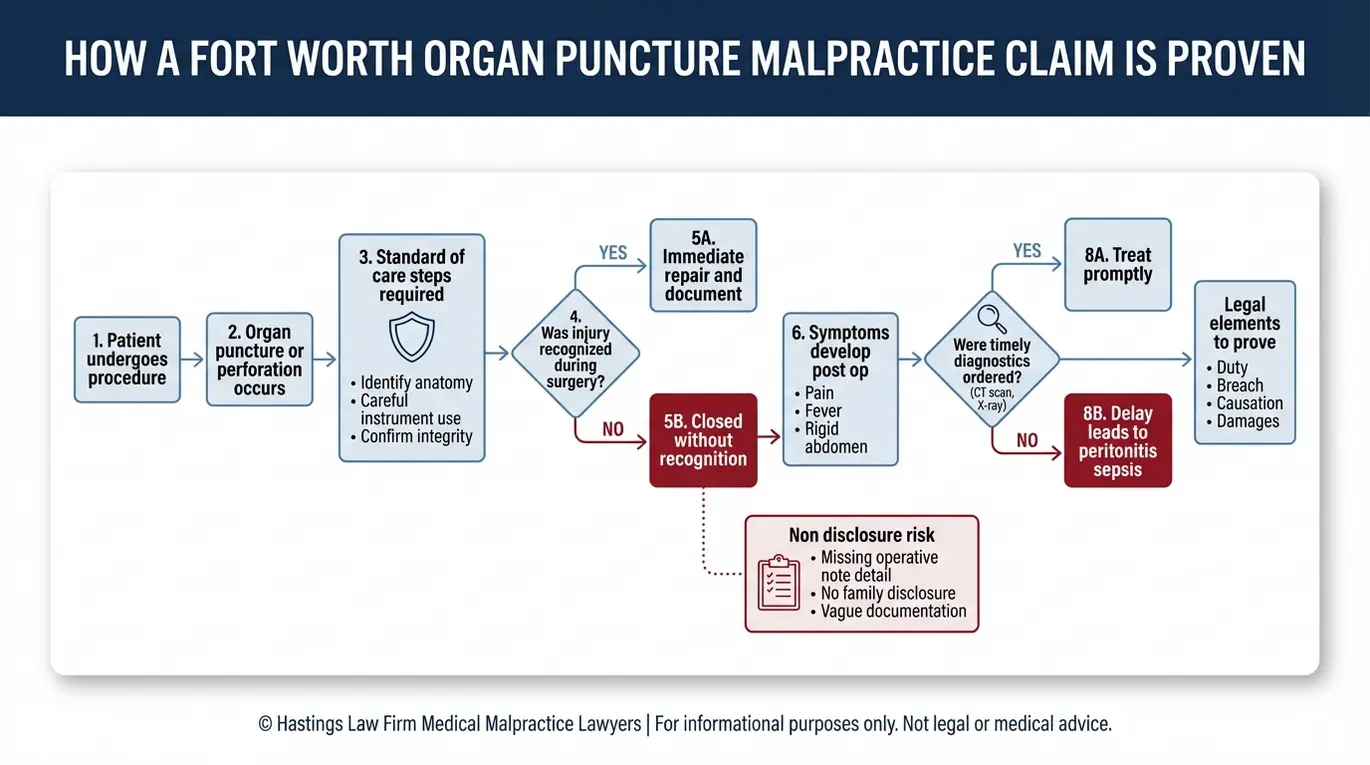
To prove negligence, a lawyer must demonstrate that the surgeon deviated from the standard of care, such as failing to identify the anatomy correctly or failing to recognize and repair the puncture immediately.
The standard of care for visceral surgery refers to the level of treatment that a reasonably competent surgeon with similar training would have provided under the same circumstances. In organ puncture cases, that standard typically requires careful anatomical identification, proper instrument handling, and attentive monitoring for signs of perforation throughout the procedure.
Under Texas Civil Practice and Remedies Code, Chapter 74, medical malpractice claims require specific procedural steps, including a report from an expert witness that identifies the breach and its connection to the injury. We must establish four elements to build a case:
- Duty: The surgeon or medical provider owed a duty of care to the patient.
- Breach: The provider violated the standard of care through action or inaction, constituting a breach of duty.
- Causation: The breach directly caused the organ perforation or the failure to detect and treat it.
- Damages: The patient suffered measurable harm, including physical injury, additional medical costs, or lost quality of life.
In many cases, the initial puncture itself may not be the strongest basis for a claim. What often establishes medical negligence is the failure to recognize and perform a surgical repair of the puncture before closing the patient. A nicked bowel during an otherwise well-performed procedure may fall within accepted risks, unlike wrong site surgery which is never acceptable. But if the surgeon closed without identifying that bowel perforation, sending the patient home to develop peritonitis, the failure to detect and repair becomes the central issue.
An even more troubling pattern involves non-disclosure by the surgeon. In some cases, a surgeon may recognize an error during the procedure but fail to document it in the operative report. Research published in PubMed on communication and handoff failures in malpractice claims highlights how breakdowns in disclosure and documentation contribute to patient harm. When records are incomplete, our team looks for gaps in the charting and missing documentation that may indicate a failure to communicate.
Exploratory surgery, formally known as an exploratory laparotomy, is a procedure where the abdomen is surgically opened to investigate the source of a problem. This is sometimes required to locate and repair internal organ damage caused by an undetected perforation. If that second procedure could have been avoided with proper care, it strengthens the case that we can present.
A bile duct injury, which is damage to the tubes that carry bile from the liver to the small intestine, is one of the most commonly litigated organ perforation injuries. It frequently results from misidentification of anatomy during gallbladder removal. Our Fort Worth organ perforation attorneys work with qualified surgical experts to reconstruct what happened and establish whether the injury was preventable.
Recoverable Damages for Surgical Perforation Injuries
Victims of organ perforation can recover compensation for medical bills, corrective surgeries, lost wages, pain and suffering, and in severe cases, wrongful death damages.
These damages fall into two main categories. Economic damages cover the measurable financial losses tied directly to the injury. Non-economic damages address the personal toll, the pain, emotional distress, and diminished quality of life that numbers alone cannot capture.
Economic damages may include:
- Emergency room visits, hospital readmissions, and ICU stays
- Corrective and reconstructive surgeries
- Long-term and future medical care costs, including home nursing or rehabilitation
- Lost wages and reduced earning capacity
- Medical equipment and supplies, such as an ostomy bag used to collect waste outside the body
An ostomy creates a surgical opening in the abdomen to reroute waste when part of the bowel is removed or needs to heal. Patients requiring a permanent ostomy face significant lifestyle changes and ongoing costs. The United Ostomy Associations of America’s New Ostomy Patient Guide outlines many of the daily adjustments these patients must manage.
Non-economic damages may include:
- Physical pain and suffering
- Mental anguish and emotional distress
- Loss of enjoyment of life
- Disfigurement or permanent physical impairment
When an organ perforation leads to sepsis, organ failure, or death, the family may pursue a wrongful death claim for additional compensation. We can evaluate the full scope of harm and identify every category of damages that applies to your case.
Texas Statute of Limitations for Surgical Injury Claims
In Texas, the statute of limitations for medical malpractice claims is generally two years from the date of the injury or the date the injury could reasonably have been discovered.
This deadline is strict. Handling Texas medical malpractice laws is critical because Texas Civil Practice and Remedies Code § 74.051 requires 60 days’ written notice to healthcare providers before filing suit, making it essential to act well before the two-year deadline approaches.
There is an exception called the “Discovery Rule.” In organ puncture cases, a perforation may not produce noticeable symptoms for days. If the injury was not immediately discoverable, the statute of limitations may begin on the date the patient knew or should have known about the injury. We can evaluate whether your situation qualifies for this extension.
Waiting puts your case at risk. Medical records can be altered, witnesses’ memories fade, and procedural details become harder to reconstruct. If you suspect a surgical error caused internal organ damage, contacting us early gives our team the best opportunity to preserve critical evidence.
Contact the Fort Worth Surgical Error Attorneys at Hastings Law Firm Today for Help
Hastings Law Firm handles medical malpractice cases and nothing else. Every attorney, nurse consultant, and patient advocate on our team is focused on one thing: holding negligent providers accountable for the harm they cause.
If you or a loved one suffered an organ puncture or perforation during a surgical or diagnostic procedure, you may have questions about what went wrong. Those questions deserve honest answers. We help you seek the truth and justice you deserve. Our team includes former defense attorneys and in-house medical staff who can analyze your records and identify where the standard of care was violated.
There is no fee unless we recover compensation for you. Every medical malpractice litigation case evaluation is free and confidential.
Contact Hastings Law Firm today to speak with a Fort Worth organ puncture or perforation lawyer who can help you understand your legal options.
Frequently Asked Questions About Organ Puncture or Perforation in Fort Worth


This content was researched and written by the Hastings Law Firm editorial team, which includes attorneys, medical professionals, and experienced researchers. Our writing is informed by internal knowledge and practical experience, and we cross-check critical details against authoritative sources cited throughout. Every piece undergoes human-led fact-checking and legal review. Because legal and medical information can change, if you spot an error, please contact us. Learn more about our content standards and review process on our editorial policy page.

Brady D. Williams is a nationally recognized medical malpractice attorney who has spent his career handling high-stakes litigation for injured patients and families across the country. Licensed in both Texas and California, Brady draws on experience from hundreds of resolved medical cases to break down complex legal and medical topics for the people who need that information most. His writing reflects the same attention to detail and commitment to clarity that he brings to every case he handles.
